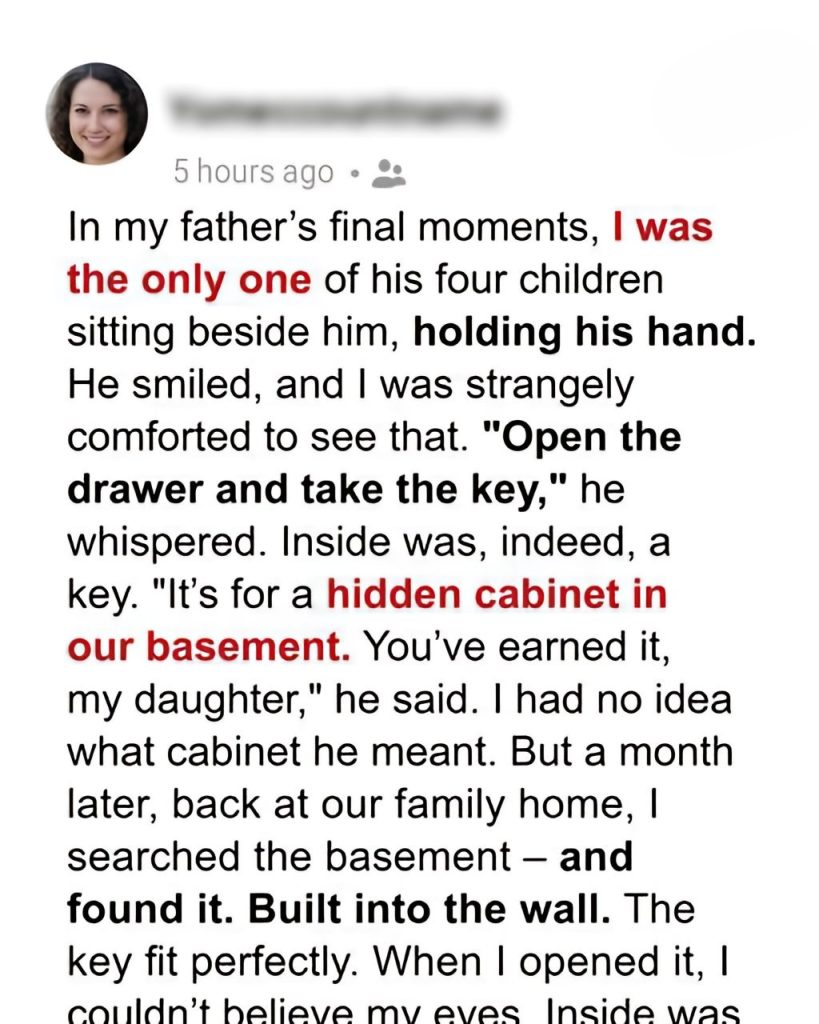
In my father’s final moments, I was the only one of his four children sitting beside him, holding his hand. He smiled, and I was strangely comforted to see that. “Open the drawer and take the key,” he whispered. Inside was, indeed, a key. “It’s for a hidden cabinet in our basement. You’ve earned it, my daughter,” he said. I had no idea what cabinet he meant. But a month later, back at our family home, I searched the basement — and found it. Built into the wall. The key fit perfectly. When I opened it, I couldn’t believe my eyes.
Inside the narrow cabinet were several neatly stacked folders, a small wooden box, and an envelope with my name written in my father’s careful handwriting. Seeing my name like that — steady, familiar, unmistakably his — made my knees weaken. I sat down on the cold concrete floor before touching anything, suddenly afraid that opening this cabinet meant opening grief all over again.
I was the youngest of four. My siblings were already gone when Father passed — busy lives, old resentments, convenient excuses. They came for the funeral, of course. They cried publicly. They spoke warmly of him to others. But in those final weeks, it was me who brought soup he barely touched, adjusted his blankets, read aloud when his eyes grew tired. It was me who learned how shallow breathing sounds when life is preparing to leave.
I had never considered myself special. Just available.
I opened the envelope first. Inside was a handwritten letter, several pages long.
“My dear girl,” it began, “if you are reading this, then my time has ended, and you have kept your promise to come back.”
I felt tears slide down my face before I reached the second sentence.
He wrote about watching his children grow, about mistakes he knew he had made as a father, especially when work consumed him. He admitted he hadn’t always been fair. He had assumed strength where there was quiet, independence where there was actually loneliness.
Then he wrote something that made my breath catch.
“I kept records because I did not trust memory alone to tell the truth.”
I opened the first folder.
Inside were copies of financial documents, handwritten notes, dates, and summaries. College payments. Down payments. Emergency loans. Gifts disguised as help. Each sibling’s name had its own folder.
My oldest brother had received money repeatedly — for failed businesses, for legal trouble, for “one last try.” My sister had been given help with childcare, tuition for her children, mortgage assistance. Another brother had accepted a large sum years ago to cover gambling debts, something we were told never happened.
My folder was thinner.
Inside were receipts for groceries I bought when Father insisted on paying me back. Gas money I refused but he transferred anyway. Notes saying “She tried to decline.” “She said it was too much.” “She came without asking.”
My hands shook.
In the wooden box were keys — several of them — each labeled. One was for a safety deposit box. Another for a small storage unit. A third I didn’t recognize.
I returned to the letter.
“I wanted you to have proof,” he wrote. “Not because you will ask for anything, but because I know they will.”
I closed my eyes.
For weeks after the funeral, my siblings had already started talking. Subtle at first. Questions about the house. About Father’s accounts. About what he might have promised whom. I had said nothing. I truly didn’t care. I assumed everything would be split evenly.
Father knew better.
The letter continued.
“Fair does not always mean equal. Love does not always announce itself loudly. Sometimes it waits quietly beside a bed.”
I sat there for hours.
A month later, the lawyer called. He requested all siblings attend the reading of the will together.
The room felt tense. Smiles too stiff. Voices too polite. When the lawyer read the distribution, silence fell heavy.
Father had divided assets unequally.
I was left the house.
The storage unit contained heirlooms meant to stay together.
The safety deposit box held savings set aside “for care provided without obligation.”
My siblings exploded.
Accusations flew. Manipulation. Favoritism. Lies. They looked at me like I had stolen something sacred.
I didn’t argue.
I simply handed the lawyer copies of Father’s records.
The room changed.
Silence again — different this time. Heavier. Sharper.
They left angry. Hurt. Some refused to speak to me again.
I went home to an empty house that smelled like old books and coffee and my father’s aftershave. I walked through rooms filled with echoes. I sat in his chair and finally cried the way I hadn’t allowed myself to before.
I realized something important in those weeks.
Love isn’t proven at funerals.
It’s proven in waiting rooms.
In unanswered thanks.
In staying when nothing is promised.
I didn’t “earn” that cabinet because I was better.
I earned it because I was present.
Now, when I open that basement door, I don’t see money or documents.
I see a man who noticed.
A father who paid attention.
And a final gift that wasn’t wealth — but truth.
And that truth gave me peace no inheritance ever could.