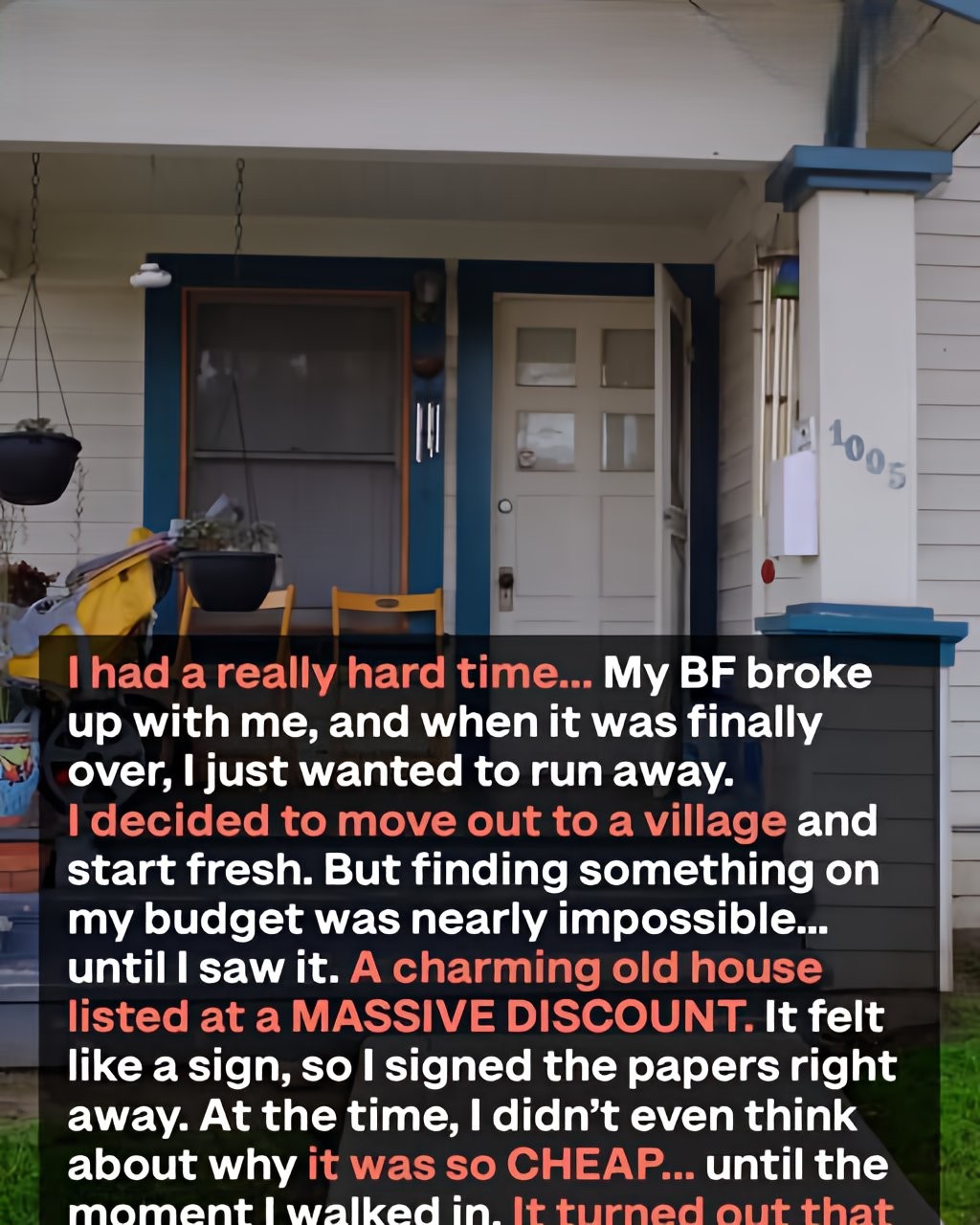
I had a really hard time… My BF broke up with me, and when it was finally over, I just wanted to run away. I decided to move out to a village and start fresh. But finding something on my budget was nearly impossible… until I saw it. A charming old house listed at a MASSIVE DISCOUNT. It felt like a sign, so I signed the papers right away. At the time, I didn’t even think about why it was so CHEAP… until the moment I walked in.
It turned out that the house wasn’t just a building; it was a community landmark that functioned as the village’s unofficial “Living Room,” and the front door didn’t even have a functioning lock.
The Impulse of the Brokenhearted
When James left, he took more than just his clothes and his half of the record collection. He took my sense of direction. For three years, our lives had been a series of “we”—we were moving to the city, we were saving for a car, we were planning a future. Suddenly, the “we” was a jagged “I,” and the apartment we shared felt like a museum of a dead civilization.
I needed to get out. I needed trees, silence, and a place where nobody knew my name or the pathetic story of how I’d been blindsided on a Tuesday night.
I found the listing on a grainy website at 3 a.m. “House 1005: Historic charm, garden space, $45,000.” In a world where a literal shed costs a quarter-million, it was a miracle. I didn’t ask for a walk-through. I didn’t check the plumbing. I saw the blue trim and the yellow chairs on the porch in the photos, and I sent the wire transfer. I thought I was buying a sanctuary. I didn’t realize I was buying a job.
The Arrival
The drive to the village of Willow Creek was five hours of winding roads and internal monologues. By the time I pulled up to the curb of number 1005, I was ready to be a hermit. I wanted to unpack my boxes, brew a pot of tea, and not speak to a human soul for a month.
The house looked exactly like the photos—quaint, slightly peeling, with a set of wind chimes that tinkled a mournful melody in the breeze. I grabbed my suitcase, walked up the steps, and reached for the door handle, expecting to find it locked.
It swung open before I even touched it.
I froze. My first thought was squatters. My second thought was robbery. I stepped into the foyer, my heart hammering against my ribs, and stopped dead.
Sitting at my kitchen table were three elderly men. They had a deck of cards spread out between them and a steaming pot of coffee that definitely didn’t belong to me.
“Oh, hello dear,” one of them said, barely looking up from his hand. “You must be the new one. Arthur, she’s here. Put the kettle on.”
The Unofficial Annex
“Who are you?” I stammered, clutching my suitcase like a shield. “This is my house. I just bought it.”
“Technically, yes,” the one called Arthur said, standing up with a friendly, toothy grin. “But for sixty years, this was Mrs. Gable’s house. And Mrs. Gable’s house is where the mail gets sorted, where the bridge club meets, and where the village stores the extra chairs for the harvest festival.”
I spent the next two hours in a state of shock as Arthur explained the “Legacy of 1005.”
The previous owner, Mrs. Gable, had been the village’s heartbeat. When the local post office burned down in the 70s, she handled the mail from her porch. When the library ran out of space, she turned her parlor into a reading room. Over decades, the house had evolved into a “public-private” hybrid. The massive discount I’d received wasn’t a gift; it was a subsidy. The village council had owned the house after Mrs. Gable passed, and they sold it cheap on the unspoken condition that the new owner would maintain the “social easements.”
“What do you mean ‘social easements’?” I asked, feeling a headache brewing.
“It means,” Arthur said, sliding a cup of coffee toward me, “that the front door stays unlocked from 8 a.m. to 6 p.m. It means the knitting circle comes on Wednesdays. And it means if someone’s pipe bursts down the street, they’re coming here to use your landline and sit by your fire until the plumber shows up.”
The Hermit’s Nightmare
That first week was a masterclass in boundary dissolution.
I tried to lock the door. Within ten minutes, there was a frantic knocking. It wasn’t an emergency; it was Mrs. Higgins, who needed to “check the ledger” in the pantry. I tried to close the curtains. A neighbor yelled through the window that I was blocking the “natural light for the community herb garden” on my windowsill.
I was miserable. I had moved here to be alone, to lick my wounds in private. Instead, I was the involuntary curator of a living museum. People would walk through my living room while I was in my pajamas, nodding politely as if I were a ghost and they were the rightful inhabitants.
I felt the “Mental Load” of twenty families. I knew whose grandson was failing algebra, which neighbor was feuding with the butcher, and why the local church bells were ringing three minutes late every Sunday. I was drowning in a life that wasn’t mine.
The Turning Point
Three weeks in, I was ready to sell the house back to the council and go back to the city. I was sitting on the porch, staring at the yellow chairs, when a young girl, maybe seven years old, walked up the steps. She looked like she’d been crying.
Without saying a word, she sat down on the floor next to my chair.
“The big kids were mean,” she whispered. “Mrs. Gable used to give me a lemon drop and let me hide in the reading room until my mom finished work.”
I looked at her, and for the first time, I didn’t see an intruder. I saw a mirror. She was heartbroken, overwhelmed, and looking for a place to “run away.”
I didn’t have any lemon drops. But I did have a box of cookies I’d bought but hadn’t opened. I went inside, grabbed two, and sat back down on the porch with her. We didn’t talk about James, or school, or the “social easements.” We just sat in the shade of the blue trim and listened to the wind chimes.
The Magic of the Open Door
That afternoon changed my perspective. I began to realize that my “hard time” after the breakup had made me view the world as a place of scarcity. I thought I had a limited amount of energy, and that every person who walked through my door was stealing a piece of it.
But the house—Mrs. Gable’s house—operated on a different logic: the logic of abundance.
I started leaning into the role. I didn’t just let the knitting circle in; I learned how to purl. I didn’t just sort the mail; I started leaving little notes on the envelopes of the people I knew were having a rough week.
I discovered the “hidden rooms” of the house—not physical ones, but emotional ones. There was a drawer in the kitchen filled with spare keys to every house in the village, a testament to the trust this building represented. There was a closet in the hallway filled with “breakup kits”—bottles of wine, cheap romance novels, and cozy blankets—that Mrs. Gable had kept for women just like me.
The “massive discount” I’d received wasn’t just on the mortgage. It was a discount on the price of loneliness.
Healing Through Chaos
By the second month, the “Fresh Start” I had envisioned—the quiet, sterile one—felt like a pale, boring shadow compared to the vibrant chaos of number 1005.
My grief for James didn’t disappear, but it became smaller. It was hard to obsess over a text he hadn’t sent when I was busy helping Arthur find his misplaced spectacles or listening to the village gossip about the scandalous new flavor of jam at the farmer’s market.
I realized that the “Mental Load” I had feared was actually a “Community Connection.” When you carry a piece of everyone’s story, your own story doesn’t feel so heavy. I wasn’t just “the girl who got dumped.” I was “The Keeper of the Key.” I was the woman who lived in the house with the blue trim.
The Legacy of the Bargain
Modern life is designed to isolate us. We live in boxes with high fences and digital doorbells that allow us to vet every visitor. We value privacy above all else, often forgetting that privacy is the first cousin of isolation.
The house at 1005 Willow Creek challenged that. It was an archaic, beautiful anomaly. It forced me to be vulnerable, to be seen, and to care for people I hadn’t chosen. And in that forced care, I found the only thing that could actually cure a broken heart: a sense of belonging.
The village council hadn’t scammed me. They had given me a gift that money couldn’t buy. They gave me a reason to wake up in the morning that had nothing to do with my own ego or my own pain.
Final Reflection
It’s been a year now. I still haven’t fixed the lock on the front door. In fact, I took the handle off and replaced it with a simple wooden latch that even a child can lift.
The yellow chairs on the porch are never empty. Sometimes it’s a neighbor, sometimes it’s a stranger passing through, and sometimes it’s just me, sitting in the sun, finally feeling like I’m home.
To anyone looking to “run away” after a hard time: don’t look for a fortress. Look for a house with no locks. Look for a place that asks more of you than you think you can give. Because the massive discount on the price is nothing compared to the massive investment in your soul.
My BF broke up with me, and I thought my world had ended. It turned out, my world was just beginning. It just happened to have blue trim, yellow chairs, and twenty elderly men who really, really like to play Bridge on Tuesdays.
And I wouldn’t have it any other way.