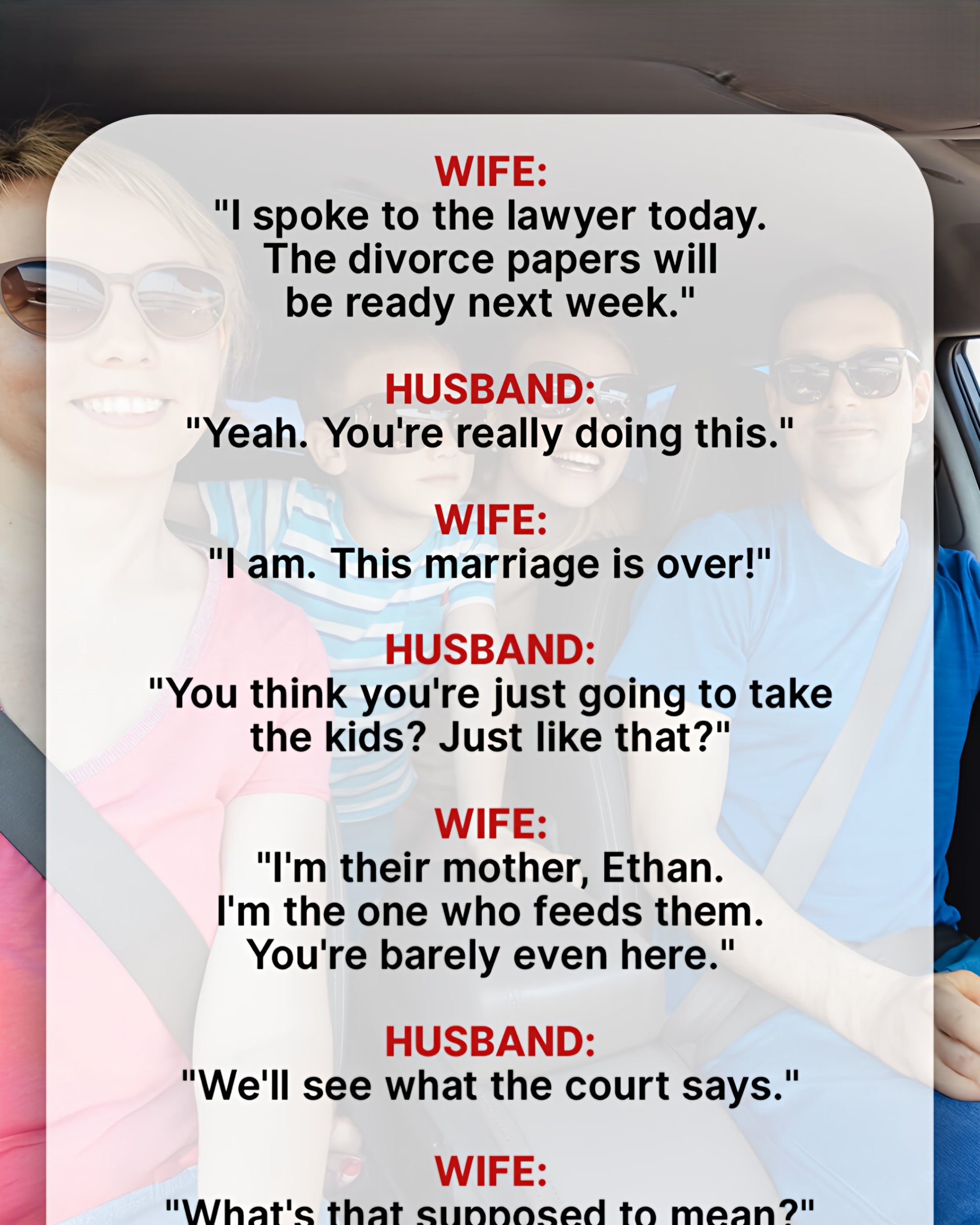
WIFE: “I spoke to the lawyer today. The divorce papers will be ready next week.”
HUSBAND: “Yeah. You’re really doing this.”
WIFE: “I am. This marriage is over!”
HUSBAND: “You think you’re just going to take the kids? Just like that?”
WIFE: “I’m their mother, Ethan. I’m the one who feeds them. You’re barely even here.”
HUSBAND: “We’ll see what the court says.”
WIFE: “What’s that supposed to mean?”
Ethan didn’t answer immediately. He kept his eyes fixed on the road, his knuckles white against the leather steering wheel. In the backseat, our two children were plugged into their tablets, oblivious to the fact that their world was being dismantled at 65 miles per hour.
“It means, Claire,” Ethan finally said, his voice dropping to a terrifyingly calm register, “that while you were busy keeping track of pediatrician appointments and school lunch menus, I was keeping track of you.”
I felt a cold shiver trace its way down my spine. “What are you talking about?”
“The ‘Daddy Log,’ Claire. Every time you left the kids with a sitter to go to ‘yoga’—which was actually you crying in your car for two hours. Every time you lost your temper and threw a plastic plate. Every time you told me you were too overwhelmed to function. I have it all. Dates, times, and doorbell camera footage. You think you’re the ‘default parent’ because you do the chores? The court sees a woman on the brink of a breakdown. I see a woman who needs a ‘break’ from her kids. So, I’m going to give you one. Permanently.”
The Myth of the “Invisibly Perfect” Mother
For ten years, I had been the “Default Parent.” In the sociology of modern marriage, this is the person who holds the “mental load.” I knew the shoe sizes, the allergy list, the names of the teachers’ pets, and which stuffed animal was required for a successful bedtime. Ethan was the “Success Story.” He was the one who provided the five-bedroom house, the private school tuition, and the lifestyle that looked so enviable on Instagram.
But the cost of that lifestyle was my sanity.
Ethan worked sixty-hour weeks. When he was home, he was “decompressing.” He “helped” by occasionally bathing the kids, but only if the towels were already laid out and the water temperature was pre-set. I was the manager, the chef, the nurse, and the emotional lightning rod.
The image of us in the car—smiling, sun-drenched, wearing expensive sunglasses—was the ultimate lie. It was a photo taken for a holiday card two years ago, a relic of a time when I still believed that if I just worked a little harder, Ethan would finally see me as a partner instead of a service provider.
Weaponized Documentation
The “Daddy Log” Ethan mentioned is a rising, toxic trend in high-conflict divorces. It is the practice of one spouse—usually the one who is less involved in daily care—meticulously documenting the other’s moments of weakness.
When you are a stay-at-home or primary-care mother, your “office” is your home. Your “coworkers” are toddlers. Imagine if your boss filmed you every time you stepped out for a breath of air or every time you snapped at a difficult client after a sleepless night. That is what Ethan had done.
By framing my burnout as “instability,” he was attempting to use the very symptoms of my labor against me. I was exhausted because I was doing everything; he was using my exhaustion to prove I should do nothing.
This is the ultimate betrayal of the marriage contract. Instead of being a sanctuary, our home had become a surveillance state. Every “I can’t do this anymore” whispered into the kitchen sink was a data point for his legal team.
The Economic Provider’s Entitlement
In the weeks that followed that car ride, the battle lines were drawn. Ethan’s lawyer argued that as the primary breadwinner, Ethan provided “stability.” They argued that my lack of income made me a “dependent,” and that my emotional struggles—brought on by the isolation of my role—rendered me “unfit for primary custody.”
This is the “Provider Trap.” It suggests that the person who earns the money has a more valid claim to the family’s future than the person who nurtured the family’s souls. Ethan didn’t want the kids because he wanted to raise them; he wanted them because they were part of his “assets.” To lose custody was to lose the brand of the “successful family man.”
“You don’t even know their middle names, Ethan!” I screamed during a mediation session.
“I know the account numbers that pay for their lives,” he countered. “And in the eyes of the law, that buys a lot of ‘good father’ points.”
The Mental Load and the Courtroom
The legal system is often ill-equipped to handle the nuances of the “mental load.” Judges look for big, tangible things: who has the house? Who has the steady income? Who hasn’t had a “documented” emotional outburst?
Invisible labor—the kind that involves soothing a child after a nightmare or ensuring there are clean socks on a Monday morning—doesn’t show up on a spreadsheet. It is the “dark matter” of the universe; you can’t see it, but it holds everything together.
During discovery, I had to produce my own “log.” I spent nights writing down every meal I had cooked, every diaper I had changed, every school form I had signed. I felt like I was defending my right to exist. I had to prove that my “presence” was more valuable than his “paycheck.”
The psychological toll was immense. I began to second-guess my own memories. Was I a good mother? Or was I the “shouting, unstable” woman Ethan’s recordings portrayed? This is a form of legal gaslighting that many women face during divorce.
The Turning Point: The Children’s Voice
The war reached a fever pitch until a court-appointed Guardian Ad Litem (GAL) entered our lives. This is an independent person whose only job is to represent the best interests of the children.
The GAL spent hours with the kids. She watched them with Ethan, and she watched them with me. She didn’t look at the bank statements or the “Daddy Log.” She looked at the children’s eyes.
She noticed that when the kids were with Ethan, they were “on their best behavior.” They were quiet, performative, and slightly anxious. They treated him like a visiting dignitary. When they were with me, they were messy, loud, and sometimes difficult.
“Do you know why that is, Ethan?” the GAL asked during a final meeting.
Ethan puffed out his chest. “Because I provide structure. They respect me.”
“No,” she replied, her voice firm. “It’s because they don’t feel safe enough to be themselves with you. They feel safe with their mother. They know she can handle their mess because she’s been handling it their entire lives. You’ve documented her ‘weakness,’ but the children see it as ‘availability.’ She is the only person in their lives who has allowed them to be human.”
The Reality of “Winning”
Ethan didn’t get full custody. But I didn’t “take” the kids, either.
The court eventually landed on a 50/50 split, but with a “Primary Residence” designation for me. It wasn’t the total victory I had hoped for, nor was it the total destruction Ethan had planned.
But the real “win” happened six months after the final papers were signed. Ethan had his first “solo” week with the kids. On Tuesday, he called me, sounding panicked.
“Claire… Leo has a fever. And he says he needs a ‘green dinosaur’ to sleep, but I can’t find it. Where is it?”
“It’s in the bottom of the toy chest, under the winter blankets,” I said, my voice calm. “And you need to call the pediatrician. His name is Dr. Aris. The number is in the contacts I shared with you.”
“I… I don’t have time to wait on hold,” Ethan muttered. “I have a meeting at ten.”
“Then you’d better start documenting that,” I said, and hung up.
The Lesson of the “Daddy Log”
The “Daddy Log” ultimately failed Ethan because you cannot litigate love. You can document a person’s worst moments, but you cannot document the ten thousand quiet moments that build a child’s sense of security.
Divorce is not just the end of a legal contract; it is the brutal exposure of the “shadow work” that keeps a family running. Ethan had to learn the hard way that “feeding them” wasn’t just about paying for the groceries; it was about knowing what they needed to eat when their hearts were hurting.
To the women standing where I stood—to the “Claire’s” who are being told they are “unstable” because they are overwhelmed: Your labor is not a liability. Your exhaustion is a badge of your commitment. The “mental load” is heavy because it is made of the very things that make a child’s life worth living.
A New Chapter
I live in a smaller house now. There are no designer sunglasses or five-bedroom estates. But there is peace. The doorbell camera no longer feels like a spy; it’s just a way to see when the kids get home from school.
Ethan is learning. He has to. He no longer has a “manager” to handle the logistics of his fatherhood. He has had to learn the middle names, the shoe sizes, and the art of the 3 a.m. fever. He has stopped keeping a log of my failures and has started keeping a log of his own responsibilities.
We are not friends. We may never be. But we are parents.
The car ride from that afternoon—the one where he told me he’d see me in court—is a distant, ugly memory. But I keep the photo from that day. I keep it to remind myself of the woman I used to be: the one who smiled for the camera while her soul was dying. I don’t smile like that anymore. Now, my smiles are smaller, quieter, and entirely real.