The first person who tried to move my father out of sight was the woman I was supposed to marry.
“He doesn't need to be at the front,” Fiona said.
We were standing in the hotel ballroom six hours before our ceremony. Two florists knelt beside an arrangement of white roses, trimming stems over a sheet of brown paper. Somewhere behind the partition, a sound technician kept saying the same numbers into a microphone.
One, two. One, two.
Fiona held the seating chart against her chest.
I looked at the small rectangle bearing my father's name. A pencil line connected it to a table near the rear doors.
“Why is he back there?”
“Because the front tables have a purpose.”
“He's my father.”
“And he'll still be your father six tables back.”
She said it without looking up, already searching for the next name she could move.
I waited until she noticed my silence.
“Daniel, those tables are for board members and investors. People Dad needs to speak with.”
“He can speak with them around my father.”
Her shoulders dropped.
For a second, I thought she understood.
Then she handed me the chart.
“Fine. Put him wherever you want.”
I moved Dad's name beside mine. The pencil left a dark groove in the paper.
Fiona watched me.
“You don't have to turn every practical decision into a statement.”
I nearly apologized.
That was the part I would remember later.
Not the argument, but how close I came to apologizing for wanting my father near me.
I had learned that reflex gradually over eighteen months, in rooms where Fiona's parents never raised their voices unless someone else had already been made to feel unreasonable.
Their corrections came wrapped in helpfulness.
A different jacket would suit that restaurant.
Perhaps Dad should wait in the kitchen while the photographer worked.
Was he comfortable with the cutlery?
Did he understand that valet parking was included?
Each remark seemed too small to fight about.
Together, they had built something I refused to name.
I folded the chart and gave it back.
“He stays beside me.”
“All right.”
She kissed my cheek, quick and dry.
Then she asked whether I had collected the rings.
At home that morning, my father had asked only whether his tie looked straight.
Our house still smelled faintly of sawdust despite his efforts to clean before I arrived. The kettle rattled on the stove. His work boots stood beneath the radiator with yesterday's pale mud hardened around the soles.
He wore the charcoal suit he had bought for my high school graduation.
The trousers had been let out once. The jacket shone slightly at the elbows.
Around his neck was my grandfather's blue tie.
Its pattern had faded until the small silver shapes looked almost like marks left by folded paper.
“Too old-fashioned?” he asked.
“No.”
He adjusted the knot anyway.
I took over and tightened it gently beneath his collar.
His throat moved when he swallowed.
“Your mother would have enjoyed this.”
He rarely said that about important days.
Usually he said something smaller.
She liked that song.
She would have put more garlic in this.
That was her favorite cup.
Hearing him place her inside my wedding morning made the house feel suddenly crowded with what we had lost.
“She would have liked you getting dressed up,” I said.
“She'd have told me to buy a new suit.”
“Probably.”
We both smiled.
Then his phone vibrated on the counter.
It was a newer phone than I remembered him owning, black and plain, with a case that had already collected a stripe of white paint.
He looked at the screen and turned it facedown.
“Everything all right?”
“Work.”
“On a Saturday?”
“Things break on Saturdays.”
That was true enough that I didn't question it.
He poured tea into two mugs and set the larger one in front of me.
I noticed he had made toast for only one plate.
“You eating?”
“Later.”
“Dad.”
“I had something earlier.”
He had been saying versions of that since I was a boy.
When my mother died, I was seven. For several months afterward, he moved through the house like somebody carrying a glass filled right to the edge.
He worked, cooked, washed clothes, signed forms, paid bills.
At night he sat beside my bed until I slept.
Sometimes I woke and found him still there, elbows on his knees, looking at nothing.
He never told me to be brave.
He told me what would happen next.
We would get up.
He would take me to school.
There was clean bread.
My blue shirt was drying.
Ordinary facts were what held our life together.
He worked construction when the projects were available. Between jobs, he repaired engines and heating systems, helped neighbors with broken steps, and took emergency furnace calls that arrived after midnight.
I remember one January night particularly clearly.
The phone rang while snow struck our kitchen window.
He stood in the doorway pulling on his coat, and I asked whether he had to go.
“Mrs. Daley's heat has stopped.”
“Someone else could fix it.”
“They could.”
He bent to tie his boots.
“But she called me.”
When he returned, his cheeks were red and his fingers looked split at every joint.
He sat beside me at the kitchen table and helped with a fractions worksheet before taking off his coat.
I had mistaken his endurance for something effortless.
Children often do.
He made it so consistent that I thought fathers simply came that way.
Only years later did I understand the meals he skipped, the notices he hid, the work he accepted when his back was already hurting.
There were harder things he kept from me, too.
I didn't know that yet.
Fiona and I met during a redevelopment project.
I was a civil engineer working for a small consultancy. She coordinated public events for her father's development group.
The first time I saw her, she was carrying folding chairs because the delivery crew had left them beside the wrong entrance.
Her expensive shoes sank into wet gravel.
She laughed at herself.
“Don't tell my mother,” she said. “She thinks I supervise.”
I liked her immediately.
She could be funny without trying too hard. She remembered details. When I mentioned my mother's birthday during a conversation three weeks earlier, Fiona remembered the date and asked how Dad was doing.
I didn't invent all the good things about her afterward.
They had been real.
That made what happened harder.
When her family disapproved of something, Fiona changed.
Her voice became lighter, her sentences less definite.
She laughed before deciding whether anything was funny.
I noticed it at dinners, but I thought she was managing difficult parents.
People make accommodations inside families.
I had made plenty inside mine.
I believed marriage would give us room to choose differently.
That belief survived because I kept feeding it excuses.
George Ashford had offered me a position six months before the wedding.
It was a substantial salary increase, supervising engineering reviews across several developments.
He described it as a sensible step.
“You'll need to think beyond invoices and overtime,” he said. “You're joining a different kind of family.”
I told him I needed time.
Fiona thought I was being unnecessarily proud.
“It's a job, Daniel. He's offering you a job.”
“He hasn't asked much about my work.”
“He knows you're competent.”
“He knows I'm marrying you.”
She looked hurt, and the discussion became about whether I trusted her.
I accepted the position.
I told myself I could prove I had earned it.
Somewhere in that decision, I began allowing her father to describe my future as something he had provided.
That morning, while Dad rinsed the mugs, I stood beside the old workbench in the back room.
He had built it from timber salvaged from a job.
Everything had a place: sockets in shallow drawers, screws sorted into jam jars, an old radio with a cracked volume knob.
Beneath the bench sat a gray metal box.
It had been there for as long as I could remember.
Years earlier, I asked what was inside.
“Papers.”
“What kind?”
“The sort you keep.”
I asked whether they were important.
He said, “Some are.”
I remember thinking the answer was boring.
On my wedding morning, a small brass key lay beside the radio.
Dad came in and slipped it into his pocket.
“You ready?”
I looked around the room once more.
“Are you?”
He smiled.
“As I'll ever be.”
At the hotel, the staff treated him more kindly than the family did.
The valet called him sir.
A young woman managing the cloakroom told him his tie was lovely.
He thanked both of them with the same careful warmth he used with everyone.
Beverly arrived while I was showing him where we would sit.
Her eyes moved across his jacket.
“Oh, Martin. You found us.”
“We had a map,” he said.
I laughed.
She didn't.
“The loading entrance can be confusing. Some guests come around that way by mistake.”
“We came through the front.”
“Yes. I can see that.”
Dad's smile remained in place.
I felt the irritation and dismissed it.
Beverly was nervous about the schedule.
She had argued for weeks that the ceremony should come after the opening dinner and speeches, with the wedding itself held beneath a canopy on the terrace at half past eight.
Guests would arrive once. Champagne first, dinner next, vows at dusk.
An event planner told her the arrangement was unusual.
Beverly said unusual was the point.
The rain forecast had moved the ceremony indoors, but nothing else changed.
Our rings had been fitted that afternoon.
Fiona wanted photographs wearing them at the family table before the vows. The celebrant had no objection as long as we understood the symbolic photographs weren't the legal ceremony.
The marriage license waited unsigned in a side room.
It would matter later that we hadn't reached that room.
At four, George found Dad standing beside a display of photographs.
One showed Fiona as a child on a sailboat.
Another showed me at twelve beside a bicycle Dad had rebuilt.
George stopped in front of that one.
“Did you do the repairs yourself, Martin?”
“Yes.”
“Useful skill.”
“Usually.”
George took a sip of water.
“We have maintenance staff for that kind of thing.”
Dad nodded.
“Handy if they're good.”
I could not tell whether he had meant the remark to be funny.
George couldn't either.
He turned to me and asked about a retaining wall report.
It was Saturday. I was getting married.
Still, I answered him.
Dad stepped away quietly.
At five, Fiona came out of the dressing suite in her gown.
For a moment, the rest of the day receded.
She looked like herself, even beneath all the careful fabric and pinned hair.
When she saw me, she smiled with relief.
“Finally.”
I went to her.
“You look beautiful.”
“You look worried.”
“I've been assigned homework.”
“Dad?”
“Who else?”
She laughed and rested her forehead briefly against mine.
That small familiar gesture made me believe we were still the people who had carried chairs together through wet gravel.
Then she asked where my father was.
“By the photographs.”
“Could you remind him the family pictures start at five thirty?”
“Of course.”
“And perhaps ask him to keep his jacket on.”
“He will.”
“The sleeves of his shirt are—”
“What?”
She touched my lapel.
“Nothing. Don't look at me like that.”
I let her change the subject.
Again.
Later, I would have to account for all those small permissions.
Not because they caused Beverly's cruelty.
Because they helped teach everyone that I could be persuaded to look away.
The room filled quickly after six.
Five hundred guests made a particular kind of noise, a constant shimmering sound broken by laughter, cutlery, chairs moving, names called across tables.
I knew perhaps sixty people.
Dad knew fewer.
Most of the room belonged to George: directors, lenders, business associates, local officials, friends who introduced themselves by naming the institutions they represented.
Dad's friends arrived in a small cluster.
Mrs. Daley wore a navy dress and brought a card she had made herself. Two men he had worked with came together. My former school principal shook his hand for a long time.
I watched Dad relax around them.
Then the photographer called us back to the front.
Fiona's family stood on the raised area near the flowers.
Dad started toward my side.
Beverly lifted one hand.
“Perhaps the Ashford family first.”
“He is family,” I said.
“Daniel, we need a photograph with our side.”
The photographer lowered his camera.
Dad touched my elbow.
“Go ahead. We'll get another.”
I should have said no.
Instead, I told myself it was only a photograph.
We took three with the Ashfords.
By the time the photographer called for mine, someone had pulled George away and Beverly needed her hair adjusted.
Our picture was Dad and me against a service corridor wall.
It became my favorite photograph of that day.
Not because the background was good.
Because we were both still smiling.
At dinner, Dad sat beside me as promised.
Fiona's place was on my other side.
George and Beverly sat across from us.
A cream folder rested beneath George's chair, partly concealed by the tablecloth.
A narrow green stripe ran down its edge.
I recognized it from his study.
He had been carrying similar documents for weeks, turning them over when I entered.
Once I asked whether the refinancing affected the project I was reviewing.
“Nothing you need to concern yourself with.”
Fiona later repeated that it was routine.
People with money rearranged it.
That was how she described the matter.
Dad noticed the folder, too.
His eyes paused on it.
George pulled it farther beneath his chair.
“Business waits for nobody,” he said.
“No,” Dad answered. “It doesn't.”
I thought they were exchanging another awkward attempt at conversation.
Then Dad's phone vibrated.
He read the message and typed a short reply with one finger.
“Furnace?” I asked.
He put the phone away.
“No. Something scheduled.”
“What?”
“Later.”
A waiter set bread before him.
He took one piece and passed the basket.
I watched his hands.
He had scrubbed them carefully, but work had settled into the fine cracks around his nails.
Fiona noticed me looking.
“What?”
“Nothing.”
She smiled.
Across the table, Beverly watched Dad cut his food.
I saw her watching.
I chose, once again, to pretend I hadn't.
The first speech came from George at a quarter to eight.
He stood with his champagne glass and waited for the room to quiet.
He was good at that.
He understood how long to pause, where to look, how to make five hundred people feel he was addressing each of them personally.
He praised Fiona.
He praised the work required to build a family.
Then he turned toward me.
“We've been pleased to help Daniel find his footing.”
A few people smiled.
I smiled because I had already begun smiling.
“He comes to us with considerable promise,” George continued. “And perhaps a useful reminder that ambition can take a young man beyond the circumstances of his birth.”
Laughter moved through the nearest tables.
Dad looked at the stem of his glass.
My face grew hot.
George raised his drink.
“To new beginnings.”
Everyone drank.
I set my glass down untouched.
Fiona leaned toward me.
“He means well.”
“Does he?”
“Please don't start.”
I looked at Dad.
He was moving his knife half an inch farther from the edge of the table.
A small, unnecessary adjustment.
He knew I was watching.
He wouldn't look back.
Then Beverly stood.
She did not have a prepared speech.
That was what she would claim afterward.
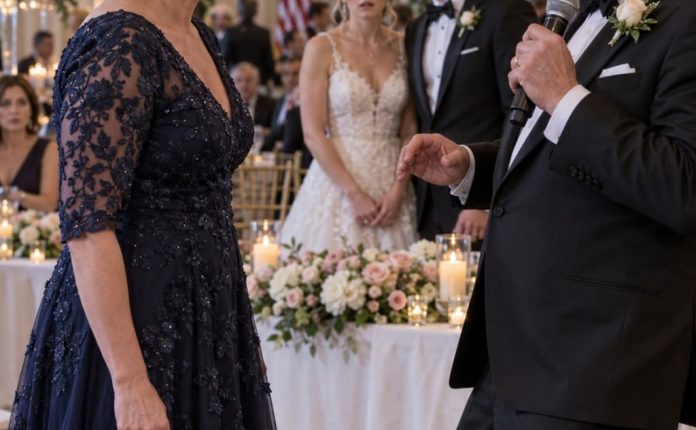
At the time, she took the microphone from George with the confidence of someone accustomed to being given whatever she reached for.
“I suppose we should acknowledge the other family.”
Her eyes settled on Dad.
The room waited.
“Martin has made quite an effort tonight.”
Some laughter.
She looked at his shoes, visible beneath the table.
Then at his cuffs.
“I told Fiona we should be careful about what gets brought into a room like this.”
George smiled into his drink.
I heard the sound technician make a small adjustment. The microphone crackled once.
Beverly's next words were perfectly clear.
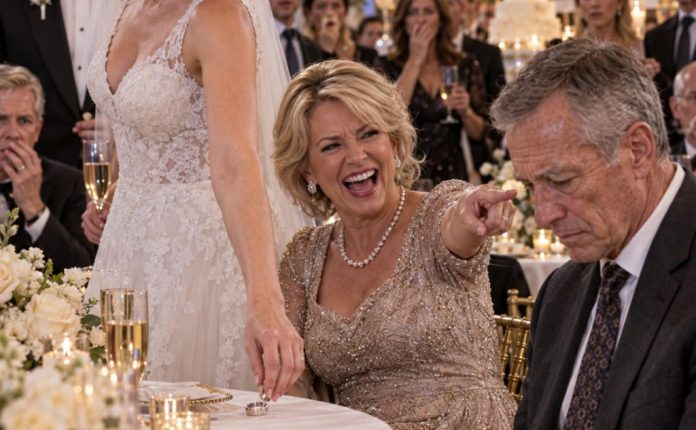
“But apparently, even the trash gets a place at the head table.”
For a second, nobody moved.
Then people laughed.
Not everybody.
Enough.
One man near the front clapped his palm against the table. A woman behind him lowered her face into her napkin.
Some guests looked shocked.
Others watched George before deciding what their expressions should be.
Dad didn't raise his head.
Fiona laughed.
It was short.
That didn't make it smaller.
She covered her mouth and reached toward her mother.
“Mum, you're embarrassing him.”
I waited for another sentence.
For a correction.
For her to say that my father didn't deserve it.
She kept smiling.
Something in me became very still.
I had expected anger to arrive noisily.
Instead, everything unnecessary dropped away.
The flowers.
The guests.
The money.
The years I had imagined with her.
I looked down at my hand.
The wedding ring was new enough that it slid easily.
Fiona saw it.
“Daniel.”
I placed it beside my cake plate.
“Daniel, stop.”
I stood.
The room was still laughing in places. Beverly had begun handing the microphone back when she saw my face.
Fiona reached for the ring.
Then she caught my wrist.
“What are you doing?”
“There won't be a wedding.”
Her fingers tightened.
“You can't say that.”
“I just did.”
“You're upset. Sit down.”
I looked at her hand.
She released me.
George stood so abruptly that his chair struck the table behind him.
“Enough.”
I faced him.
“Not yet.”
“You are embarrassing my daughter.”
“She seemed comfortable with embarrassment a moment ago.”
A few people stopped pretending they weren't listening.
George lowered his voice.
That was more frightening than the shouting.
“Sit down. We'll discuss this privately.”
“No.”
Beverly looked around the room.
“You're making a spectacle.”
“You had a microphone.”
She flinched.
I didn't enjoy it.
There was no pleasure in any of this.
Only a sick understanding that the woman beside me had heard someone call my father garbage and found it entertaining.
Fiona stood.
“It was a joke.”
“Was it?”
“She shouldn't have said it like that.”
“How should she have said it?”
“Don't twist my words.”
“What words, Fiona? You haven't defended him.”
She looked toward Dad.
He had risen quietly.
He was already moving away from the front table.
That hurt more than the laughter.
He was making himself disappear to save me from choosing.
I stepped out from behind my chair.
George blocked the narrow space between our table and the next.
“Do you understand how much this evening cost?”
“Yes.”
“Then act like it.”
I looked at his hand gripping the chair back.
“That isn't a reason to marry someone.”
Beverly came around the table.
Her perfume was sharp and familiar, a smell I would later associate with rooms where I had ignored my own judgment.
“You're throwing away more than a wedding,” she said. “Most men from your background never get an opportunity like this.”
I had still been searching for some possibility that I was overreacting.
She closed it.
I went past George.
Nobody physically stopped me.
A waiter holding a tray stepped aside.
Someone said my name.
I crossed the room toward Dad.
He stood beside the rear tables, his shoulders slightly rounded, champagne glass abandoned somewhere along the way.
“Son.”
I put my hand on his shoulder.
“We're going.”
“You don't have to—”
“I know.”
He studied me.
“You should think about what you're doing.”
“I have.”
Behind us, Fiona called for me.
Dad looked past my shoulder.
His face held something worse than shame.
He thought he had cost me my life.
I moved closer.
“You didn't do this.”
He swallowed.
“I could have let it pass.”
“I couldn't.”
For the first time that evening, he looked directly at me.
Then he nodded.
We walked out together.
The doors closed behind us, soft and heavy.
In the lobby, people who hadn't attended the dinner looked up as though we were leaving any ordinary event.
The woman at the desk asked whether we needed a taxi.
“My truck,” Dad said.
He gave the valet his ticket.
Rain struck the entrance canopy hard enough to splash onto the stone beneath it.
I realized I had left my jacket behind.
My shirt sleeves were damp before the pickup arrived.
The old engine idled noisily.
Its windshield wipers dragged across the glass with their familiar squeak.
I nearly laughed.
After everything inside, that sound belonged to a world I understood.
Dad reached for the door.
Then his phone vibrated.
He read the message.
His hand stopped.
Behind us, the hotel doors opened.
Fiona came first, lifting the hem of her gown.
George followed.
Beverly stood just inside the entrance, keeping herself out of the rain.
“Daniel, come back.”
I didn't turn.
George's voice hardened.
“You'll think differently in the morning.”
Dad looked toward the front gate.
Several black cars entered, headlights sweeping across wet gravel.
They slowed beneath the canopy.
I expected some guest to step out.
Instead, Dad put his phone away and straightened.
A man in a dark suit emerged from the first car.
He opened an umbrella.
He walked past George.
Then he stopped in front of my father.
“Mr. Henderson. Everyone is ready for you.”
The respect in his voice was quiet and unmistakable.
Dad glanced at me.
I glanced at George.
His mouth was slightly open.
“Martin?” he said.
For eighteen months, he had used my father's name without ever sounding as though it belonged to anyone important.
Now he seemed unable to say it normally.
The man with the umbrella turned.
“Mr. Ashford. A moment, please.”
George stopped moving.
On the dashboard of the car behind them lay a cream folder.
A narrow green stripe ran along its edge.
My father looked at my empty ring finger.
“Daniel,” he said. “I need to tell you something.”
END PART 1