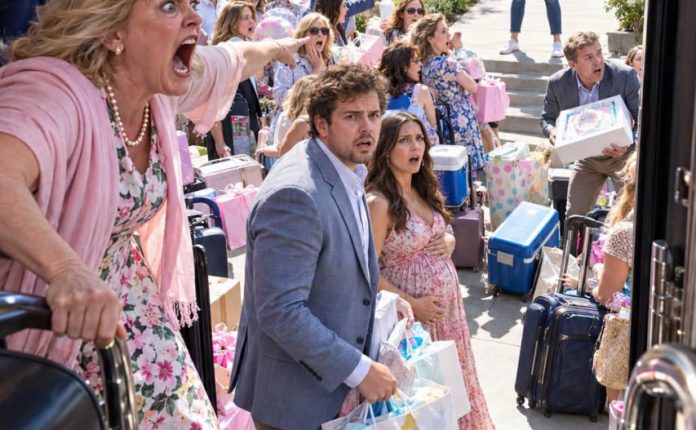
My sister hit me hard enough that I caught the back of a folding chair to stay upright.
Before I could straighten, my father pointed at me and said, “You owe her an apology.”
Ruby screamed. Owen stood so still that, for a moment, I thought he hadn’t understood what had happened. Then I saw his hands. He had curled them into fists against his shorts, pressing his thumbs beneath his fingers.
He was eleven. He had asked a question.
That was all.
Tessa’s fiancé, Cole, moved between us, but not quickly enough to stop her from striking me a second time. Her palm caught the same cheek. This time I heard the sound before I felt it.
“Tessa, what are you doing?” Cole demanded.
She struggled against his grip.
“She’s been turning her kids against me!”
My father didn’t ask whether I was hurt. He didn’t look at his youngest daughter’s hand or at the little girl crying beside my knees.
He looked at me.
“Mara. Your son caused this. Fix it.”
Beyond the white tent, someone’s pontoon boat passed our dock. Its motor made a low, steady noise that seemed strangely ordinary against the silence on the lawn.
That morning, I had worried about whether the cake would slide across the back seat.
By lunchtime, my children were watching their grandfather explain why their mother deserved to be hit.
The cake had been my second purchase of the day.
First, I met a carpenter in the parking lot of a bait shop outside Crosslake and paid him six hundred eighty dollars for replacing the dock steps. He handed me an invoice, thanked me, and said the new boards should last a good while if somebody sealed them before winter.
“I’ll put it on the list,” I told him.
I already had a list. There was always a list.
The water heater had needed replacing the previous autumn. The porch railings had loosened. Propane deliveries cost more every winter. Whenever something broke at Grandma’s cabin, Dad called me with the same opening.
“You’re the practical one, Mara.”
That meant I was about to become the paying one.
At the bakery, the woman behind the counter opened the box to show me blue flowers and carefully piped names: Tessa and Cole.
My sister had sent three messages about the flowers. She wanted them pale blue, not navy, and had asked me to confirm that the frosting wouldn’t look purple in photographs.
She hadn’t asked what the cake cost.
Owen watched me put my card into the reader. He had watched me count out the carpenter’s money, too.
When we turned onto County Road 66, he leaned forward between the seats.
“Didn’t Aunt Tessa say this was her party?”
“It’s the reunion and the engagement celebration together.”
“But she said she was paying.”
Ruby was trying to arrange her stuffed rabbit beside the cake box without touching the frosting.
“Everybody’s helping,” I said.
Owen looked at the receipts in the cup holder.
He didn’t argue. That should have relieved me. Instead, his silence made me uncomfortable.
At thirty-seven, I could explain photosynthesis to a roomful of thirteen-year-olds who had arrived determined not to care. I could teach the difference between an observation and a conclusion. For thirteen years, I had stood at the front of a middle school science classroom in Brainerd and told children that questions mattered.
With my own son, I had just evaded one.
I kept driving.
The cabin stood above Cross Lake, tucked among trees that scattered pine needles across the roof. Its gray cedar siding had darkened unevenly over the years. The green shutters were the same shade Grandma chose when I was little.
My grandfather had built the dock. My grandmother had spent forty-six years making the house behind it feel like somewhere you could arrive hungry, muddy, ashamed, or exhausted and still be offered a chair.
Evelyn Mercer made egg coffee in an aluminum pot with a dent near the handle. She used pine soap. There was usually cardamom somewhere in the kitchen, even when she hadn’t baked.
As a child, I associated that smell with the rare experience of not needing to explain myself before someone believed me.
Dad stood in the driveway when we arrived.
His navy polo bore the emblem of the high school where he had coached basketball for thirty years. Retirement hadn’t changed the way he summoned people. He clapped once, as though calling a team into formation, and opened his arms.
“There she is. My reliable daughter.”
I balanced the cake against my hip while Ruby ran to him.
He kissed her forehead, squeezed Owen’s shoulder, and lowered his voice as he turned toward me.
“We’ll take care of that paperwork after the toast.”
I stopped.
“What paperwork?”
“The county business I mentioned.”
“You said there were old records to sort out.”
“That’s what this is.”
He glanced toward the lawn, where guests were gathering.
“Your name got put on something years ago. We just need to straighten it out.”
“What did my name get put on?”
“Mara, it’s a form.”
He said the word as though forms were harmless by definition.
I spent my working life reading permission slips, laboratory safety agreements, and individualized education plans. I knew perfectly well that a piece of paper could change someone’s life.
Still, I let my father make the question seem childish.
“Could you send it to me first?”
“Martin’s here. He can help us do it properly. Two minutes, and it’s over.”
Martin Beck was Cole’s father. He worked in banking, and Dad had been talking about him for weeks with a satisfaction I hadn’t quite understood.
The Becks were a good family, he said. Well connected. Solid people.
I had assumed he was pleased Tessa had found a considerate fiancé.
Now, standing beside the cake box, I wondered why a banker needed to be involved in a county correction.
Dad touched my elbow.
“Please don’t make this into work.”
Ruby was tugging at my skirt. The cake felt heavier. From the porch, Tessa called my name.
“All right,” I said. “We can look afterward.”
Dad’s face relaxed immediately.
“That’s my girl.”
I had not agreed to give anybody anything. I had agreed to look at papers.
But in my family, hesitation and consent were often treated as the same thing, provided my father wanted the answer to be yes.
Tessa came down the porch steps in a pale blue sundress.
She was thirty-two, with fresh blonde highlights and an engagement ring she held slightly away from her body when greeting people. A white leather guest book rested against her chest.
“You made it,” she said, brushing her cheek near mine.
Then she checked the cake.
“Perfect. You remembered the right flowers.”
“The baker sent a picture yesterday.”
“I know. I just didn’t want any confusion.”
She pointed toward the dessert table.
“Put it over there. Ruby, sweetheart, don’t touch anything until the photographer gets here.”
Ruby pulled her hand away from the ribbon she had been examining.
Tessa was already moving toward another guest.
Owen looked across the driveway at her black SUV. Dad had announced its arrival three months earlier, explaining that Tessa needed dependable transportation as she began married life.
He called it an investment in the family.
I had not asked which members of the family were financing that investment.
My own car had a seat belt that sometimes caught in the door and a dashboard light the mechanic said could wait. It carried school projects, grocery bags, and two children whose shoes seemed to become too small between one payday and the next.
I was good with money, Dad always said.
What he meant was that I could make less money cover more obligations without complaining in public.
Martin shook my hand near the porch.
He had a measured manner, neither hurried nor overly familiar.
“Mara. Richard tells me you teach science.”
“Middle school.”
“That must keep you busy.”
“It keeps me inventive.”
His wife, Patricia, smiled.
“And patient, I imagine.”
“On the good days.”
She asked about my students and listened to my answer. It was such a simple courtesy that I noticed it.
Cole was arranging drinks near the dock, his sleeves rolled above his wrists. When Ruby asked where the lemonade was, he crouched to point it out rather than directing her from above.
“Pink or regular?” he asked.
“Which one tastes pink?”
“I haven’t worked that out yet.”
She considered him seriously.
“I’ll investigate.”
He laughed, and for a moment I thought perhaps the afternoon would be easier than I expected.
Then I saw the dock sign.
Grandpa’s old cedar board had read MERCER LANDING in dark green letters. Now a polished white sign hung in its place, with Tessa and Cole beneath a painted heart.
I looked toward the boathouse, hoping the old sign had merely been moved.
I couldn’t see it.
Inside, the kitchen doorway had been painted white.
Ruby stopped beneath it.
“Mom.”
I followed her gaze.
Every summer, Grandma had measured us against that frame. The pencil marks overlapped, some faint, some thick from her insistence that we press harder. Names, ages, dates. A record of bodies growing while the house stayed still.
Ruby put her fingertips against the paint.
“Where are our lines?”
“They might still be underneath.”
“Why did somebody cover them?”
Tessa appeared behind us.
“It needed freshening up. The whole kitchen looked so tired.”
Ruby turned toward her.
“But Grandma wrote there.”
“I know, honey. We can make new ones another time.”
She said it lightly, already looking past us toward the flowers outside.
Ruby stayed in the doorway.
I should have said something then.
I should have asked why keeping the cabin beautiful meant removing the things that made it ours.
Instead, I guided my daughter toward the lemonade and told myself paint could be removed.
That was how I had endured my family for years: by imagining every small harm could be repaired privately after the person who caused it had gone.
At half past twelve, Dad called everyone beneath the tent.
He lifted his cup and began speaking about loyalty.
I had heard him give enough speeches to recognize the shape of this one. He thanked the visitors. He mentioned tradition. He paused where he expected applause.
Then he turned toward Tessa.
“We wouldn’t be standing here without her.”
My sister lowered her eyes.
“She’s put so much into keeping Evelyn’s place going. This family owes her a great deal.”
People clapped.
I stood beside the cake I had bought, within sight of the dock steps I had paid to replace that morning.
The railing behind Dad had been purchased with my money. The water heater beneath the kitchen sink existed because I had stretched a credit card payment over several months.
For fifty-four months, five hundred forty dollars had left my checking account on the first day of the month.
Cabin expenses, the transfer description read.
Dad said the money covered taxes, dock assessments, and maintenance.
I had never seen a tax bill.
Tessa pressed a tissue beneath her eye.
Owen watched her, then looked at me.
He had the serious expression he wore when a classroom explanation failed to match the experiment in front of him.
“Aunt Tessa?”
She smiled.
“Yes, sweetheart?”
“Can I ask something?”
“Of course.”
He pointed vaguely toward the cake and the dock.
“How come you never pay for anything?”
The applause stopped.
Somebody gave a short laugh, mistaking his question for a joke.
Then Owen continued.
“Mom pays for the things here. But Grandpa just said you do.”
Tessa’s expression emptied before it hardened.
“What have you been telling him?”
She wasn’t asking Owen.
She was looking at me.
“Nothing,” I said. “He saw—”
She crossed the space between us.
I remember the blue skirt moving before I remember her hand.
Then the chair beneath my fingers. Ruby’s scream. Cole’s voice.
And Dad, choosing which daughter required protection.
After the second slap, Tessa was breathing hard.
“You couldn’t let me have this,” she said. “You always need people to feel sorry for you.”
I had not asked anybody to feel sorry for me.
I had not even finished a sentence.
Martin stood beside his chair.
“Richard, we need to stop.”
Dad ignored him.
“Mara, apologize.”
I looked at my father’s mouth, at how readily the instruction came.
For twenty-eight years, I had obeyed some version of it.
Apologize because Tessa cried.
Apologize because Dad was angry.
Apologize because my mother didn’t need another argument.
Apologize because people were watching.
Now people were watching, and two of them were mine.
Owen whispered that if he hadn’t spoken, she wouldn’t have hit me.
I crouched despite the pain in my face.
“Listen to me. Asking a question did not make her hit anybody.”
His eyes filled.
“But Grandpa said—”
“I heard him.”
I made myself hold Owen’s gaze.
“He’s wrong.”
Dad shifted behind me.
“Mara.”
I stood, taking Owen’s hand.
Ruby clung to my other side.
“That was a good question,” I told my son.
Then I walked away.
Dad stepped into our path.
“You’re going to make this worse.”
I didn’t answer.
He had always warned me that refusing him would cause consequences. Usually, the warning worked because I had been taught that his anger was everybody else’s emergency.
This time I stepped around him.
Near the driveway, the fire ring was smoking.
Someone had stacked branches and scraps of wood inside it. Among them lay a paddle with my name carved into the blade.
The first letter was crooked.
Grandma had carved it when I was twelve. She had laughed at the way the tool caught and said my name deserved a proper introduction even if her hand refused to cooperate.
I recognized that crooked letter before I recognized anything else.
Tessa had said she’d cleared out rotten keepsakes.
The blade wasn’t rotten.
It was burning.
I stopped just long enough to see the letters darken.
Ruby pulled my hand.
“Can we go?”
“Yes.”
Behind us, Dad was speaking to Martin in a low, reassuring voice.
“She takes things personally. But the forms are sorted. She agreed.”
Martin’s reply was quieter.
I heard only the last part.
“Nothing can proceed without her signature.”
I put the cake receipts in my purse, buckled the children into their seats, and closed the doors.
My father had not merely expected an apology.
He had expected something in writing.
I drove until Owen’s silence became more frightening than the noise at the reunion.
In Pequot Lakes, I pulled into a gravel parking area beneath the enormous fishing-bobber water tower.
Ruby had fallen asleep against the window. Her rabbit lay beneath her chin.
I turned off the engine and climbed into the back beside Owen.
He kept looking at his shoes.
“Tell me what you’re thinking.”
He rubbed one sole against the other.
“I didn’t mean to ruin it.”
“You didn’t ruin anything.”
“Aunt Tessa was happy before I said it.”
“She was happy while people believed something that wasn’t true.”
He looked up.
“Were you going to tell them?”
I had no easy answer.
“No,” I said finally. “Probably not.”
“Why?”
“Because I’ve spent a long time avoiding arguments with Grandpa.”
Owen considered that.
“Even when he’s wrong?”
“Especially then.”
The honesty hurt. It also felt cleaner than the explanation I had given him in the car that morning.
He glanced at Ruby.
“Can grown-ups be wrong and still make everybody listen?”
“Yes.”
“But you don’t have to agree?”
“No.”
He nodded, then reached across me to take his sleeping sister’s hand.
I sat between them and remembered another child waiting for somebody to say those things.
In August 1998, I was nine.
Grandpa Walter had died that spring. His fishing rod was one of the few things I could hold that still felt connected to him.
I was standing on the dock when Tessa wanted it.
She was four. She wanted many things because they were in somebody else’s hands.
I told her to wait.
She grabbed the flexible end, twisted, and snapped it.
Her scream brought Dad running.
He saw the broken rod and her tears.
Then he turned to me.
“What did you do?”
I tried to explain.
He interrupted.
Tessa sobbed harder.
My mother stood near the porch steps holding a dish towel. I looked at her because I still believed an adult who had seen enough of me would know I wasn’t lying.
She lowered her eyes.
Dad told me to apologize.
When I cried, he said the tears proved I knew I had done something wrong.
Eventually, I said I was sorry.
The rod was repaired. A week later, it went into Tessa’s room.
Nobody asked whether I wanted it back.
That evening, Grandma found me sitting near the kitchen door.
She measured my height, wrote my name beside the line, and said she had seen what happened.
I remember how quickly I looked at her.
“You know I didn’t break it?”
“Yes.”
“Will you tell Dad?”
She rested the pencil against the frame.
It took her too long to answer.
Years later, I would understand that delay differently. At nine, I understood only that the person who believed me wasn’t going to change what happened.
Grandma kept records.
Receipts went into dated envelopes. Fishing licenses stayed together in a drawer. Visitors signed a green clothbound book, and she added weather reports, maintenance notes, catches, birthdays, and whatever else she considered worth preserving.
She called it keeping a proper memory.
At sixteen, I asked why she didn’t argue with Dad when he blamed me for Tessa’s behavior.
She was doing a crossword at the table.
“He isn’t always looking for an answer,” she said. “Sometimes he’s looking for someone to lose.”
I took that as a reason to stop asking questions.
I wish I had understood it as a warning about the person answering them.
My mother died when I was twenty-five.
Dad spoke beautifully at the funeral about devotion and holding a household together.
I arranged the reception, signed the necessary forms, and drove Grandma home.
Tessa couldn’t help. Dad said she was too upset.
She was able to complain about the food.
Five years later, my marriage ended.
My husband moved to North Dakota for another relationship. Calls became less frequent. Birthdays arrived with cards, sometimes late, and my children learned to stop asking exactly when he would visit.
I became responsible for everything that could not be allowed to fall apart.
There was nothing noble about most of it. Someone had to sign the school form, wash the uniforms, pay the electric bill, and remember that Ruby needed different medicine than Owen when they were sick.
I did those things because they needed doing.
Dad treated that competence as evidence I needed less consideration than Tessa.
Grandma was different.
As her arthritis worsened, I drove to the cabin on weekends. I cooked, cleaned, and helped with the dressings on her legs.
Owen learned to bait a hook beside her.
Ruby made bread dough so sticky that we once had to scrape it off a drawer handle.
When Grandma’s fingers became too unsteady, she dictated the logbook entries while I wrote.
Sometimes she began a sentence about Dad and stopped.
“Richard and I talked about—”
Then she looked toward the water.
“Put down Ruby’s three sunfish instead.”
I thought she was tired.
Sometimes I thought she was becoming forgetful.
I did not consider that she might be deciding what I was allowed to know.
The last time we measured the children while she was alive, Owen was six and Ruby was two.
Grandma insisted on using her old carpenter’s pencil.
“Make it dark,” she told me.
I pressed harder.
She watched each name appear.
That autumn, she suffered the stroke that killed her.
At the funeral reception, Dad announced that he would manage the cabin.
Tessa would live there and look after it.
“Your grandmother wanted somebody in the house,” he said.
I asked about the will.
He looked at me as though I had chosen an indecent moment to mention money.
“We’re not making this complicated.”
I let the question go.
That winter, he sent a message explaining the monthly expenses.
Five hundred forty dollars.
Tessa couldn’t manage that amount, but I had steady work and knew how to budget.
I established the automatic transfer.
Then I continued paying separately when something substantial broke.
At home after the reunion, I made sandwiches because none of us had eaten much beneath the tent.
I washed my face carefully.
The skin along my cheek felt hot. A mark near my jaw had darkened.
Ruby asked whether Aunt Tessa would come to our house.
“No.”
“What if Grandpa tells her she can?”
“He doesn’t decide who comes here.”
She held her rabbit tighter.
“Promise?”
“I promise.”
Owen hugged me for a long time before bed.
I stayed until he loosened his arms.
Once both children were asleep, I opened my banking app.
Fifty-four payments.
I multiplied the amount twice, as though arithmetic might change if I approached it more carefully.
Twenty-nine thousand one hundred sixty dollars.
That didn’t include the dock steps, the water heater, the railings, the propane, or the cake.
I had given Dad almost thirty thousand dollars while my own children’s history was painted over in a house where my sister could strike me and expect me to apologize.
The numbers made the evening feel different.
Not less painful.
More difficult to dismiss.
Grandma’s green logbook sat on the highest shelf in my dining room.
I had brought it home after her funeral because nobody else wanted it. Tessa said it smelled old. Dad called it clutter.
For nearly five years, I had avoided opening it.
I could bear the coffee pot because it was something useful.
Her handwriting was harder.
That night, I took the book down.
The cover had faded where sunlight touched it. The pages smelled of paper and cedar.
I found the last summer.
There was my handwriting recording Owen’s sunfish and Ruby’s fall from the dock. Grandma had insisted I note that Ruby was unharmed and indignant, not frightened.
I smiled despite myself.
Then my fingers caught a raised edge inside the back cover.
Beneath the old library-card pocket, a manila envelope had been taped in place.
The tape had yellowed.
Grandma’s writing hadn’t.
The instruction told me to open it when someone placed a pen in my hand.
I sat very still.
That afternoon, Dad had promised the paperwork would take two minutes.
At the driveway, Martin had said nothing could proceed without my signature.
Grandma had died years before either conversation.
Yet she had left something for precisely that moment.
I checked the hallway.
Both bedroom doors were closed. My children were asleep.
Then I carried the logbook to the kitchen table and laid a butter knife beside it.
For the first time, I was going to read something my father had not explained before deciding whether I understood it.
END PART 1