“Mom, I need you here.”
Chloe sounded as though she had put her mouth against the watch to keep someone else from hearing.
I pushed my chair away from the conference table.
“What happened, sweetheart?”
For a second there was only breathing. Someone beside me was explaining a column of figures on the wall. I could see his mouth moving, but the words no longer reached me.
“Dad’s on the floor.”
I stood so abruptly that my chair struck the cabinet behind me.
“Is he talking to you?”
“No.”
“Chloe, listen. Where are you?”
A thin scraping noise came through the call. Then my daughter said something I have heard in dreams ever since.
“I feel funny, too.”
The time on my phone was 3:17.
I remember it with the clarity of a number engraved into glass. I cannot tell you what we were discussing in that meeting. I cannot remember whether it was raining when I left. But I know exactly how the three and the seventeen looked above my daughter's name.
My colleague reached for my elbow.
“Do you need help?”
“My family,” I said, already moving. “Something’s wrong at home.”
I left my folder open on the table. My coat stayed on the back of the chair. All I took was my phone and the keys I had to dig out of my bag while I walked.
“Chloe, go toward the front door if you can.”
I was trying to make my voice ordinary. A mother asking her child to fetch a sweater. A mother reminding her about shoes.
“Can you hear me?”
There was another dragging sound.
“Mom?”
“I’m coming.”
Her answer was so faint that I could not tell whether it was a word or an effort to breathe. Then the call ended.
Daniel worked from home several days a week. On those days, Chloe came straight back after school instead of going to an after-school program. Their afternoons followed a small, comfortable routine: backpack by the den, snack at the kitchen island, homework while he finished whatever remained on his computer.
Sometimes she called me to complain about a spelling word. Sometimes she sent a photograph of something Daniel had made for lunch, usually accompanied by a dramatic assessment of his cooking.
She knew I could not answer every ordinary call during work. We had explained the distinction carefully. A forgotten assignment could wait. Feeling unsafe could not.
That afternoon, she had remembered.
In the elevator, I called Daniel.
His phone rang until voicemail.
I called again while crossing the parking lot, then tried Chloe's watch. I stared at the green button as if pressing it harder might make her answer.
Nothing.
I told myself Daniel might have fainted. People fainted. They recovered. Maybe Chloe was frightened and describing that fear as feeling strange.
Those explanations lasted until the next unanswered call.
Daniel was the person who checked the smoke detectors even when the calendar reminder had not appeared yet. He would notice a loose stair tread before anyone else tripped over it. When Chloe learned to use her watch, he practiced emergency calls with her without turning the lesson into something frightening.
“Say where you are first,” he had told her.
She had pointed at the kitchen.
“Here.”
He had laughed and tried again.
Thinking of that laugh while driving home almost undid me.
At each red light I looked at my phone. I did not remember deciding to leave it on the passenger seat. I simply remember it sitting there, silent, with Daniel's name still on the screen.
By the time I turned onto our street, I had stopped inventing harmless explanations.
His car was not in the driveway.
For one ridiculous instant that seemed reassuring. Perhaps he had taken Chloe somewhere. Perhaps the call had been a mistake.
Then I remembered that his car could be in the garage.
The house looked exactly as it had when I left that morning. A package lay against the porch railing. One of Chloe's hair ties sat on the windowsill, where she had abandoned it while putting on her shoes. There was no broken glass, no open door, no visible sign that our ordinary afternoon had ended.
I unlocked the front door.
“Chloe!”
The cinnamon air freshener in the hall was familiar. Beneath it was another odor, faint and sweet, which I could not place.
I would later be asked to describe it more than once. I could never find a comparison I trusted. I knew only that it did not belong in our house.
“Daniel?”
No answer came from the kitchen.
My daughter's pink backpack was the first thing I recognized. It should have been hooked over the chair near the den. Instead, it was caught beneath her shoulder.
I reached Daniel first because he lay nearest the kitchen island.
A broken mug surrounded his hand. Coffee had spread beneath one of the cabinets and dried into a dark edge. His glasses were still on, crooked against his cheek.
“Daniel. Daniel, look at me.”
He did not.
Then I was beside Chloe.
Her school jacket was zipped halfway up. One shoe had folded under her other leg. The small watch on her wrist looked horribly bright against the stillness of her hand.
I said her name the way I used to say it when waking her for school.
Then I said it differently.
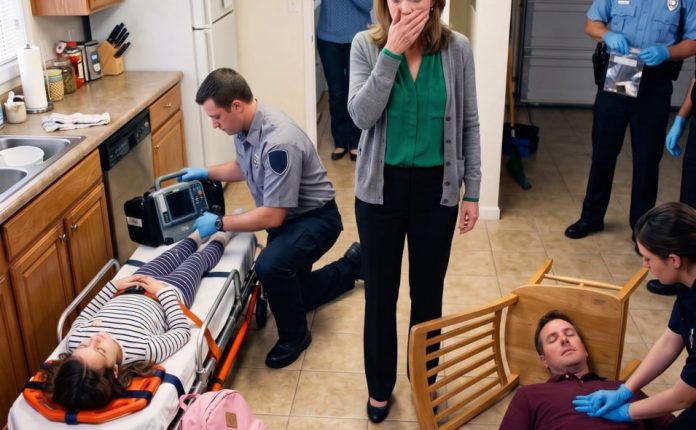
Both of them were breathing. That was the only fact I could hold on to.
I called 911 with my phone slipping against my palm.
The dispatcher asked for our address. I gave it twice because I could not remember whether I had finished the first time.
“My husband and daughter,” I said. “They’re unconscious. I think they’re breathing.”
“How old is your daughter?”
“Ten.”
The number caught in my throat.
I told her about the strange smell. She asked questions I answered without understanding why they mattered, and gave instructions I followed because her steady voice was the only steady thing in the house.
I wanted to carry Chloe. I wanted to lift Daniel. I wanted some action large enough to reverse what I was looking at.
Instead, I stayed on the call and did what I was told.
When the first siren sounded, I turned toward it with such relief that I almost dropped the phone.
People entered carrying equipment. They asked me to move, and I moved. A paramedic knelt where I had been kneeling, then another bent over Daniel.
“My daughter called me,” I said.
Someone asked when.
“Three seventeen.”
A police officer guided me toward the doorway while the crew worked. I resisted for half a step, not because I doubted them, but because leaving Chloe's side felt like abandoning the one job I understood.
“We need room,” he said gently.
I stood outside with the front door open behind me.
Our neighbor was on her porch. When I looked at her, she lifted a hand to her mouth. That was when I understood how this looked from the street: emergency vehicles outside our house, people moving quickly, me standing without a coat while my family was being treated inside.
I had never wanted privacy more. I had never been less capable of asking for it.
The officer stayed close enough that I did not have to find him when a question came into my head.
“Are they going to be okay?”
“They’re getting help right now.”
It was not a promise. I appreciated that later. At the time, I wanted a promise so badly that I searched his face for one anyway.
He asked whether anyone else lived with us.
“No. My sister sometimes stays.”
“How often?”
“A few nights a week. Recently.”
“What’s her name?”
“Lauren.”
Saying it did not frighten me yet.
Lauren was my younger sister. For two months she had been arriving with an overnight bag, complaining about bills and saying she only needed a little breathing room.
She did not move in completely. That distinction had mattered to her. She kept insisting she was still managing on her own, just accepting a few nights of help.
Daniel made room in the refrigerator for the yogurt she liked. Chloe left drawings on the guest-room pillow. I tried to ask about her finances without making every dinner feel like an interview.
She would smile, change the subject, and promise things were improving.
I believed that the smile meant she was embarrassed.
That morning, Lauren had been at the kitchen table when I came downstairs. Her overnight bag leaned against the wall, half zipped, and Chloe was showing her something from school.
I was watching the clock. Daniel was looking for a paper he needed. Lauren had asked whether I would be home late, and I answered without pausing over it.
“Probably. We’ve got the budget meeting.”
She had nodded.
It was the kind of exchange a person forgets before reaching the driveway.
Now it returned to me complete with the sound of her spoon against a bowl.
The officer asked when I had last seen her, and I gave him that morning. He asked whether she had seemed upset.
“Not more than usual.”
I disliked the answer. Lauren had been worried for weeks, but worried did not mean dangerous. I did not want to make every sigh or distracted glance look like something I should have recognized.
“She’s having money problems,” I added. “We were trying to help.”
He asked how.
“Giving her a place to stay. Meals. Not making her feel like she had to explain herself every time.”
I looked toward the house as I said the last part.
The officer followed my gaze, then waited while I gathered myself.
I remembered Daniel clearing a space in the guest-room closet. He had moved a box of old paperwork to the top shelf so Lauren would not have to live out of her bag whenever she stayed.
She thanked him and joked that we were spoiling her.
He said she was family.
At the time, it seemed too obvious to require any further thought.
“How does she usually get here?” the officer asked.
“Her SUV.”
“Does she come while neither of you is home?”
“Sometimes she gets here before me. Daniel’s usually here.”
“Would he expect her today?”
“I don’t know.”
Another question I could not answer. There had been no reason for Daniel to tell me whether my sister planned to stop by. If she arrived, he would let her in. If she needed somewhere to sit, he would offer the kitchen.
We had treated her presence as ordinary.
Behind us, someone called for another piece of equipment. My attention snapped back to the doorway.
I tried to see around the officer without stepping where he had asked me not to stand.
“Do they need anything from me?”
“They’ll tell us.”
I nodded, then immediately asked whether he was sure they knew Chloe had called.
“Yes. They know.”
Her watch was the one piece of the afternoon that did not seem to accuse me of ignorance. She had used it. I had heard her. Whatever I had not known about our house, I had known that my daughter needed me.
I held on to that while the officer asked about visitors and repairs and whether anyone had recently been given permission to enter.
I could not name anyone who made sense as a threat.
The list of people I trusted was easier to provide than the list of people I feared, because until that afternoon those lists had not overlapped.
When an officer walked past with a camera of his own, documenting the doorway and the hallway, I watched him pause near the brass dish.
He did not straighten the felt.
He photographed it as it was.
I understood then that things I considered untidy might have become evidence. The house was full of details I had spent years putting back into place without remembering them.
For once, every object had to remain where somebody had left it.
I put my own keys into my bag so I would stop reaching for the dish out of habit.
It felt strangely important to avoid changing anything else.
Now, standing outside our house, I described those visits to a stranger with a notebook.
“Does she have a key?”
“She can get in when we’re home. She knows the house.”
He asked about other ways inside. The garage. The side door. Spare keys.
I was struggling to connect the questions to Daniel on the kitchen floor.
“Did somebody break in?”
“We haven’t found signs of that.”
The answer should have reassured me.
Instead, it left an empty space where an explanation ought to have been.
I looked at the front door. The lock was intact. The window beside it had not been touched. Whoever had entered, if someone had entered, had not needed to force a way through.
Another officer came outside to ask about cameras.
“We have one over the garage,” I said.
“Is it recording?”
I closed my eyes.
“No. It’s been offline.”
“For how long?”
“About two weeks.”
Daniel had blamed the router. He had tried to sort it out one evening, then put replacing it on the list of household jobs that always seemed less urgent than everything else.
We still had that list attached to the refrigerator.
I could picture his handwriting.
Replace router.
Buy printer ink.
Chloe's permission slip.
The officer asked who knew the camera was not working.
“I don’t know,” I said. “Anyone who heard us talking about it.”
That answer felt careless as soon as I gave it.
We talked in our own kitchen without lowering our voices. We discussed appointments while loading the dishwasher. We mentioned bills over breakfast. Our routines were not secrets.
Why would they have been?
Through the open doorway, I saw a paramedic adjust something beside Chloe. Her backpack had been removed. It lay on a chair, still closed, with the little charm she had chosen herself dangling from the zipper.
I found myself wondering whether her lunch container was still inside.
I hated that thought. It seemed so small, so stupid, while people worked to keep her alive.
Then I realized I was looking for something ordinary to understand.
An officer emerged from near the laundry room holding a bagged object.
“Do you recognize this?”
Daniel's spare car fob.
“Yes.”
“Where is it usually kept?”
“In the hall. In the key dish.”
He waited.
“Under the lining,” I added.
The dish was brass, shallow and dented along one edge. We had kept it for years because it was useful, not because it was attractive. A piece of felt covered the bottom. Beneath it, Daniel kept the spare fob.
He worried about locking the main one in the car.
Chloe knew not to play with the dish. Lauren had seen Daniel lift the felt more than once.
The officer asked whether I had moved the spare recently.
“No.”
“Your husband?”
“I don’t think so.”
I could hear how uncertain I sounded. There were so many ordinary things Daniel might have done that day without telling me. I had never needed to know where every object in our house was at every hour.
The officer did not make me feel foolish for that.
He simply wrote down the answer.
Daniel's car was inside the garage. Another officer checked that area with the caution I had begun recognizing in everyone's movements around the house.
I wanted to ask what they had found. Before I could, the crew started bringing Daniel out.
Seeing him on the stretcher was worse than seeing him on the floor in one particular way: now other people were handling him as someone who could not help himself.
This was the man who opened stubborn jars for me without making a joke about it. The man who carried Chloe upstairs when she fell asleep during a movie, though her legs had grown long enough to make the task awkward.
His arm lay beside him, motionless.
I walked toward him.
“Daniel, I’m here.”
A paramedic answered a question I had not quite asked.
“We’re taking him for treatment.”
“Which hospital?”
He told me. I repeated the name, trying to make sure it stayed in my head.
Then Chloe came through the doorway.
Someone had covered her. I could see only her face and a little of her hair.
I reached for her hand, careful around the people and equipment, and touched the tips of her fingers.
“You called me,” I whispered. “I came.”
She gave no sign that she heard.
I wanted to ride with her. I wanted to be with Daniel. For the first time in ten years of parenting, choosing where to stand felt impossible.
A police officer told me they would help me get to the hospital. He needed a few more answers first, enough to identify who had access and what had happened before my arrival.
I answered as quickly as I could.
My workplace. Daniel's schedule. Chloe's school. The time she usually reached home.
“Just after three twenty,” I said.
The officer looked up.
“Today?”
“I wasn’t here. Her watch called at three seventeen.”
He wrote that down, too.
There were two times now. The time I expected my daughter to come home, and the time she had asked me to save her.
I did not yet understand how much those three minutes mattered.
A dark SUV pulled in behind a cruiser.
I knew Lauren's vehicle before I saw her get out.
For a heartbeat, relief moved through me. My sister was here. Someone who knew Daniel, who loved Chloe, who could stand beside me without requiring explanations about our lives.
Then I wondered how she knew.
I had not called her.
I had not called anyone except Daniel, Chloe, and 911.
Perhaps a neighbor had reached her. Perhaps she had been coming to stay that evening and found the street crowded with emergency vehicles.
Lauren stepped out with her phone in one hand.
She did not look at me first.
She looked toward the stretchers.
Her mouth opened. She stopped beside her door so suddenly that it remained ajar behind her.
An officer walked toward her.
“Ma’am, stay by your vehicle.”
“I’m her sister.”
“I understand. Stay here.”
Lauren moved her eyes from Daniel to Chloe.
The change in her face was unmistakable. Whatever she had expected to see outside our house, it had not been my daughter beneath that blanket.
“I can explain,” she said.
I heard her over the movement around us.
I turned fully toward her.
“Explain what?”
She put a hand over her mouth, then lowered it. Her phone slipped against her fingers. She seemed to be looking for somewhere else to place her attention, but there was nowhere harmless left to look.
“I didn’t know Chloe would come home.”
The words did not fit the scene.
People who arrive after an accident ask whether everyone is all right. They ask what happened. They do not begin by explaining what they thought a child would do.
“What are you talking about?”
Lauren shook her head.
“She shouldn’t have been—”
She stopped.
The officer beside her had gone very still.
“She lives here,” I said.
It sounded absurd to say it. It was the most basic fact in the world. My daughter lived in the house behind us. She came home from school to her father.
Lauren started crying.
I had seen her cry before. Over bills. Over arguments. Once over a broken bracelet she insisted could not be replaced. I knew when to hug her and when to leave her room to regain her pride.
This time, I did neither.
“What did you do?”
“I didn’t want this.”
“What did you do to them?”
She looked toward Daniel, then down at the pavement.
“I was only trying to make him sleep.”
The officer asked her to put her phone away and keep her hands where he could see them.
I remember that instruction because it changed her position in the afternoon. She was no longer a relative arriving to help. She was someone the police needed to watch.
I took a step toward her.
The officer beside me said my name, though I could not remember giving it to him.
“Let us speak to her.”
“She knew,” I said.
He did not argue.
Lauren was talking faster now. Fragments came out between breaths: she hadn't realized, it wasn't supposed to happen, she had thought there was time.
Time for what?
I looked at the house and saw the brass dish through the open door. Its felt lining had been pushed crookedly against the edge.
A tiny disturbance. Something I might have straightened without thinking on any other afternoon.
Now Daniel's spare fob was in an evidence bag.
Lauren knew where we kept it. She knew which afternoons Daniel worked at the kitchen island. She knew when I would be in meetings, because I had mentioned that morning that mine might run late.
Every kindness we had extended to her seemed to have left something exposed.
One of the officers came from the garage holding another bag. Inside it was a folded sheet of paper.
He spoke quietly to the officer near Lauren. I could not hear the first part.
Then I heard the question.
“Is this yours?”
Lauren looked at the paper.
Her crying stopped for a second.
It was such a small pause that I might have missed it if I had not been watching her as closely as I once watched Chloe learn to walk.
“I didn’t write it,” she said.
Nobody had asked who wrote it.
The officer kept his voice level.
“We’ll talk about that.”
He moved her farther from the house, toward a place where she could not reach me or the evidence.
I wanted to shout at her. I wanted answers loud enough to undo the silence in my kitchen. Instead, I asked the question that had become more urgent than anything else.
“Can I go to my daughter now?”
“Yes,” the officer said. “We’ll get you there.”
Before we left, he confirmed the school-bus time once more.
“A little after three twenty,” I said. “Usually.”
He glanced at the folded page.
“What is that?” I asked.
He hesitated, choosing how much to tell a woman whose family had just been taken away in ambulances.
“Instructions,” he said.
The word made the afternoon rearrange itself.
The spare fob had not simply been misplaced. Lauren had not wandered into an accident. Someone had written down a sequence of actions and brought it into our home.
The officer did not read every line to me then.
He told me enough.
The final instruction concerned Chloe.
Whoever prepared that paper had expected Lauren to leave before the school bus arrived.
My daughter had called me at 3:17 because the bus had brought her home three minutes earlier than usual.
I looked across the driveway at Lauren.
She was crying again, but I could no longer hear it as grief alone.
There had been a plan for my house that afternoon.
And it had included a time by which my sister should already be gone.
END PART 1