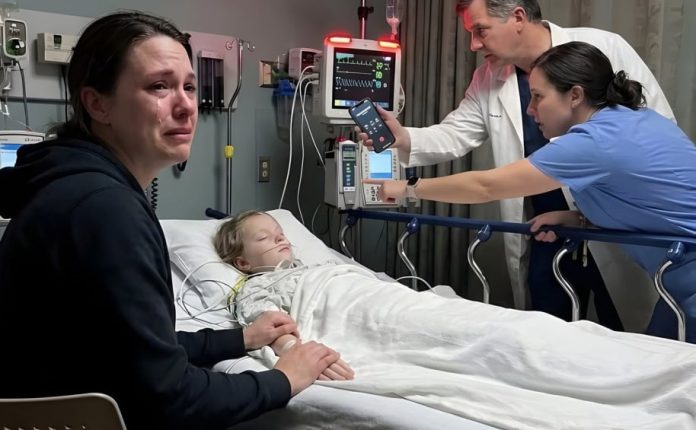
The medicine Lily needed had disappeared, and Daniel was telling me to stop bothering him. Beside me, our daughter’s fingers lay motionless inside my hand.
“Where are you?” I asked. “The doctor has been looking for you.”
A cart rattled past the open doorway. Somewhere down the corridor, someone called for a fresh blanket. Those ordinary sounds made his absence seem even stranger.
“I’m busy, Emily.”
“Then get someone who isn’t. Her medication still hasn’t arrived.”
He exhaled through his nose. I knew that sound. It usually meant he was preparing to explain why whatever frightened me was really my fault.
“First, stop calling my office.”
“I haven’t called your office.”
“Someone has.”
“Probably the people trying to keep your daughter alive.”
I looked toward the glass partition. A nurse was speaking into a wall phone, one hand pressed against her other ear. She glanced at Lily’s monitor, then turned slightly away.
Daniel said nothing.
That silence bothered me more than his irritation. He always had an explanation ready. He could explain a delayed shipment, a rejected authorization, a disagreement between specialists. He could make a complicated system sound orderly.
For almost six years, I had relied on that.
When Lily was first diagnosed, I used to carry a notebook to every appointment. Daniel would glance at the pages afterward and tell me which concerns were important.
I thought we were sharing the work.
Now I wondered how much of my confidence had belonged to him.
Two mornings earlier, Lily had stood in our kitchen wearing one sock and holding the other like a small white flag.
“Do I have to do gym today?”
I was slicing a pear into the little plastic container she liked.
“Does something hurt?”
“Everything feels heavy.”
That was how she described fatigue. Not tired, not sleepy. Heavy.
I put the knife down.
“Sit for a minute.”
Daniel was beside the refrigerator, checking his phone. His coat hung over one shoulder. He had a meeting at nine and had already reminded us twice.
“She didn’t sleep well,” he said.
Lily climbed onto a chair. Her feet did not reach the floor.
I touched her forehead, then crouched so our faces were level.
“Is your stomach bothering you?”
“A little.”
“Your chest?”
She shook her head.
Daniel pocketed his phone.
“Her last labs were stable.”
“They were last week.”
“And we don’t need to turn every difficult morning into an emergency.”
He said it gently enough that Lily looked relieved.
That was one of his gifts. He could dismiss me without seeming unkind to anyone else.
I asked Lily whether she wanted to stay home. She looked at the permission slip on the counter.
Her class was making paper models of bridges that afternoon. She had spent the previous evening explaining which shapes made a structure stronger.
“If I feel worse, I’ll tell Mrs. Alvarez.”
I packed her lunch. I kissed the top of her head. I watched her walk toward the school doors with her backpack sitting slightly crooked.
For the next two days, that crooked backpack would return to me whenever I closed my eyes.
At eleven seventeen, the school called.
“Mrs. Carter, Lily became faint in class.”
I was standing in the laundry room with a damp sheet gathered against my chest.
“Is she awake?”
“The ambulance crew is here.”
“Is she awake?”
“Yes. They’re taking her to St. Matthew’s.”
I left the sheet on the floor.
At the hospital, someone asked me to confirm her birthday. Someone else asked about allergies. I answered questions while staring at the curtain separating me from the examination bay.
I could hear Lily crying.
Not loudly. That would have been easier.
She was making small, frightened sounds between breaths.
When they let me through, she reached toward me with a hand marked by the adhesive from an unsuccessful attempt to place an IV.
“Mom, I didn’t mean to fall.”
“You didn’t do anything wrong.”
“My bridge broke.”
I bent over her until my forehead touched hers.
“We’ll make another.”
Daniel arrived forty minutes later with his identification badge already clipped to his pocket.
People recognized him.
A nurse said, “Daniel, I’m sorry.”
He nodded with the grave expression he wore at professional conferences when someone mentioned a difficult case.
He asked about test results. He asked which specialist had been contacted. He used abbreviations I understood only because I had spent years learning them.
For a few minutes, his presence steadied me.
Then Lily asked him to sit beside her.
“I have to make some calls,” he said.
She watched him step behind the curtain.
“Is he fixing it?”
“I think so.”
It is difficult to explain what that memory became afterward.
At the time, it was a father helping his child.
Later, it was the moment I realized how easily authority could be mistaken for care.
By evening, Dr. Bennett had explained that Lily’s autoimmune condition was flaring aggressively. Her immune system was attacking tissue it should have left alone, and several measurements suggested her organs were under strain.
He did not make promises.
He pulled a chair close enough that I did not have to crane my neck to hear him.
“We’re treating what we can immediately. The injectable therapy we discussed is especially important now.”
“How soon?”
“We’ve ordered it urgently.”
Daniel stood behind my chair.
“Network pharmacy has her allocation,” he said.
Dr. Bennett looked up.
“You’ve confirmed that?”
“Yes.”
Something in me loosened.
Lily had received the medication before. I knew what the packaging looked like. I knew the nurse checked her name against the label, then checked it again with another nurse.
I knew the treatment was expensive.
I also knew that expense did not matter when your child was the person waiting for it.
Daniel had always been precise about the procedure.
“Patient-specific,” he once told me when I asked why a dose could not simply be borrowed from another shipment. “There are controls for a reason.”
That was the phrase he used whenever I questioned a delay.
Controls for a reason.
On the first night, Lily remained on the pediatric ward. She slept in brief stretches, waking whenever someone entered.
At two in the morning, she asked whether the school would let her redo the bridge project.
“Yes.”
“Even if the other kids already finished?”
“Yes.”
She studied my face.
“You don’t know.”
“No,” I admitted. “But I’ll ask.”
She seemed satisfied with that.
Lily preferred an honest uncertainty to a bright lie. I had learned that about her during the long months after her diagnosis.
Daniel had not.
He called shortly before dawn.
“How is she?”
“Still uncomfortable. They’re waiting for the medicine.”
“It’s being handled.”
“By whom?”
“Emily, I work with these people.”
“That isn’t what I asked.”
“I’ll check when the office opens.”
I accepted it.
I was exhausted, and accepting his answer cost less effort than arguing.
The next morning, Lily’s breakfast arrived on a tray she barely touched. She asked me to peel the lid from her juice, then fell asleep before drinking it.
Dr. Bennett returned with another doctor.
Their conversation stayed calm, but the decisions came faster.
More monitoring. More blood work. A transfer to intensive care.
I asked whether the medication had arrived.
“Pharmacy is tracing the order,” Dr. Bennett said.
“Daniel confirmed it yesterday.”
“I know.”
There was something careful in his expression.
He was not concealing Lily’s condition. He was choosing not to speculate about a problem he had not yet understood.
I called Daniel.
No answer.
I texted him the ICU room number.
He sent back: In meetings. Update me.
I stared at the message until the screen dimmed.
Update me.
Not I’m coming.
Not Tell Lily I love her.
I told myself he was working behind the scenes.
It was a generous explanation. I had become skilled at supplying those.
For months, Vanessa Cole had occupied the space between his explanations and the things I could actually see.
She was his assistant, though that title never seemed to cover the hours they spent together.
There were late dinners after department meetings. Weekend messages. A conference he insisted I should not attend because I would find it boring.
When he returned, his suitcase smelled faintly of a floral detergent we did not use.
I asked about it.
He looked at me as though I had interrupted him to discuss the weather.
“Hotel laundry.”
Then he asked why I was going through his belongings.
I had been unpacking his shirts.
Another time, Vanessa called while he was helping Lily arrange game pieces on the coffee table.
He stepped into the kitchen to answer.
Lily followed him with a piece she wanted him to move.
He covered the microphone.
“Give me a minute.”
She stood there longer than a minute.
Eventually, she returned to the table and played both sides herself.
I remembered that now because it was the first time I had seen our daughter make herself smaller to accommodate his absence.
When I brought up Vanessa, Daniel said I was jealous.
When I mentioned his changing schedule, he said I did not understand his responsibilities.
When I asked whether he still wanted our marriage, he said my suspicion was making it hard to live with me.
I had spent so long wondering whether I was being unfair that I almost missed the simplest question.
Was he being honest?
A month before Lily collapsed, he told me Vanessa had been diagnosed with a similar autoimmune disorder.
We were washing dishes.
“She’s having trouble getting treatment covered.”
“That’s awful.”
“She doesn’t have our resources.”
I looked at the kitchen window, where Lily’s paper snowflakes still clung to the glass though winter was over.
“We’re fortunate.”
He dried a plate.
“She’s trying to keep working through it.”
“I hope her appeal gets approved.”
He nodded, but something about the exchange left me uneasy.
It felt less like information than preparation.
Later, I would remember that conversation word for word.
In the ICU, however, I was not thinking about Vanessa.
I was thinking about whether Lily could hear me.
She had become quieter. Her eyelids moved when I spoke, but she did not always open them.
I read from the book in her backpack because it was the only thing I had brought that belonged to our ordinary life.
There was a bookmark made from a folded grocery receipt.
At the bottom, in Lily’s handwriting, she had written: Do not lose my place.
I kept losing mine.
The words blurred. I started the same sentence twice. Once, I read an entire paragraph without knowing what it said.
The nurse brought me water.
“You need some too.”
I thanked her and forgot to drink it.
At the workstation outside the room, people were making calls.
I heard the words delivery record.
Then cancellation.
Then, more quietly, assigned patient.
I lifted my head.
The nurse saw me looking and came inside.
“They’re working on locating the medication.”
“Was it delivered somewhere else?”
“We’re checking.”
“Can you order more?”
“The team is checking every available option.”
She did not pretend that answer meant the same thing as yes.
I appreciated her for it, even while fear made me want to demand a certainty she could not give.
That evening, Dr. Bennett stood at the foot of Lily’s bed and studied the newest results.
I watched his hand rest against the metal rail.
“How worried are you?” I asked.
“Worried enough that I want no further delay.”
I called Daniel again.
This time, the phone rang until it stopped.
Then, several minutes later, he called back.
I answered so quickly I almost dropped it.
That was where my hope had been when the conversation began.
I thought his irritation was the price I would have to pay for good news.
I thought he would tell me where the medication was.
Instead, he said, “I canceled the delivery.”
The room seemed to narrow around those words.
I looked at the IV tubing, at Lily’s bare wrist, at the little indentation where her school bracelet had been removed.
“What did you say?”
“I canceled it.”
“Why?”
He made another impatient sound.
“I redirected the remaining doses.”
“To where?”
“Vanessa needed them.”
For a moment, I could not fit the two statements together.
Lily’s treatment.
Vanessa’s need.
They existed in separate places in my mind.
Then they became one decision.
“You took Lily’s medication?”
“Don’t use that tone.”
“You took medication assigned to our daughter?”
“She’s in an ICU, Emily. There are people watching her.”
I turned toward the glass wall.
The nurse was already looking at Lily’s monitor.
“What does that have to do with anything?”
“If she needs something else, they’ll handle it.”
“They need the medicine you took.”
“You’re making this sound worse than it is.”
I held the phone away from my face for a second.
His name glowed on the screen.
Daniel.
The man listed as Lily’s father on every school form, every hospital form, every document I had filled out since she was born.
When I brought the phone back, he was still speaking.
“Vanessa is trying to maintain a career. She has responsibilities.”
“So does Lily.”
“She’s eight.”
“Yes.”
My voice came out strangely quiet.
“She’s eight, Daniel.”
He seemed to hear accusation rather than fact.
“Vanessa needs to get back on her feet.”
“And Lily needs to live long enough to get out of that bed.”
He laughed.
It was brief, dismissive, and utterly wrong for the room I was standing in.
I had heard that laugh when I mispronounced a technical term. When I asked whether a bill had been paid. When I questioned an explanation he thought should be enough.
I had never heard it while our daughter struggled to breathe.
“Stop performing,” he said.
Something hot rose in my throat.
I swallowed it because Lily’s hand was still in mine.
“Bring it back.”
“I can replace it next week.”
“The doctor says she needs it now.”
“They always say urgently when they want something expedited.”
“You know that isn’t true.”
He did.
That was what made the conversation unbearable.
He understood the risk more fully than I did. He knew the treatment history, the timing, the reason her doctors had ordered the medication.
I could not comfort myself with the thought that he had made a foolish mistake.
“Vanessa matters to me,” he said.
“Lily is your child.”
“Vanessa needs me.”
“Lily needs you too.”
Then he said it.
Not in a shout. Not in a moment of confusion.
With the flat certainty of a man who expected his priorities to become everyone else’s.
“She means more to me than that little girl.”
I looked down at Lily.
A faint line of moisture shone at her hairline. Her lips were parted. The blanket moved almost imperceptibly over her chest.
I had washed that hair the previous Sunday.
She had complained when I pulled a knot.
I had promised to be gentler.
That ordinary promise seemed enormous now.
Gentler.
I could not make the world gentle enough for her. I could not keep the man who had helped bring her into it from choosing to harm her.
But I could stop asking him to care.
The monitor sounded.
The nurse entered without waiting for me to move.
She looked at Lily, then at the screen.
“Dr. Bennett.”
He was already approaching.
I stood because everyone else was standing.
“What’s happening?”
“Her pressure is falling,” he said.
Daniel was still talking.
I heard my own name from the phone.
Emily. Emily.
As if I were the person wandering away from what mattered.
I covered the microphone.
“He canceled it.”
Dr. Bennett looked at me.
“Who?”
“Daniel. He says he redirected her doses to Vanessa Cole.”
The nurse’s hand paused above a control.
Then she resumed what she was doing.
“When did he tell you?” Dr. Bennett asked.
“Just now. He’s still on the phone.”
“Give it to me.”
I handed it over.
He switched to speaker.
“Mr. Carter, this is Dr. Bennett.”
There was a small silence.
Then Daniel’s voice changed.
It became the voice he used with colleagues.
“Doctor. I understand there’s been a supply issue.”
My stomach turned.
A supply issue.
He had already begun.
“Your wife tells me you canceled Lily’s assigned medication.”
“There are details she doesn’t understand.”
“Did you cancel it?”
“I arranged an alternative allocation.”
“Under whose clinical authorization?”
Daniel did not answer.
Dr. Bennett glanced at the nurse.
She had moved closer to Lily’s head.
“Your daughter is deteriorating,” he said. “We need the location of the doses immediately.”
“I’ll have replacement stock by next week.”
“This is not a request for next week.”
I could hear Daniel breathing.
For the first time, he sounded unsure whom he was speaking to.
Dr. Bennett’s voice stayed even.
“You do not have authority to remove treatment from a patient because you prefer another recipient.”
“Doctor, I think this conversation should happen privately.”
“It is happening while your daughter’s condition worsens.”
I watched the numbers on the monitor shift again.
I did not understand every measurement.
I understood the nurse’s face.
Dr. Bennett handed me the phone.
“Tell us where the medication is,” I said.
“Emily, be careful.”
There it was.
Not concern for Lily.
A warning to me.
I thought of every time I had softened a disagreement so our daughter would not hear. Every time I had waited until after bedtime to ask a difficult question.
He had counted on that habit.
He expected me to keep protecting the appearance of our family even after he had endangered the person at its center.
“Where is it?”
“Don’t say anything you’ll regret.”
I looked at the nurse reaching toward the emergency controls.
I realized I no longer needed an answer about our marriage.
That question had been settled.
The only answer I needed was a location.
Then the alarm changed.
It became louder, faster, impossible to mistake.
The nurse called for help.
Dr. Bennett moved between me and the bed.
“Mrs. Carter, step back.”
I let go of Lily’s hand because he needed me to.
It was the hardest movement I had ever made.
A second nurse entered. Someone pushed a cart through the doorway. The room filled with people who knew exactly where to stand.
My phone was still connected.
Daniel heard every sound.
I wanted to tell Lily I was there.
I wanted to ask someone whether she could hear me.
Instead, I pressed myself against the wall, holding the phone like a piece of evidence I had not yet learned how to use.
The nurse looked at the monitor and raised her voice.
“We’re losing her.”
END PART 1