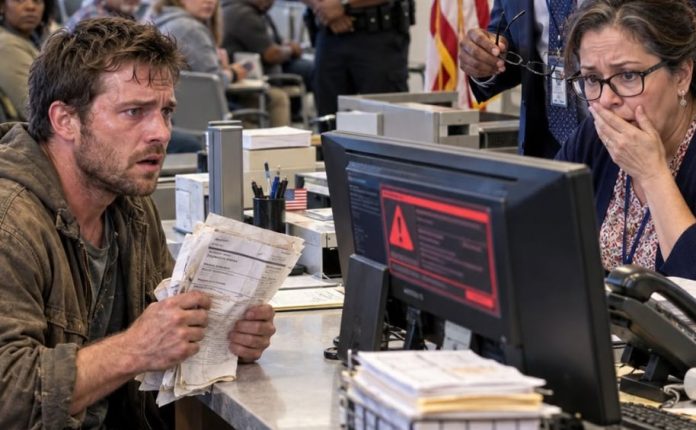
The woman handling my Medicaid application stopped typing and asked whether I had brought the wrong Social Security card.
“No,” I said. “It’s the only one I’ve ever had.”
She checked the number against the application, entered it again, and leaned toward her monitor. Behind her glasses, her eyes moved across something that seemed to require several readings.
I waited for the usual problem. An unsigned form. A missing pay stub. One more document I would have to print somewhere that charged by the page.
Instead, she asked, “What year were you born?”
“Nineteen ninety-one.”
Her hand remained on the mouse.
“And your full name?”
“Ethan James Miller.”
I had already written it six times that morning. Once on the appointment sheet, twice on the application, and three times on forms explaining that I had lost the insurance I could no longer afford.
The clerk’s badge said LINDA RAMIREZ. She had been pleasant when I sat down, the sort of person who explained confusing questions without making you feel foolish for asking.
Now she turned the screen slightly away from me.
“There’s a discrepancy in the record.”
“What kind?”
She glanced past my shoulder toward the waiting area.
A little boy was rolling a toy truck beneath his mother’s chair. An older man held a numbered ticket between two fingers. Near the exit, a security guard watched the room with the patient exhaustion of somebody approaching the end of a shift.
Nobody else seemed to have noticed anything.
Linda picked up her telephone.
I tightened my grip on the folder in my lap.
“Mrs. Ramirez?”
She paused with the receiver halfway to her ear.
“According to the original record associated with this number,” she said quietly, “the child it belonged to died in nineteen ninety.”
For several seconds, I heard only the fluorescent light above us.
Then I laughed.
It was a short, unpleasant sound, and I stopped as soon as I heard it.
“Well, that’s clearly wrong.”
“I understand.”
“I wasn’t born yet.”
She looked back at the monitor.
“That’s why I need my supervisor.”
I watched her dial an extension. My insurance papers were sticking out of the folder, the edges softened by carrying them to appointments where nobody seemed responsible for paying anything.
Six weeks earlier, the lumber mill had shut its gates.
Before that, a forklift accident had injured my right shoulder. I had been helping shift a load when the operator moved too soon. My arm was caught between a stack and a support, briefly enough that the first doctor called it a strain, long enough that the second doctor stopped using that word.
The insurance argument had outlasted my employment.
By the time I reached Linda’s desk, I had fifty-two dollars in my wallet, overdue rent, and a shoulder that woke me whenever I rolled onto it.
I had come to ask for help.
Apparently, even that required being someone else.
“Marcus,” Linda said into the receiver, “can you come to station three? I have an identity record that needs immediate review.”
Her voice was controlled, but her left hand had begun smoothing the same corner of my application.
I knew that movement.
My mother used to do it with dish towels when Gary started asking questions she did not want to answer.
I shifted in the chair.
“Am I in trouble?”
Linda covered the receiver.
“Nobody is accusing you of anything.”
That was supposed to reassure me.
It did the opposite.
I had heard variations of that sentence on construction sites when a supervisor wanted somebody to admit breaking equipment. I had heard it from landlords standing in doorways with inspection notices.
Usually, the next question was designed to establish whose fault something was.
“I’ve been working under that number since I was eighteen,” I said. “I’ve paid taxes. I’ve renewed my license. It’s never caused a problem.”
“I’m not questioning that.”
“Then what are you questioning?”
She lowered the receiver.
“Whether the documents you were given accurately identify you.”
I looked down at the card.
It was yellowing around the edges. Carol had put it in a manila envelope with my birth certificate on the day Gary threw me out.
I had never considered that envelope a gift.
It had been the paperwork accompanying my removal.
My eighteenth birthday fell on a Friday. I remember because I worked the morning shift at the grocery store and spent part of it stocking the bakery display.
A woman bought a cake with eighteen candles. I joked with her that I was turning eighteen too.
She wished me a happy birthday.
That stranger was the first person who did.
When I got home, two duffel bags stood beside the front door.
One was mine. The other was an old gym bag Gary had stopped using because the zipper caught at the corner.
My work shoes squeaked on the kitchen floor.
“Are we going somewhere?”
Gary sat in his recliner with the television on. He reached for the remote, lowered the volume, and pointed toward the bags.
“You are.”
I looked toward the kitchen.
Carol stood at the sink, although there were no dishes in it.
“Mom?”
Gary answered before she could.
“You’re eighteen. I’ve done my part.”
There was a grocery cake on the counter behind her. The lid was still closed. Through the clear plastic, I could see a smear of blue icing where it had touched the container.
“You mean move out?”
“You’ve got a job. You’ve got a car.”
“I’m still finishing school.”
“You can finish from somewhere else.”
I had imagined leaving that house many times. Usually, I had enough money, a plan, and the satisfaction of telling Gary I would not need anything from him again.
Standing there in my work apron, I had none of those things.
Carol twisted a towel around her fingers.
“Say something,” I asked her.
Her lips parted.
Gary glanced at her, and she closed them again.
That was the moment I understood I would be leaving.
Not when he pointed at my bags. Not when he called me an adult.
When she decided that silence would be easier than standing beside me.
“You’re not my blood,” Gary said. “You never were.”
I had heard that argument in a hundred forms.
Emily needed new school clothes. I could manage another semester with what I had.
Emily wanted dance lessons. I should find something useful to do after school.
Emily’s birthday required invitations, a skating rink, and a table full of presents. Mine required a cake from the grocery store and a reminder that money did not grow on trees.
Emily was not responsible for any of it.
She was Gary’s daughter from his first marriage, six years younger than me, and she had never understood why things that appeared ordinary in her life became unreasonable when I asked for them.
At twelve, she thought fairness meant sharing.
She slipped cookies into my room. She left the television remote where I could find it. Once, she told Gary I should come to a school event because other children brought their brothers.
He told her not to make everything complicated.
I tried not to resent the things she had. Sometimes I failed, and then felt worse because she was the only person in that house who gave me anything without keeping an account.
On my birthday, she came down the stairs while I was picking up the bags.
“Where’s Ethan going?”
“To start his own life,” Gary said.
She looked at Carol.
“Right now?”
Nobody answered.
Emily followed me outside in socks. The driveway gravel hurt her feet, but she kept walking until I stopped at my car.
“This isn’t right.”
“I know.”
“Can you stay at Grandma’s?”
Margaret Miller lived in Sarasota. I had not seen her in nearly two years.
Gary always found a reason to prevent visits. The drive was too long. I had summer work. Margaret was getting older and did not need a teenager underfoot.
He never told her those things in front of me.
When she called, Carol usually said I was busy.
“I’ll figure something out,” I told Emily.
She held the open car door with both hands.
“Will you call?”
“I’ll try.”
I meant it when I said it.
Later, trying became complicated. Gary answered the house phone. Carol let messages go unanswered. Emily had no phone of her own yet, and I did not want her caught between us.
Distance became habit.
Habit became years.
Before I drove away, Gary brought out the manila envelope.
He held it by one corner.
“Your documents.”
I reached for it.
“Don’t come back asking questions,” he said.
I assumed he meant money.
At Linda Ramirez’s desk, those words returned with a meaning I had never considered.
The card had been in that envelope.
So had a birth certificate I had used without once asking why Carol did not keep copies of my baby photographs beside it.
She had an explanation for the photographs.
A storage unit had flooded.
That was what she said whenever I asked why other children had albums full of birthdays and baths and ridiculous little hats, while my childhood seemed to begin with school pictures.
The first photograph I remembered seeing of myself was from second grade.
I was wearing a shirt too large at the shoulders. My hair had been combed flat, and I was smiling with the effort of somebody who had been ordered to do it.
There was one photograph of Richard Miller.
He stood beside a truck, one foot raised on the running board, his face partly shaded by a cap.
Carol kept it in a drawer.
She had told me he died on a rain-slick highway outside Charleston in September 1997, when I was six.
I could remember a funeral.
At least, I believed I could.
Dark clothing. Flowers. Carol’s hand pressing mine so hard that I wanted to pull away but knew I should not.
I remembered her bending down to tell me we would be all right.
Linda’s supervisor arrived while I was trying to place those images in order.
Marcus Cole was tall, with gray hair, a narrow tie, and reading glasses hanging from one hand. He looked like somebody who spent his days resolving problems that other people had allowed to grow.
“Mrs. Ramirez?”
She pointed to the screen.
He read it.
Then he read it again.
When he turned toward me, his face changed.
“God,” he said under his breath.
“What?”
He did not answer immediately.
His eyes moved from my forehead to my jaw, then returned to the monitor.
“Do you know me?” I asked.
“No. Not personally.”
“Then why are you looking at me like that?”
He pulled a chair beside Linda’s desk.
“My name is Marcus Cole. I supervise this office. Before we continue, I want to make something clear. You came here seeking medical coverage, and nothing we’ve seen suggests you knowingly provided false information.”
“False information?”
Linda’s fingers tightened around her pen.
Marcus noticed.
“Let’s speak somewhere private.”
He stood and indicated a room along the side of the waiting area.
I did not move.
“What happens if I don’t?”
“You’re free to leave.”
The security guard had stepped closer. Marcus looked toward him and shook his head.
The guard returned to the entrance.
“I would prefer,” Marcus said, “that you hear what we know before deciding.”
People were watching now.
The older man with the ticket lowered his eyes when I looked at him. Somebody farther back was holding a phone at chest height.
I gathered my folder.
Linda came with us.
The interview room contained a table, four chairs, and a print of a mountain lake that had faded to several shades of blue. A box of tissues stood beneath a laminated notice about respectful conduct.
Marcus left the door partly open.
Linda brought a cup of water.
I set my card on the table between us.
“Tell me what it says.”
Marcus sat opposite me.
“The original identity connected to this number belongs to a child named Ethan James Miller. He and his father, Richard Miller, died in a trucking accident in March 1990.”
I stared at him.
He continued carefully.
“There’s also an investigative alert attached to the identity. It was circulated through federal and international channels in 1994.”
“Interpol?”
“That appears in the record, yes.”
“What does international police have to do with me?”
“That’s part of what we need to establish.”
“My father died in 1997.”
“You’ve told Mrs. Ramirez that.”
“Because it’s what happened.”
“Do you have anything documenting that date?”
I opened my mouth.
For the first time, I could not answer.
Everything I knew about Richard’s death came from Carol.
I had never seen a death certificate. I had never visited a grave she could point to without changing the subject.
When I asked about it as a teenager, she said she preferred remembering him alive.
I had thought that was grief.
Marcus waited without filling the silence.
Finally, I said, “I was six.”
“How old was the boy in the original record?”
I hated that he called him the boy, as though somebody else now occupied the name I had brought into the room.
“Three,” Marcus said.
I touched the card.
“How can that be mine?”
“We don’t know yet.”
“Then why has nobody noticed?”
He folded his hands.
“Different systems verify different information. Some records may have accepted the documents presented. Others may not have communicated with the original death record. The alert we’re seeing has recently been connected to this verification system.”
“So I’ve been a mistake in a computer for my entire life?”
“A computer can tell us there’s a conflict. It can’t tell us how that conflict began.”
Linda pushed the water closer.
I drank because my mouth had gone dry, not because I wanted it.
Marcus asked for Carol’s full name.
“Carol Miller. Before she married Richard, Carol Porter. After Gary, Carol Dawson.”
He wrote all three.
“When did she marry Gary?”
“When I was eight.”
“And where is she now?”
“I don’t know.”
The admission embarrassed me.
It was one thing to say I did not need family. It was another to sit across from a stranger and admit I could not locate the woman who had raised me.
“Emily told me they divorced,” I said. “Several years ago. Carol moved west.”
“Do you speak with Emily?”
“Occasionally. Not recently.”
He asked about Margaret.
“My father’s mother.”
“Did she know you before Richard died?”
“I don’t remember.”
That question bothered me more than it should have.
Margaret sent cards. She called on Sundays. When I did see her, she hugged me with both arms and called me her boy.
Surely she knew.
Surely somebody knew.
Marcus asked whether he could make a call to an investigator.
“About me?”
“About the identity record.”
“Is there a difference?”
“There might be.”
He explained that I could verify the person’s credentials before sharing anything further. He asked permission to provide my phone number.
I gave it.
He stepped outside.
Linda remained near the door, holding my application folder against her chest.
“Does this mean I can’t get coverage?” I asked.
She looked startled.
“We’ll continue working on your application.”
“I don’t have money for another appointment.”
“I understand.”
The words sounded different now.
She was no longer using them to keep an upset applicant calm. She meant she had heard what the morning had cost me.
Marcus returned with his telephone still in his hand.
“The investigator will contact you directly.”
“Who?”
“Agent Dana Blake.”
“An FBI agent?”
“Yes.”
I pressed my palms against my knees.
“What exactly have I walked into?”
Marcus pulled the chair closer, but not so close that I felt crowded.
“Tell me about your earliest memory.”
“I told you about the funeral.”
“Earlier than that.”
I closed my eyes.
A kitchen came first.
Yellow walls, or perhaps yellow wallpaper. Flowers near the window. Carol standing at the stove with her back to me.
A song.
Something warm on a plate.
When I tried to see myself in the room, I could not.
“I remember a kitchen.”
“Where?”
“I don’t know.”
“Anything else?”
“We moved a lot.”
“Who told you that?”
“My mother.”
“Do you remember the moves?”
I looked at him.
“Some.”
“Before you were six?”
The question opened an empty space.
I remembered boxes in one apartment. I remembered a brown sofa in another. I could not attach an age to either memory.
“We didn’t have much money,” I said.
“Was that before or after Richard died?”
“After.”
“But you said you moved frequently before then.”
I rubbed my forehead.
“I don’t know. You’re asking me about things that happened when I was little.”
“I know. I’m not asking you to get them right.”
It took me a moment to understand the distinction.
He did not want the story I had learned.
He wanted anything I had experienced without somebody telling me what it meant.
My phone vibrated on the table.
Unknown number.
The message introduced Dana Blake, provided a number through which I could verify her identity, and asked whether I was willing to speak.
Marcus helped me make the verification call.
Nobody rushed me.
That frightened me more than urgency would have.
People were being careful because whatever they were about to say could not be taken back.
When Dana came on the line, she used my name.
“Ethan, I understand this has been a difficult morning.”
“You could say that.”
“I won’t ask you to accept an explanation over the telephone. We have records I’d like you to see in person.”
“What records?”
“Records involving the woman who raised you.”
I looked at Marcus.
“Carol?”
“Yes.”
“Did something happen to her?”
There was a pause.
“She was taken into custody in Utah yesterday.”
I stood too quickly.
My bad shoulder struck the doorframe, sending pain down my arm.
Linda moved forward. I held up my hand.
“For what?”
Dana’s voice stayed steady.
“An outstanding warrant connected to a child abduction.”
I could see the mountain lake on the wall. One corner of the frame was hanging lower than the other.
I concentrated on that.
It seemed possible that if I kept looking at an ordinary thing, the sentence I had heard would become ordinary too.
“What child?”
“We believe you may be connected to that case.”
“No.”
The word came out before I decided to say it.
“No. She’s my mother.”
“I understand that’s what you’ve always known.”
“I’m not telling you what I’ve always known. I’m telling you who she is.”
Dana let me finish.
Then she said, “You deserve evidence. That’s why I’m asking you to come.”
I looked down at the Social Security card.
Gary had pushed it toward me without touching my hand.
Don’t come back asking questions.
“My stepfather knew something,” I said.
Marcus did not look surprised.
That was enough to make my stomach tighten.
Dana asked, “What makes you say that?”
I told her what Gary said on my birthday. I told her about the envelope and the way Carol stood at the sink.
I stopped before describing Emily.
Some part of me still wanted to keep her outside whatever this was.
Dana listened.
Then she said, “Gary Dawson contacted us this morning.”
I lowered myself into the chair.
“About Carol?”
“About you.”
The room seemed to become smaller.
“What did he say?”
“We’ll go through that together.”
“No. Tell me one thing.”
“What?”
“Did he know before he threw me out?”
For the first time, Dana took long enough to answer that I heard her breathing.
“Yes.”
Linda turned her face toward the doorway.
Marcus looked at the table.
I sat between them, holding the documents I had trusted since the morning I stopped trusting people.
Gary had not simply decided I was old enough to survive without him.
He had known something about me that he chose to keep.
And whatever it was, he had handed me the evidence in an envelope and watched me drive away.
END PART 1