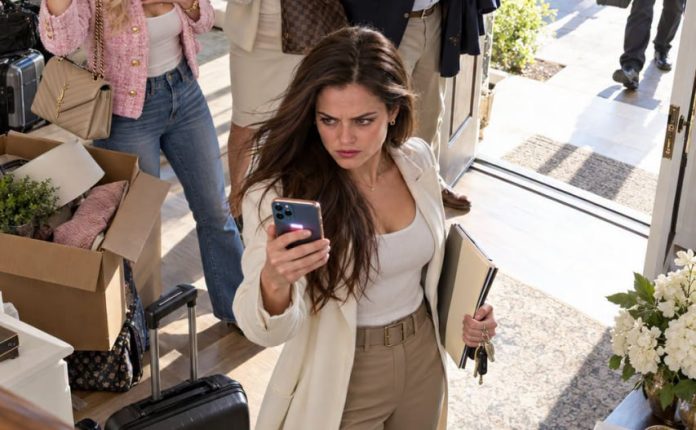
My sister opened my front door before I could unlock it.
She had a mug in one hand, my house key in the other, and behind her my father said, “Come inside, Natalie. We’ve already worked everything out.”
I stayed on the porch.
“What, exactly, have you worked out?”
Jenna’s fingers closed around the key ring. She looked over her shoulder, then back at me.
“Can we talk without you getting upset?”
A child laughed somewhere inside. The television was playing a cartoon. From the kitchen came the smell of coffee, although I had emptied the pot and rinsed it before leaving for Denver four days earlier.
My laptop bag pulled against my shoulder.
“Why are you here?”
“We needed somewhere to stay.”
“You asked. I said no.”
Her mouth opened, but nothing came out.
A few minutes earlier, I had been thinking about a shower, clean pajamas, and whatever I could assemble from the food in my refrigerator. The conference had ended late. My flight had been crowded. I wanted the particular relief of closing my own door after several days of answering questions.
Then I saw the curtains.
The pale linen panels I had chosen for the front windows were still hanging on one side. On the other, someone had put up pink fabric scattered with little white flowers.
At first I thought I had pulled into the wrong driveway.
Then I noticed Jenna’s minivan.
A purple scooter leaned against the garage. Two pairs of children’s sneakers sat beside the porch steps, toes pointing in different directions. A pink backpack rested against the doorframe.
I had sat in the car until the engine began making those small cooling clicks beneath the hood.
Nobody was supposed to be inside.
I had locked both doors, checked the windows, and set the alarm. Marcus Reed, who checked the property when I traveled, knew my schedule. My parents knew I would be away, too.
That last thought was the one I had not wanted to follow.
Three weeks earlier, my mother had called while I was making dinner.
“Jenna needs somewhere she can get settled,” she said. “You have three bedrooms.”
“I’m sorry she’s dealing with this, Mom. She can’t move in here.”
“You haven’t even heard the whole situation.”
“I know she and Tyler are separating.”
“The children shouldn’t have to suffer because their father is being difficult.”
“They shouldn’t.”
“So you understand.”
“I understand the problem. My answer is still no.”
The silence afterward had been so complete that I checked whether the call had dropped.
Then Mom said, “You weren’t always like this.”
I had turned down the heat beneath my saucepan and watched a bubble break slowly through the sauce.
“I wasn’t always good at saying no.”
She ended the conversation without asking what I had meant.
Now Jenna stood in the doorway with proof that nobody had taken my answer seriously.
I stepped past her.
My living room had acquired a basket of unfolded laundry, three open boxes, and a stack of coloring books. A child’s blanket covered the armchair. My coffee table was sticky in one corner, and somebody had pushed the small side table against the wall to make room for a plastic storage bin.
Nothing was destroyed.
That almost made it worse.
They had not arrived like intruders. They had arrived like people who expected to stay.
My father was on the sofa, arms folded across his chest. Richard Hayes could make even sitting down look like a statement of authority.
Mom came out of the kitchen carrying my blue mug.
“Natalie, sweetheart. You look exhausted.”
“Where did Jenna get the keys?”
Mom stopped.
Dad stood slowly, as if my question required him to leave a meeting he had been conducting.
“I had another set made.”
“From what?”
“The spare.”
“The emergency key?”
He gave a short shrug.
I turned to Mom.
“You told me you lost it.”
Her eyes dropped to the mug.
I had given it to her during a weekend visit six months earlier. She had wanted to go for a walk while I was working upstairs, and I had handed her the spare so she could let herself back in.
Before she left, I asked for it.
She searched her handbag, checked her coat pockets, and looked suitably embarrassed.
I remembered reassuring her.
Don’t worry. It happens.
“You kept it,” I said.
“Natalie, this isn’t the important part.”
“It is to me.”
“We didn’t want you worrying about something that could be resolved.”
“What could be resolved?”
“Jenna’s situation.”
“With my house?”
Dad stepped around the sofa.
“Your sister needed help. We helped her.”
“You gave her access to property you don’t own.”
His expression tightened.
“Don’t start talking as though we’re strangers.”
I looked toward Jenna. She had set her mug on the hallway table, beside a framed wedding photograph I had never seen there before.
My ceramic bowl was gone.
“Where’s my bowl?”
She blinked.
“What?”
“The bowl that was on that table.”
“Oh. I put it in the cabinet.”
The ease of the answer made my stomach contract.
She had already decided where my things belonged.
“How long have you been here?”
“Since Tuesday.”
Two nights. Enough time to unpack, change curtains, rearrange furniture, and decide my hallway needed a different photograph.
“Were you planning to tell me?”
“Of course.”
“When?”
Mom moved closer.
“We thought it would be better to discuss everything in person.”
“You mean after she was already here.”
“Natalie.”
“You waited until I was gone.”
Dad exhaled through his nose.
“We knew you’d make this harder than necessary.”
The refrigerator hummed from the kitchen. One of the children called to Jenna, asking where a charger was.
She answered automatically.
“Check the basket by the couch.”
She knew where the charger belonged in my house.
I lowered my laptop bag to the floor because my hand was beginning to ache.
“How long were you planning to stay?”
Jenna rubbed the key ring between her palms.
“Until I get things sorted out.”
“That could mean anything.”
“I don’t know yet.”
“Give me the number you discussed.”
She glanced at Dad.
“Maybe a year.”
For a moment, I could not hear the television.
“A year.”
“Not necessarily the whole year.”
“What does that mean?”
“It depends how things go with Tyler.”
Mom spoke before Jenna could continue.
“The children need consistency. They’ve had enough changes.”
I looked at the boxes. A year meant a school year, holidays, birthdays, ordinary weekdays. It meant learning where I kept spare batteries and deciding which shelf was theirs in the refrigerator.
A year meant making me the visitor.
“You understand I live here?”
Dad looked impatient.
“You’re hardly ever home.”
“I was at a conference for four days.”
“You travel.”
“For work.”
“And Jenna has two children.”
I waited for him to explain how those facts transferred ownership.
He seemed to believe he already had.
“You have options,” Mom said gently. “You’ve done well for yourself.”
“I bought a home.”
“Exactly. You’re capable of doing it again if circumstances change.”
I stared at her.
“You think I should buy another house?”
“Don’t twist my words.”
“You just said them.”
“I’m saying you aren’t trapped the way your sister is.”
Jenna looked down.
I could see she was embarrassed. I could also see she had unpacked anyway.
Those two things could exist together.
I was thirty-six, unmarried, steadily employed, and financially comfortable because I had spent years making choices that were often lonely and rarely convenient. In my family, none of that counted as a life requiring protection.
It counted as surplus.
An extra bedroom was not a room I might choose to use. It was a room somebody else had a stronger claim to.
Savings were not security I had built. They were money waiting for a sufficiently persuasive emergency.
My time had been treated the same way.
“Nobody is taking anything from you,” Dad said.
I pointed to Jenna’s keys.
“Then explain those.”
Mom’s voice softened further.
“Families shouldn’t have to get formal permission every time somebody needs help.”
I looked at her for a long moment.
“You did ask.”
She said nothing.
“And I answered.”
“Natalie, please don’t turn this into a confrontation.”
“You knew what my answer was. That’s why you arranged it while I was away.”
Dad made a dismissive movement.
“We thought you’d see the situation differently once you were home.”
“Once the children were here.”
He did not deny it.
Something in me settled.
Until then, anger had been moving too quickly for me to separate one thought from another. Now I could see the shape of what they had done.
This was not confusion.
They had used my absence to get past my refusal, then placed the children inside the outcome so changing it would make me look cruel.
Jenna touched my arm.
“I didn’t plan all of it.”
I moved my arm away.
“But you moved in.”
“Tyler gave me thirty days to figure something out. You know what rents are like near the school.”
“I do.”
“What was I supposed to do?”
“Ask for help finding a place.”
“Dad said—”
“I’m asking you.”
Her eyes filled.
Dad stepped between us.
“She’s dealing with enough. Stop making her defend herself.”
I looked around him.
“Jenna, did you think I had changed my mind?”
She swallowed.
“I thought you might.”
“That isn’t what I asked.”
Mom put a hand on Dad’s sleeve.
“We all need to calm down.”
“I am calm.”
“You don’t sound calm.”
It was an old trick, whether she knew she was using it or not. If my voice rose, the problem became my temper. If it stayed level, the problem became my coldness.
There was no approved way to object.
I walked into the kitchen because I needed space.
The room had been one of my favorite places since childhood. The oak trim still carried a small dent near the doorway. Afternoon light came through the narrow window above the sink, just as it had when my grandmother stood there rinsing strawberries.
On the counter beside the fruit bowl sat a beige folder.
My name was written on the tab.
I stopped.
Dad followed my gaze.
“That’s just paperwork.”
I picked it up.
“Natalie, leave that.”
Inside were copies of my mortgage statement, my property tax bill, and my insurance documents. Behind them were pages from my closing packet.
At the bottom was a copy of the deed.
I turned the pages slowly.
These were not papers I left on the kitchen table. They had been in the locked drawer in my office.
“Who opened my desk?”
Mom set the blue mug down.
“We needed to check a few things.”
“Who opened it?”
Dad folded his arms again.
“It wasn’t difficult.”
That answer was worse than an explanation.
I looked at the small tear along the corner of one photocopy. Someone had fed my private documents into a machine, collected them, and put them in a folder under my name.
They had made a file about me inside my own home.
“What were you checking?”
“Whether there were restrictions,” Dad said.
“On what?”
“Additional occupants. Future arrangements.”
“Be specific.”
He gave me the expression he used when he thought I was deliberately being tedious.
“Whether the property could eventually be transferred. There’s no reason to act as if discussing possibilities is a crime.”
I closed the folder.
“Transferred to whom?”
Mom answered too quickly.
“No decisions have been made.”
“To whom?”
Jenna’s face had changed.
“Nat, I didn’t ask him to look through your documents.”
“What did he tell you?”
“Just that things could be worked out.”
“What things?”
Dad said my name sharply.
I ignored him.
Jenna stared at the edge of the counter.
“He said the house would probably end up back with the family.”
The sentence seemed to empty the kitchen.
Back with the family.
I looked at the doorway, the old trim, the window above the sink.
They knew whose house it had been. They knew I had bought it from the couple who purchased it after Grandma died.
What they did not know was what I had found before the sale.
They had assumed my decision was sentimental. A successful daughter had recovered an old family property. In their minds, I had restored something they were entitled to manage.
I took out my phone.
Dad moved closer.
“Who are you calling?”
I opened Marcus’s messages.
When I discovered the first unfamiliar belongings from the driveway, I had sent him a brief note. I had wanted someone local to know what I had found before I walked into whatever was waiting.
His reply had come while Dad was explaining that he had copied the key.
Nearby. Tell me what you need.
Now I wrote:
Please come. Bring the locksmith if he’s available. I need the emergency access changed.
Marcus responded almost immediately.
On our way.
Dad watched my thumb move across the screen.
“We can handle this without involving outsiders.”
“You involved people in my home without asking me.”
“We’re your parents.”
“That doesn’t make this your property.”
Jenna wiped her face with the heel of her hand.
“You’re really going to make us leave?”
I looked toward the den.
Her children had lowered the television volume. One of them was standing in the doorway, watching us with the careful expression children learn when adults are pretending not to argue.
I walked over and crouched.
“Everything’s all right. We’re working out where everyone’s staying.”
Emma looked past me at her mother.
“Are we in trouble?”
“No.”
I made sure she saw my face.
“You haven’t done anything wrong.”
I asked them to gather their coloring books and keep watching their show while the adults finished talking.
When I returned to the kitchen, Dad was standing beside the folder.
“See what you’re doing?”
“Yes,” I said. “I’m trying to keep the children out of an argument they shouldn’t have been placed inside.”
He shook his head.
“You’re so determined to be right.”
“I’m determined to have a say in my own home.”
My phone lit up a little later.
We’re here.
I went to the door before Dad could speak again.
Marcus stood on the porch in a dark jacket, carrying the folder he used for property records. Beside him was a locksmith with two metal cases.
Marcus looked at my face, then beyond me at the boxes.
“Do you want me to come in?”
“Yes.”
Dad appeared behind me.
“Who’s this?”
“Marcus. He checks the property when I travel.”
“You need somebody to look after a house?”
“Today, apparently.”
Marcus did not react. He nodded to my parents and asked me, quietly, which locks I wanted changed.
“Both exterior doors.”
Jenna made a small sound behind us.
The locksmith waited while Marcus confirmed the work with me. Nobody argued about whose approval mattered.
That alone felt unfamiliar.
“Tonight?” Mom asked.
“Yes.”
Dad stared at the metal cases.
“This is absurd.”
I faced Jenna.
“I’ll pay for a hotel for three nights. That gives you time to arrange somewhere else.”
“You’d rather spend money on a hotel than let her use a room?” Dad asked.
“Yes.”
“Listen to yourself.”
“I have been listening to myself. For once.”
Mom pressed her fingers to her lips.
“We weren’t trying to hurt you.”
“Then you should have stopped when I said no.”
The locksmith began with the front door.
The sound of his tools was ordinary: a screwdriver against metal, a screw dropped into a small tray, the low scrape of a mechanism being removed.
Dad watched as though somebody were dismantling his authority.
Jenna went upstairs for the children’s bags.
I helped Emma locate a missing marker and gathered the papers she had spread across the coffee table. There was a drawing of a house among them, with four stick figures beside the front door.
She handed it to me.
“This one’s for you.”
“Thank you.”
I placed it on the counter where it would not get bent.
Jenna came down carrying an overnight bag.
“Mom and Dad said you wouldn’t mind after a while.”
I looked at her.
“Did they ask you to wait until I was gone?”
She stared at the zipper.
“They said it would be easier.”
“For whom?”
She did not answer.
Dad stepped forward.
“Enough. She doesn’t need to be questioned like this.”
“I need to understand what happened in my house.”
“You’re making her feel worse on purpose.”
I had expected the accusation. I still felt it land.
“Do you think this is something I wanted?”
He looked away.
“I’ve spent years helping when things went wrong. I gave up an apartment so I could be nearby when Jenna needed childcare. I delayed graduate school. I paid daycare bills. When your contract work stopped, I covered the property taxes.”
Mom’s head lifted.
“We never asked you to keep a ledger.”
“I didn’t. You’re the ones insisting this is the first time I’ve ever had a chance to help.”
Dad’s voice sharpened.
“You offered.”
“Yes.”
I let that stand for a moment.
“I offered. That was a choice. You treated each choice as permission for the next one.”
Jenna sat on the edge of the sofa, overnight bag against her knees.
I could see her listening now.
In our family, every crisis had been presented alone. One bill. One month. One temporary arrangement. Nobody put them next to one another because the picture changed when you did.
Mom’s eyes filled.
“We thought you liked helping.”
“I did.”
“Then why does it sound like you resent us?”
“Because there’s a difference between being asked and being assigned.”
The locksmith tested the new deadbolt.
A solid click traveled through the room.
Dad’s jaw tightened.
“Your grandmother would have hated seeing you behave like this.”
I became so still that Marcus looked up.
Dad noticed and mistook it for an opening.
“This was her home. She knew what family meant.”
“Don’t use Grandma to explain this.”
“Why shouldn’t I? You bought the place because it belonged to us.”
“No.”
He looked irritated.
“You spent all that money on an old house nowhere near your office. What other reason was there?”
Mom said, “Richard.”
He kept going.
“You can’t bring a family house back into the family and then act surprised when the family comes here.”
I looked at the cabinet beside the fireplace.
In its bottom drawer, beneath insurance papers, was a thin green folder I had brought with me on closing day.
I had never shown it to them.
At fourteen, I had cried in the upstairs hallway because my parents had missed my award ceremony for Jenna’s recital. Grandma had found me there and sat beside me without explaining why I ought to understand.
At seventeen, I had slept in the little back bedroom for three weeks after an argument with Dad. She had not sent me home simply because a father was supposed to be obeyed.
At eighteen, I had believed something my parents told me because trusting them seemed more reasonable than questioning them.
The green folder contained the reason I had stopped.
“You want to know why I bought it?” I asked.
Dad gave an impatient shrug.
I crossed the living room, opened the drawer, and lifted the folder.
Mom’s face changed immediately.
Not confusion.
Recognition.
Jenna noticed it, too.
“Mom?”
“Natalie,” she whispered. “This isn’t the time.”
I held the folder with both hands.
Dad frowned at it.
“What is that?”
“You should know.”
His eyes moved from the folder to my mother.
Jenna stood.
The bag slid from her knees onto the floor.
“What did you do?”
Nobody answered her.
Outside, the locksmith’s van idled in the driveway. Inside, the house had become so quiet that I could hear the old clock above the kitchen doorway.
I looked at my parents.
“You came here because you thought I’d give in again.”
Mom shook her head, but she was looking at the folder.
“This time,” I said, “you’re going to hear why I won’t.”
END PART 1