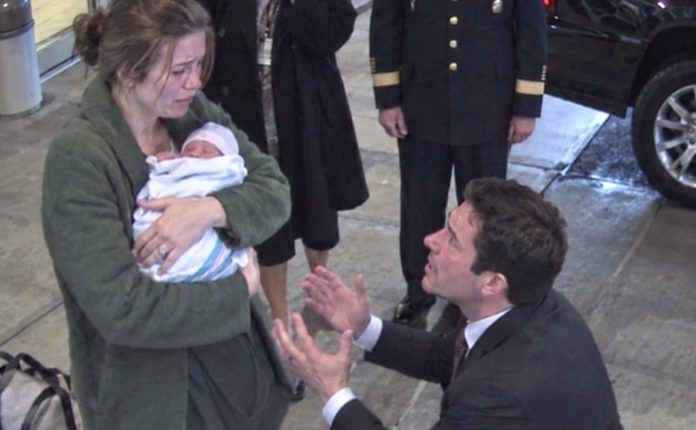
My daughter had been alive for thirty-two minutes when my ex-husband called.
She was asleep against my chest, her cheek warm beneath my chin and one tiny fist tangled in the neckline of my hospital gown. Outside the maternity-room window, October rain streaked the glass and blurred the parking-lot lights into silver ribbons. Inside, everything smelled faintly of antiseptic, clean cotton, and the strange metallic warmth that seems to follow childbirth into a room.
I was exhausted enough that the phone vibrating on the bedside table sounded impossibly far away.
Then I saw the name.
Richard Holloway.
I had deleted his number six months earlier.
Apparently my body had not.
My pulse jumped before my mind caught up.
The nurse helping me settle the baby noticed. “Do you want me to silence that?”
I should have said yes.
Instead I looked at my daughter.
Her hospital tag still read BABY GIRL VANCE, because I had not yet entered the name on the final paperwork. My maiden name. The name I had reclaimed after the divorce.
“Let it ring.”
It stopped.
Then started again.
I answered.
“Charlotte.”
Richard sounded relaxed. Almost cheerful. The tone he used when he believed he had already won whatever conversation he was beginning.
“Richard.”
“I hope this isn’t a bad time.”
I looked at the IV line taped to my hand, the blood-pressure cuff, the newborn sleeping beneath my chin, and the nurse pretending very hard not to listen.
“It is.”
He gave the soft laugh I used to mistake for charm.
“Still dramatic.”
There were moments during our marriage when he could make that word erase an entire argument. If I objected to him moving money without telling me, I was dramatic. If I asked why Jessica Wynn’s perfume was on his jacket, I was dramatic. If I cried after my miscarriage while he answered work emails from the chair beside the hospital bed, I was dramatic.
Divorce had taught me that repeated labels are sometimes just cages with familiar names.
Richard continued. “I’m getting married tomorrow afternoon.”
My stitches burned as I shifted upright.
“Congratulations.”
“To Jessica.”
“I assumed.”
“You remember her.”
I almost laughed.
I remembered Jessica’s perfume.
I remembered her earrings catching the light across a mediation table while Richard explained that I had contributed almost nothing to our marriage financially.
I remembered three days before he filed for divorce, when our joint account dropped from $86,412 to less than $900.
I remembered Jessica later telling me the transfer was none of my concern because Richard had earned most of it.
Mostly, I remembered the message she sent the day after I told Richard I might be pregnant.
An address.
A private clinic.
And one sentence.
Handle the problem quietly, or Richard will make sure you leave with nothing.
I had saved that message.
I had saved everything after that.
Richard said, “Jessica thought inviting you tomorrow would provide closure.”
I stared at the rain.
“You called me from your wedding rehearsal to invite your ex-wife?”
“We’re mature adults now.”
“No. You’re getting married tomorrow. I’m busy.”
“With what?”
“My daughter was born this morning.”
There was no sound from his end.
Not traffic.
Not breathing.
Nothing.
Then Richard’s voice changed completely.
“What did you say?”
“My daughter was born this morning.”
“Your daughter?”
“Yes.”
“Charlotte.”
He inhaled sharply.
“Whose baby is that?”
I looked toward the bassinet.
Beneath it was a small locking drawer.
Inside waited a sealed envelope from an accredited laboratory, copies of our messages, prenatal medical records, financial records from the divorce, and a letter delivered two weeks earlier by the Holloway family attorney.
Beside my water cup lay a small brass key.
Richard’s late father had given it to me years before.
“Mine.”
“Don’t play games with me.”
I closed my eyes.
“You taught me the games, Richard.”
Then I opened them and looked at my daughter.
“I simply learned to keep evidence.”
The call ended.
Not dramatically.
No final threat.
He just hung up.
The nurse, whose name was Olivia, looked at me.
“You okay?”
“No.”
She nodded.
“Do you want visitors restricted?”
“Yes.”
I answered immediately.
Then I hesitated.
“Actually, I want one person specifically denied access unless I approve him.”
She took out a tablet.
“Name?”
“Richard Holloway.”
“Relation?”
“Ex-husband.”
She entered it.
“And the baby’s father?”
I looked at her.
“Also Richard Holloway.”
Her fingers stopped for half a second.
Then she continued typing without comment.
I appreciated her professionalism enormously.
Twenty-eight minutes later, the door slammed hard enough against the stopper to wake my daughter.
She startled.
I instinctively pulled her closer.
Richard stood in the doorway wearing black formal trousers and a white tuxedo shirt buttoned incorrectly at the collar. Rain darkened his shoulders. His hair, usually styled with obsessive precision, was wet and pushed back with one hand.
Behind him stood Jessica.
She was still dressed for the rehearsal.
Champagne-colored dress.
Diamond necklace.
Hair pinned beautifully.
Her makeup was flawless except around her mouth, where anger had tightened everything.
Olivia moved between them and my bed.
“You cannot enter this maternity room without the patient’s permission.”
Richard barely heard her.
He stared at the bassinet.
Then at the baby in my arms.
“Tell me the truth right now.”
Jessica folded her arms.
“This had better not be another one of her performances.”
I looked at the necklace around her throat.
Three months earlier, I had seen the charge for it while reviewing financial discovery with my attorney.
The store description was vague enough that Richard claimed it was a business gift.
Now the business gift was hanging above Jessica’s collarbone.
Interesting.
Olivia reached toward the security button.
“It’s okay.”
She looked at me.
“You sure?”
“Yes.”
Then I looked at Richard and Jessica.
“Let them stay.”
Olivia remained near the door.
Good.
Richard stepped closer.
His eyes dropped to the bassinet label.
BABY GIRL VANCE.
He stared.
“Vance?”
“My maiden name.”
His jaw moved.
“Not Holloway?”
“No.”
“That child is mine.”
Jessica gave a brittle laugh.
“You intentionally had a baby to destroy our wedding weekend?”
I looked at her.
For the first time, I noticed her left hand trembling.
“No.”
I answered quietly.
“I had her because she survived you both.”
Everything stopped.
Jessica’s face went blank.
Richard said:
“What does that mean?”
I almost admired him.
Six months earlier he had read my message telling him I had three positive pregnancy tests.
He had responded with:
We have already lost one. Don’t use this to delay the divorce.
Then:
If there is actually a pregnancy, handle it responsibly.
I had asked what responsibly meant.
He sent me the clinic website.
Jessica sent the address the following morning.
Richard canceled my health coverage that same day.
Our divorce petition had not even been formally served yet.
Technically, his employer's plan required notice and processing before removal, but Richard had listed our separation date weeks earlier and pushed HR to terminate dependent coverage as soon as legally possible.
The coverage issue was eventually corrected temporarily after my attorney intervened.
But the intent was impossible to misunderstand.
I had called Richard.
Begged him to restore the policy until my bloodwork was complete.
He answered:
Sign the property documents first. Then we can discuss whether your condition deserves my money.
That sentence changed my life.
Not because it frightened me.
Because something inside me finally stopped expecting him to become decent.
I did not go to the clinic Jessica sent.
I called legal aid.
Then a maternal-fetal specialist.
Then a lawyer.
I changed hospitals.
Changed emergency contacts.
Changed passwords.
Stopped sharing medical information.
And when an ultrasound at eight weeks showed a heartbeat, I told almost nobody.
My mother.
My attorney.
My doctor.
That was all.
Richard stepped toward the bed.
“You told the divorce court there was no child.”
“No.”
“I read the filing.”
“Then read it more carefully.”
His face reddened.
“At the time of filing, there was no living child to list. There was a possible pregnancy under medical evaluation.”
Jessica whispered:
“Richard, why does that matter?”
He ignored her.
His eyes moved to the brass key on my bedside table.
That was when the blood drained from his face.
Not when he saw the baby.
Not when I said daughter.
The key.
He recognized it.
Of course he did.
His father, Malcolm Holloway, had kept it on his own key ring for thirty years.
Richard stepped toward the table.
I put my hand over it.
“Don’t.”
He stopped.
Jessica looked between us.
“What is that?”
“Nothing.”
Richard answered too quickly.
I almost smiled.
Jessica’s eyes narrowed.
“What trust?”
He turned toward her.
“There is no trust issue.”
“Then why did you leave our rehearsal dinner without telling anyone?”
“I told you Charlotte was creating a problem.”
“You said she was probably lying.”
Richard looked back at me.
“Where did you get that?”
“Your father.”
“No.”
“Yes.”
“When?”
“After my miscarriage.”
That landed.
Years earlier, before everything between Richard and me collapsed, we had wanted a child.
At least I had.
I still do not know what Richard wanted.
Maybe the image of fatherhood.
Maybe his father’s approval.
Maybe the trust.
We conceived after two years of trying.
At eleven weeks, I miscarried.
Malcolm came to see me while Richard stayed at the office.
I still remembered him sitting beside my hospital bed, awkwardly holding flowers as if flowers were complicated machinery.
Before leaving, he placed the brass key in my palm.
“If another child comes,” he told me, “you may need this before Richard understands why.”
I had been grieving too deeply to ask what he meant.
Later, Malcolm explained.
The Holloway Legacy Trust.
Created by Richard’s grandfather.
Revised by Malcolm.
The trust owned a significant block of shares in Holloway Industrial Systems, the family company.
Richard was not the sole beneficiary.
He had a conditional income interest and certain management expectations, but the first verified biological grandchild of Malcolm’s line would become the primary generational beneficiary of a protected share.
The child would not run the company.
No infant was inheriting a boardroom.
An independent trustee controlled the voting mechanics.
But financially and legally, the birth changed the trust.
A portion Richard had spent years talking about as “his inheritance” would no longer be his.
It would be held for the child.
Education.
Health.
Future security.
Long-term ownership.
Protected from Richard.
Protected from me too.
That last part had mattered to Malcolm.
He did not trust anyone completely where family money was concerned.
Good for him.
Jessica stared at Richard.
“You told me the trust passed to you when Malcolm died.”
“Most of it did.”
“Most?”
Richard’s jaw tightened.
I said:
“He told you there was no child.”
She turned toward me.
“You kept this secret.”
“Yes.”
“You knew what it would do to him.”
I almost laughed.
“No.”
I looked at Richard.
“I knew what he had already done to me.”
Measured footsteps approached in the hall.
Richard heard them too.
His shoulders stiffened.
The door opened.
Graham Whitaker entered.
Sixty-two.
Gray suit.
Black leather case.
The Holloway family attorney for almost twenty-five years.
Behind him stood the hospital administrator and two security officers.
Jessica's face drained.
Graham looked first at me.
Then the baby.
His expression softened.
“Charlotte.”
“Graham.”
“Congratulations.”
“Thank you.”
Then he looked at Richard.
“I advised you this afternoon not to contact Mrs. Vance until the paternity documents had been served.”
Richard spun toward me.
“You filed what?”
I unlocked the drawer beneath the bassinet.
The sealed folder came out.
Graham placed another packet on top.
Across the first page:
PETITION TO ESTABLISH PATERNITY AND PRESERVE BENEFICIARY RIGHTS
Underneath:
RICHARD MALCOLM HOLLOWAY — ALLEGED/VERIFIED BIOLOGICAL FATHER
Richard grabbed the first page.
“How did you verify anything?”
I removed the laboratory report.
Noninvasive prenatal paternity testing.
My blood.
A sample Richard had voluntarily provided years earlier as part of a private fertility evaluation.
The clinic still held genetic material under records retention.
Obtaining and using it required careful legal authorization and chain-of-custody work.
My attorney had spent months making sure the result could be verified independently after birth.
The prenatal result was overwhelming.
The hospital would conduct a legally recognized post-birth confirmation too.
Richard stared at the percentage.
99.99 percent.
Jessica sat down.
Not gracefully.
The chair near the wall caught her.
“You knew.”
She whispered.
Richard looked at her.
“Jessica—”
“You knew she might be pregnant.”
“She said she might.”
“You told me she was lying.”
“I thought she was.”
“You told me the miscarriage had made her obsessive.”
My stomach turned.
There were lies I knew about.
Apparently there were others.
Graham opened the trust document.
“I want to be clear before anybody misstates this.”
He looked directly at Richard.
“The child does not control Holloway Industrial Systems.”
Then at Jessica.
“And Charlotte does not personally inherit company assets through this clause.”
Good.
Facts.
“But upon verified birth of Malcolm Holloway’s first biological grandchild, the child becomes the primary protected beneficiary of the generational share.”
Richard stared.
“How much?”
Graham paused.
“You know how much.”
“Say it.”
“Twenty-eight percent beneficial interest in the trust’s company holdings.”
Jessica inhaled sharply.
Richard whispered:
“That was my remainder.”
“Conditional remainder.”
Graham corrected.
“You were advised repeatedly.”
“That trust was supposed to terminate into me.”
“Only if there was no qualifying descendant.”
Richard looked at the newborn.
Not like a father.
Like an accountant staring at a number that had changed.
Something inside me hardened permanently.
Jessica saw it too.
Her face changed.
Graham turned another page.
“And because Malcolm amended the administrative section after learning of Charlotte’s first pregnancy—”
Richard interrupted.
“He couldn’t do that.”
“He did.”
Graham continued.
“—the controlling beneficiary designation now reads First Biological Grandchild Of Malcolm Holloway, By Independent Trustee, With Charlotte Vance As Natural Guardian For Beneficiary Communications Until Court Order Otherwise.”
Jessica stared at me.
“You are controlling the trust?”
“No.”
I answered before Richard could weaponize it.
“The trustee controls it.”
Graham nodded.
“Charlotte cannot withdraw funds for herself.”
“Richard cannot either.”
“The child’s beneficial interest cannot be pledged for wedding expenses, personal debt, or company leverage.”
Richard’s face became terrifyingly still.
I understood something.
He had already pledged it mentally.
Maybe actually.
Graham must have understood too.
Because he opened another document.
“Which brings us to why I was coming to speak with you tomorrow.”
Richard looked at him.
“What?”
“Your proposed loan.”
Jessica turned.
“What loan?”
Graham placed the paper down.
Richard did not touch it.
Holloway Industrial had recently been seeking private financing for an expansion.
Richard had represented part of his expected trust remainder as evidence of future liquidity.
Not formal collateral.
Not yet.
But enough to influence negotiations.
The birth destroyed that assumption.
Jessica stared.
“You said our house was being purchased after the wedding.”
Richard said nothing.
“What house?”
I asked.
Jessica looked at me as though she hated me for being present when her life began cracking.
“A house in Westbridge.”
I knew Westbridge.
Seven bedrooms.
Golf club.
Gated entrance.
I looked at the diamond necklace.
Then at Richard.
“With what money?”
Jessica stood.
“Richard.”
“Not here.”
She laughed.
“Apparently every important conversation happens around Charlotte.”
Richard’s voice sharpened.
“Jessica, stop.”
That command.
I knew it.
She did too.
Her expression changed.
Graham closed the leather case.
“Security needs to remove you both.”
Richard turned toward me.
“You cannot keep my daughter from me.”
There.
Finally.
Daughter.
Not child.
Not trust.
Not problem.
Yet even then I could not tell whether he meant her or what came with her.
“I’m not.”
I answered.
“We’re establishing paternity correctly.”
“I have rights.”
“Yes.”
“And obligations.”
That irritated him.
Good.
“You canceled my insurance when I told you I might be carrying her.”
His face hardened.
“You emptied our account.”
“Charlotte—”
“You called her existence manipulation.”
“Stop.”
“You made Jessica send me an abortion-clinic address.”
Jessica shouted:
“He did not make me!”
Everyone looked at her.
She looked almost shocked by her own honesty.
Then:
“He told me to send it.”
Silence.
Jessica’s voice became smaller.
“But I chose to.”
For the first time, she had said something I respected.
Not enough for forgiveness.
Enough for accuracy.
Richard turned on her.
“Are you insane?”
Jessica removed the diamond necklace.
Her fingers shook.
“Was this bought with the joint account?”
No answer.
“Richard.”
“It was my money.”
Charlotte’s attorney voice had apparently entered my bloodstream because I said:
“Marital funds do not become exclusively yours because you earn more.”
He glared.
Jessica stared at the necklace in her palm.
Then placed it on the table.
“I want documentation.”
Richard laughed.
“Our rehearsal dinner is downstairs waiting.”
“Then they can wait.”
Security stepped forward.
Richard looked at the baby one more time.
She slept.
Completely unaware that adults had already spent half an hour arguing about what her existence changed.
I looked down at her.
“No one is using you.”
I whispered.
Richard heard.
His face moved.
Maybe shame.
Maybe anger.
The security officers escorted him toward the door.
He stopped beside me.
“I’ll be back with an attorney.”
Graham answered:
“I am an attorney.”
Richard glared.
“Not mine anymore.”
Graham nodded.
“Correct.”
That surprised Richard.
Graham continued:
“The firm represents the trust and company.”
Not Richard personally.
Another thing Richard had apparently mistaken as his.
When the door finally closed, silence fell.
Jessica remained.
Security waited.
She stared at the necklace.
Then at me.
“I believed him.”
I was too tired for that sentence.
“You also threatened me.”
Her face crumpled slightly.
“I know.”
“You sat in mediation while he called me parasitic.”
“I know.”
“You helped empty the account.”
“I didn't transfer it.”
“You knew.”
Silence.
“Yes.”
I shifted my daughter higher against my chest.
“You do not get to convert complicity into victimhood just because he lied to you too.”
Jessica’s eyes filled.
“I know.”
That was better.
She picked up her handbag.
Left the necklace.
Then paused.
“What is her name?”
I looked down.
For months I had been afraid to say it aloud too often.
As if claiming my daughter might invite someone to take her.
Not anymore.
“Nora.”
Jessica nodded.
“Nora Vance.”
“Yes.”
She left.
Olivia closed the door.
Graham exhaled.
“Well.”
I almost laughed.
“Legal terminology?”
“No.”
He looked at the abandoned diamond necklace.
“That was a disaster.”
“Thank you.”
“You're welcome.”
He pulled up a chair.
“There are things we need to discuss.”
“I know.”
“The trust.”
“I know.”
“Richard’s paternity rights.”
“I know.”
“Post-divorce financial remedies.”
I closed my eyes.
“That one sounds expensive.”
“We’ll see.”
He looked at Nora.
Then softened.
“But none of it happens tonight.”
For the first time that day, someone said something I could actually use.
He stood.
“I’ll secure the necklace as potential disputed property only if your attorney directs it. Do not touch it.”
“Fine.”
“And Charlotte?”
“Yes?”
“Malcolm would have been very happy.”
My throat closed.
That was unfair.
I started crying.
Not elegantly.
The kind that hurts stitches.
Olivia came over.
Graham quietly left.
Nora stirred.
Her eyes opened.
Dark.
Serious.
She made one tiny sound.
I pressed my lips to her forehead.
“Hi.”
She blinked.
“You caused quite a morning.”
Then I laughed through tears.
Outside, rain continued hitting the glass.
Somewhere across the city, Richard’s wedding rehearsal was presumably collapsing.
I did not care.
For six months, he had believed he left me with nothing.
No house.
No savings.
No marriage.
No insurance.
No power.
But underneath Nora’s bassinet sat a folder proving something I had finally learned during the worst year of my life.
Power was not who could move money fastest.
It was who could prove what happened after the money moved.
And for the first time since Richard filed for divorce, every page was in my hands.
END PART 1