MY 5-YEAR-OLD NIECE BEGGED ME NOT TO LEAVE HER ALONE WITH HER FATHER—BUT WHAT THE DOCTOR DISCOVERED THAT CHRISTMAS NIGHT EXPOSED A SECRET OUR FAMILY HAD HIDDEN FOR YEARS
Part 3 — The Christmas Night Everything Fell Apart (Full Story and Ending)
“Andrew, if you believe she is returning to a house where she is in active danger tonight, you cannot treat this like a journalistic investigation.”
Dr. Julia Vance’s words echoed through my rental car.
I sat outside my brother’s enormous Austin mansion, staring at the Christmas lights wrapped around the front pillars.
Behind those expensive glass doors, my five-year-old niece was probably being told to brush her teeth and get ready for bed.
And for the first time in my life, I was terrified of what might happen after she closed her bedroom door.
“What do I do?” I asked.
“Call 911. Explain exactly what Chloe said, without adding interpretations. Tell them she’s reporting pain and that you’re concerned about her immediate safety. I’ll help coordinate with the appropriate pediatric team.”
I swallowed hard.
“Julia, what if I’m wrong?”
Her voice softened.
“Then professionals will assess the situation. But if you’re right, that little girl needs someone to act.”
I ended the call.
For several seconds, I stared at my phone.
My brother Michael had been my childhood hero.
He taught me to ride a bicycle.
He helped me through college.
When our father died, Michael was the one who stood beside me at the funeral.
I wanted desperately to believe there was some innocent explanation.
But I kept seeing Chloe’s drawing.
The little girl.
The dark figure.
The bedroom door.
And those terrible words:
DADDY COMES IN. MOMMY SAYS DON’T TELL.
I dialed 911.
The dispatcher remained calm while I explained the situation.
I told her my niece was five years old, had complained repeatedly of pain, and had spontaneously described frightening incidents involving her father.
I explained that her parents had dismissed her complaints and threatened her with being sent away.
Then I read the words from her drawing.
The dispatcher asked where Chloe was.
“At home with her parents.”
“Are you nearby?”
“Yes. I’m parked outside.”
“Remain in a safe location. Officers are being sent to assess the situation.”
I looked toward the house.
Through the upstairs windows, I could see movement behind the curtains.
Then my phone rang.
Michael.
I stared at his name until the call stopped.
A text appeared.
Why are you sitting outside my house?
My blood turned cold.
Then another message arrived.
Andrew. I can see your car on the security cameras.
Of course he could.
My brother owned a cybersecurity company.
His house had cameras covering every entrance, driveway, and hallway.
He knew exactly where I was.
The phone rang again.
This time, I answered.
“Michael.”
“What are you doing?”
“Just making a call.”
“To whom?”
“A friend.”
He laughed, but there was no humor in it.
“Don’t insult my intelligence.”
I said nothing.
Then his tone changed.
“Did Chloe tell you something?”
My heart slammed against my ribs.
“Why would you ask that?”
“Because Victoria says you were whispering with her in the dining room.”
I looked at the front door.
“She’s been complaining about pain, Michael. She needs a doctor.”
A long silence followed.
Then he said something I would remember for the rest of my life.
“Andrew, there are things about my daughter you don’t understand.”
Before I could answer, the call ended.
Two police vehicles arrived less than fifteen minutes later.
I stepped out of my car and showed the officers the drawing.
One officer carefully documented it while the other listened to my account.
They did not ask me to question Chloe again.
Instead, they approached the front door.
Michael answered wearing a dark cashmere sweater.
His expression shifted from irritation to disbelief when he saw the police.
“Officers? Is there a problem?”
“We’ve received a report concerning the welfare of a child living at this address.”
Michael glanced toward me.
His eyes narrowed.
“Andrew, what have you done?”
I didn’t answer.
Victoria appeared behind him.
“What’s going on?”
One officer asked whether Chloe was home and whether she needed medical care.
Victoria smiled tightly.
“Our daughter is perfectly fine. My brother-in-law has a tendency to exaggerate. He’s a journalist.”
Then a small voice came from the staircase.
“Uncle Andrew?”
Chloe stood halfway down the stairs in pink Christmas pajamas, clutching her rabbit.
The second she saw me, she hurried toward the doorway.
Victoria stepped forward.
“Chloe, go back upstairs.”
Chloe stopped.
Her expression changed immediately.
One of the officers crouched slightly.
“Hi, Chloe. My name is Officer Martinez. We’re here to make sure everyone is okay.”
Chloe looked at her mother.
Then at Michael.
Finally, she whispered, “I don’t want to go to bed.”
Nobody moved.
“Why not, sweetheart?” Officer Martinez asked gently.
Chloe’s lower lip trembled.
“Because Daddy gets angry when I tell.”
Michael’s face hardened.
“That’s enough.”
The officer stood.
“Sir, please allow us to speak without interruptions.”
For the first time that evening, Michael obeyed.
What happened next moved quickly.
The officers consulted with their supervisor and child protection personnel. Given Chloe’s reported pain, fear, and the information I’d provided, arrangements were made for her to receive urgent medical attention.
Victoria protested.
Michael insisted this was a family misunderstanding.
But Chloe refused to let go of my sleeve.
As we prepared to leave, she looked up at me.
“Uncle Andrew, am I bad?”
I crouched beside her.
“No, sweetheart.”
“Mommy said the police take bad girls away.”
My throat tightened.
“The police are here because grown-ups want to make sure you’re safe. You haven’t done anything wrong.”
She studied my face.
“Promise?”
I wanted to promise that nobody would ever hurt her again.
But I knew I couldn’t control everything.
So I told her the truth.
“I promise I’m going to do everything I can to help you.”
She wrapped her small arms around my neck.
And I held her.
At the hospital, Dr. Julia Vance met us near the pediatric emergency department.
She was accompanied by a specially trained pediatric team.
I explained what Chloe had told me and gave the medical staff the exact words I remembered.
Julia thanked me.
Then she asked me to wait outside while Chloe received an age-appropriate medical assessment with a trained support professional.
I hated leaving her.
But I knew Chloe deserved privacy, and the people caring for her needed to work without family members influencing what she said.
I sat in the hallway beneath a television playing a cheerful Christmas movie.
Children laughed onscreen.
A family decorated gingerbread houses.
I couldn’t bear to watch.
An hour passed.
Then another.
At approximately two in the morning, Julia approached me.
Her expression was serious.
“Andrew, can we talk privately?”
I followed her into a consultation room.
“Is Chloe okay?”
“She’s stable. We’re addressing her pain and making sure she’s comfortable.”
I exhaled.
Then Julia continued.
“Chloe has findings that require further medical evaluation. Some are not specific to a particular cause, and we must be careful not to draw conclusions from an examination alone.”
I nodded.
“But there’s something else.”
My stomach tightened.
“What?”
“During routine clinical care, we noticed an older mark on her upper arm. Chloe had also complained that sitting caused her pain. Those observations alone cannot tell us exactly what happened. However, when we reviewed the available medical history, a serious inconsistency emerged.”
“What kind of inconsistency?”
Julia folded her hands.
“According to the information her parents previously provided, Chloe was evaluated several weeks ago for an accidental injury.”
I stared at her.
“Michael never mentioned an injury.”
“That’s one of the concerns. We have verified that a prior medical visit occurred, and the explanation documented at that visit differs substantially from the history given tonight.”
A cold sensation crawled across my skin.
“Are you saying Michael lied?”
“I’m saying there are conflicting accounts that investigators and child protection specialists will need to examine.”
Then Julia said something that made me feel physically ill.
“The previous visit was arranged after Chloe reportedly fell down the stairs. But the medical record notes that she repeatedly asked not to go home, and that her parents declined the recommended follow-up.”
I gripped the edge of the chair.
“Why wasn’t someone called?”
Julia’s face tightened.
“That is also being reviewed.”
I looked toward the hallway.
Somewhere beyond those doors, my niece was lying in a hospital bed.
For weeks, she’d been trying to tell someone she was afraid.
And somehow, everyone who could have helped her had missed the full picture.
By morning, investigators had begun collecting evidence.
They preserved Chloe’s drawing and reviewed the information supplied by the hospital.
They also sought the appropriate legal authority to examine relevant recordings, electronic devices, and records.
Michael’s profession made the digital evidence particularly important.
He had designed the house’s security system himself.
There were cameras in the hallways.
Smart locks on the doors.
Motion sensors throughout the property.
And a network server storing selected household recordings.
At first, Michael claimed that the surveillance system retained only a few days of footage.
He said older files were automatically deleted.
But investigators later discovered that an authorized backup system had preserved some recordings longer than he had acknowledged.
The evidence didn’t come from a dramatic computer hack.
It came from ordinary records, preservation requests, and investigators following the proper legal process.
Several recordings showed Chloe approaching her parents late at night, visibly distressed.
Others captured her being reprimanded for speaking about incidents inside the home.
One recording included Victoria telling her:
“If you keep making accusations, nobody will ever want you.”
I listened to that statement much later, when investigators explained what the recording contained.
And I couldn’t understand how a mother could say something so cruel to her own child.
But the most devastating discovery wasn’t a video.
It was a series of messages between Michael and Victoria.
The messages were recovered during the investigation.
Weeks before Christmas, Victoria had written:
She keeps complaining about the same thing. We need to do something.
Michael replied:
Stop encouraging her to talk about it.
Victoria answered:
She’s five, Michael. She’s scared.
His response was brief.
Then teach her to stay quiet.
Investigators would have to establish the full context and meaning of those exchanges.
But they were deeply troubling when considered alongside Chloe’s statements and the other evidence.
Then they found another conversation.
This one was between Victoria and a woman named Lauren.
Lauren was a former nanny who had worked for the family earlier that year.
In the messages, Lauren expressed concern about Chloe’s fear of being alone with Michael.
She also described occasions when Chloe had become visibly distressed before bedtime.
Victoria dismissed the concerns.
Eventually, Lauren resigned.
I remembered meeting Lauren once during a visit the previous summer.
She had seemed kind.
Quiet.
Protective of Chloe.
I had no idea she’d been worried.
When investigators contacted her, she agreed to provide a statement.
She described several occasions when Chloe had sought comfort from her after becoming frightened at night.
She also recalled bringing those concerns to Victoria.
According to Lauren, Victoria’s response had been:
“Don’t interfere in our marriage.”
That sentence explained something I’d struggled to understand.
Victoria had not simply been unaware of her daughter’s distress.
She had repeatedly been confronted with reasons to seek help.
And she had chosen to dismiss them.
Three days after Christmas, I received a call from Victoria.
I was back in Chicago, temporarily staying at my apartment while Chloe remained under professional care and a protective placement was being arranged.
Victoria’s voice sounded exhausted.
“Andrew, you have destroyed this family.”
I closed my eyes.
“No, Victoria.”
“Michael’s company is losing clients. The police took his devices. People are talking.”
“Chloe is five years old.”
“You don’t understand what it’s like living with him.”
I sat upright.
“Then tell me.”
Silence.
For a moment, I thought she’d hang up.
Instead, she began crying.
“He wasn’t always like this.”
I said nothing.
“When we first got married, he was wonderful. He bought me everything. He took me traveling. When Chloe was born, he cried because he was so happy.”
“Victoria, what happened?”
Her breathing became uneven.
“He started controlling everything. My phone. My friends. The money. He always knew where I was.”
I stared at the wall.
It sounded nothing like the confident woman I’d seen entertaining guests at Christmas.
“I was afraid of him,” she whispered.
I believed that she might have been.
But another truth remained.
“Chloe was afraid, too.”
Victoria began sobbing harder.
“I know.”
“Then why did you threaten her?”
“I thought if she stopped talking about it, things would calm down.”
My voice shook.
“She was begging for help.”
“I know.”
“She hid a drawing under a chair because she was scared someone would find it.”
Victoria didn’t answer.
I took a breath.
“You needed help, Victoria. But Chloe needed protection. She was depending on you.”
The line went quiet.
Then she whispered, “I’m sorry.”
It was the first time I’d heard her say those words.
But an apology couldn’t undo what had happened.
Michael was later arrested after investigators concluded that sufficient evidence existed to pursue criminal charges related to Chloe’s alleged abuse.
The case continued through the legal system.
Victoria’s conduct was examined separately, including allegations that she had failed to protect Chloe and had intimidated her into remaining silent.
I won’t pretend that every unanswered question was resolved overnight.
It wasn’t.
There were hearings, assessments, interviews, and painful decisions about Chloe’s future.
The investigation also uncovered serious questions about earlier reports of possible harm and whether opportunities to intervene had been missed.
For me, those discoveries were devastating.
Because I kept remembering every Christmas when I’d sent Chloe gifts.
Every birthday when I’d called Michael and heard her laughing in the background.
Every time I’d assumed she was safe because she lived in an expensive house with two successful parents.
I had confused financial comfort with security.
And I learned that one cannot guarantee the other.
Several weeks later, child welfare professionals contacted me about the possibility of becoming Chloe’s kinship caregiver.
I immediately said I wanted to help.
But wanting to protect a child and being approved to care for one are different things.
There were background checks, home assessments, interviews, and legal discussions.
I also had to consider whether my career would allow me to provide a stable home.
My documentaries sometimes required long trips.
I couldn’t keep working the same way.
So I spoke with my production company.
I reduced my travel schedule.
I arranged to work remotely whenever possible.
And I began preparing the spare bedroom in my apartment.
I painted the walls a soft yellow.
Bought a small bookshelf.
Found a warm quilt decorated with stars.
Then I placed a stuffed rabbit on the pillow.
It wasn’t a replacement for Chloe’s original rabbit.
That one was still with her.
I simply wanted her to see something familiar when she arrived.
After the necessary evaluations and approvals, Chloe was permitted to live with me under a temporary kinship arrangement.
The day she walked into my apartment, she held my hand so tightly my fingers ached.
“Is this my room?”
I nodded.
“For as long as the people helping us decide it’s the right place for you to stay.”
She looked around.
“Can I close the door?”
“Of course.”
“Will you be mad?”
I crouched beside her.
“No, Chloe.”
She thought about that.
Then she asked another question.
“Can I open it again?”
My throat tightened.
“Anytime you want.”
She walked to the bedroom door.
Closed it.
Then opened it.
She repeated the action three times.
Finally, she looked at me and smiled.
It was the first genuine smile I’d seen on her face since Christmas.
Healing wasn’t simple.
Some mornings Chloe woke up crying.
Sometimes loud voices on television frightened her.
She struggled with bedtime and occasionally became upset when she thought she’d done something wrong.
Her doctors and therapists helped us understand how to support her without pressuring her to explain painful memories.
We established routines.
Breakfast at the same time.
A bedtime story every night.
A small nightlight shaped like a moon.
And a rule that nobody would ever force her to hug someone when she didn’t want to.
I also stopped asking whether she was happy.
That question was too big.
Instead, I asked smaller things.
“Would you like pancakes or eggs?”
“Do you want the blue blanket or the yellow one?”
“Would you like me to sit nearby while you fall asleep?”
Gradually, she began making choices without looking frightened.
One afternoon, about three months after moving in, Chloe came into my office carrying a drawing.
“Uncle Andrew, look!”
I turned away from my computer.
The picture showed a little house.
A large yellow sun.
Two stick figures holding hands.
And a small rabbit sitting beside them.
“Who’s this?” I asked, pointing to the taller figure.
“You.”
“And this one?”
“Me.”
I smiled.
“What’s the rabbit doing?”
“He’s guarding the door.”
My chest tightened.
“That’s a very important job.”
Chloe nodded seriously.
“He makes sure only nice people come inside.”
I placed the picture on my desk.
I still have it.
The first anniversary of that Christmas dinner arrived quietly.
I had expected the holidays to be difficult.
And parts of them were.
Chloe was still receiving professional support.
The court proceedings and child welfare decisions had created uncertainty that no five-year-old should ever have to carry.
But her daily life was becoming steadier.
She had started kindergarten.
She loved reading books about animals.
She had made a friend named Olivia.
And she had discovered that she was surprisingly good at building elaborate cities with colorful blocks.
On Christmas Eve, we baked sugar cookies.
Some came out shaped like stars.
Others looked like melted snowmen.
Chloe thought the ugly ones were hilarious.
After dinner, she helped decorate our little tree.
There were no twenty-foot ceilings.
No marble dining room.
No twelve-place table.
Just a small apartment, a slightly crooked Christmas tree, and two people doing their best to create a peaceful evening.
Later, while I was washing dishes, Chloe appeared beside me.
“Uncle Andrew?”
“Yeah, sweetheart?”
“Can I ask something?”
“Always.”
She hugged her stuffed rabbit.
“Are you sorry you came to our house last Christmas?”
I turned off the faucet.
“Why would I be sorry?”
“Because everything got bad.”
I dried my hands and knelt beside her.
“Chloe, things were already wrong. You telling me didn’t make them wrong.”
She looked down.
“Mommy said I ruined everything.”
My heart broke all over again.
I took care not to make promises I couldn’t keep.
But there was one thing I knew I could tell her.
“You did not ruin anything. The grown-ups were responsible for keeping you safe. You were brave enough to ask for help.”
She was quiet for a long time.
Then she whispered, “I thought nobody would believe me.”
I hugged her gently.
“I believed you.”
Her arms tightened around my neck.
“I know.”
Months later, I received a letter from Michael through his attorney.
It contained several pages of explanations.
He blamed stress.
His childhood.
The pressures of running a company.
He accused Victoria of exaggerating.
He accused me of destroying his reputation.
Near the end, he wrote:
You’re my brother, Andrew. Blood should mean something.
I sat at my kitchen table reading those words.
For years, I’d believed family loyalty meant protecting one another from outsiders.
Keeping arguments private.
Resolving problems behind closed doors.
But that belief had nearly convinced me to ignore the fear in a little girl’s eyes.
And I had finally learned the difference between loyalty and silence.
Blood should mean something.
It should mean that a child can trust the adults around her.
That parents protect their children.
That an uncle doesn’t look away when a niece begs him to listen.
I never sent Michael a reply.
Instead, I put his letter in a folder and returned to the living room.
Chloe was sitting on the carpet, building a tower from wooden blocks.
“Uncle Andrew!”
I smiled.
“What is it?”
“Look how tall!”
The tower wobbled.
Then collapsed.
She burst into laughter.
I sat beside her and helped rebuild it.
As Chloe grew more comfortable, I began noticing the little ways she was changing.
She stopped asking permission to get a glass of water.
She no longer flinched whenever I accidentally dropped something in the kitchen.
She began singing while getting dressed.
Sometimes she sang nonsense songs about her rabbit.
Other times she made up stories about princesses who rescued dragons instead of waiting for dragons to rescue them.
One evening, after her therapy appointment, she climbed onto the couch beside me.
“Uncle Andrew?”
“Yes?”
“Do you remember my old chair?”
I felt my stomach tighten.
“Yes.”
“I didn’t like that chair.”
“I know, sweetheart.”
She looked thoughtful.
“Do you know why I put my picture under it?”
I didn’t want to question her about the past.
So I simply said, “You can tell me if you want to.”
She stroked the rabbit’s ears.
“Because nobody looked under there.”
I waited.
“Daddy looked in my room. Mommy looked in my bag. But nobody looked under the chair.”
My throat tightened.
She continued.
“I thought maybe somebody nice would find it.”
I blinked back tears.
“I’m glad you showed it to me.”
Chloe leaned against my shoulder.
“Me too.”
Then, after a moment, she said something I’ll never forget.
“I didn’t want Daddy to get in trouble.”
I closed my eyes.
“I know.”
“I just wanted him to stop scaring me.”
I held her hand.
“You deserved to feel safe.”
She nodded slowly.
For once, she didn’t ask whether she was bad.
There was no magical ending.
No single court hearing that erased what Chloe had experienced.
No Christmas miracle that transformed our family into what it had once pretended to be.
The adults involved had to answer for their decisions through the appropriate legal and child protection processes.
Chloe continued receiving care.
I continued learning how to be the steady adult she needed.
Some days were difficult.
Some nights were harder.
But there was also laughter.
School projects.
Birthday parties.
Trips to the library.
And ordinary mornings when Chloe would run into my bedroom and announce that she wanted chocolate-chip pancakes.
Those moments mattered.
Because childhood should contain far more than fear.
Last Christmas, Chloe and I started a new tradition.
Every Christmas Eve, we each write one wish on a piece of paper and hang it on the tree.
My wish was simple.
Let Chloe grow up knowing she is loved, believed, and safe.
She took much longer to write hers.
Her tongue poked out in concentration as she carefully formed each letter.
Then she folded the paper and attached it to a branch near the top of the tree.
I didn’t ask what she’d written.
It was her wish.
She was allowed to keep things private.
But later that evening, while helping her straighten the decorations, I noticed her paper had fallen.
I picked it up.
It had opened slightly.
I could see the words.
I wish all little kids had somebody who listens.
I stood beneath the Christmas tree holding that small piece of paper.
And I thought about the night everything changed.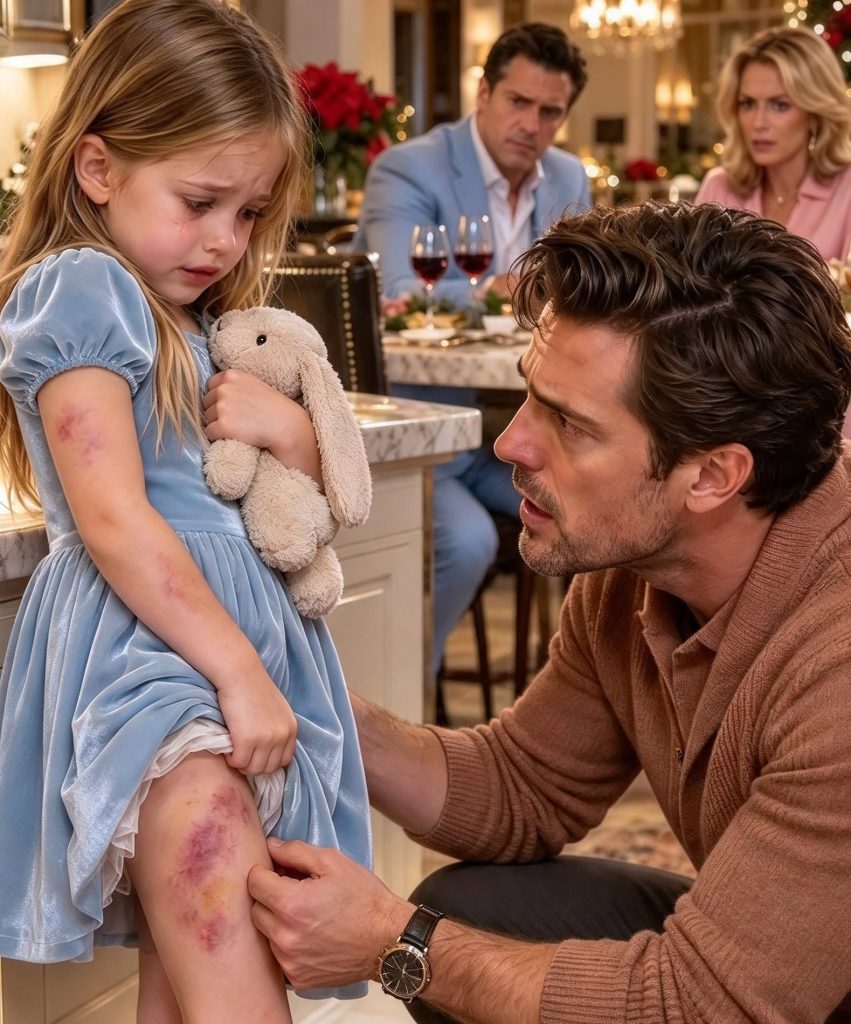 The enormous house.
The perfect decorations.
The polished dining table.
The adults laughing while a frightened little girl said her chair hurt.
I remembered how easy it would have been to believe them.
How easy it would have been to tell myself Chloe was simply having a difficult phase.
How easy it would have been to finish dinner, exchange gifts, and fly back to Chicago.
But I hadn’t.
I had listened.
I had taken her words seriously.
And I’d called for help.
I carefully folded Chloe’s wish and placed it back on the tree.
Then I walked into the living room.
She was sitting beneath a blanket, watching a Christmas movie with her rabbit tucked beside her.
“Uncle Andrew?”
“Yes, sweetheart?”
“Can you sit with me?”
I sat down.
She rested her head against my arm.
Outside, snow began falling over Chicago.
Inside, the apartment was warm.
And for the first time in a long time, Chloe fell asleep without asking whether someone would come into her room.
People sometimes ask whether I regret exposing what happened inside my brother’s home.
They remind me that Michael and I grew up together.
That we shared a father.
That he helped me through difficult years.
That our family will never be the same.
They’re right about that last part.
Our family will never be the same.
But I don’t regret calling for help.
I regret that Chloe had to hide a drawing beneath a chair because she believed nobody would listen.
I regret that adults dismissed her pain.
I regret that she learned to be afraid of telling the truth before she’d even started kindergarten.
And I regret that I didn’t recognize her fear sooner.
But I will never regret choosing her safety over my brother’s reputation.
Because a child’s protection must matter more than the appearance of a perfect family.
That night, Chloe didn’t ask me to solve a mystery.
She didn’t ask me to investigate a crime.
She didn’t even ask me to confront her parents.
She asked one simple question.
“Would you believe me?”
And when I said yes, I meant it.
THE END.