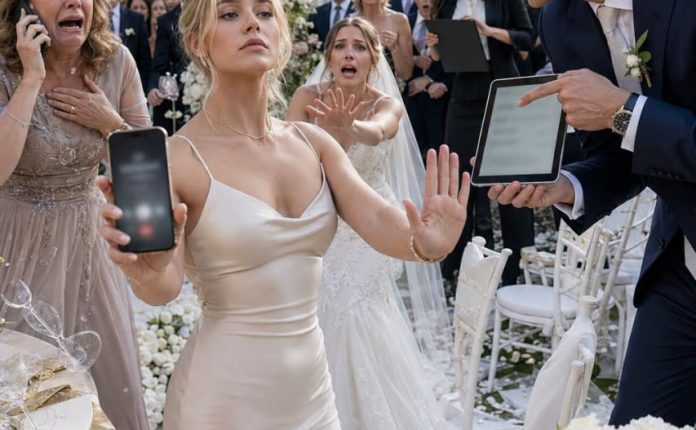
Madison posed beneath the White Pine Chateau sign while her photographer crouched on the gravel. Two assistants held reflectors in the wind. The white silk dress had a train long enough to brush the road. When she saw Nora and me approach, she straightened and waved a printed email. “I have permission to be here,” she called through the gate. Nora told her the old confirmation had been invalidated and that notice had been sent in writing.
Madison lowered the paper. “I only need half an hour,” she said. Her photographer stopped working and glanced between us. I told her the property was booked for my wedding and she needed to leave. She gripped the gate bars. She had already told her followers she was at the chateau, she said, and leaving without pictures would make things worse. I waited for her to hear what she was asking: she wanted me to lend her my wedding venue so she could continue pretending it had been hers.
She accused me of enjoying what had happened to her. Up close, she looked exhausted. I did not enjoy seeing her that way. “I wanted my wedding back,” I told her. “I gave Preston the documents because he deserved to know what he was being asked to celebrate. The choices after that were yours.” Madison looked toward the photographer, who had begun packing his camera. For a moment she seemed embarrassed that he had heard us. Then she said Mom had promised I would let her use the venue.
“Mom promised because I usually gave in,” I said. Madison did not deny it. She asked what she was supposed to do now that Preston was gone and the sponsors had left. I had spent years answering questions like that for her. I could see how frightened she was beneath her anger, but I could not plan another escape from consequences she had chosen. “I don’t know,” I said. Nora signaled security, and Madison left before the guards reached the gate.
We kept our wedding date. Nora’s team checked the guest list with us, the vendors reconfirmed their contracts, and I chose where the flowers would go without consulting my mother. Meanwhile, Northstar’s board removed Dad as chief executive and entered supervised restructuring. Investigators continued reviewing its public projects, including the bridge. The board appointed new leadership, and many employees kept their jobs. Dad had insisted that holding him accountable would destroy the company; what ended was his control of it.
My mother lost clients after the venue records came to light. She described the transfer as a private misunderstanding, but the emails and forged request made that explanation difficult to sustain. Madison’s sponsors withdrew, and Preston did not return to her. Bank investigators received the attempted withdrawal and the matching signature records. My attorney kept me informed where my own accounts were concerned. I stopped searching for daily updates about the rest. There was a wedding to prepare and a wildfire recovery still underway at work.
Mom called from an unfamiliar number and asked me to correct what people were saying. I told her I had made no public statement. She said my silence allowed everyone to assume the worst. “They have the documents,” I replied. She went quiet, then told me she had found the blue wedding notebook I had kept when I was twelve. I remembered drawing a mountain lake, wildflowers, and an arch I could never make symmetrical. Mom asked if I wanted it. I gave her my attorney’s mailing address.
The notebook arrived two weeks before the wedding. On its inside cover, Mom had written that I had always been the difficult daughter. I removed that page and kept the drawings. Their crooked lines made me remember how certain I had once been that a beautiful place would be enough for a happy wedding. I showed one sketch to our florist. She used its cedar arch and uneven clusters of flowers as a starting point, arranging them with far more skill than twelve-year-old me had possessed.
The night before the ceremony, Elias and I stood on the chateau terrace after the staff had finished setting tables. Light from the dining room fell across the stone. He asked whether I was comfortable marrying there after all that had happened. I looked at the lake, then at the arch our florist had made. “Yes,” I said. The place had been ours when we chose it, and it was ours again. We stayed until the air grew cold, talking about the guests arriving in the morning.
Before we went inside, Elias placed a brass key in my hand. It opened a cabin across the lake, he said, where we could spend quiet weekends when our schedules allowed. He had bought the surrounding land too, to protect the view. I stared at him until he smiled. My family had measured him by his sedan and his sweaters. Those things had been perfectly real; so was the company he had built. I asked why he had waited to tell me about the cabin. “I wanted to see whether you liked it first,” he said.
Sixty guests came to our wedding. They knew which ceremony they were attending. I recognized old friends, colleagues, and people who had helped us through difficult years without expecting a place in our decisions. As I walked toward Elias beneath the cedar arch, I saw Nora standing discreetly near the terrace doors. The flowers smelled fresh in the cool morning air. Elias reached for my hand, and we made our vows beside the lake where we had first planned to make them.
Six months later, snow lay along the cabin railings. I had been promoted to state crisis management director, and the towns affected by the wildfire had reopened. The crew we had searched for survived. Engineers replaced the weakened sections of the bridge before it carried public traffic again. Dad surrendered his professional licenses as part of a settlement and left infrastructure work. Northstar continued under new management. My parents sold their large house and moved apart. I learned most of this through public records and occasional news from relatives, without contacting them.
Dad sent a letter to the cabin. He wrote that mistakes had been made by everyone and that he was willing to forgive my part in Northstar’s collapse. He suggested Elias could offer consulting work, I could publicly clear up concerns about my office, and we could help Madison find her footing. I read it at the kitchen table. There was no admission that he had used my name in the application or signed the bridge certification. I gave the letter to my attorney for the file and wrote no reply.
Mom approached me once after a public emergency-preparedness conference. She had heard me speak and waited near the exit while attendees were leaving. She said she should have been proud of me. I had wanted to hear that for so long that it hurt to receive it there, from a woman who had tried to damage the same career. When she asked if we could start again, I told her no. I said it quietly. She asked for more time to explain, but I had the records of what she had done and did not need another account of it.
On our first anniversary, Elias and I ate dinner at White Pine Chateau. The lake had thawed, and sunlight moved between the cedar branches. Afterward he asked whether I missed my family. I thought about childhood dinners, the blue notebook, and all the years I had waited for my parents to celebrate something that mattered to me. “I miss what I hoped we might have been,” I said. He took my hand, and we stayed on the terrace until the last light had gone.
My mother had taken the venue because she believed I would yield it, pay the balance, and arrive at the next family gathering ready to help Madison again. She had known me well enough to expect that. What she had not counted on was my calling Nora, keeping the records, and saying no when it still felt frightening. Elias stood with me through it, but the choice was mine. When we left the chateau that evening, I carried my wedding notebook home with us.
The End
Read more original stories on Feel Every Story.
While I Directed a Wildfire Evacuation, My Mother Called to Tell Me She Had Given My Wedding Away
Part 4 of 4