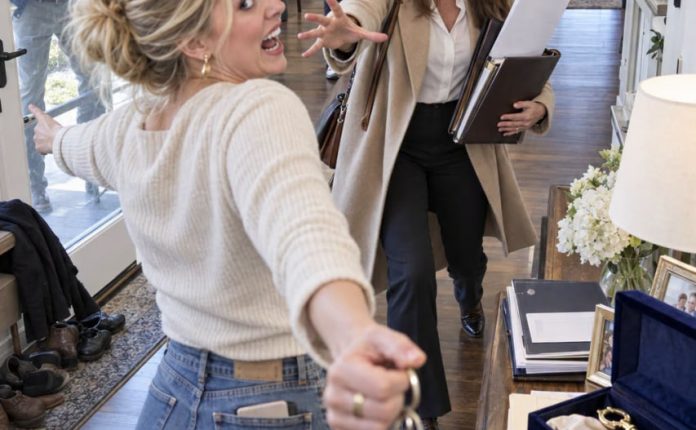
My daughter watched her birthday cake fall into the trash while my father filmed her face. His wife said only her own children deserved parties in that house. I took my daughter home without arguing. Weeks earlier, I had signed a document about the property. Neither of them knew what it meant.
PART 1 — The Birthday Party My Father Promised My Daughter
Lily chose yellow frosting because her mother used to make yellow birthday cakes. She was turning nine, and she wanted a small party at Grandpa Walter’s house: two school friends, her cousin Ava, and the adults who had known her since she was little. I checked with Dad twice before ordering the cake. Both times, he said we should come.
His second wife, Diane, was in the kitchen when I arrived with the cake box. She looked at the yellow balloons tied around my wrist, then at Lily’s friends following us through the door. “Walter said you were bringing dessert,” she told me. I said we were having Lily’s birthday gathering, as we had discussed. Diane stepped aside without answering.
I had brought paper plates, juice, and a bag of decorations so nobody would have to prepare the house for us. Dad came down the hall holding his phone. He gave Lily a quick hug and told her to put her presents beside the couch. For a moment, I thought Diane’s expression meant nothing. People get tired. Kitchens get crowded.
Diane’s children, Max and Ella, were at the dining table. Max was sixteen and wearing headphones; Ella, thirteen, waved to Lily. I liked them both. They had never been the reason visits felt difficult. The tension came from the way Diane counted every favor done for Lily, then described ordinary kindness toward her own children as something the household naturally owed them.
I set the cake on the counter and helped Lily’s friends hang a banner in the living room. Dad stayed by the doorway filming them. Since buying a new phone, he recorded every family gathering. Sometimes he sent the videos to me afterward. That afternoon, I was glad Lily would have a record of her friends laughing beneath the crooked banner.
The trouble began when Ella asked if she could have a slice of cake after we sang. Diane said the cake was not staying in her kitchen. I thought she meant she wanted it served outside, so I offered to move everything to the patio. She crossed the room, lifted the cake box, and carried it toward the trash can.
“Diane,” I said. Lily turned at the sound of my voice. Diane opened the lid of the can with her foot. “Only my kids get parties here,” she said, and tipped the cake in. The yellow frosting struck the liner first. One sugar flower caught on the rim, then fell after the rest.
Nobody spoke for a moment. I heard Dad’s phone recording and saw his shoulders shake. He was laughing. He pointed the camera at Lily, whose hands were still wrapped around a paper streamer. “Well,” he said, “that’s one way to settle the guest list.” His smile stayed in place when he looked at me.
I wanted to take the phone from him. Instead, I went to Lily. “We’re leaving,” I said quietly. I asked the children to collect their bags and thanked them for coming. Ava’s mother had dropped her off; I called to say I was taking everyone to my house. Ella stood beside the table, watching the trash can. Max took off his headphones.
Lily did not cry until we reached the car. She waited while I fastened her seat belt, then asked whether Grandpa thought it was funny because she had done something wrong. I told her she had done nothing wrong. From the porch, Dad called my name. I shut the car door and drove away before he reached the sidewalk.
At home, I called the other parents and explained that the party had moved. Nobody asked Lily to repeat what happened. One mother stopped at a bakery and brought a small cake with pink frosting. Lily’s friends played in the yard while I put fresh plates on the table. She smiled when they sang, though she kept glancing at the door.
After everyone left, we sat on the kitchen floor with the leftover balloons. Lily asked whether Diane disliked her. I said Diane had been unkind and that adults were responsible for their own behavior. Lily picked at the ribbon on a balloon. “Grandpa could have stopped her,” she said. I could not give her a comforting answer that was also true.
Dad called three times that evening. His first voicemail said Diane had overreacted and he would buy another cake. The second said I should not have taken the guests away so quickly. In the third, he sounded annoyed: “Lily will forget it if you let her.” I saved the messages and put my phone facedown.
My husband, Owen, came home from an out-of-town shift after Lily went to bed. I told him what happened. He sat through Dad’s first voicemail, then stopped the recording. He asked how Lily was. I said she had enjoyed the party at home, but wanted to know why her grandfather laughed. Owen went upstairs to sit with her.
While they talked, I opened the folder marked Maple Street in my desk drawer. Dad called the house his because he had lived there for twenty-six years. Three years earlier, when medical bills and overdue property taxes threatened a forced sale, he sold it to me. We signed the purchase documents together, and I paid the outstanding debts.
I had not bought the house to make a profit. Dad wanted to remain where he had lived with my mother, and I wanted him to have that stability. We agreed on a three-year lease at a rent he could manage. The deed was in my name. Dad knew it. Diane knew it too; she had signed the occupancy agreement when she moved in.
That agreement would expire in eleven weeks. For months, Dad had asked me to renew it for another three years. I had not answered because I was worried about the way Lily was treated there, and because Diane had begun making changes to the property without telling me. I had asked a real estate attorney to review my options before the birthday.
A week earlier, I signed the attorney’s engagement letter and authorized her to prepare a decision about the lease. I had not yet instructed her to send Dad anything. After Lily’s party, I pulled out her business card. I would not decide what happened to the house in a rush, but I could no longer pretend the family arrangements inside it were working.
END PART 1
PART 2 — The House Dad Called His Had a Different Name on the Deed
On Monday morning, I called my attorney, Priya Shah. She had handled the purchase three years earlier and knew why Dad remained in the house. I told her about the birthday, the lease’s approaching end, and my concerns about changes Diane had made. Priya asked me to bring the lease and every message concerning those changes.
Before the appointment, I took Lily to school. She wore the paper crown her friends had made at our kitchen table. At the gate, she slipped it into her backpack and asked if she had to visit Grandpa that weekend. I told her no. She gave me a quick hug and ran toward her classroom without asking what Dad would think.
At Priya’s office, I started with the lease rather than the cake. Dad and Diane were both named as occupants. It permitted their children to live there and required written approval for major alterations. Dad paid reduced rent, while I covered insurance and the remaining loan I had used to purchase the property.
Priya asked whether I could afford to continue that arrangement. I said I could, though it had become harder since Owen changed jobs. The question was no longer only about money. For three years, I had treated the house as a way to give Dad security. He had begun treating that security as proof he could decide who belonged there.
I showed Priya photographs from my last visit. Diane had turned my mother’s small sewing room into a home salon without asking me. Customers came through the side entrance, and shelves had been fixed to the wall. Dad had promised to send me details about insurance and permits but never did. I had been waiting for him to follow through.
Priya said we should inspect the alterations and establish how the space was being used. The lease would also need a clear decision before its end date. She explained the notice required if I chose not to renew and the time Dad and Diane would have to make other arrangements. I asked her to draft both a renewal proposal with conditions and a notice ending the lease.
“You don’t have to choose today,” she said. I knew that. I wanted both documents prepared because I needed to see the decision in concrete terms. If Dad could keep the home, acknowledge boundaries, and address the unauthorized business use, I was willing to consider it. If he could not, I needed to stop extending a promise that had become harmful.
Dad left another voicemail while I was there. He said Diane had been under stress and I knew how she got when the house was full. Then he asked if I could send him the next year’s lease soon. Priya heard the second half on speakerphone. She asked whether he had apologized directly to Lily. He had not.
That afternoon, Ella messaged me. She said she was sorry about the cake and had not known Diane planned to throw it away. I thanked her and told her she was not responsible. Ella replied that Diane had complained about Lily’s party the night before, saying the house would be too crowded. Dad had promised to speak with me, but apparently had not.
I did not ask Ella for more. She was thirteen and lived in that house; I would not turn her into a witness against her mother. Her message did tell me the cake had not been an impulsive objection to a surprise gathering. Diane had known about the party. Dad had known she objected. Neither warned me before Lily brought her friends inside.
Owen and I talked after dinner. He asked what I hoped would happen if Dad apologized. I said I wanted Lily to know he understood what he had done. Owen asked whether that would make the house arrangement right again. I looked at the lease folder on the table. I did not know. I had tied Dad’s housing to our family closeness for so long that separating them felt harsh.
Lily came in while we were clearing dishes and asked if she could watch the video Dad had taken. I asked why she wanted to see it. “I want to know if I looked silly,” she said. I told her she had not. Owen suggested she did not need to watch herself being hurt. Lily considered that and asked me to keep the video if Dad sent it.
I had not seen Dad’s recording. He had filmed the cake falling and Lily’s reaction, then laughed. I sent a short message requesting a copy. Dad answered that he had deleted it because I was making too much of the incident. I saved his reply. Later, he called and said he might still have the clip in his recently deleted folder.
He offered to restore it if I would let him explain first. I told him he could send it or not; I would not discuss Lily’s birthday as a misunderstanding. Dad said he had been startled and laughed without thinking. “Diane threw away her cake,” I answered. “You kept filming.” He said he would come by after dinner. I told him not to.
The next day, Priya’s property inspector visited Maple Street with written notice. Dad let him in. Diane refused access to the salon room at first, then opened it when Dad reminded her it was required under the lease. The inspector photographed shelves, additional sinks, and an electrical outlet installed where the old sewing cabinet had stood.
His report did not declare the room unsafe. It said an electrician should examine the work and that the business use needed review. Priya sent Dad a request for details, including any permits and insurance. Dad called me within minutes. He said I was humiliating Diane over a birthday cake. I said the inspection concerned changes to the property, not the cake.
“Everything in that house becomes a document with you,” he said. I reminded him that documents were why he had been able to stay when the taxes came due. I regretted the sharpness in my voice, but the fact was true. Dad went quiet. Then he said he would send Priya what she asked for.
That night, I opened the purchase file again. The sale had paid off the debts and left Dad with enough money for living expenses. He had chosen the arrangement because it kept him in the house and released him from a mortgage he could not manage. I had chosen it because I thought it gave us a way to care for each other without pretending money did not matter.
Lily noticed the family photographs spread across my desk. She picked up one of my mother teaching her to plant marigolds beside the porch. “Are the flowers still there?” she asked. I said Diane had replaced that bed with gravel when customers began using the side entrance. Lily frowned, then returned the photograph to me.
“Can flowers grow somewhere else?” she asked. I told her they could. She said she wanted to plant yellow ones at our house when spring came. I promised we would choose a place together. After she left, I put the photograph in a separate envelope. The house held memories, but Lily should not have to enter it to keep them.
END PART 2