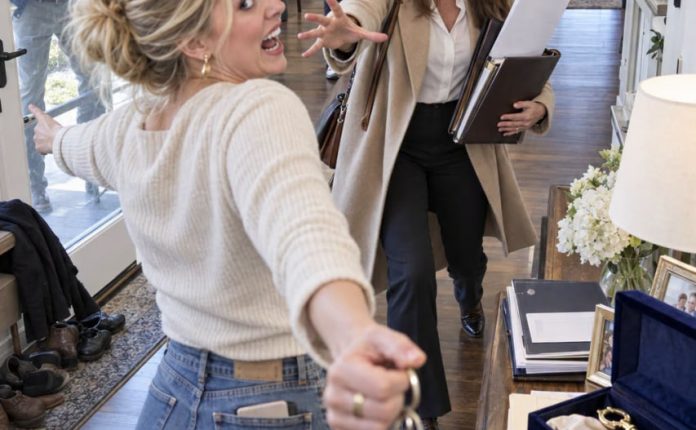
I came home after three years in Japan expecting dust, overgrown roses, and the creak of my old front door. A stranger answered instead. My brother said he had sold my house, and Mom called it shared property. I had the deed in my name. Someone else had the sale money.
PART 1 — A Stranger Answered My Door and Knew My Brother’s Name
The woman who opened my front door held a roll of painter’s tape. Behind her, a man carried a cardboard box toward the dining room. My blue hallway runner was gone. So was the brass bowl where I kept my keys. I checked the number beside the porch light, though I had checked it before knocking.
“Can I help you?” she asked. She looked to be about my age, with paint on one wrist and the exhausted expression of someone who had moved recently. A little girl called for her from inside. I glanced past the woman at the staircase I had painted with my father eight years earlier.
“I’m sorry,” I said. “I own this house.” The woman’s grip tightened on the tape. “We bought it,” she answered. She told me the closing had been the previous Friday. Her husband appeared behind her and introduced himself as Daniel Ruiz. His wife was Elena. Neither looked as if they had expected a dispute at their door.
I had come from Dallas Fort Worth Airport in a rental car, my luggage still in its trunk. Three years in Japan had left me wanting a shower and a quiet night at home. Instead, I stood on the porch of my six-hundred-thousand-dollar house while Elena asked whether I might have the wrong address.
I showed her my driver’s license. The address matched the one on their purchase papers, she said. Daniel stepped outside and pulled the door nearly closed behind him, leaving their daughter inside. He told me they had bought from a man named Marcus Bennett. My brother’s name was Marcus Bennett.
I called Marcus while Daniel watched. He answered on the second ring. “I’m at the house,” I said. There was a pause before he asked which house. I could hear traffic behind him. “Mine,” I said. “The one with strangers carrying boxes through the front door.” He let out a breath.
“I sold it last week,” Marcus said. “Why are you back so soon?” I had told my family I was returning in October. A project in Osaka ended early, and I had flown home in August without announcing the change. Marcus had expected two more months in which I would be twelve time zones away.
“You had no authority to sell it,” I said. He told me to lower my voice. I was standing on the porch, speaking as evenly as I could. Daniel could hear enough to know the call concerned his purchase. I asked Marcus where he was. He said he was busy and would call back.
I called our mother next. She answered cheerfully until I told her where I stood. “Marcus said you’d understand once you were settled,” she said. I asked what there was to understand. Her tone sharpened. “It was shared, Claire. Don’t make a big deal out of it in front of those people.”
The house had never been shared property. I bought it before I went to Japan, using money from my work as an engineer and a mortgage in my name. Mom and Marcus sometimes stayed there while I was abroad. I had given Marcus a key for repairs. I had not given either of them ownership.
I told Mom the deed carried only my name. “A house is more than paperwork,” she replied. She said Marcus had looked after it while I lived my life overseas. I looked at the fresh moving boxes visible through the front window and asked whether she had signed something. She did not answer.
Daniel suggested we step away from the door. His daughter had begun watching through the glass. I agreed. Elena joined us with a folder bearing the logo of a local title company. She showed me the first page of their closing statement. It identified Marcus as the seller under a power of attorney for me.
“I never signed a power of attorney,” I said. Elena looked at Daniel. He asked whether I could prove that immediately. It was a fair question from someone who had spent his savings on a house and met a stranger claiming to own it five minutes earlier. I told him I would obtain the recorded documents.
I had a copy of my original deed in cloud storage. I showed them the county recording stamp and my name as grantee. Daniel said the title company had given them a later deed transferring the property from me, through Marcus, to them. We stood beneath the porch light comparing two documents on our phones.
Their deed appeared to have been recorded that morning. I could not tell from the small image how the authority behind it had been established. Elena said she had asked why the seller lived overseas and did not attend closing. The agent told her Marcus held a valid power of attorney and the title company had verified it.
I asked them not to throw away any closing paperwork or messages from Marcus. Daniel said they would not, but they had nowhere else to go that night. Their furniture had been delivered, and their former lease had ended. I told him I would not try to force them out. I needed to find out what had happened first.
Marcus sent a text while we spoke: Stop frightening the buyers. We’ll discuss it tomorrow. I showed it to Daniel. His expression changed at the word “buyers.” Marcus had not asked how they were or expressed surprise that I had appeared. Daniel said he would call the title company before its office closed.
We tried together from the driveway. The main line went to voicemail. Elena found her closing agent’s direct number, and a woman named Tracy answered. Daniel explained that I stood beside him and denied signing the power of attorney. Tracy said she could not discuss the file without checking identities, but would notify her manager.
I gave Tracy my name and number. She asked for a copy of my identification through a secure channel she would send me, not by text. Her questions sounded careful. I was grateful for that, even while wondering what checks her office had made before allowing Marcus to close the sale.
The locksmith’s van turned into the driveway as we ended the call. Elena had arranged to change the locks after moving in. She looked at me, uncertain whether to send him away. I said I understood why she wanted new locks. My key no longer determined who lived there; we would have to address that through counsel.
I took my suitcase from the rental car and drove to a hotel near the county offices. At a stoplight, I saw Marcus’s text again. We’ll discuss it tomorrow. I had heard that promise from him since childhood, usually after he broke something and wanted our mother to help him explain it.
In my hotel room, I downloaded the county’s public property records. The new deed was there, filed that morning. It named Daniel and Elena as buyers and Marcus as my attorney-in-fact. The attached power of attorney carried a signature that resembled mine at a glance. Its date fell in June, when I was in Kyoto.
I enlarged the signature. The first letter had the long upward stroke I used. The final letter ended in a tidy curve I did not. I could not settle a property dispute by examining a screen, but I knew I had not signed the page. Beside the signature was a Texas notary’s seal.
The notary’s name was Rochelle Price. The document said I had personally appeared before her in Fort Worth on June eighteenth. I opened my travel calendar. On that date, I had presented at a manufacturing conference in Kyoto. My employer’s photographs showed me at a podium, but photographs alone would not tell the entire legal story.
I downloaded the conference itinerary and emailed it to myself along with the recorded deed. Then I called my bank to check whether the mortgage had been paid. The automated system showed a large payment posted on the closing date and a zero balance. Someone had used the sale proceeds to clear my loan.
It should have been reassuring to see a debt paid. Instead, the payment showed how far the transaction had progressed while I knew nothing about it. I had made monthly mortgage payments throughout my assignment. Marcus knew that. I searched my email for any lender notice and found one from weeks earlier in a filtered folder.
The message said a payoff statement had been requested by a settlement company. I had assumed it was spam because I had not requested one. I saved it now and called the lender’s fraud department. The representative took my report and said an investigator would contact me. She could not reverse a paid mortgage over the phone.
By then it was past nine in Texas and morning in Japan. I called my manager in Osaka, explained that I needed travel and work records, and asked her to preserve them. She said the company could confirm when I attended the Kyoto conference and when I left Japan. I thanked her without telling her the whole family story.
Mom left me a voicemail. She said Marcus had “handled the hard parts” for three years while I lived comfortably abroad. She asked me to remember that the house was where our family gathered before I bought it. That was true of a different house, the one Dad had rented when we were children. Mine stood on land I had chosen myself.
I slept badly. At seven the next morning, I called a real estate litigation attorney recommended by a colleague. Her name was Priya Shah. She asked me to bring every document I had and not to confront the notary or title company on my own. She also asked whether the buyers knew about the dispute. I told her they did.
Priya saw me at ten. She read the recorded power of attorney, checked the county index, and asked about my access to the house. I explained that Marcus had a key and permission to coordinate repairs, but nothing more. She had me describe exactly what I said to the Ruizes, then asked for their closing agent’s information.
“Their purchase may be innocent,” she said. “That doesn’t make the power of attorney genuine.” She explained that several questions would have to be handled separately: whether Marcus had authority, whether the deed could stand, where the proceeds went, and what happened to a family already living in the property.
Priya did not promise I would have my house back by Friday. I appreciated her honesty. She prepared notices to preserve the closing file and the notary’s records. She also began the steps to place the property dispute in the public record so it could not quietly be sold again while we investigated.
Before I left, Tracy from the title company called. She had verified my identification and could share the documents used to support Marcus’s authority through Priya. She said the closing file contained more than the recorded power of attorney. There was a video identification session with the person who claimed to be me.
I put Tracy on speakerphone. Priya asked when the video had been recorded. Tracy gave us a date in July and said the session lasted nearly nine minutes. I had been in Japan then, but that alone did not answer who appeared on camera. Tracy would send the file to counsel after completing the required review.
When the call ended, Priya wrote the date on her legal pad. I thought about my mother’s unwillingness to answer whether she had signed anything. Somewhere between a forged document and a completed sale, a person had looked into a camera and told a title company she was me.
END PART 1
PART 2 — The Closing File Contained a Face I Had Never Seen
Tracy sent the video link that afternoon. Priya opened it on a secure laptop while I sat across from her desk. The recording began with a woman adjusting a webcam in a softly lit room. She wore glasses and had dark hair cut near her shoulders. Her face was unfamiliar. She gave my name without hesitation.
The title company representative asked her to hold up an identification card. The image blurred whenever she moved it, but the name and birth date matched mine. The photograph appeared to be of the woman on camera. Priya paused the video. I checked the spelling of my middle name. Even that was correct.
The woman answered questions about the house: its address, purchase year, and mortgage lender. Marcus knew those details. So did Mom. The representative asked why she was appointing Marcus rather than attending closing herself. “I’m still working in Japan,” the woman said, “and I trust my brother to manage this.”
I could hear the room’s air conditioner behind her voice. She sounded American, roughly my age, with no attempt to imitate my speech. The title company was verifying a stranger against information and identification prepared for her. I watched the rest of the recording, taking notes whenever she supplied a detail that could reveal who had coached her.
At the end, the representative asked whether she understood that Marcus could sign documents transferring the property. The woman said yes. She smiled briefly, thanked him, and ended the call. I had never seen her before. I asked Priya whether a buyer could have known the video was false. She said we needed the complete file to assess what each party saw.
Tracy’s secure delivery included the identification image used during the call. It showed a Texas driver’s license with my information and the stranger’s photograph. My real license was in my wallet. Priya asked me to place it beside the screen while she noted the differences in format and issue date.
The false card listed an issue date from the year after I moved to Japan. I had never requested a replacement. Priya told me to report it to the state agency that issued licenses and to preserve the confirmation. She would determine whether other documents had been created in my name. Each step widened what I needed to check.
We examined the power of attorney again. Its notarial certificate said I appeared in person before Rochelle Price in June. The July video could not establish what happened in June. Priya requested Rochelle’s journal entry and the documents presented to her. She also asked the title company who supplied the power of attorney.
The answer came from its intake record: Marcus. He submitted a scanned copy with an email saying his sister had completed it during a brief visit home. I had not entered the United States that June. My passport history, work records, and conference itinerary could help establish that. Priya asked me to obtain official travel records if possible.
Marcus called while I was still at her office. Priya suggested I let it go to voicemail. His message was brief. “You’re turning this into something it doesn’t have to be. Mom wants us all at her place tonight. Come hear me out before you start making accusations.” He sounded annoyed rather than frightened.
I played it for Priya. She told me I could meet him if I wanted, but I should not make agreements about the property without counsel. I was not ready to sit at Mom’s table. I sent Marcus a text asking him to communicate with Priya about the sale. He replied that hiring a lawyer proved I cared more about money than family.
I drove to Mom’s neighborhood anyway, though I did not stop at her house. I parked near the public library where I studied during high school and tried to understand what Marcus believed he had done. He had sold a house I owned to people who planned to raise their daughter there. Blaming me for asking questions could not change that.
Daniel Ruiz called while I sat in the car. He and Elena had spoken to their own attorney. They wanted to know whether I intended to enter the house. I told him I would not. Priya had advised me that our positions would be handled through counsel. Daniel said he appreciated hearing that directly.
He sounded tired. Their daughter, Lucy, had chosen her new bedroom and wanted to know whether they were moving again. I could not give him reassurance I did not have. I said I was sorry she was caught in this. Daniel replied that he was sorry I had come home to strangers at my door.
Before hanging up, he mentioned one thing from closing. Marcus had insisted the house be transferred promptly because I planned to return from Japan in the fall. The agent presented it as a reason to finish while everyone was available. Daniel now wondered why my return had been treated as a deadline rather than a reason to wait for me.
I told Priya. She asked Daniel’s attorney for any messages that described the timing. We would not rely on a memory if a written record existed. I went to my hotel, uploaded my passport scans through Priya’s secure portal, and called my employer’s travel department. They could confirm my assignment and business travel during June and July.
Mom appeared in the hotel lobby that evening. She stood near the elevators in a cream cardigan, holding a paper bag from a restaurant I liked. I had not told her which hotel I chose. When I asked how she found me, she said Marcus had called around. She offered the bag. I told her I had already eaten.
“We need to talk,” she said. I agreed to sit in the lobby, where other guests passed within sight. Mom placed the bag between us and said Marcus had been under pressure. He had kept the lawn maintained and paid for repairs while I was away. I said I had reimbursed the invoices he sent.
“He did more than you saw,” she replied. I asked why that entitled him to sell the house. Mom watched a family cross the lobby before answering. She said she thought I intended to let Marcus have a share eventually. Years earlier, when he lost his job, I had said I would help him get back on his feet.
“I helped with bills,” I said. “I didn’t promise him my house.” Mom’s expression hardened. She asked whether I knew how embarrassed Marcus felt asking for help. I remembered several loans that became gifts because he could not repay them. I had never discussed them as a claim on the property.
I asked if she knew a stranger had pretended to be me on a title company call. Her eyes moved to the elevator. “Marcus said the paperwork was handled,” she answered. I asked again, more directly. She said she had not been on a call and had not watched anyone else make it.
That was not a denial that she knew. I told her the recorded deed depended on a power of attorney I had never signed. Mom folded the top of the paper bag. “I knew he was selling it,” she said. “I thought you’d already agreed to help him.” I asked why she told me it was shared when I arrived.
“Because you always make him sound like a thief,” she said. I had not called Marcus one in front of her. She heard the word in the facts I was describing. I stood and said I would speak further when she was prepared to tell me what she knew about the documents. She left the food on the chair.
Priya received Rochelle Price’s initial response the next morning. Rochelle confirmed her notarial seal appeared on the power of attorney but said she needed to inspect her journal before discussing the entry. She worked from a small office in Arlington. Priya arranged a formal request and told me not to visit her unannounced.
The title company supplied its remaining closing documents. Marcus had signed the deed, seller disclosures, and settlement statement as my attorney-in-fact. One disclosure claimed there had been no recent water intrusion. I knew of a leak near the back window that a contractor repaired before I left. I had given Marcus the repair records.
I told Priya. If the leak was fully repaired, the disclosure might still be accurate, but I wanted Elena and Daniel to have the records. Priya sent them through their attorney. I did not want the buyers discovering another surprise after they had unpacked. The house’s history should not be hidden because Marcus mishandled its sale.
The sale price was six hundred and twelve thousand dollars. After fees and the mortgage payoff, the seller’s proceeds totaled a little over two hundred and thirty thousand. The settlement statement listed a wire to an account titled Bennett Property Services. I had never opened a business by that name.
A public business search showed Marcus had formed Bennett Property Services the previous spring. Mom appeared as a registered contact. That did not establish she received any money, but it contradicted her claim that she had merely believed Marcus’s assurances. She had been involved with the entity receiving the proceeds.
I sent the registration to Priya. She said tracing the funds would require records from the closing company and receiving bank, sought through proper channels. I wanted to drive to Marcus’s apartment and demand the account statements. Priya reminded me that documents mattered more than an argument he could later describe differently.
My employer sent a letter confirming I was working in Japan on June eighteenth and July ninth. Flight records showed no trip to Texas during either period. I forwarded them to Priya, along with conference photographs from Kyoto. She said the records strongly supported my account, while the false identification and notary entry still needed investigation.
That afternoon Rochelle called Priya back. Her journal contained an entry for my supposed appearance. It recorded a driver’s license number and a signature. Rochelle said she had checked the license and remembered a woman attending with a man she understood to be her brother. Priya asked whether Rochelle would provide a copy of the entry.
Rochelle agreed to do so through counsel. She sounded troubled, Priya told me, but insisted she had followed her usual process. I asked if the woman in the title company video was the same person who visited her. Rochelle had not seen the video yet. Priya arranged for her to review it with the appropriate investigator.
As I left the office, I received a text from Marcus: Mom didn’t know how the documents were made. Leave her out of it. I read it twice. I had not accused Mom in any message to him. Marcus seemed to know exactly which question I was asking and was already trying to decide whose answer I would hear.
END PART 2