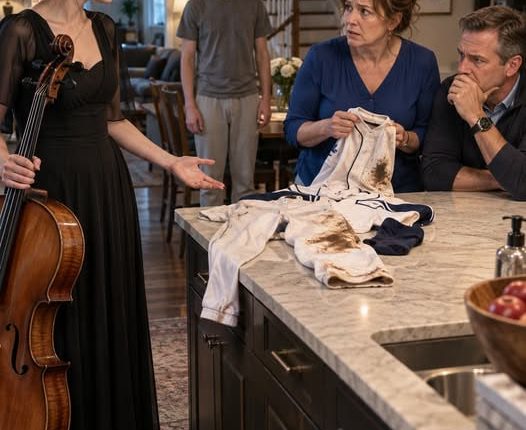
PART 4 — BY NINE O’CLOCK, THE HOUSE WAS UNDER MY CONTROL AGAIN
Nobody touched the quitclaim deed for several seconds. It had never been signed or notarized, which mattered legally, but its existence changed the emotional temperature instantly. My name appeared as grantor. A limited liability company controlled by Colin appeared as grantee. The property description matched Mom’s house exactly.
Colin said it was a template. Megan stared at him. “A template for what?” He claimed a broker had sent several documents while they explored financing options. I turned to the final page. His company name was typed beneath “prepared for recording.” This was not something accidentally mixed into a generic packet.
Mom gripped the back of a dining chair. “Were you trying to take the house?” Colin looked horrified by the accusation. “No. I was trying to create options.” Megan said, “Answer her.” He repeated that nothing had been signed. Again, his defense relied entirely on failure.
I photographed every page and called David. He asked me to scan the document and not argue about intent. “You have enough,” he said. “Preserve the facts.” The lender’s fraud department would receive it. So would Mom’s attorney if it related to financial exploitation.
Colin paced the kitchen. “This is insane. I never filed that.” I said, “Then the record will show that.” He looked at me with genuine hatred. “You come back after six years and suddenly act like some protector.” The accusation still hurt, but it no longer controlled me.
“You are right about one thing,” I said. “I should have come sooner. That does not make anything in this box acceptable.” Mom stood beside me. “And Rachel being far away does not mean you were allowed to decide what belonged to me.”
Colin turned toward her. “Linda, I kept this place running.” Mom laughed softly, almost sadly. “Rachel paid the taxes, insurance, repairs, lawn service, security, and association. My pension paid groceries and utilities. What exactly did you keep running besides your own bills?”
Megan looked down. Colin’s shoulders fell. He finally seemed to understand that the version of himself he had presented as provider could now be measured against actual records. Numbers are unkind to stories built from repetition.
The moving truck remained outside while we inventoried the file box. There were no additional signed deeds, but we found drafts of property-management agreements, loan applications, and correspondence with two brokers. One email described Colin as “family representative for owner currently residing abroad.”
Another broker had asked for direct contact with me. Colin responded that I had delegated communication because of international travel. That statement was false. He never attempted to contact me. The broker eventually declined to proceed because ownership documents did not match the proposed borrower.
Megan read the emails over my shoulder. “You told me Rachel didn’t answer them.” Colin said he had assumed contacting me would create unnecessary complications. Megan stared at him. “Because she would say no.” He didn’t answer.
The fight that followed belonged to their marriage. Megan accused him of using her relationship with Mom to keep the household afloat. Colin accused her of enjoying the lifestyle and pretending ignorance. Both statements contained enough truth to make the argument ugly.
I stopped them before the children came downstairs. “Take this somewhere else.” Megan wiped her face. Colin grabbed his jacket and walked outside. He did not take the file box. That was the first sensible decision he had made since I arrived.
Megan sat at the table after he left. “I knew about the association signature,” she said. “I knew about the first loan application. I didn’t know about the quitclaim document or those other brokers.” I believed that distinction might matter legally, but emotionally it changed less than she hoped.
“Why did you copy my signature?” I asked. She looked toward Mom. “Because I thought you’d say no.” I nodded slowly. “So you already knew the answer.” Tears filled her eyes. “I told myself you wouldn’t care because you were rich and living overseas.”
“I’m not rich enough for fraud to become harmless.” She flinched. “I know.” I asked why she never simply called. Megan gave the most honest answer she had offered all week. “Because I knew you would ask Mom what she wanted.”
Mom looked at her. The sentence broke something open between them. Megan covered her face and started sobbing. “I’m sorry.” Mom did not immediately comfort her. That was new. She let the apology remain in the room without rushing to rescue the person giving it.
After a long silence, Mom said, “I believe you’re sorry.” Megan looked up hopefully. Mom continued, “But I need you to understand that being sorry does not mean I’m ready to trust you with my money or my home again.” Megan nodded and cried harder.
I watched my mother create a boundary without cruelty. It was stronger than anything I had done with locks, forms, or lawyers. She was not punishing Megan. She was separating love from access, which might have been the lesson all three of us had needed for years.
The moving process resumed. Colin returned after an hour, calmer and accompanied by a friend with another vehicle. He avoided me. By seven, most of their furniture was gone. The downstairs suite looked like Mom’s again, while the upstairs bedrooms slowly emptied of boxes and business equipment.
Ava hugged Mom repeatedly. Luke carried his gaming console to the car and then came back because he forgot to say goodbye to me. “Are we banned?” he asked quietly. My chest hurt. “No. You’re kids. None of this is your fault. Visits just happen when Grandma invites you.”
He nodded. “Dad said you hate us.” I closed my eyes for a moment. “I do not hate you. I love you.” Luke looked relieved. “Okay.” Then he walked away before I could decide whether to cry.
I told Megan what he had said. Her face tightened. She called Colin over immediately. “Did you tell the kids Rachel hates them?” Colin said he had been angry. Megan whispered, “They are children.” He looked ashamed, but I was finished evaluating his feelings.
By eight, the moving truck left with the largest furniture. Megan and the children followed in her SUV toward the short-term rental. Colin remained to collect final business files. David had already instructed him in writing not to remove documents connected to Mom or the property.
He signed a simple inventory acknowledging the preserved records. Then he handed me his temporary house key. “Happy?” he asked. I looked at the key. “No.” That seemed to surprise him. “I’m relieved Mom has control again. Those are not the same thing.”
Colin stood in the doorway. “You think you won.” I shook my head. “There was never supposed to be a competition.” He gave a bitter laugh. “Easy for you to say. You made more money than all of us and still kept the house in your name.”
I finally understood the resentment beneath his behavior. “You thought because I had more, taking from me counted less.” He didn’t deny it. “I thought family helped each other.” I replied, “Help offered freely is family. Help taken through someone else’s signature is something different.”
At eight-twenty, Colin drove away. Mom watched from the living-room window until his taillights disappeared. Then she locked the door herself. Her hand trembled slightly while turning the new deadbolt, but she smiled afterward.
The children still had belongings in the upstairs closets, so we agreed Megan could collect them by appointment. No one would enter without Mom’s knowledge. The rule sounded ordinary. That was precisely why its absence had been so damaging.
At eight-thirty, I called the association manager and confirmed every update. Mom was primary resident. I was sole owner. No third party could modify the account without verification through my new domestic number and email. The forged authorization was permanently flagged.
At eight-forty, the security company confirmed all old codes had been deleted. Mom tested hers twice. The panel chirped green. “I feel like I’m breaking into my own house,” she joked. I answered, “You’re doing the opposite.”
At eight-fifty, we reset the smart garage system. Colin’s phone disappeared from authorized devices. Megan’s did too. Mom added June because she wanted one local friend to have emergency access. I liked that decision because it belonged entirely to her.
At eight-fifty-five, the bank sent confirmation that all third-party access had been revoked. Mom’s card, accounts, and alerts belonged to her again. Her new financial adviser would review recurring payments the next morning and cancel anything she did not recognize.
At eight-fifty-eight, I changed the last property-management password. It controlled the water-leak sensors, thermostat, and maintenance portal. Colin had been administrator. His profile vanished after one click. I checked the clock because the precision suddenly felt symbolic.
At exactly nine o’clock, every lock, emergency contact, property account, financial login, alarm code, and administrative line of access we had identified was back under Mom’s or my control. The house itself looked almost the same, but authority inside it had changed completely.
Mom stood in the kitchen wearing slippers and Dad’s old baseball cap. “What happens now?” she asked. I expected myself to say we celebrate. Instead, I looked at the dining table covered with evidence. “Now we figure out what happened without letting anger decide what happens next.”
The next two weeks were less dramatic and more difficult. Legal problems do not resolve themselves simply because someone leaves a driveway. Mom’s elder-law attorney reviewed eighteen months of transfers. David coordinated property documents. The lender opened a formal fraud investigation regarding the unauthorized application.
No money had been obtained against the house, which limited the financial damage. The more serious issue involved Mom’s accounts. Her attorney identified approximately thirty-four thousand dollars in questionable transfers and charges beyond ordinary shared household expenses.
Some were clearly authorized. Mom had willingly paid certain groceries, school supplies, and utilities. Others had no reasonable connection to her needs. Rather than guessing, the attorney categorized everything and requested explanations from Megan and Colin through counsel.
Colin hired an attorney almost immediately. Megan initially shared representation with him, then retained separate counsel after learning several transfers to his business had not been disclosed to her. Their marriage became strained, but I refused to let their relationship become the center of Mom’s recovery.
The rejected home-equity application produced another discovery. Colin had submitted estimated property values and renovation costs claiming he had personally invested more than seventy thousand dollars into improvements. My records showed I paid every major renovation invoice.
His attorney later described the numbers as preliminary estimates rather than fraudulent reimbursement claims. I didn’t argue. The lender had the documents. People whose job was to interpret them could do so without my emotion contaminating the process.
Mom’s attorney recommended mediation over the questionable financial transfers if possible. Mom wanted repayment but did not want a long family lawsuit unless necessary. “I want accountability,” she told me, “not a courtroom audience.” I respected that.
Megan came alone for the first mediation meeting. Colin attended separately with counsel. I was not a party to Mom’s financial dispute, though my property documents were involved. For once, I sat outside the conference room instead of directing the process.
Mom emerged after three hours looking tired but calm. Megan followed with red eyes. They had agreed in principle to repayment of funds Megan acknowledged benefiting from. Colin disputed several categories but agreed to produce business records.
“Was it awful?” I asked Mom in the parking lot. She considered the question. “Yes.” Then she smiled faintly. “But nobody spoke for me.” That mattered more to her than the settlement amount.
The lender eventually confirmed no lien had ever attached to my property. The unsigned quitclaim deed had never been recorded. My title remained clean. David recommended a title-monitoring service and additional verification restrictions, which I happily installed.
The association formally removed the false authorization from its file but preserved it as evidence. The manager apologized for accepting the signature without direct owner verification. They changed their policy for absentee owners after my complaint.
Mom’s accounts stabilized within a month. Recurring transfers stopped. For the first time in years, she knew exactly what arrived and left. She bought herself an expensive pair of walking shoes without asking anyone whether it was necessary.
She showed me the receipt like a teenager confessing a secret. “One hundred forty-eight dollars.” I smiled. “Scandalous.” Mom laughed so hard she had to sit down. The shoes became strangely important because they represented money spent solely because she wanted something.
Megan visited twice during that month, always after asking. The first visit lasted twenty minutes and felt painfully formal. The second lasted an hour. She brought no paperwork, no requests, and no children as emotional buffers.
Mom did not give her a key.
That was perhaps the clearest sign that things had changed. Before, Mom measured love by how much access she offered. Now she could hug Megan goodbye, tell her she loved her, and still watch her walk to the car without offering unrestricted entry.
Colin did not visit. Communications went through attorneys except for messages regarding the children. I preferred it that way. Mom seemed relieved too, though she occasionally asked whether he was okay. Compassion survived even after trust didn’t.
One afternoon, Ava came over after school with Megan’s permission. She and Mom baked cookies. I worked at the dining table while listening to them laugh. Nothing about the visit felt tense because everyone knew why she was there and when she was leaving.
That evening, Ava asked me whether I planned to sell the house. I said no decision had been made. She looked toward Mom. “Grandma likes it here.” Mom surprised both of us. “I’m learning to like it again.”
After Ava left, Mom stood on the patio where I had first seen her scrubbing stone. The bucket was gone. Rain had washed the surface clean. She looked toward the garden and said, “I want to stay.”
I nodded. “Then you stay.” Mom looked at me. “But I want something in writing this time.” I smiled because the request sounded exactly like the new woman emerging from the old one. “What kind of writing?”
“I want to know nobody can ever tell me I’m a guest here again,” she said. I understood immediately. The deed could remain mine for financial protection, but her right to live there needed to feel stronger than a family promise.
David and Elena designed a recorded life-estate arrangement giving Mom the exclusive right to occupy the property for the rest of her life, while preserving my remainder ownership. No sibling, spouse, or future relative could remove her or borrow against the house.
Mom read every page herself.
She asked questions.
She changed two clauses.
Then she signed.
When the recorded document arrived, she held it against her chest and whispered, “Now it really is my home.” I realized the six hundred thousand dollars had never been the true gift. Security was.
Two days later, Colin’s attorney sent a proposed settlement regarding the remaining disputed transfers. The number was substantial but manageable over time. Mom read it carefully, then asked one question.
“Does accepting this mean nobody has to admit what they did?”
Elena explained that civil settlements often resolve money without assigning criminal labels. Separate authorities could still make their own decisions about the lender documents. Mom looked at me, but I refused to answer for her.
She smiled slightly. “Good. You’re learning too.”
She signed the mediation agreement.
Megan would repay her share directly. Colin’s business would reimburse additional amounts over three years. Mom retained the right to pursue enforcement if payments stopped. The agreement also acknowledged that neither of them had any ownership interest in the house.
I thought that would be the final major consequence.
I was wrong.
Three months after my surprise return, the lender’s investigator called David. Their review had uncovered something unrelated to Mom’s property but connected to the same signature files Colin kept in his business records.
Another authorization bearing someone else’s name appeared in a separate business loan application.
This time, the signature belonged to Megan.
And she said she had never signed it.
END PART 4