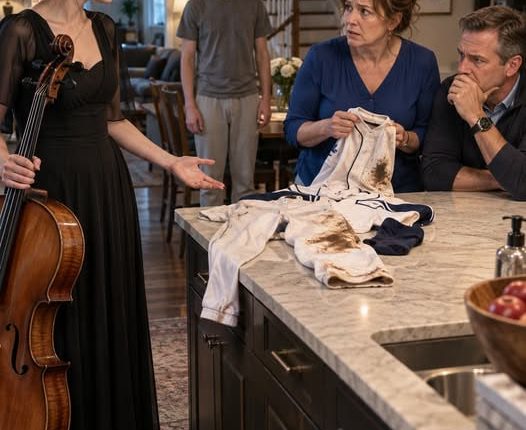
After six years overseas, I expected tears when I surprised my mother. Instead, my brother-in-law opened the door of the house I had bought for her and said, “The maid is out back.” Then I saw Mom scrubbing patio stones, and everything I believed about my family collapsed in seconds.
PART 1 — THE HOUSE I BOUGHT FOR MOM NO LONGER FELT LIKE HERS
I had imagined my homecoming hundreds of times during six years working overseas, but none of those versions included my brother-in-law standing barefoot inside my mother’s front doorway. Colin stared at me as if I were a delivery driver who had arrived early, then glanced behind him before asking, “Rachel? What are you doing here?”
I smiled because I still thought surprise explained his expression. “I came home two days early. Mom doesn’t know.” I lifted the small bakery box in my hand and looked past him. “Where is she?” Colin scratched his jaw, completely relaxed, and said words I would replay for years afterward. “The maid is out back.”
For several seconds, I thought he was joking. My mother, Linda Bennett, had never employed a maid in her life. She had spent thirty-one years teaching fourth grade and still rinsed disposable plastic containers because throwing away something reusable offended her. I laughed uncertainly and asked, “What maid? I’m asking where Mom is.”
Colin’s expression changed, but only slightly. “Oh. Linda.” He gestured toward the back of the house. “She’s probably cleaning the patio. Megan had people over last night.” I stopped smiling. He had said my mother’s name like she was an inconvenient relative staying temporarily in a house that somehow belonged to him.
I walked past him without waiting for permission. The living room looked familiar and wrong at the same time. My mother’s blue sofa had disappeared. A huge leather sectional faced a television mounted over the fireplace, children’s toys covered the rug, and framed photographs of my sister Megan’s family occupied every surface where Mom’s pictures once stood.
“Rachel, hold on,” Colin called behind me. I kept walking through the kitchen, noticing dirty dishes stacked beside the sink and wineglasses scattered across the island. The French doors stood open. Beyond them, under bright North Carolina sunshine, my sixty-eight-year-old mother was kneeling beside the patio with a bucket, scrubbing dried food from the stone.
She wore faded gardening pants, rubber gloves, and one of my father’s old baseball caps. Her shoulders looked smaller than I remembered. For a moment, I couldn’t move. Six years of missed birthdays, video calls, delayed flights, and promises that I would visit soon seemed to collapse into the distance between that doorway and her bent back.
“Mom?” I said. She turned so quickly that water sloshed over the bucket. Her mouth opened, but no sound came out. Then she pushed herself upright, pulled off the gloves, and crossed the patio toward me. “Rachel?” Her voice broke on my name before she wrapped both arms around me.
I held her harder than I meant to. She smelled like lemon cleaner, sunscreen, and the lavender soap she had used since I was a child. “Surprise,” I whispered, although nothing about the moment felt joyful anymore. Mom pulled back and touched my face. “You said Thursday.” I swallowed. “I wanted to surprise you.”
Behind us, Colin stepped onto the patio. “I told her you were out here.” Mom’s face changed immediately. The warmth disappeared behind a careful expression I recognized from childhood, the one she used whenever she wanted my sister and me to stop arguing in public. “Colin didn’t know you were coming,” she said quickly.
I looked at the bucket. “Why are you scrubbing the patio?” Mom glanced down. “There was a dinner last night.” Colin answered for her. “Megan hosted some clients. Linda likes keeping busy.” I turned toward him. “She’s not Linda to you. She’s your mother-in-law.” His eyebrows rose as if my correction amused him.
Mom touched my arm. “Rachel, please. You just got here.” Her quiet urgency told me more than Colin’s words did. She wasn’t asking me to relax because nothing was wrong. She was asking because she already knew exactly what would happen if I challenged him before Megan came home.
Six years earlier, I had accepted a technology-management position in Singapore that was supposed to last eighteen months. The contract kept expanding, the salary became difficult to walk away from, and eventually I was overseeing hospital systems across Southeast Asia. I told myself every promotion justified one more year away because I was building security for both Mom and me.
Dad had died shortly before I left. Mom stayed in the modest house where Megan and I grew up, but the place was deteriorating faster than she could maintain it. During my second year abroad, a pipe burst inside the wall. Six months later, the roof required replacement. When mold appeared downstairs, I made a decision.
I found a four-bedroom house in Cedar Glen, twenty minutes from Megan, with a small garden, a downstairs primary bedroom, and wide hallways Mom could comfortably use as she aged. The price was just over six hundred thousand dollars. I paid cash from savings and an overseas performance bonus, then told Mom it was hers to enjoy permanently.
She cried when I handed her the keys. She wanted the deed placed in her name, but my financial adviser recommended I keep legal ownership while granting her permanent use. Mom agreed because she trusted me completely. I paid taxes, insurance, major repairs, and association fees. She covered groceries and ordinary utilities from her pension.
For the first two years, the arrangement worked exactly as intended. Mom planted hydrangeas beneath the front windows, turned one bedroom into a sewing room, and sent me photographs whenever she changed something. She hosted book club, watched my niece and nephew after school, and told everyone she finally understood why Dad had always wanted a garden.
Megan lived fifteen minutes away with Colin and their children, Ava and Luke. I was grateful Mom had family nearby. Megan sent pictures of Sunday dinners and birthday cakes, and whenever I asked whether Mom needed anything, she insisted my sister checked on her constantly. I believed that meant Mom was protected while I was gone.
Standing on that patio, I realized I had confused proximity with care. I looked toward the French doors. “Where’s your sewing room now?” Mom rubbed her palms together. “Things changed a little.” Colin gave a short laugh. “A lot changed. We needed the space.” I turned toward him. “We?”
Before he could answer, a car pulled into the driveway. Mom closed her eyes briefly. “That’s Megan.” The garage door rose, and a minute later my sister entered the kitchen carrying two shopping bags and talking loudly into her phone. She stopped mid-sentence when she saw me standing beside the island.
Her reaction lasted only a second before she smiled too broadly. “Rachel! What are you doing here?” She ended the call and hugged me. I hugged her back automatically, but my attention remained on Mom, who had returned to the patio long enough to pick up the cleaning bucket. “I came to surprise Mom,” I said.
Megan glanced toward the patio. “Well, you definitely surprised everyone.” She set her bags down and looked at Colin. Something passed between them. It was quick, but unmistakable. “You should have told us,” she added. I frowned. “Why? This is Mom’s house.” Megan’s smile tightened. “Of course. I just meant we would have prepared.”
“Prepared what?” I asked. Nobody answered immediately. Ava came downstairs wearing headphones, saw me, and shouted my name before running over. She was sixteen now and nearly as tall as I was. Luke followed more slowly, staring at me with the awkward curiosity of a twelve-year-old who remembered me mostly through screens.
Their excitement softened me for several minutes. I gave them the gifts I had carried from Singapore and listened while Ava talked about school. Then she casually said, “You can sleep in Grandma’s room if Dad hasn’t put boxes in there.” Megan’s face changed. I looked at Ava. “Grandma’s room?”
Ava pointed toward the hallway. “The little one by the laundry room.” Mom stared at the floor. My stomach tightened. The house had a large downstairs primary suite designed specifically for her. “Mom,” I said carefully, “where are you sleeping?” She started to answer, but Megan stepped between us verbally before she could.
“We switched rooms because it made more sense.” I looked at my sister. “For whom?” Megan exhaled. “Rachel, we moved in eighteen months ago. You knew we were having financial trouble.” I absolutely did not know they had moved in. “You told me you were renovating your kitchen,” I said.
“We were,” Colin replied. “Then the contractor situation became a mess, our lease ended, and Linda offered us somewhere temporary.” Mom’s eyes stayed down. “Temporary became practical,” Megan added. “The kids needed stability, and this house has plenty of room.” I stared at her. “So you took Mom’s bedroom?”
“It has the attached bathroom,” Megan said defensively. “There are two of us. Mom doesn’t need all that space.” I felt heat rise under my collar. “The entire reason I bought this house was so she could have that room.” Colin leaned against the counter. “You weren’t here, Rachel. Real life required adjustments.”
I looked toward Mom. “Show me where you sleep.” Megan muttered my name, but I ignored her. Mom hesitated, then walked down the hallway. Her room was the smallest bedroom in the house, originally intended as a guest room. Half the closet contained storage bins. A folding drying rack stood beside her dresser.
Her queen bed had been replaced by a narrow twin. Dad’s framed photograph sat on the nightstand beside three prescription bottles and an old lamp I remembered from our childhood home. There was barely enough space between the bed and wall for her to walk comfortably. “What happened to your furniture?” I asked.
Mom sat on the edge of the bed. “Megan needed some things when they moved in.” I crouched in front of her. “That isn’t what I asked.” Her eyes filled, and she looked toward the open doorway. I stood, crossed the room, and closed it. “Mom, I need you to tell me the truth.”
She whispered, “I don’t want the children hurt.” My heart dropped. “Nobody is talking about hurting the children.” She nodded quickly. “I know. I only mean they’ve had enough instability.” I sat beside her. “Did you invite Megan and Colin to move in?” Mom stared at her hands. “At first.”
“At first?” She took a long breath. “Their rent increased, and Colin’s business had slowed down. Megan asked for three months. I said yes.” She looked around the cramped room. “Then Colin said moving twice would be wasteful. They began getting mail here. The children changed schools. Everything became harder to undo.”
I tried to keep my voice steady. “When did you give them your bedroom?” Mom swallowed. “About a year ago.” She explained that Megan complained about sharing the upstairs bathroom with the children. Colin said the downstairs suite made more sense for adults. Mom resisted until Megan accused her of choosing comfort over her grandchildren.
“Why didn’t you tell me?” I asked. Tears slipped down her cheeks. “You were working. Every call you looked exhausted, and you were proud of what you’d built.” She gave me a sad smile. “I kept thinking they would get back on their feet before you came home, so there was no reason to burden you.”
I took her hand. “You are not a burden.” Mom nodded, but she still wouldn’t meet my eyes. That frightened me more than anything. “What else changed?” I asked. She hesitated so long that I knew the answer would be worse than the bedroom. “They started managing the household expenses,” she finally whispered.
Mom’s pension and Social Security were deposited into an account she had controlled for years. After Colin moved in, he convinced her that combining household bills would be simpler. Megan became an authorized user on one debit card. Then online passwords changed because, according to Colin, Mom kept “forgetting things” and could accidentally expose herself to fraud.
“Are you forgetting things?” I asked. Mom looked offended for the first time. “No.” Relief and anger hit me together. “Then why did you let them say that?” She wiped her cheek. “Because whenever I argued, Megan said I was proving her point.” I sat perfectly still, understanding how efficiently that trap worked.
Mom told me she still received spending money every week, as if saying the amount might reassure me. It did the opposite. “Spending money from your own pension?” I asked. She flinched. “They pay most household expenses.” I looked around the room. “I pay the property tax, insurance, association fees, and major repairs.”
She nodded. “I know.” I stood and walked once across the tiny room because sitting still had become impossible. “What expenses are they paying?” Mom listed groceries, utilities, streaming services, school costs, and vehicle payments. The last two made me stop. “Their school costs and vehicle payments are not household expenses.”
“I know,” she whispered. A knock sounded at the door. Megan’s voice followed. “Rachel, can we talk like adults instead of interrogating Mom?” I opened the door. My sister stood with her arms folded. Colin was behind her. “I’m not interrogating anyone,” I said. “I’m finding out what happened inside my property.”
Colin’s expression hardened. “Your property?” The question carried real surprise. I felt something inside me become calm. “Yes. My property.” Megan looked at him, then back at me. “Rachel, don’t start throwing legal language around. You bought the house for Mom.” I nodded. “Correct. And I kept the deed.”
The silence that followed was small but revealing. Colin straightened. “Linda told us the house was hers.” I looked at Mom. She shook her head immediately. “I told you Rachel bought it for me to live in.” Colin’s jaw tightened. Megan said, “Same difference.” I answered, “Legally, it is not.”
Megan followed me into the hallway. “What exactly are you implying?” I turned. “I’m not implying anything. I’m telling you that you don’t own this house.” She laughed sharply. “Neither does Mom, apparently, which is interesting considering you’ve spent six years telling everyone you gave it to her.”
“I gave her a home,” I said. “Not an asset for somebody else to take over.” Colin stepped closer. “We haven’t taken over anything.” From behind him, I could see his office equipment filling Mom’s old sewing room. “You moved into her bedroom and put her beside the laundry room.”
“That was her choice,” Megan said. Mom appeared in the doorway behind me. “Not exactly.” My sister’s face changed. Mom’s voice trembled, but she continued. “I agreed because you kept telling me the children would suffer otherwise.” Megan stared at her as if betrayal had just occurred in the opposite direction.
“Mom, seriously?” Megan said. “After everything we do for you?” I looked at her. “What exactly do you do for her?” Colin answered. “We’re here. Unlike you.” That sentence struck precisely where he intended. For six years, I had carried guilt about being an ocean away. He knew it without my saying anything.
I almost defended myself. Then I looked at Mom’s narrow bed and stopped. My absence might have created opportunity, but it did not create their choices. “You’re right,” I said. Colin looked surprised. “I was gone too long. I trusted all of you. That was my mistake. I’m correcting it now.”
Megan’s eyes narrowed. “What does that mean?” I took out my phone. “It means I’m checking the deed, the financial accounts, and every service connected to this address.” Colin laughed, but there was strain beneath it. “You’re being dramatic.” I opened the county property portal and searched the parcel number I still remembered.
My name appeared exactly where it had six years earlier. Rachel Anne Bennett. Sole owner. No transfer. No recorded lien. I turned the screen toward them. “Still dramatic?” Colin glanced at the display and looked away. Megan’s mouth tightened. “Nobody said we owned it.” I remembered the confidence in his expression when he opened the door.
“Good,” I said. “Then nobody should have a problem with me reviewing everything.” Mom touched my elbow. “Rachel, maybe we should eat first.” Her instinct was still to feed people through conflict. I kissed her forehead. “Soon.” Then my phone buzzed with an email notification from the homeowners association.
I had requested an account reset while walking down the hallway. The association manager, apparently working Saturday hours, sent a copy of the current contact sheet. Colin Mercer was listed as primary resident. Megan Mercer was secondary. My mother’s name appeared under “other adult occupant.” Mine had been removed from routine correspondence.
I looked at Colin. “How did you become primary resident with the association?” He shrugged. “Someone needed to handle things locally.” I scrolled farther. The emergency contact for property damage had also been changed from my international number to his. A note beside the record said “owner resides permanently overseas.”
“That part is true,” he said when I showed him. “You did reside overseas.” I stared at him. “You are not the owner.” His face hardened. “Nobody said I was.” I clicked the attached form. At the bottom, beneath a statement authorizing the association to communicate with him on the owner’s behalf, was my name.
It was not my signature.
I enlarged the page. The letters were close enough to look convincing if someone had never watched me sign documents. Megan went pale. Mom whispered, “Rachel?” Colin said nothing. I looked from the forged signature to my brother-in-law and understood that the disrespect inside the house was only the visible part.
“Who signed this?” I asked. Colin’s voice became flat. “It was administrative. The association needed something on file.” My sister stepped between us. “He wasn’t stealing your house.” I held up the phone. “Then why is my signature on a form I have never seen?” Neither of them answered.
Mom sat on the edge of the hallway bench, one hand over her mouth. I crouched beside her. “Did you know about this?” She shook her head. “No.” I believed her immediately. She looked frightened, but not surprised enough. “Mom, is there something else?” Her eyes moved toward her bedroom.
She returned carrying a brown envelope from the bottom dresser drawer. “This came about four months ago,” she said. “Colin told me it was a mistake and took care of it.” I opened the envelope. Inside was a lender’s notice regarding an incomplete home-equity application against the Cedar Glen property.
The application had been rejected because the applicant could not verify ownership. Attached to the letter was a photocopy of a proposed authorization form. My name appeared again. So did a signature that was supposed to be mine. The requested credit line was one hundred eighty thousand dollars.
I looked at Colin. “You tried to borrow against my house.” Mom gasped. Megan said, “It wasn’t like that.” Colin’s face had lost all color. I held the paperwork higher. “Then tell me what it was like.” He stared at me, then at the deed information still glowing on my phone.
For the first time since I had arrived, nobody tried telling me I was overreacting. Nobody mentioned family, distance, sacrifice, or the children. The house became completely quiet while I held proof that someone had tried to turn the home I bought for my mother into collateral without my knowledge.
END PART 1