### Part 5
I waited three days before opening Mom’s email.
I told myself I was busy.
That wasn’t completely false.
My new job had become demanding, and I was working on a project that required long days.
But I also knew the real reason.
I didn’t want an apology to weaken something I had spent months building.
Distance.
When I finally opened the email, it was long.
Longer than anything Mom had ever written me.
She started with childhood.
She admitted that Brooke had received more.
Not “maybe.”
Not “if you felt that way.”
More.
She wrote that Brooke had always been louder about what she wanted and that I had seemed “independent.”
That word made me stare at the screen.
Independent.
It was the family’s favorite way of romanticizing neglect.
I hadn’t been born needing less.
I had learned that needing something usually ended in disappointment.
Mom admitted that because I rarely complained, they convinced themselves I was fine.
Brooke cried when she didn’t get something.
I got quiet.
They responded to the louder child.
Then the pattern became habit.
Mom apologized for the art program.
The shoes.
The college years.
She even remembered the graphing calculator.
I laughed when I reached that part.
Not because it was funny.
Because I had spent years assuming nobody else remembered.
She wrote about Grandma.
About the flower shop.
About asking me to mortgage the house.
“That was wrong,” she wrote.
I read that line repeatedly.
She said Dad agreed.
They had believed helping Brooke would eventually allow Brooke to succeed and take care of them in return.
That admission surprised me.
Their favoritism hadn’t only been emotional.
They had built their retirement expectations around Brooke’s success.
They kept investing because admitting she wasn’t capable of running those businesses would mean admitting they had gambled everything on the wrong assumption.
Then Mom wrote something that made me sit back.
“When you refused to help us, I thought you were abandoning us. I understand now that we had been asking you to rescue us from choices you warned us not to make.”
That was the closest thing to accountability I had ever gotten from her.
For a few minutes, I cried.
Quietly.
Not because I wanted them back.
Because part of me had waited my entire life to hear those words.
At the end of the email, Mom wrote:
“We would like to visit you when you’re ready. Please send us your new address. We won’t stay long.”
And just like that, the softness disappeared.
I pictured Mom carrying a suitcase through my front door.
Dad saying the apartment was too expensive.
One week becoming three.
Brooke calling because Mom and Dad had nowhere else.
I closed the laptop.
The apology could be sincere.
That didn’t mean access had to follow.
It took me several days to respond.
When I did, I kept it short.
I told Mom I appreciated the apology.
I told her I believed she meant what she wrote.
I also told her I wasn’t ready to see them.
I did not give her my address.
She replied once.
“I understand.”
I didn’t answer.
That was almost a year ago.
My life now is quiet in ways I didn’t know I needed.
I still live in the little house I bought after moving.
I replaced the ugly light over the dining table.
I painted the spare room a pale green.
I planted tomatoes in the backyard, although I accidentally grew enough to supply a small restaurant, which felt like a joke the universe was making specifically for me.
I’m doing well at work.
Lena and I have become closer.
I even started painting again.
Nothing serious.
Just small canvases on Sunday afternoons.
The first time I bought brushes and paint, I stood in the art supply aisle longer than necessary.
I thought about that summer program I never attended at fifteen.
Four hundred dollars.
At the time, it felt like proof that I wasn’t worth spending money on.
Now I understand something I wish I had known then.
Other people’s willingness to invest in you does not determine your value.
I’m also seeing someone.
His name is Daniel.
We met through friends.
He’s kind.
Normal.
The first few months, I kept waiting for the hidden demand.
I expected him to ask for money.
A favor.
Some unreasonable sacrifice disguised as love.
He never did.
One evening we were making dinner at my house when he noticed the framed picture of Grandma.
“That your grandmother?”
“Yeah.”
“You look like her.”
I laughed.
“I wish.”
He looked at the picture again.
“She looks tough.”
“She was.”
I almost told him everything that night.
The favoritism.
The businesses.
The lost houses.
The moving trucks.
I didn’t.
Not because I’m ashamed.
Because I’m learning that I don’t owe everyone my whole history immediately.
Trust can grow slowly.
A few months ago, I finally told him most of it.
When I finished, he sat quietly.
Then he asked, “Do you miss your family?”
That question surprised me more than any opinion would have.
I thought about it.
“Sometimes.”
That was the truth.
I miss moments that could have existed.
I miss the mother I wanted.
The father I thought might someday choose me.
I miss having a sister in theory.
But I don’t miss being assigned responsibility for everyone else’s choices.
Daniel didn’t tell me I should forgive them.
He didn’t say, “But they’re family.”
He just nodded.
That meant more than he probably realized.
Brooke had her baby, a girl.
Paige sent me a picture after asking permission first.
She’s adorable.
I sent a small gift through Paige.
No return address.
Maybe that seems cold.
Maybe someday I’ll want some kind of relationship with my niece.
But children grow up inside whatever patterns adults create around them, and I refuse to walk back into that family system pretending nothing happened.
Brooke has never apologized to me.
Not once.
According to Paige, she still believes I “betrayed everyone” by selling Grandma’s house.
That tells me everything I need to know.
My parents and Brooke eventually started speaking again, although apparently things are not the same.
Money has a way of exposing relationships.
So does failure.
The people who once acted like Brooke could do no wrong now have to live with the consequences of betting their home on her decisions.
Brooke, meanwhile, resents them for expecting gratitude.
I stay out of it.
There was a time when every family crisis pulled me in.
Now I hear about those arguments the way I hear about storms in another state.
I know they exist.
I just close the window.
Last month, Mom emailed me again.
No request.
No address question.
Just a short message wishing me happy birthday.
For the first time in my life, she remembered before Grandma’s old calendar reminder would have told her.
I wrote back.
“Thank you.”
Nothing else.
Maybe someday we’ll meet for coffee in a neutral city.
Maybe we won’t.
Forgiveness is complicated.
I no longer hate my parents.
But not hating someone is not the same thing as trusting them.
And I don’t forgive Brooke.
Not because the businesses failed.
People fail.
That happens.
I don’t forgive her because every failure became someone else’s responsibility.
Grandma’s inheritance.
My parents’ home.
My savings.
My house.
There was always supposed to be another person waiting behind her with a net.
I finally stepped away.
Sometimes I think about Grandma’s old house.
I wonder whether Aaron and Melissa kept the hydrangeas.
I wonder whether their daughter still sleeps in the bedroom I painted.
For a while, selling that house felt like losing Grandma twice.
Now I see it differently.
Grandma gave me a home when I needed security.
Then selling that home gave me something else when I needed it even more.
Freedom.
My parents lost their house because they believed rescuing Brooke was love.
Brooke lost two businesses because everyone kept protecting her from consequences.
And I almost lost myself because I believed being the responsible daughter meant fixing things I never broke.
I don’t believe that anymore.
I chose my own life.
I chose a locked door instead of an open house full of resentment.
I chose distance over another decade of obligation.
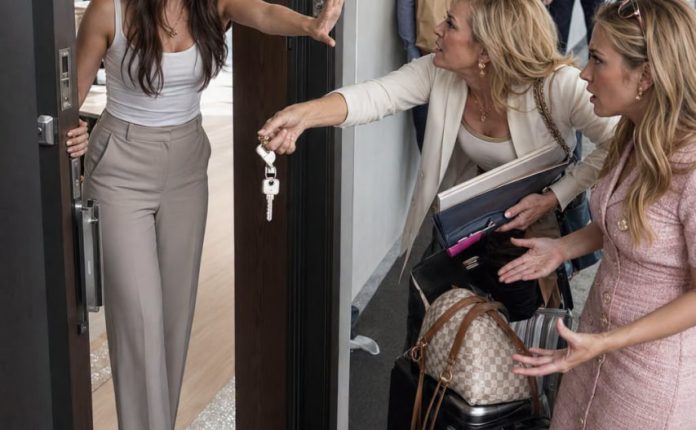
And yes, when I remember those two moving trucks sitting outside Grandma’s old house while my family realized strangers lived there, I still feel a little guilty.
But then I remember something else.
They weren’t shocked because I had promised them a home.
They were shocked because they had never imagined I was allowed to say no.
That was the real change.
For once, I wasn’t waiting for my family to finally choose me.
I had already chosen myself.
THE END!
Disclaimer: Our stories are inspired by real-life events but are carefully rewritten for entertainment. Any resemblance to actual people or situations is purely coincidental.