### Part 3
Once I believed my father would actually show up at my house with luggage, everything changed.
I started seeing my home differently.
The guest room was no longer the room where Paige stayed when she visited.
It was where Mom would put her clothes.
The den became Dad’s television room.
The larger upstairs bedroom became the room Brooke would insist she needed because she and Mason were a couple.
The garage became storage.
My peaceful kitchen became a place where four people would sit around expecting me to solve whatever problem came next.
I hated that my mind went there.
But my family had trained me well.
They rarely asked.
They announced.
Two weeks later, Paige called.
“The restaurant is probably done.”
I was trimming dead leaves from a houseplant beside the front window.
“What happened?”
“Most of the employees are gone. They owe vendors. They’re barely opening during the week.”
I looked around the living room.
Fresh white walls.
The hardwood floor I had refinished myself.
Grandma’s old brass lamp beside the couch.
I pictured a moving truck outside.
Then another.
My stomach turned.
That night I barely slept.
Around two in the morning, I went downstairs and made tea.
The house was completely quiet.
I stood in Grandma’s kitchen and remembered something she used to say whenever I was scared to change my life.
“A house is supposed to protect the people inside it. You’re not supposed to become its prisoner.”
She said it years earlier when I was debating whether to leave my first terrible apartment.
At the time, I thought she was talking about rent.
Now I wasn’t so sure.
For the past year, my college friend Lena had been trying to recruit me to her company in another state.
Better salary.
Better position.
More opportunity.
I had declined twice.
I always had the same reason.
The house.
My job was nearby.
My routine was comfortable.
Grandma had left me something important, and leaving it felt wrong.
But that night I opened Lena’s last email.
I read the offer again.
Then I walked through every room.
I touched the kitchen counter.
I stood in the guest room doorway.
I ran my hand along the banister where Grandma used to hang Christmas garland.
And for the first time, I realized Grandma had not left me the house so I could spend the rest of my life defending it.
She left it because she wanted me secure.
Selling it didn’t erase that.
At breakfast the next morning, I called Lena.
“Is the job still available?”
She laughed.
“I knew you’d come around.”
I didn’t tell anyone in my family.
Not Paige.
Not my parents.
Definitely not Brooke.
I contacted a realtor.
Her name was Monica, and when she walked through the house, she kept stopping to compliment the renovations.
“You did all this?”
“Mostly.”
She ran her hand over the kitchen island.
“You’re going to do very well.”
That sentence hit me harder than it should have.
The house had increased significantly in value.
Partly because of the market.
Partly because of the work I had put into it.
For years, my family talked about Grandma’s house as though it was a gift I had simply been handed.
They never saw the invoices.
The weekends I spent covered in dust.
The evenings I came home from work and painted until midnight.
The money I invested.
The labor.
I listed the house.
We had multiple offers quickly.
I accepted one from a young couple named Aaron and Melissa.
They had a little girl who walked through the empty guest room holding a stuffed rabbit and asked whether it could be her bedroom.
That made the decision easier.
They weren’t taking Grandma’s house from me.
They were turning it into their home.
Closing day was harder.
After signing the final documents, I drove back one last time.
The house echoed because almost everything had been packed.
I sat on the living room floor.
For a while, I cried.
Not because I regretted it.
Because endings hurt even when they are right.
“Thanks, Grandma,” I whispered.
Then I locked the door and left the keys for the new owners.
A week later, I moved to another state.
Lena helped me find a small house in a quiet neighborhood about twenty minutes from the new office.
It was nothing like Grandma’s place.
Newer.
Smaller.
No memories attached.
The first night there, I ate takeout noodles sitting on a cardboard box because my dining table hadn’t arrived.
I opened the back door.
Cool evening air came inside.
Somewhere nearby, a dog barked.
And suddenly I realized nobody in my family knew where I was.
The feeling wasn’t loneliness.
It was relief.
Two months passed.
Then my phone rang.
Mom.
I stared at the screen.
I considered letting it go to voicemail.
Then I answered.
Her first words were, “The bank took the house.”
I closed my eyes.
So it had happened.
“What about the restaurant?”
“Gone.”
Her voice cracked.
“We have nowhere to go.”
I leaned against my kitchen counter.
This kitchen had gray cabinets and a window overlooking my tiny backyard.
Mom kept talking.
“So here’s what we’re going to do.”
Not ask.
Tell.
Of course.
“Your father and I will stay with you for about six months. Brooke and Mason need somewhere too, just until they get back on their feet.”
I covered my mouth with my hand.
Not because I was shocked.
Because if I didn’t, I might laugh.
Mom interpreted my silence as agreement.
“We’ll need the downstairs bedroom because your father’s knee bothers him. Brooke thinks the large bedroom upstairs will work best for her and Mason.”
I looked around my completely different house.
She thought I was standing in Grandma’s kitchen.
She had no idea.
“When?”
“Two weeks.”
I should have told her immediately.
I know that.
The mature thing would have been to say, “Mom, I sold the house. You can’t come.”
But then I remembered Dad pointing at me.
We’re moving in with you.
I remembered Brooke wanting me to mortgage my home for her first failed business.
I remembered decades of assumptions.
Something in me went very still.
“Okay,” I said.
Mom exhaled.
“Thank God.”
Then she added, “We’ll bring most of our furniture.”
“Sure.”
“You might need to clear your garage.”
“Okay.”
She sounded relieved.
For the next two weeks, the messages came constantly.
Mom wanted specific rooms prepared.
Dad wanted space in the garage for tools.
Brooke texted, “Mason and I need the biggest room. We have more stuff.”
I stared at the message for a long time.
Then I sent a thumbs-up emoji.
That became my strategy.
Thumbs-up.
Smiley face.
“Sounds good.”
“Okay.”
“Drive safe.”
Every time I sent one, a small part of me wondered whether I was becoming cruel.
Then I reminded myself of something.
They had still never asked whether they could move in.
They were arranging my belongings in their heads.
Two days before their planned arrival, Mom texted me a list of groceries she wanted me to buy before they got there.
Brooke sent a picture of two moving trucks.
“All packed!”
I stared at the photo.
Cardboard boxes filled the trucks behind her.
Mason was smiling.
Dad stood beside them wearing work gloves.
They looked confident.
Like people moving toward a solution.
I put my phone down.
My hands were shaking slightly.
Not from fear.
From anticipation.
Because two days later, my family was going to drive four hours to a house they believed they still had the right to claim.
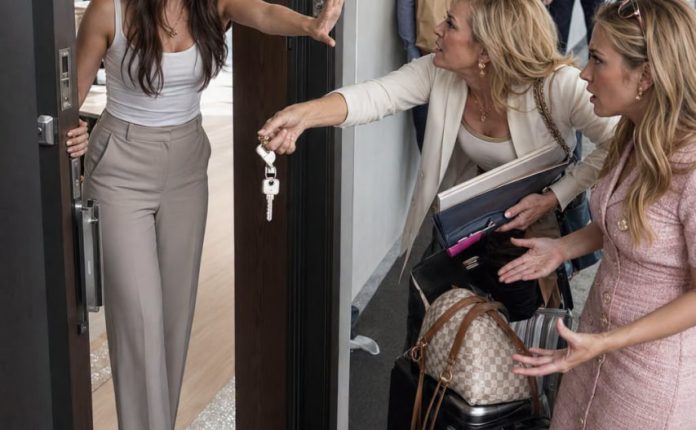
And strangers were going to answer the door.