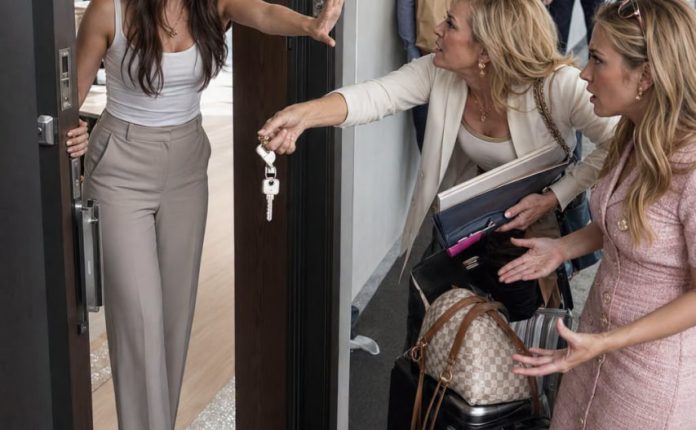
“And now you’re both standing in my kitchen telling me you’ve already decided how my inheritance is going to be spent?”
David hesitated.
Only for a fraction of a second.
But I saw it.
Then he admitted the truth.
“I already promised Jason we were going to bail him out.”
I stared at him.
“We?”
Brenda immediately stepped in.
“You’re married. What belongs to you belongs to your husband too.”
I looked at her.
Then back at David.
And something inside me changed.
It wasn’t heartbreak.
It wasn’t even anger anymore.
It was clarity.
Complete and absolute clarity.
They genuinely believed grief had made me vulnerable.
They believed the shock of losing my mother would make me easier to manipulate.
They expected tears.
They expected a fight.
They expected me to become emotional and, eventually, surrender.
Instead, I calmly placed the heavy manila folder on the granite counter.
Then I looked David directly in the eyes.
“You know what?”
I lowered my voice.
“You’re absolutely right.”
Their bodies visibly relaxed.
Brenda’s shoulders dropped.
A satisfied smile appeared on her face.
That was their first mistake.
Then Brenda smiled wider.
That was their second.
Because neither of them knew what was inside the folder.
They had no idea that my mother had spent the final months of her life preparing for the possibility that someone would eventually come looking for her money.
And they had absolutely no idea that I had been preparing too.
“In fact,” I said, “I have a little surprise for both of you.”
For the first time that morning, I smiled.
Brenda blinked.
She had expected anger.
Tears.
Maybe a screaming match.
She had expected to be able to tell the rest of the family that I was unstable, emotional, or incapable of handling a fortune that large.
What she didn’t understand was that people like Brenda were comfortable when they had control.
They knew what to do with someone who cried.
They knew how to pressure someone who begged.
They knew how to manipulate someone who apologized.
But they had no idea what to do with someone who had already accepted the truth.
David leaned against the staircase railing.
“What surprise?”
His voice was still confident.
But there was uncertainty underneath it now.
I opened the folder.
And placed the first document on the counter beside my coffee.
My mother had protected her estate long before she died.
The $140 million hadn’t simply landed in my personal checking account waiting for whoever demanded it.
She had placed the inheritance into a protected trust.
David frowned.
Brenda immediately objected.
“That doesn’t matter. You’re married.”
I slid the document toward her.
“It does.”
She picked it up.
Her eyes moved across the page.
Then stopped.
The confidence began to disappear from her face.
The trust had been structured to protect the inheritance from outside claims and from financial obligations that were not mine.
Brenda insisted marriage gave David rights to the money.
The documents said otherwise.
Then I pulled out another piece of paper.
This one wasn’t legal paperwork.
It was a letter.
My mother’s handwriting covered the page.
The handwriting had become weaker toward the end of her life, but I recognized every curve and every imperfect letter.
I read one line aloud.
“Money does not change people. It reveals what they were hiding.”
David stopped moving.
Brenda stopped arguing.
Suddenly, my mother’s final months began making sense.
She had noticed things I hadn’t.
The strange loans.
The unexplained transfers.
The constant emergencies surrounding Jason.
The endless requests for financial help.
Over eight years, more than $800,000 had moved through our extended family in one form or another.
I had always thought each incident was separate.
My mother hadn’t.
She had seen a pattern.