I wrote, “When I woke up, the person beside me was the person who chose to come.” My hand shook after that sentence. Then I wrote about the receipt. I did not accuse Mom of cruelty because I did not need to. “I know you went shopping after Nolan got his keys. You were allowed to make that choice. I am allowed to understand what that choice means.”
I wrote that I had spent thirty-four years being “the independent one” and understood how often that label excused neglect. I told them I had changed my address, my phone number, and my emergency contacts. Then I added, “You do not need to call the hospital next time. You won’t be listed.” It sounded harsh when I reread it, but harsh was not the same as untrue.
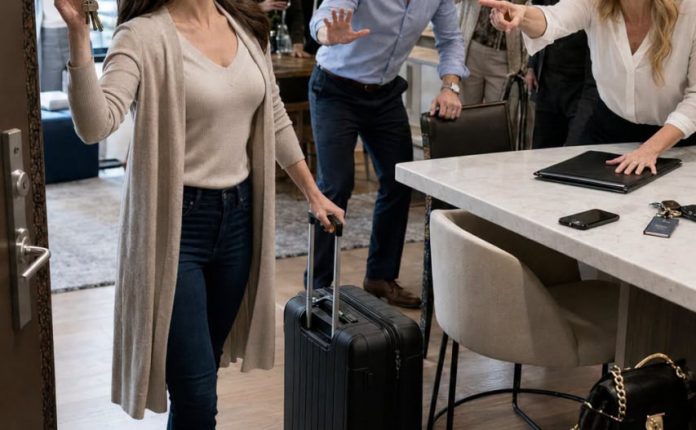
At the bottom, I wrote that I was not asking them to agree or understand. I was telling them what was happening. “Please do not come looking for me. I need a life where love is not measured by how little inconvenience I create. I wish you well. Erin.” I folded the paper once, placed it in the center of the table, and set the house key beside it.
Returning the key had seemed theatrical when I imagined it, but standing there I understood it was about access. My parents had spent my life assuming that because I always left the door open, they could walk back through whenever they wanted. I locked the side door from inside and left through the front. Tessa waited half a block away. She looked at my empty hands. “You left the key?” “Yeah.”
She asked how I felt. I considered every answer available and finally said, “Hungry.” Tessa smiled. “That is the healthiest answer you have ever given me.” We got tacos together. Two weeks passed. My parents had no direct way to contact me because I had changed my number. I knew myself too well. If Mom cried or Dad said “kiddo,” I might spend days wondering whether I had been too severe.
They called Tessa instead. She ignored several attempts until Nolan called. That evening, she told me he wanted to know whether I was alive. She had said I was safe but refused to give him my address or number. Then she explained that Mom had found the note first and read it twice before calling Dad into the kitchen. Dad wanted to drive to my apartment until Nolan told them I had moved.
Mom had cried. Once, hearing that would have wrecked me. Now I only felt tired. “People can cry because they hurt someone,” I told Tessa. “They can also cry because there are consequences.” Then Tessa said something that shifted my anger. Nolan claimed he had not known how serious the crash was. Our parents told him I was stable and that they would visit after his closing.
For days, I had assumed Nolan stood beside that red door knowing I might die. According to Tessa, he did not learn the truth until after reading about my note. That did not erase his failure to call, but it changed the shape of my anger. He wanted to write to me. I remembered how, at twenty, he drove across town with cheap soup when I had the flu. I agreed.
A week later, a sunflower card arrived with cramped handwritten pages. Nolan wrote that he knew I had been in an accident but not that doctors feared I might die. Mom had told him I was stable. “I should have called anyway,” he admitted. “I didn’t. I was excited about the house, selfish, and completely wrapped up in my own life. That part belongs to me.”
He wrote that learning what Mom told the hospital made him feel sick, and discovering they went shopping afterward made it worse. “I’m sorry I didn’t show up for you. I can’t undo it. I miss you. I hope someday you let me earn back some part of being your brother.” There was no demand for forgiveness, no excuse, and no “but.” I read the letter three times.
Then I cried for the first time since leaving the hospital. Not because I wanted the old family back, but because one person inside it had looked at what happened without asking me to make it easier for him. I wrote Nolan one page. I said I believed he had not known everything, but that did not erase his silence. I was not ready to be close, but I left the door open.
By spring, my scar had faded from angry red to pale pink, and the new apartment no longer felt temporary. I bought basil, rosemary, mint, and a tomato plant I was unqualified to keep alive. Nolan and I began speaking occasionally, first through email and later short calls. He never pushed. When he apologized again months later, he said he was not trying to get something from me.
In late April, a padded envelope appeared in my office mail with no return address. Inside was a letter from Mom. I nearly threw it away unopened, then carried it home and left it on the kitchen counter for two days. On the third evening, I opened it. “Erin, I have rewritten this letter so many times. I don’t know how to begin except by saying I am sorry.”
She wrote that she had replayed the hospital call and convinced herself that doctors were handling me while Nolan needed them present. “I thought because you had professionals around you, you were safe. I thought because Nolan needed help with the closing, we were needed there.” Then she wrote, “I can see now how monstrous that sounds.” Those words were once everything I had wanted from her.
Mom admitted they had gone to the décor store afterward because Nolan and Kayla needed curtains before their first night in the house. Then came the sentence that stopped me: “I did not understand you believed you were abandoned until I read your note.” Believed. Not that they abandoned me. That I believed they had. Even inside an apology, she filtered the event through my feelings instead of naming her choice.
She asked for one meeting with no expectations and said Dad wanted the same thing but did not know how to say it. I called Tessa and told her Mom had apologized. “But?” she asked. I explained the difference between Mom saying I believed I was abandoned and admitting they had abandoned me. Tessa asked what I wanted to do. For once, I knew. “Nothing,” I said, and meant it.
Months earlier, an apology from Mom would have felt like everything. Now it was late information arriving after I had learned to live without needing it. I did not answer, not because I wanted to punish her, but because I had already communicated my boundary. My parents had spent years teaching me that my “no” could be negotiated if someone felt strongly enough. I was no longer participating in that lesson.
A few weeks later, Nolan and I met for lunch, our first face-to-face meeting since before the accident. He started to hug me, stopped himself, and asked, “Can I?” That almost made me cry. I said yes. We talked about work, his basement renovation, my plants, and Kayla’s new job. Near the end he mentioned Mom’s letter, then quickly said I did not have to discuss it.
He told me Mom kept asking whether he thought I would come back. “What do you tell her?” I asked. Nolan looked uncomfortable. “The truth. That I don’t know. And if she wants a different answer, she should have made different choices.” I stared at my brother, then thanked him. We did not discuss our parents again. That summer, Tessa planned a dinner marking one year since the accident.
Seven people came: coworkers, a former roommate, my downstairs neighbor, and Nolan. My parents were not there. Tessa used expensive plates she had saved for special occasions. The apartment smelled like garlic and roasted vegetables, someone opened wine, and Marvin claimed an empty chair. Nothing dramatic happened until dessert, when Tessa stood with her glass and looked at me. “I had a whole funny speech,” she said, her eyes shining.
She abandoned the joke and gave the shorter version. “I am very glad you are still here.” My throat tightened. Tessa raised her glass. “To people who show up.” Everyone lifted theirs. I looked around the table at people who had brought groceries, carried packages, sat beside me, and called without being asked. None had ever announced that they were my real family. They had simply behaved like one.
Later, after everyone left, I stood by the open window and thought about the rainy highway, the operating room I never saw while conscious, and Marisol telling my mother I might not survive. For a long time, I thought the cruelest part was that my parents did not come. Eventually I understood something deeper: they had assumed I would still be waiting afterward for their visit, explanation, apology, and approval.
I was not waiting anymore. Maybe my parents regretted what they did, and I hoped they did. Maybe they changed, and I hoped that too. But becoming better people did not entitle them to become part of my life again. Nolan and I slowly rebuilt something smaller and more honest. Tessa remained first on every emergency form, and whenever a form asked for relationship, I stopped writing “friend.” I wrote “family.”
Family, I learned, is not the person whose name you automatically place first because you share blood. Family is the person who hears there might not be a tomorrow and starts driving today, who sits in the terrible chair, drinks terrible coffee, and stays when staying is inconvenient. I spent thirty-four years trying to become easy enough to deserve love. Nearly dying taught me that people who truly love you simply show up.
THE END!
Disclaimer: Our stories are inspired by real-life events but are carefully rewritten for entertainment. Any resemblance to actual people or situations is purely coincidental.