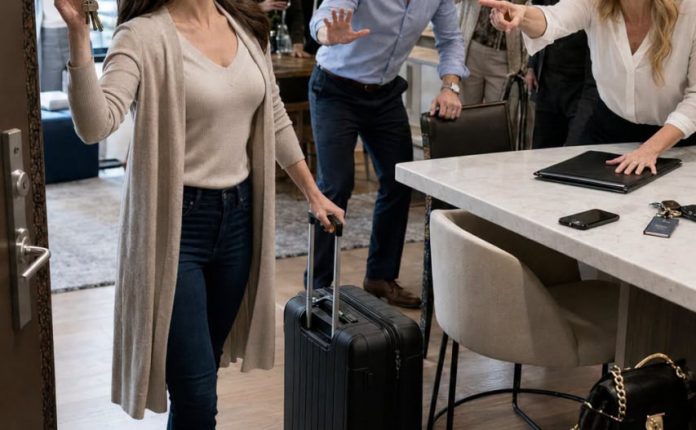
Mom announced that she had made up my old room for weeks. “No,” I said before I could soften the word. They stared. I told them I was leaving with Tessa to recover there. Mom insisted I needed family around me. I looked at Tessa packing my clothes. “I will have family around me.” Dad used my name in his old warning tone, but nothing inside me retreated.
Dad reminded me that they had driven to the hospital. “And I appreciate the effort,” I said. We both knew how cruel the sentence was because they had waited four days to make that drive. Mom claimed they were trying to give me space. I told her they had done what they wanted and assumed I would understand because I always understood. “That doesn’t mean I have to anymore.”
The room became completely still. Tessa zipped my bag while Mom glanced toward the flowers as if considering taking them back. Dad’s jaw tightened, but I did not reconsider. Less than an hour later, an attendant wheeled me toward the exit while Tessa brought the car around. My parents followed steps behind. Outside, cold air hit my face hard enough to make my eyes water.
Dad opened his mouth and said, “Call us when you get there.” I looked at him and answered, “Okay.” I got into Tessa’s car while Mom stood beside him clutching her purse. As we pulled away, I watched them shrink in the side mirror. Tessa asked whether I was okay. “I don’t know,” I said. “That’s allowed.” I leaned back against the seat and closed my eyes.
A few miles later, I asked whether she thought I was overreacting. Tessa kept her eyes on the road before answering. “I think you nearly died, and you’re still worried about whether your reaction is inconvenient for the people who didn’t come.” The highway stretched ahead beneath a pale winter sky. That evening, after reaching her apartment, I removed my mother as my emergency contact and entered Tessa instead.
It took less than a minute, but pressing save felt larger than it should have. Tessa lived in a third-floor walk-up in Wicker Park with uneven floors, a temperamental radiator, and a gray cat named Marvin who behaved as if he owned the building. For the first several days, my world became small: the guest bed, the bathroom, the couch, the kitchen table, and slow careful steps between them.
Tessa never hovered. She made soup and left instructions on masking tape, moved common dishes to lower shelves, and put a chair in the shower without announcing it. Then she went to work and treated me like a competent adult instead of a fragile project. At night we watched terrible television. I slept constantly, and between naps I started thinking about everything that had happened long before the crash.
I remembered being sixteen and performing the lead in our school play. Dad missed opening night because Nolan had a baseball tournament. Mom reminded me I had three more performances. At college graduation, my parents left dinner early for Nolan’s girlfriend’s birthday party. When I got promoted at thirty-one, Mom forgot and called two days later asking whether I could help Nolan revise his résumé.
None of those moments had felt enormous at the time. That was the trick. My parents had never abandoned me in one moment. They had taught me, through a thousand smaller ones, that disappointment was the fee I paid for belonging to the family. The surgery simply made the pattern impossible to minimize. Once I saw it clearly, I could not persuade myself back into the old explanation.
About a week into my stay, Mom texted, “Hope you’re healing. Your father and I are giving you the space you need.” I read it twice. Not “We’re sorry.” Not “Can we come see you?” Giving you space. As though my absence were another kindness they were performing. I did not answer. The following day, Nolan messaged asking whether everything was okay because Mom said I was upset.
He knew I had been in a car accident and had surgery, yet his message sounded casual. I typed three replies and deleted them all. Finally I wrote, “Recovering. I’ll reach out later.” His answer came quickly: “Glad you’re okay. House is chaos. Boxes everywhere.” I set my phone down. I had nearly died, and the central crisis in everyone else’s life still seemed to be cardboard boxes.
That afternoon, I called my landlord. My apartment was less than twenty minutes from my parents, chosen years earlier because Mom loved saying, “At least you’re close.” I hated that sentence. I asked what it would cost to end my lease early. The amount made me wince, but I paid it anyway. Money could be earned again. Time spent waiting for people to become different could not.
I found a smaller apartment closer to Chicago, close enough to commute to my office twice a week and far enough that nobody could appear casually on my doorstep. The brick building was fully renovated, with large windows and a narrow balcony facing an alley lined with bright flowerpots. When the leasing agent asked how soon I wanted to move, I said, “As soon as possible.”
Over the next several days, I changed everything. Medical forms. Work records. Insurance information. The person authorized to receive updates if I was ever unconscious again. Everywhere my mother’s name appeared because I had once assumed parent meant safest person, I replaced it, usually with Tessa. Then I rented a storage unit, hired movers, and returned to my old apartment with Tessa on a Wednesday.
Walking inside felt strange. A coffee cup sat in the sink from the morning I left for the conference. A grocery list remained on the refrigerator beneath a magnet: bananas, dish soap, rice, gas. I stared at the last word until Tessa asked what was wrong. “I was going to stop for gas right before the accident,” I said. “I thought that was going to be my whole day.”
Tessa leaned against the counter. “Most days don’t tell you when they’re about to divide your life into before and after.” We packed for hours. Among my belongings was a framed photograph of the four of us at a lake house when I was thirteen. Nolan stood beside me grinning with missing teeth. Dad had one hand on my shoulder. Mom’s cheek was pressed against mine. We looked safe together.
I held the picture for a long time, then wrapped it in newspaper and placed it in a box. Not everything needed to be destroyed because its meaning had changed. Sometimes an old photograph was simply evidence that people had once been capable of something they later stopped choosing. By the second week, the new apartment was mine, but one unfinished thing continued bothering me: the key to my parents’ house.
I had carried that key since college. It opened the side door beside the kitchen. For years, Mom had said, “You never have to knock. This is always your home.” I knew those words would become weapons once they realized I was leaving. You cannot erase your family. You will always have a home here. We have done everything for you. I decided I would not argue with any of it.
Instead, I would leave one thing behind: a note. Not a screaming letter and not a list of accusations. Just the truth. Wednesday evening was perfect because my parents attended the same church discussion group every week. I waited until they left, then drove toward the house. The neighborhood looked painfully ordinary, with a basketball hoop at the curb, old holiday lights, and a dog barking behind a fence.
I parked in the driveway and stayed inside the car for several seconds before taking the key from my purse. The side door opened easily. The familiar smell hit me first: coffee, vanilla candle, lemon cleaner. On the kitchen counter sat a stack of mail beside a photograph of Nolan and Kayla in front of their red door. Mom had already printed it and placed it in a frame.
When I picked up the frame, a folded receipt slipped from behind it. I was not trying to snoop, but the date caught my eye. It was the day of my surgery. The receipt came from a home décor store. Curtains. Throw pillows. A lamp. My mother had gone shopping after Nolan’s closing, after being told I might die. For days, I had still been protecting softer explanations for what happened.
Maybe they had been trapped by the appointment. Maybe Mom had panicked. Maybe Dad thought surgery would be quick. Maybe once the closing finished, they planned to rush to the hospital. The receipt killed every excuse. They had not been trapped. They had gone shopping. I stood in my parents’ kitchen holding proof that the worst day of my life had simply not been urgent enough to interrupt theirs.
I sat at the kitchen table with the receipt beside me. This was where I had done homework, filled out college applications, eaten birthday cake, and laughed with Nolan until milk came out his nose. There had been good things here, and that mattered. I had no interest in rewriting my childhood into a horror story. My parents had loved me. They simply loved me best when I was the easiest person in the room.
I took out a sheet of paper and began, “I’m not writing this because I want an argument.” I wrote that I knew what they had been told before surgery, that they understood I might not survive, and that Mom had asked the hospital to call afterward because Nolan’s closing was happening. Then I wrote about Tessa driving through bad weather and sitting beside me until I opened my eyes.