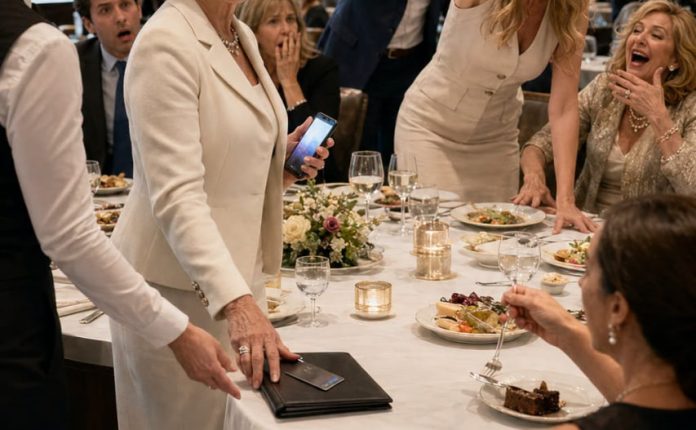
Brooke said I owed her because we were family. I reminded her that I remembered perfectly well what being her family had cost me. She accused me of seeking revenge and demanded that I simply give her the job.
“You’re not qualified,” I said. Brooke argued that I could train her because I controlled the company. I corrected her. “I run the company. There’s a difference.”
She accused me of acting superior because I had always handled Dad’s “stupid spreadsheets.” I stared at her. “Those stupid spreadsheets are the experience listed on your résumé.”
That silenced her briefly. Then Brooke said Dad had approved everything she wrote. I told her I already knew. Her expression changed because she suddenly realized we had verified far more than she expected.
I opened the folder David prepared. Inside were the employment-verification report and my archived complaint from seven years earlier.
I placed Dad’s verification first. “He confirmed that you performed work you never actually did.” Brooke shrugged. “People exaggerate.”
“Not like this.” Then I pushed the archived complaint toward her. “Let’s discuss something else.”
Brooke read the first paragraphs and frowned. I told her it was the reason my original Apex application had been rejected. She immediately claimed she knew nothing about it.
I believed that specific statement was possible because there was no evidence Brooke had personally sent the complaint. I refused to invent guilt merely because I disliked her.
But something in her expression changed as she read. She recognized something. I asked what she knew. Eventually, she muttered, “Mom said she handled it.”
The room seemed to narrow. I asked what Mom had supposedly handled. Brooke tried to retreat, but I pressed her until she finally admitted Mom believed I needed to stop being selfish.
I asked whether Brooke knew our mother had contacted Apex. She said she knew Elaine had called or emailed somebody but claimed she didn’t know exactly what had been said.
“Why?” I asked.
Brooke slammed her palm against the table. “Because you left!”
“I left because you locked me in a room.”
“Mom locked you in the room.”
“So you could go to Miami.”
“I had already paid for the trip!”
For several seconds, I simply stared at her. The answer was so completely Brooke that it almost sounded like satire.
Then I asked a question I had never asked anyone in my family. “After I climbed through the window, did you ever wonder where I slept that night?”
Brooke’s face flickered. She called the question unfair. I repeated it.
“Did you wonder whether I was safe?”
She looked away.
“No.”
There it was. The closest thing to honesty I had ever received from her. She had never wondered whether I had shelter, food, money, or somewhere safe to sleep.
Maybe my parents had spoiled her into believing my needs mattered less. Maybe they had rewarded that belief her entire life. None of those explanations changed the answer.
No.
Then Brooke’s anger disappeared and became something more calculating. “Claire, I’m in trouble.” She explained that her mortgage payments were behind, the children needed things, and Parker Logistics wasn’t doing well.
I told her to apply for jobs she was genuinely qualified to perform. She insisted I didn’t understand, but unfortunately, I understood better than she realized.
Her eyes filled with tears. This time, I believed them. Real tears did not automatically create my responsibility. Then Brooke revealed the detail that finally explained why she had applied to Apex.
“Mom and Dad said you would help if I got in front of you.”
I felt cold. I asked whether they knew she was applying to my company. Of course they did.
Then I asked whether they already knew I was CEO.
Brooke hesitated before nodding.
So this wasn’t coincidence. My family had sent her. Not because they missed me or because seven years had taught them anything.
They needed something again. Brooke reached across the table and whispered my name. I moved my hand before she could touch me.
Her expression hardened instantly. “You really think you’re something now, don’t you?”
“No,” I said, standing. “I think I’m someone.”
There was a difference.
Brooke sneered that I would always be the girl who took care of her children. I walked toward the door and answered, “And you’ll always be their mother. You should probably start acting like it.”
Security escorted Brooke from the executive floor after she refused Andrea’s request to leave. Nobody dragged or publicly humiliated her. She simply walked toward the elevator beside a security manager.
Before the doors closed, Brooke warned me that Mom would call. She was right. Twenty-seven minutes later, my private phone rang from a number I hadn’t seen in seven years.
I let Mom’s first call go to voicemail. Then the second and third. By noon, she had called nine times. Dad called twice, while Brooke emailed my corporate address until IT blocked her.
Part of me wanted to ignore all of them. But another part wanted one final thing.
Not an apology.
The truth.
I asked David to arrange a scheduled call through his office with counsel present. The next morning, I sat inside a conference room while David connected the call.
Mom answered first. “Claire?” Her voice sounded almost unchanged. Seven years vanished for a moment, and I could almost smell furniture polish in my parents’ hallway.
“Hello, Mom.”
She immediately started sobbing. “Oh, Claire. Finally. We have missed you every day.”
That was the first lie. Dad quickly joined the conversation and announced, “This has gone far enough.”
I asked what exactly had gone too far.
“This punishment,” he said. “Your sister needs help.”
“Then help her.”
“We have.”
“Apparently not enough.”
Dad’s voice sharpened. “You have more money than you could possibly need.”
There it was. Seven years disappeared again. Different building, different furniture, same transaction. My worth remained connected to what I could provide.
Mom interrupted and said they had made mistakes. I looked at the archived complaint lying in front of me and asked one question.
“Did you send an email to Apex after my interview seven years ago?”
Silence.
Dad immediately asked why we were discussing ancient history. I ignored him and addressed Mom directly. Eventually, she admitted she had contacted the company because she was scared.
“Scared of what?”
“Losing you.”
I closed my eyes. “You locked me in a bedroom.”
“We were desperate.”
“You told Apex I was unstable.”
“You broke a window!”
“Because you locked the door.”
“You abandoned three children,” Mom said.
“They weren’t my children.”
That sentence landed heavily. Mom reminded me that I loved Brooke’s children. I said loving them did not make me their unpaid parent.
Dad interrupted and insisted they had given me a home. I reminded him that I had given his company years of unpaid labor.
“You were learning,” he said.
“Brooke’s résumé says she did the learning.”
Another silence followed. Dad accused me of enjoying their humiliation.
“No,” I replied, and I meant it. Strangely, that seemed to bother him more. I wasn’t enjoying their fear because I didn’t need anything from them anymore.
Mom finally admitted the truth. She had contacted Apex because she believed getting the job would allow me to disappear permanently.
“I did disappear,” I said.
“I know.”
“You just made my first year harder.”
Mom cried and apologized. Seven years earlier, those words might have destroyed me. Now they felt small compared with everything that had happened afterward.
Then she asked whether I forgave her.
I looked through the conference-room window at employees carrying laptops and coffee. They knew me as Claire, not the maid, babysitter, or daughter whose purpose was absorbing everyone else’s inconvenience.
“No,” I said.
Mom stopped crying. “What?”
“I don’t forgive you.”
She insisted that being my mother had to mean something. I agreed. “It means you had a responsibility toward me too.”
Dad called my response unbelievable. I told him the unbelievable part was that they still believed biology entitled them to permanent access to me.
I set clear boundaries. No calls, visits, attempts to contact Apex employees, or public accusations involving the company. Any professional interference would be handled by legal counsel.
Personally, I wanted no contact. Mom whispered, “Forever?” I thought carefully before answering because I had no need to make promises about a future I couldn’t see.
“I don’t know what forever looks like,” I said. “But I’m done building my life around the possibility that someday you’ll become the parents I needed.”
Then I ended the call.
My hands shook afterward. Healing apparently didn’t mean turning into stone. It meant feeling pain while still choosing the boundary that protected you.
That evening, I went home early, made grilled cheese, opened sparkling water, and sat on my balcony while Atlanta turned gold beneath the sunset.
For the first time, revenge felt irrelevant. I had something better.
Distance.
Three weeks later, however, a message appeared on a private social-media account I rarely used. The sender was Lily Parker, Brooke’s oldest daughter.
She was twelve now.
Her first sentence tightened my throat.
“Aunt Claire, I don’t think Mom knows I found you.”
I stared at the message before continuing. Lily said she had seen my photograph in an article at school and remembered me even though everyone acted strangely whenever she asked questions.
The last time I saw Lily, she was five. She carried a stuffed rabbit everywhere and refused sandwiches unless I cut them diagonally.
“I know you probably don’t want to talk to Mom,” she wrote. “I’m not asking you to. I just wanted you to know I remember you reading to me.”
That almost broke me. Leaving a toxic family doesn’t always mean leaving only the people who hurt you. Sometimes innocent relationships become collateral damage.
For years, I had anonymously sent Brooke’s children birthday books through a third-party gift service. I never knew whether they received them until Lily asked, “Were the books from you?”
I smiled and answered yes.
Her reply appeared almost immediately. “I knew it. Mom said they were probably from somebody at church.”
I laughed out loud. We exchanged simple messages about school, books, science, and her dream of building robots. I never discussed Brooke or our grandparents.
A twelve-year-old did not need to carry adult history. Before ending the conversation, I told Lily she never had to choose sides with me.
“You’re allowed to love your family and still become your own person.”
She sent a heart. I closed the app and cried, not from hopelessness like I had seven years earlier, but because I finally understood how far I had traveled.
A month later, Apex completed its largest acquisition. At the signing dinner, Martin Ellis sat beside me. He had gray hair now and joked constantly about retiring.
Halfway through dessert, he told me something strange. “I remember your first interview.”
“The one where I looked like I’d been attacked by a hedge?”
He laughed. Then his expression became serious.
“You were my first choice.”
I stopped moving. Martin explained that he had personally recommended me for the management program. Then the external complaint arrived, compliance froze my application, and another candidate accepted before anyone investigated properly.
For seven years, I had wondered whether Mom’s sabotage actually cost me that first job.
Now I knew.
Martin apologized. I told him not to. Surprisingly, I meant it.
If I had entered the management program at twenty-four, maybe my career would have advanced more quickly. Maybe I would have earned more money and avoided the diner, rented room, and exhaustion.
But those months taught me something no executive program could have taught me.
I could survive without my family.
That lesson changed everything.
I never reconciled with my parents. Some people dislike that part because they expect successful children to become generous enough to reopen every closed door.
They want the mother to cry, the father to admit he was wrong, the sister to apologize, and everyone to hug at Thanksgiving.
That wasn’t my ending.
My parents made choices. Brooke made choices. Adulthood taught me that forgiveness isn’t an entrance fee to peace.
I don’t wake up hating them. I don’t spend my days imagining revenge. I simply stopped giving them seats at my table.
Brooke never worked for Apex. Her application was formally rejected because she materially misrepresented her experience. I later heard she accepted an entry-level administrative position elsewhere.
Perhaps starting honestly at the bottom would teach her responsibility. Maybe it wouldn’t. Either way, that was no longer my problem.
Parker Logistics struggled but survived. Dad eventually sold the oversized Marietta house and moved somewhere smaller. Mom disappeared from several social circles she once treated like royalty.
None of that brought me happiness because their decline was never my success.
My success belonged to me.
At Apex, I built a culture where junior employees could question broken systems without being mocked. We created paid internships for young adults without wealthy parents or powerful connections.
I established a scholarship for students who worked while supporting relatives. I didn’t name it after my family.
I called it the Open Door Fund.
Because once, somebody had locked one in front of me.
Years after climbing through that broken window, I bought a house outside Atlanta. It wasn’t enormous, but it was beautiful, with tall windows, a wide kitchen, and a small garden.
Every bedroom door could be unlocked from both sides.
On my first morning there, sunlight stretched across the hardwood floor while I stood barefoot in the kitchen drinking coffee.
No shouting.
No demands.
No suitcase hitting the floor.
My phone buzzed. Lily had been accepted into a summer engineering program.
“Someday I’m going to have an office as cool as yours,” she wrote.
I answered, “Make yours cooler.”
Then I put the phone down and looked around the home I had chosen and paid for, surrounded only by people who understood love was something freely given, not something extracted through obligation.
My parents once believed locking one bedroom door could decide my entire future.
They were wrong.
That morning in Marietta, when I broke the window and climbed outside, I thought I was simply escaping from them.
Years later, I understood what I was really doing.
I was walking into my own life.
THE END!
Disclaimer: Our stories are inspired by real-life events but are carefully rewritten for entertainment. Any resemblance to actual people or situations is purely coincidental.