PART FOUR The verdict ended the criminal case, not the children’s fear. Sadie still woke when heating pipes clicked, and Evan became anxious whenever Denise latched the backyard gate. They attended therapy, medical appointments, and school meetings. Progress arrived unevenly. One week Evan slept alone; the next he placed a chair beneath his bedroom handle even though it locked from neither side. Sadie returned to a classroom part-time and sat nearest the exit. Teachers let her step into the hallway without requesting permission. Accommodations that looked small to outsiders gave her something Paul had denied: control over her own movement.
Denise eventually received permanent guardianship. She framed the order only after asking whether the children wanted it displayed. Sadie said yes but chose the hallway rather than her bedroom. Evan asked if guardianship meant Denise could create family rules. She answered that every home had expectations, but no rule could remove food, medical care, privacy, education, or the right to ask another safe adult for help. Together they wrote five promises on colored paper: doors have handles, food remains available, questions are allowed, apologies cannot be forced, and nobody keeps dangerous secrets. They hung it on the refrigerator without laminating it because Evan wanted rules that could change.
Evergreen welcomed Sadie back into sixth grade after evaluating her academic needs. She was embarrassed by gaps in math and terrified classmates knew her story. The principal protected her privacy, assigned one counselor, and avoided public celebrations of her return. A student invited her to art club without asking personal questions. That simple kindness mattered. Evan moved into second grade and stopped standing near the classroom door by winter. He still visited my crossing post, sometimes speaking and sometimes only waving. I followed his lead. Our connection had begun with a promise, but respecting him meant never using that bond to satisfy my need to feel important.
A year after the rescue, Sadie asked to view selected evidence with her therapist. She wanted proof that the room existed outside her memory. Bell showed her photographs but withheld the most distressing recordings. Sadie studied the missing handle and said she had sometimes imagined she invented it because Paul repeated that good children experienced the room as peaceful. Bell told her confusion was a predictable result of sustained control. Sadie chose one photograph of the outside latch for a sealed personal file. She did not want it displayed. Evidence had served the court; she was allowed to decide how much space it occupied in her life.
Evan’s recovery took a different shape. He began building houses from cardboard boxes, carefully cutting doors that swung both ways. His therapist never interpreted the game aloud. She supplied tape, safe scissors, and time. Eventually his houses gained windows, beds, and kitchens. In one, a tiny paper police officer stood permanently on the porch. When the therapist asked whether the figure needed to enter, Evan shook his head. “No. He already knows we’re okay.” That answer reached me later through Denise, and I carried it more proudly than any commendation. The best outcome was not being needed forever.
My department recognized Ortiz, Bell, the digital team, and me at a council meeting. I accepted because refusing would have shifted attention toward false modesty, but I used my minute at the microphone to name the people whose ordinary competence mattered: the dispatcher who kept my location open, Ramirez’s gentle examination, the technician who preserved metadata, the teacher who admitted missed signs, and Denise’s patient care. Then I said Evan’s courage should challenge adults, not excuse us. Applause felt less important than the silence afterward, when people seemed to consider what children in their own neighborhoods might be unable to name.
Two years after our first walk, Evan approached me after dismissal wearing shoes that fit and carrying a backpack covered with planets. Sadie, taller and healthier, waited near Denise’s car but let him speak privately. “Can you walk me home again?” he asked. My chest tightened until he smiled. “Nothing bad. I want to show you something.” I notified Denise, who nodded, and we followed the same streets. The wind chimes still tapped on the weathered porch. Lawns remained imperfect. This time Evan talked about a science project, a classmate who cheated at kickball, and whether police dogs received birthdays.
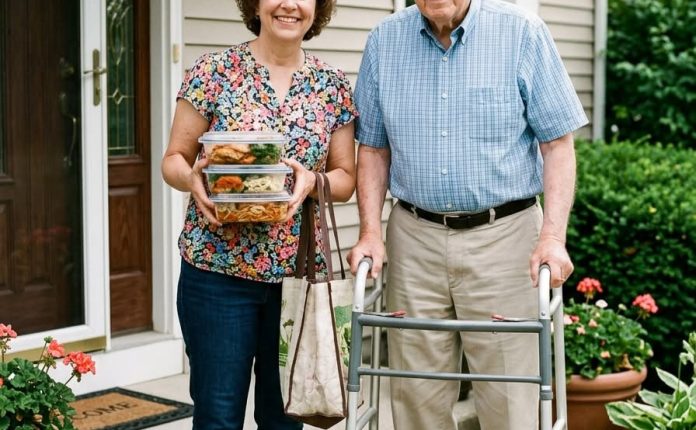
Denise’s house stood three blocks beyond the old route. Sunflowers leaned over the fence, two bicycles rested in the yard, and curtains were open to the afternoon. At the porch, Evan removed a key from his pocket. His hand did not shake. “Before I unlock it, can you wait until I open the door myself?” he asked. I stepped back. He turned the key, opened the door, closed it, and opened it again from inside. Then Sadie came through the side gate laughing because he had rehearsed the demonstration all week. Denise watched from the kitchen, giving the moment space rather than claiming it.
Evan led me to the refrigerator, where the five colored promises had collected drawings, spelling corrections, and a grease mark from pizza. He pointed to the first line: doors have handles. Sadie showed me her bedroom door, which had a handle on both sides and a wooden wedge she controlled. Nobody entered. We ate cookies at the kitchen table while the children argued about whose turn it was to feed the neighbor’s cat. The disagreement ended without silence, apology scripts, or punishment. Denise rolled her eyes affectionately and asked them to solve it. Their ordinary irritation sounded like freedom.
Before I left, Evan asked whether I remembered what he had said at his old front door. I told him I remembered every word. He said he had believed my promise meant I would personally prevent every frightening thing forever. Now he understood that I had brought other people who knew how to help. “But you listened before Dad explained,” he said. “That was the part I needed.” I told him he had given me an important lesson: explanations must never become louder than evidence, especially when a child is afraid. He considered that, then offered a serious handshake before running back to his cookies.
Walking toward my patrol car, I thought about the first house: closed blinds, spotless cushions, bleach, and a welcome mat outside a door that concealed terror. Nothing about its exterior had announced what waited behind the laundry room. The lesson was not that every neat home hid cruelty or every strict parent was dangerous. It was that normal appearances proved very little when a child asked an adult to look closer. Evan had not needed a heroic rescue speech. He needed time, attention, and someone willing to enter uncertainty without allowing his father to define it first.
At the corner, I looked back. Evan stood inside the open doorway, one hand resting on the handle. Sadie called him, and he disappeared toward the kitchen without flinching when the door moved behind him. Two years earlier, he had asked whether showing me the truth would keep him from pretending everything was okay. The courts, doctors, teachers, investigators, and Denise had spent years honoring that request together. I could not give him back the childhood Paul had interrupted. But he no longer lived behind someone else’s definitions. He could open a door, close it, speak, disagree, eat, and ask for help. Behind him, the kitchen filled with laughter, conversation, and the ordinary sounds of safety. This time, home meant he was free.
THE END!
Disclaimer: This fictional story is for entertainment only. It does not represent any person or organization and does not encourage inappropriate behavior.