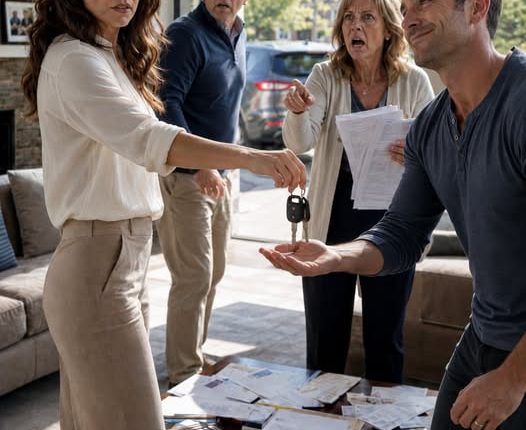
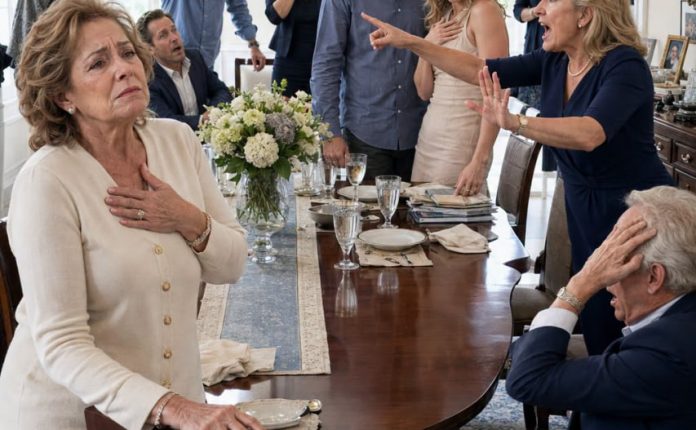
I drove away. My father stepped into the driveway as though he might stop the SUV with his body, then moved aside. Vanessa followed several yards through the snow. My mother stood beneath the porch light with both hands over her face. I watched them shrink in the rearview mirror until the curve hid them. For the first few miles, I felt no triumph and no grief, only exhaustion. At a red light, I checked my phone: thirty-one missed calls, twelve texts, three voicemails.
My mother begged me to call. Vanessa wrote, “You cannot seriously let this happen because of something I said.” Grant wanted to discuss the “financial implications rationally.” At home, I put my phone in a drawer and made tea. My quiet apartment—no chandelier, no champagne, no one criticizing my coat—finally broke me. I sat on the kitchen floor and cried.
I did not regret withdrawing the money. I cried because I finally understood there was no kinder family hidden beneath the cruelty. The begging had proved they could become gentle and attentive, but only when I held something they needed.
The next morning Daniel told me the lender had resumed its existing foreclosure timeline. There would still be notices, procedures, and legal steps; nobody was arriving that day to change the locks. But the temporary protection tied to my payment was gone. Without another source of funds, my parents were in serious trouble. I asked whether they could save the house themselves. “Possibly, if they can raise enough money quickly.” “Can they?” Daniel paused. “Based on what you showed me? Unlikely.”
That afternoon my father called from an unfamiliar number, and I answered by mistake. He said we needed to meet. I refused. “This is bigger than Vanessa,” he said. “Your mother and I could lose our home. We’re nearly seventy.” I told him I knew. He demanded to know how I could sound so calm, then said they had made mistakes and should have handled things differently. But he still did not apologize. He simply said, “Then help us.”
I asked him, “If the house were safe right now, would you be making this call?” Silence. “Would Mom have apologized? Would Vanessa?” More silence. Finally he said, “This is not the time to settle childhood grievances.” I smiled sadly. “My childhood was not a grievance. It was my life.” When I told him their finances were no longer my responsibility, he became angry. “You have more than enough money. What are you going to do, sit comfortably while your parents lose everything?” I thought for a moment. “Yes.” He hung up.
Over the following weeks, relatives and family friends contacted me about forgiveness. None had mentioned it while Vanessa tore up my check. Then my mother left a voicemail: “Claire, the house is going.” I almost called back until she added, “Please don’t let your sister lose everything.” Even at the end, it was still Vanessa. I blocked her number.
Months later, after failed refinancing attempts and desperate efforts to raise money, the house was sold. My parents sold jewelry, my father approached old business partners, Vanessa unloaded expensive clothes, and Grant contacted former investors. Nobody produced enough. The Westport estate—once my mother’s proof of family superiority—was gone. My parents moved into an ordinary two-bedroom rental.
Vanessa and Grant deteriorated faster. Creditors closed in, Grant’s business collapsed, and they filed for bankruptcy protection. Vanessa disappeared from social media, then returned posting about “simplifying” and “learning who your real people are during hard seasons.” She never mentioned the sister whose $100,000 check she had destroyed.
Six months after Christmas, Vanessa appeared in the lobby of my office building. I could have sent her away, but I went downstairs because some part of me wanted to know whether anything had changed. She looked different—no diamonds, no professionally styled hair, just a simple wool coat. For the first time in years, she looked like an ordinary thirty-eight-year-old woman rather than a carefully managed image.
We sat in a nearby coffee shop. After several minutes, she said, “I’m sorry.” Once, I had imagined those words would change everything. Now they landed quietly between us. “For what?” I asked. “Christmas.” “What part?” “Everything.” “Be specific.” Her jaw tightened. “I shouldn’t have torn the check.” “Why?” “Because it was stupid.” “Why was it stupid?” She answered without thinking: “We needed it.”
I leaned back. She realized immediately what she had said. “That’s not what I meant.” “It is.” She tried again. “I shouldn’t have called you unwanted.” I told her she had said what she had been allowed to believe her entire life. Her eyes filled. “Mom and Dad were wrong.” “So were you.” She admitted it, then said, “I lost everything. Grant and I are separated. Dad barely speaks to me. Mom cries all the time. Everyone blames me.”
I told her I was sorry she was struggling. Hope appeared on her face. “Maybe we could start over.” “No.” She stared at me. “You won’t even try?” “I tried for thirty-five years.” “We’re sisters.” “That never stopped you.” She reminded me that she had apologized and asked what else I wanted. “Nothing,” I said. That confused her more than anger would have.
Vanessa still thought an apology worked like currency: pay it and receive forgiveness, access, and restoration. I no longer wanted payment. “I forgive you enough that I don’t spend my mornings angry at you,” I told her. “But forgiveness does not mean access.” Her face crumpled. I told her I was choosing a life where I did not have to prove my worth to people who recognized it only when they needed something. When I stood to leave, she whispered, “For what it’s worth, you were the strongest one of us.”
Six months earlier, that sentence might have meant everything. Now it meant almost nothing. “That’s because I had to be,” I said, and left her there.
A year after that Christmas dinner, my life looked ordinary, and I loved it. I moved into a brighter apartment, traveled when I wanted, and became a director at my firm. I called my friend Naomi first. That night, six friends crowded around my table eating takeout and drinking cheap champagne from mismatched glasses.
Nobody cared that the glasses did not match, evaluated my clothes, or compared me to Vanessa. They were happy because I was happy. Watching them laugh, I finally understood that family was not a room I had been locked out of. Family was the people who noticed when you entered and did not require a $100,000 check before deciding you mattered.
My parents still occasionally tried to reach me. So did Vanessa. I never gave them money. I never rebuilt the relationship. I did not seek revenge either. I simply stopped volunteering to be hurt. Sometimes I still remember that Christmas night—the fireplace, the smell of pine, the champagne glasses raised while pieces of my check lay scattered across the rug. For years, I might have remembered it as the night my family rejected me. I don’t anymore.
It was the night they accidentally freed me.
Vanessa had looked into my eyes and called me an unwanted child. Ten minutes later, she was beside my car begging me not to leave. She never understood the real tragedy. It was not that she destroyed a $100,000 check. Money can be earned again. Houses can be replaced. Bank accounts recover. What she destroyed was the final reason I had to keep coming back.
I spent thirty-five years waiting for my family to choose me.
That Christmas, I finally realized I had been waiting for the wrong people.
So I chose myself.
And I never went back.
THE END!
Disclaimer: Our stories are inspired by real-life events but are carefully rewritten for entertainment. Any resemblance to actual people or situations is purely coincidental.