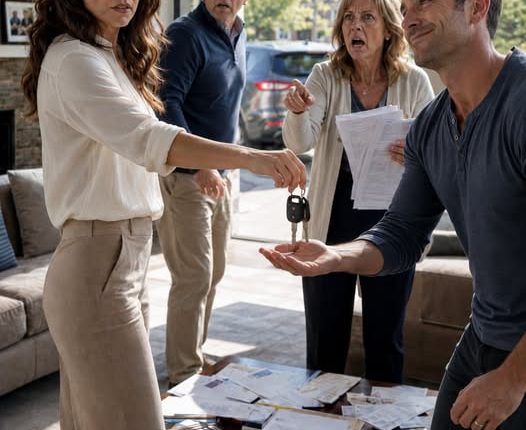
Vanessa ripped the envelope open. The sound was surprisingly loud beneath the crackle of the fireplace. She pulled out the cashier’s check and stared at the amount. $100,000. Grant took a step toward her. “Vanessa—” She raised one hand and stopped him. I could see the choice forming in her face. She could accept help from the sister she had mocked for thirty-five years, or she could protect the fantasy that she was still above me. Vanessa looked up and laughed.
“Everybody, look,” she announced. “Claire discovered we’ve had a little cash-flow issue, and apparently she thinks this is finally her chance to become important.” I told her that was not what this was. She turned toward our relatives. “She thinks throwing some of her boring accounting money at us means we’ll suddenly need her.” Grant had gone pale. “Vanessa,” he said quietly, “maybe we should—” She snapped at him, then faced me again.
“The lender’s temporary hold expires tonight,” I said. “That payment brings the loan current.” Any rational person would have stopped. Vanessa did not. She accused me of snooping through their finances. I told her the records were public and that I had discovered our parents were about to lose their house. My mother cut in. “How dare you embarrass your sister on Christmas?” I stared at her. “Embarrass her? I tried to save your house.” “And make Vanessa look irresponsible,” she replied.
My father shook his head. “You always do this, Claire.” “Do what?” “Turn everything into numbers. Money. Documents. Problems.” They were angry at me, not at the people whose decisions had endangered the house, because I had seen behind the curtain. Vanessa smiled, tore the check in half, folded it, tore it again, and kept shredding until pieces covered the carpet.
“I do not need charity from an unwanted child.”
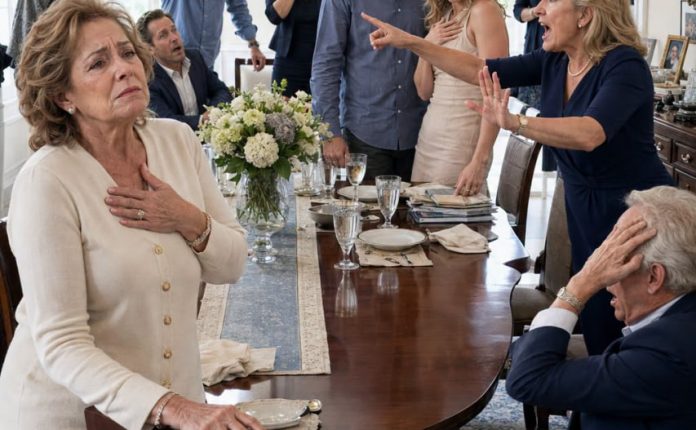
Nobody corrected her. My mother clapped twice. One uncle laughed awkwardly. My father raised his drink. Grant, perhaps sensing that Vanessa needed the room on her side, lifted his glass too. “To family pride,” he said. Other glasses rose. The humiliation should have crushed me. Instead, something inside me went completely quiet. I had spent years waiting for an apology, a compliment, some moment when somebody would choose me. What they gave me instead was clarity.
I crouched and collected the pieces. Vanessa laughed, and my mother said I was being dramatic. I slipped the torn paper into my coat pocket. “Finished?” Vanessa asked. “Your loss,” I said, and walked out. Behind me, my mother laughed, “Ignore her. She’ll sit in her car for twenty minutes like she did when she was sixteen.”
I got into my SUV, opened my laptop, and called Daniel. Vanessa had made one critical mistake: the torn check was not protecting the house. I was. My money still sat in an account I controlled, and the lender’s temporary hold existed only because I had supplied proof of funds and conditionally committed to cure the delinquency. Final payment had never been completed.
“She rejected it,” I told Daniel. “Explicitly?” “She tore up the check in front of everyone and told me she didn’t need my charity.” He exhaled. “That’s fairly explicit.” I looked through the living-room windows at Vanessa pouring herself another drink. “I want out.” Daniel warned me that if I withdrew, the temporary protection could disappear immediately and the lender could resume the process already underway. “Send the withdrawal,” I said. Then I logged into my account and canceled the pending disbursement authorization.
Transaction canceled.
I expected guilt. Instead, relief hit so hard I had to lean back against the headrest. The money was still mine. For the first time that evening, I could breathe. A minute later, Daniel texted that the lender had been notified. Almost immediately, the scene inside the house changed. Grant stopped near the fireplace and stared at his phone. Vanessa walked over. Her champagne glass lowered. My father’s phone rang. His expression moved from annoyance to confusion to terror. He pointed toward the front door—toward me.
My phone began vibrating. Dad. Mom. Vanessa. Grant. I declined every call. Then came the texts: WHAT DID YOU DO? CALL THE BANK NOW. CLAIRE THIS IS NOT FUNNY. Not “We made a mistake.” Not “We’re sorry.” As though consequences were something I had invented. Then the front door opened.
Vanessa ran out first in her green dress and high heels, without a coat. Grant followed, then my father in house shoes and my mother clutching herself against the wind. Vanessa reached my SUV and slammed both palms against the passenger window. “CLAIRE!” I lowered it a few inches.
“Claire, call them.”
“What happened?” I asked.
“You know what happened!”
“I’d like to hear you say it.”
“The lender resumed the foreclosure process,” she said. Grant added that they were also moving against accounts tied to the collateral agreement. From the porch my father shouted, “Fix it!” Not please. Not yet. Just fix it.
Vanessa leaned toward the opening. “This isn’t the time for one of your little power games.” I almost smiled. “My power game?” “You proved your point.” “What point?” “That we need the money.” There it was. Not that they needed me. The money. She told me to call the lender back because it was our parents’ house. I reminded her that she was the one who had put it at risk. “Grant’s business had problems,” she said. “Your parents mortgaged their home to cover them.” “You don’t understand.” “I understand it professionally.”
My mother reached the SUV, eyes wet. “Claire, please.” I had waited thirty-five years to hear softness in her voice, but now it came from fear. “Ten minutes ago, you applauded,” I said. “It got out of hand.” “No. It became honest.” Vanessa crouched beside the window. “We were joking.” “No, you weren’t.” “I didn’t mean it.” “You called me an unwanted child.” “I was angry.” “And Mom applauded.”
My father reached us, red-faced from cold and fury. “Claire, family does not do this to family.” For once I had an answer immediately. “You should have remembered that inside.” He tried the passenger door. It was locked. “Open this door.” “No.” Grant insisted they could solve everything. I told him he had had three years. When he began talking about setbacks and investors, I cut him off. “I know about the failed financing. I know about the unpaid vendors. I know about the judgments.”
Vanessa stared at Grant. “You told me those were handled.” He told her not now. She demanded to know what he meant. My father stepped toward him. “You said the new round would cover everything.” Grant said it was supposed to. “You guaranteed it.” “I said it was likely.” Vanessa spun toward him. “You told Dad the investors had signed.” Grant’s silence answered her. The perfect marriage, the perfect business, and the perfect life began cracking in the driveway.
My mother turned on Vanessa. “How much did you know?” Vanessa claimed she had been protecting them from stress. My father laughed bitterly. “You let me mortgage my house.” “You offered!” she shouted. “Because you said the company needed temporary liquidity.” Ten minutes after toasting one another, they were tearing each other apart in the snow.
My mother looked back at me. “Please put the money back.” “The offer was rejected.” She claimed they had not understood. “You knew I said I was saving your house,” I replied. When she admitted she thought I was exaggerating, I asked why. Because anything from me had to be insignificant? She could not answer.
“If Vanessa handed you a $100,000 check, would you let someone tear it up?” My mother cried harder because we both knew the answer. My father stepped closer. “What do you want?” The question revealed everything. He was still searching for the transaction that would unlock the money. Vanessa said, “You always wanted us to respect you. Fine. We respect you.” I asked what I did for a living. Her face went blank. “Accounting,” she finally said. “What position?” Silence.
I asked my father what company had promoted me two years earlier. Nothing. I asked my mother where I spent my thirty-third birthday. Silence. “I know Vanessa’s favorite champagne. I know where Grant went to business school. I know Dad hates mushrooms. And none of you can even name my job title.” For the first time, I saw shame instead of panic.
Vanessa grabbed the edge of the window. “If you leave, we lose everything.” I thought of the photograph of eight-year-old me smiling while everyone looked at her. Then I said the simplest truth of my life.
“You lost me long before tonight.”