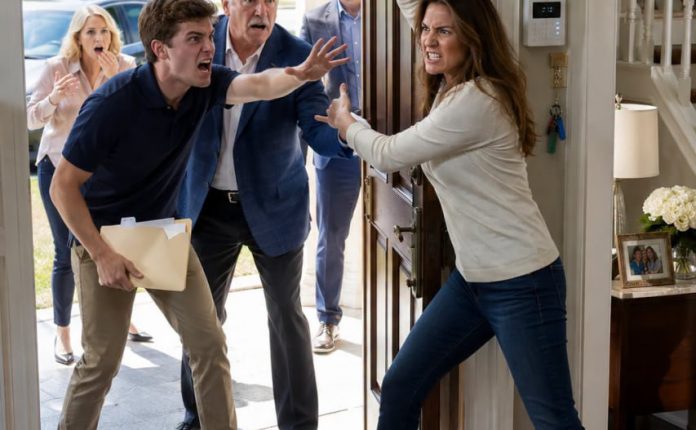
I did not raise my voice. That seemed to make Daniel angrier. He stood under the brass hallway light with his coat still on, breathing hard as though he had driven fifty miles solely on resentment. I carried my tea into the kitchen. He followed. “Mom, I’m talking to you.” “I know.” “Then say something.” I set my mug beside the sink. “What would you like me to say?” He stared at me. “That you’ll fix it.” There it was. Not explain it. Not discuss it. Fix it. I leaned against the kitchen island. “Your wife told me your household required independence, privacy, and distance.”
“That was moving stress.” “She told me your address was none of my concern.” Daniel dragged a hand through his hair. “Brooke was irritated.” “I believed her.” “You know how she talks when she’s stressed.” “Yes,” I said quietly. “I do.” His expression shifted. He had expected me to attack Brooke. That would have made everything easier for him. He could defend his wife, accuse me of interfering, storm out, and avoid examining his own choices. I refused to give him that escape. “I’m not angry that Brooke wants distance,” I said. “Adults can choose who they want in their lives.” “Then what is this?”
“This is distance.” He blinked. “The insurance?” “The insurance. The automatic transfers. The roadside plan. The grocery support. The storage. Everything.” His face changed as I listed them. “You stopped the transfers?” “Yes.” “Without telling me?” “You moved without telling me.” “That’s completely different.” “Is it?” Daniel paced toward the dining room, then back. “Brooke is going to lose her mind.” “That sounds like something Brooke will need to manage.” He stared at me as though I had spoken in another language. “Do you understand what our bills look like right now?” “No.” I let the word hang between us.
“And that is the arrangement your wife requested. Your household finances are private.” He lowered his voice. “That’s cruel.” The accusation struck harder than I expected. For half a second, I saw my boy again. Then I remembered the ledger. The trips. The errands. The calls that became requests. “Daniel,” I said, “do you know how much money I have contributed to your household in the last two years?” He looked away. That told me he had some idea. “I never forced you.” “No. You didn’t.” “Then why are you acting like we stole from you?” “I’m not.” “What do you call this?” “Stopping.”
He frowned. I continued. “Helping you was my choice. Stopping is also my choice.” Silence settled across the kitchen. The clock above the pantry ticked. Daniel stared at the hardwood floor. Finally he muttered, “Brooke thinks you’ll cave.” I almost smiled. “She said that?” “She thinks you’re lonely. She thinks you’re doing this because you want us to come running back.” Something cold and clean moved through me. Not anger. Clarity. I walked past him and opened the front door. The evening air entered the hallway carrying the smell of wet pavement. Daniel looked at me. “Are you kicking me out?”
“I’m ending a conversation that isn’t going anywhere.” “Mom.” “Tell Brooke something for me.” His shoulders stiffened. “What?” “Tell her loneliness is infinitely preferable to being treated with contempt.” His expression changed again, this time into something close to shame. He picked up his keys. At the doorway, he turned. “You’re really going to throw away your relationship with Noah over this?” That one landed exactly where he intended. I felt my fingers tighten around the edge of the door. Noah. Four years old. Brown curls. A laugh like hiccups. The child who ran toward me yelling “Grandma!” whenever I arrived.
Daniel saw my reaction. For one terrible second, I realized he had discovered the lever. Then something else occurred to me. If access to my grandson depended upon my willingness to pay his parents’ bills, then it was not access. It was a transaction. “I love Noah,” I said. Daniel waited. “I will always love him.” His face softened, confident he had won. “But I will not buy permission to be his grandmother.” The softness vanished. Daniel left without another word. His taillights disappeared beyond the corner. I locked the deadbolt. My hands shook after that. Not because I regretted what I had said.
Because I knew what would come next. Brooke had just learned that money no longer controlled me. Now she had only one weapon left. Noah. And the very next morning, she used it. Brooke’s message arrived at 7:18 Monday morning. Until you stop punishing our family financially, we think it’s best you don’t see Noah. I read it while standing beside the coffee maker. I did not immediately respond. The smell of dark roast filled the kitchen. Rain tapped softly against the windows. My first instinct was exactly what Brooke expected. Fix it. Restore the payments. Call Daniel. Apologize for something I hadn’t done.
Then another thought surfaced. If I surrendered now, what would happen next year? Or five years from now? Would every disagreement come with a price tag attached to my grandson? Would I have to finance their choices to remain welcome? I sat down. My hands were cold around the coffee mug. I typed one sentence. I’m sorry you feel that way. I will respect your decision. Brooke replied within thirty seconds. That’s all you have to say? I did not answer. By noon, I was sitting across from Eleanor Price, my estate attorney. She was in her early sixties, with silver-streaked dark hair, narrow glasses, and an unnerving ability to remain silent.
She reviewed my documents. “You originally named Daniel as successor trustee,” she said. “Yes.” “And primary beneficiary after your lifetime, aside from several charitable gifts.” “Yes.” “Brooke is listed as secondary financial representative if Daniel cannot act.” “Yes.” Eleanor took off her glasses. “What changed?” I told her. Not dramatically. Just facts. The move. The hidden address. The financial support. Daniel’s confrontation. Brooke’s message about Noah. Eleanor listened without interruption. When I finished, she folded her hands on the desk. “What outcome do you want?” That was the question no one else had asked. Not what punishment. Not how angry I was. What outcome.
“I want Noah protected.” She nodded. “And Daniel?” I looked toward the office window, where bare branches moved against a pale November sky. “I want Daniel to become the adult I raised him to be.” “That may not be something your estate plan can accomplish.” “I know.” “And Brooke?” I thought about it. “I don’t want her controlling anything that belongs to me.” Eleanor nodded once. “That we can accomplish.” We spent almost two hours restructuring the plan. Daniel was removed as successor trustee. Brooke was removed as alternate financial representative. The portion once intended to pass directly to Daniel was redirected.
Some went to causes Robert and I had supported for years: the historical society, the county library, a local housing program. But the largest protected share was designated for Noah’s future education and early-adulthood expenses. It would be managed by an independent trustee. Daniel could not withdraw it. Brooke could not borrow against it. Neither could redirect it for household expenses. Noah would benefit. His parents would not control the money. Eleanor slid the revised pages toward me. “Take them home tonight. Read everything again. Come back tomorrow if you still feel the same.” I appreciated that. I did read them. Twice.
Then I opened the old manila folder. For the first time, I noticed something inside the back pocket. A photocopy of the emergency reserve account Robert had created years ago. Daniel’s name was still attached as a payable beneficiary. I stared at it. That account had grown substantially. Robert had started it after watching one of his coworkers lose everything during a prolonged family crisis. “Money should protect people from disaster,” he had told me, “not protect them from responsibility.” I could almost hear him saying it. The next morning, I returned to Eleanor’s office. The notary seal came down with a heavy thump. I signed each page.
Margaret Elaine Hayes. Line after line. When I reached Daniel’s old beneficiary designation, my hand paused for only a moment. Then I signed the replacement. Eleanor looked at me. “You’re certain?” “Yes.” She gathered the documents. I thought I would feel victorious. I didn’t. I felt sad. But sadness was not the same thing as doubt. When I returned home, Brooke had sent four messages. Daniel had left two voicemails. I ignored them. Instead, I opened the curtains, set up my easel, and tried painting the maple tree outside my window. Twenty minutes later, my phone rang again.
This time the caller ID showed a number I didn’t recognize. I almost let it go. Something made me answer. “Hello?” A woman’s voice said, “Mrs. Hayes? My name is Laura Bennett. I’m calling from Westfield Storage regarding the unit you arranged for Daniel Hayes.” My stomach tightened. “Yes?” “There’s been an issue.” “What kind of issue?” She hesitated. “Your son says his wife believes some property in the unit belongs to her and that you had no authority to move it.” I closed my eyes. Of course. Brooke had found another battlefield. But what she didn’t know was that I had photographed every single item before it left my garage.
And years of archive work had taught me something she was about to learn the hard way. Paper beats outrage every time. I drove to Westfield Storage the following morning with a folder on the passenger seat. Inside were photographs. Dates. The moving inventory. Copies of messages from Daniel acknowledging that his tires and boxes had been stored at my house. I had no interest in starting a legal war over camping equipment and winter tires. I simply refused to be bullied with invented accusations. Laura Bennett met me in the office. She was a compact woman in her forties with bright red glasses. “Your daughter-in-law was very upset,” she said carefully.
“I’m sure she was.” “She claimed an antique cedar chest had been removed from your home.” I blinked. “There was no cedar chest.” Laura looked relieved. “I didn’t see one on the intake inventory.” “There wasn’t one.” I opened my folder. Every item had been photographed against the garage wall. Four tires. Two plastic storage bins. One tent. Three boxes of Daniel’s college books. A folded card table. No cedar chest. Laura examined the pages. “That clears it up.” I thanked her and left. Brooke’s accusation bothered me less than it should have. By then, her pattern had become predictable.
When control slipped, she created a crisis. But Daniel’s participation still hurt. He knew there was no cedar chest. He knew his belongings had occupied my garage for years. Yet he had apparently stood beside his wife and allowed her story to grow. I drove home along county roads edged with brown fields and bare trees. At a stoplight, my phone buzzed through the car speakers. Daniel. I did not answer. That afternoon, I went to watercolor class. Frank had placed three pears and a dented copper kettle on the demonstration table. I painted terribly. Helen noticed. “You’re murdering that fruit,” she said. I laughed for the first time all day.
After class, the three of us went for coffee. They knew only a little about what was happening. I had never wanted to become the woman who dominated every conversation with complaints about her children. But when Helen asked why I seemed distracted, I told them the truth. Not every detail. Enough. Diane stirred sugar into her coffee. “My daughter didn’t speak to me for eleven months once.” I looked up. “What happened?” “I stopped paying her credit card.” I nearly choked. She smiled. “Funny how boundaries become cruelty when the other person benefits from you having none.” That sentence stayed with me.
December arrived with the first hard frost. My days changed. Thursday painting. Every other Wednesday at the archives. Friday mornings digitizing pioneer journals. Sunday afternoons reading by the fireplace. I cooked smaller meals. My grocery bill fell. My gasoline expenses dropped. My house became quieter. But it also became mine again. Then, in late November, Daniel called. This time I answered. “Hi, Mom.” His voice sounded tired. “Hello, Daniel.” There was a pause. “How have you been?” “Good.” Another pause. “We’re figuring things out.” “I’m glad.” “Brooke picked up another remote contract.” “That’s good.” “And we found a cheaper insurance package.” “I’m glad.”
The silence became almost awkward. Then he said, “We were wondering if you could help with Christmas travel.” There it was. The old rhythm. Warm conversation. Update. Request. My heart sank more from disappointment than anger. “No.” He breathed out slowly. “Mom.” “I said no.” “It’s Christmas.” “Yes.” “We wanted to take Noah to see Brooke’s parents.” “That sounds lovely.” “But it’s expensive.” “I’m sure.” Daniel’s voice hardened. “Do you even care anymore?” I looked across the room at my half-finished painting. “Yes. I care about you very much.” “Doesn’t feel like it.” “Caring about you and financing you are two different things.”
He was silent. Then came the sentence that finally closed something inside me. “So this is who you are now?” I almost answered defensively. Then I realized I didn’t need to. “No, Daniel. This is who I always was. You just knew the version who said yes more often.” He hung up. I sat quietly afterward. There was sadness. But no urge to call back. That evening, I hosted Helen and Diane for beef stew and sourdough bread. Frank came too, carrying a bottle of sparkling cider and a loaf of something he claimed he had baked himself, though none of us believed him.
Laughter filled my dining room. For years, I had kept that table open for Daniel’s family, postponing plans in case they might visit. Now every chair was occupied by people who had actually chosen to be there. Late that night, after everyone left, I found an envelope pushed through my mail slot. No stamp. No return address. My name was written on the front in Daniel’s handwriting. Inside was a single sheet of paper. Mom, I found out about the trust. I stared at the sentence. I had never told him. Neither had Eleanor. Which meant someone had been looking somewhere they had no business looking.
And suddenly the story was no longer just about hurt feelings and cancelled insurance. Someone had been trying to find out exactly what they stood to inherit.