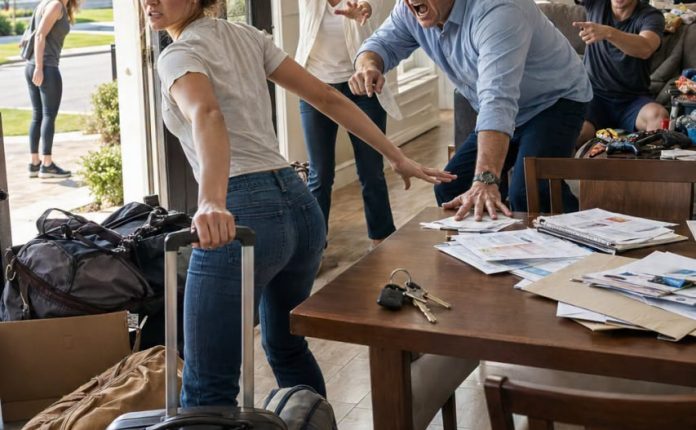
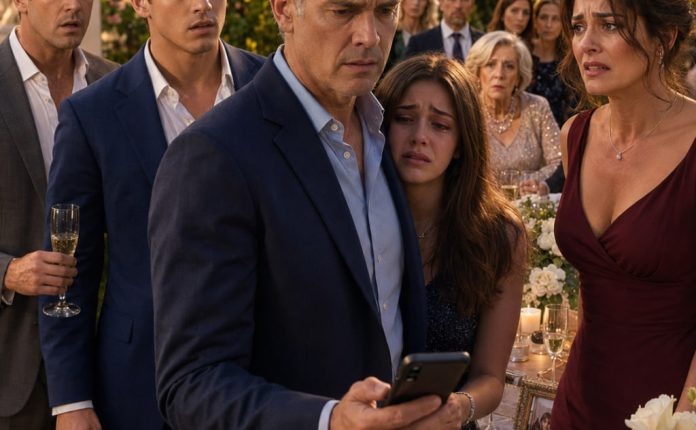
For several seconds, nobody spoke. Then my father laughed. A short, uncomfortable laugh. Like he thought this was some strange joke. “You’re joking.” I handed the papers to him. “No.” His smile disappeared. And for the first time in my entire life, my father looked afraid. Because he was finally realizing something. The daughter he had ignored for years was no longer asking for permission. She was enforcing the truth. My father stared at the papers in his hands like they were written in another language. He flipped through the pages once. Then again. His eyes moved faster each time, searching for something.
A mistake. A loophole. Anything that would let him return to the version of reality where he was still in control. “This is ridiculous,” he finally said. His voice had changed. The confidence was gone. “You expect me to believe that my own father secretly gave this house away?” Patricia didn’t react. She had heard every version of denial before. “Mr. Dawson, this trust was created and signed years ago. It was properly notarized, filed with the county, and reviewed by independent counsel.” My father looked at her. Then back at me. “You knew?” That question hurt more than I expected.
Not because I felt guilty. Because it showed me what mattered to him. Not what happened to Theo. Not what Lauren did. Not that his grandson had been dragged across stone by his own daughter. Only the house. “You knew all this time?” he repeated. I nodded. “For four years.” My mother gasped. Four years. She heard that number like it was the betrayal. Not the way she laughed while Theo cried. Not the way she told a seven-year-old child he needed to learn his place. Four years was what shocked her. “You lived here knowing this?” she whispered.
I looked at her. “I lived here knowing my son would eventually be protected.” Her face tightened. “Your son?” She said it like I had used a weapon. Like Theo wasn’t her grandson. Like his name on those papers was an insult. Lauren stepped forward from behind her. She had stopped filming now. For the first time in days, she looked uncertain. “This is insane,” she said. “Claire, you can’t just come here and throw us out.” I looked at her. The same sister who had pulled my son by his hair. The same sister who had looked me in the eyes and said he was fine.
“You’re right,” I said. Her expression softened slightly. Then I continued. “I didn’t throw anyone out.” I pointed toward the papers. “The owner of the property is requesting possession.” Lauren stared. “What?” “The owner,” I repeated. Her mouth opened. Then closed. Because she finally understood. This wasn’t me taking something from them. It was them having something returned. Something they never owned. My father stepped closer. “You think your grandfather wanted this?” That was the first thing he said that made me angry. Not because it was cruel. Because it was dishonest. “You know what Grandpa wanted,” I said quietly.
His jaw tightened. “You were always his favorite.” There it was. The sentence my father had carried for years. Not anger about the trust. Not confusion. Jealousy. “You think this is because he loved me more?” My father didn’t answer. He didn’t have to. I already knew. My grandfather had never chosen me because I was special. He chose me because I listened. Because I cared. Because I didn’t believe money existed to make people powerful. My father had spent his whole life believing the opposite. “You know what’s funny?” I said. Everyone looked at me.
“Grandpa never cared about whether someone was his child. He cared about whether someone acted like family.” My father’s face hardened. “Watch yourself.” “No,” I said. And for the first time, I didn’t lower my voice. “No, Dad. I spent my whole life watching myself. I watched every word I said. Every accomplishment I minimized. Every time Lauren hurt me, I was told to be the bigger person.” Lauren crossed her arms. “Oh, here we go.” I ignored her. “I watched Mom excuse everything you both did because keeping the family image mattered more than fixing the family.”
My mother looked away. That tiny movement told me everything. Because deep down, she knew. “You’re destroying this family,” my father said. I almost laughed. Almost. Because that sentence was the final proof. They always blamed the person who stopped accepting the damage. “You’re right,” I said. His eyebrows lifted. “I am?” “Yes.” I looked directly at him. “I’m destroying the version of this family where everyone gets to hurt my son and call it discipline.” Nobody spoke. The silence was heavy. Then my mother started crying. Not angry tears. Not the dramatic tears she used when relatives were watching.
Real tears. But somehow, they still didn’t move me the way they once would have. “Claire,” she whispered. “We made mistakes.” I looked at her. “Mistakes are forgetting someone’s birthday.” Her eyes dropped. “Mistakes are saying the wrong thing when you’re tired.” I pointed toward the house. “What happened to Theo wasn’t a mistake.” My voice became quieter. “It was a choice.” That was when my father finally lost control. He slammed the papers against the porch table. “You’re doing this because you hate us!” The officers shifted slightly. Not dramatically. Just enough to remind everyone they were there.
I looked at him. And strangely, I wasn’t angry anymore. Because I realized something. My father wanted me to be emotional. He wanted me to scream. He wanted to turn this into a family argument. Because arguments could be manipulated. Facts couldn’t. “I don’t hate you,” I said. That surprised him. “I don’t even want revenge.” “Then why?” I looked back at the house. Because the answer was simple. “Because my son deserves better than what I accepted.” Nobody had a response to that. Not my father. Not my mother. Not Lauren. The officers gave them the official notice.
They had a limited amount of time to collect personal belongings. Nothing attached to the property. Nothing that belonged to the house. My mother looked devastated as she walked inside. My father stayed outside. He didn’t look at me. He just stared at the land. The acres he had spent decades bragging about. The place he had built his identity around. And I wondered if he was finally understanding something my grandfather had understood years ago. A person can live inside a house for decades and still never truly own it. I sat in my car while they packed.
I didn’t want to watch. I thought I would feel satisfaction seeing them lose everything. But I didn’t. I felt tired. Because losing my family had started long before they lost the house. My phone rang. It was Patricia. “They’re going to fight,” she said. I looked toward the porch. “How?” “Probably through the trust.” I sighed. “Can they?” “They can try.” A pause. Then she added: “But Claire, there’s something you should know.” I sat up. “What?” “We found something during the final review of the trust documents.” My stomach tightened. “What kind of something?”
Patricia was quiet for a moment. Then she said: “Your grandfather didn’t only leave the house to Theo.” I looked back at the farmhouse. The windows. The porch. The place where so many memories had been created. “What else did he leave?” Patricia took a breath. “And why he chose you as trustee.” I gripped the phone tighter. Because suddenly, I understood. The house was never the whole story. It was only the first thing my family was going to lose. I met Patricia the next morning at her office. I had been there dozens of times over the past four years, but that day it felt different.
Usually, I walked into that building carrying a strange mixture of sadness and patience. That morning, I walked in carrying certainty. Patricia’s office looked exactly the same as always. The old wooden bookshelf. The framed certificates on the wall. The small plant near the window that somehow survived despite everyone forgetting to water it. She always joked that the plant was proof that neglect didn’t kill everything. I used to laugh. That morning, I couldn’t. Patricia placed a folder on the desk. Not the same folder my grandfather had given me. A different one. Older.
Thicker. “This was attached to the trust instructions,” she said. I looked at it carefully. “Why didn’t I see this before?” “Because your grandfather specifically instructed that this section remain sealed until the primary conditions were triggered.” “The house transfer?” She nodded. I swallowed. My grandfather had always been deliberate. Nothing about him was accidental. “What is it?” Patricia opened the folder. Inside were several documents. Financial statements. Letters. Notes written in his handwriting. I immediately recognized it. That careful, slightly slanted writing I had seen on birthday cards and fishing notes. The first page wasn’t about property.
It was about my family. Not in an angry way. That was the thing about my grandfather. He rarely hated anyone. He simply observed. And sometimes observation was more devastating than anger. Patricia handed me the letter. “Read it.” I unfolded the paper. Claire, If you are reading this, it means the conditions have been met and Theo is old enough for the trust to begin protecting him directly. First, I want you to understand something. This was never about punishing your father. It was never about taking something away from him. It was about preventing something from being taken away from Theo.
I stopped reading for a moment. Because those words felt heavier than the entire house. Preventing something from being taken away. My grandfather had known. He had known exactly what kind of people my parents were. The letter continued. I have watched Arthur confuse possession with responsibility for most of his life. He believes that because he inherited opportunities, he earned them. But opportunities are not proof of character. How someone treats people who cannot benefit them is the true measure. My eyes burned. Because that was exactly what happened. My parents had treated Theo poorly because they believed he had nothing to offer them.
A seven-year-old child. A child who couldn’t give them money. Status. Approval. Nothing. My grandfather had seen that flaw years before I did. I kept reading. I have also created a secondary account for Theo’s education and future needs. You will oversee it until he becomes an adult. No withdrawals may be made without proper authorization. My eyebrows pulled together. A secondary account? I looked at Patricia. “What does this mean?” She hesitated. “That account is where things get complicated.” My chest tightened. “What happened?” She turned another document toward me. “Four withdrawals were made.”
I stared at the numbers. The dates. The amounts. My confusion turned slowly into disbelief. “These weren’t approved by me.” “I know.” “Then how?” Patricia folded her hands. “We’re still investigating.” A cold feeling moved through me. “Who had access?” She didn’t answer immediately. That was answer enough. “Patricia.” She looked at me. “The account was connected to your mother.” I felt like the air had left the room. My mother. Not Lauren. Not my father. My mother. The woman who had cried when Theo was born. The woman who had told me she wanted to be the grandmother he could always count on.
I stared at the paperwork. The withdrawals weren’t huge. Not enough to immediately notice. Not enough to trigger alarms. That was what made it worse. They were small. Careful. The kind of theft someone planned because they believed nobody would look closely. “How much?” “About fourteen thousand dollars.” I closed my eyes. Fourteen thousand dollars. It wasn’t the money. It was what the money represented. My son’s future. His education. His opportunities. Someone had looked at a child’s account and decided they were more entitled to it. “Are you sure?” I whispered. Patricia’s expression softened.
“I wish I wasn’t.” I sat there silently. Because I suddenly understood something. The patio incident wasn’t the first time Theo had been hurt. It was just the first time I had seen it happen. My mother had been taking from him quietly. My sister had hurt him openly. My father had defended them both. Different actions. Same belief. Theo mattered less. Patricia slid another document toward me. “We need to discuss your next steps.” I looked up. “What steps?” “The trust violation.” She paused. “And the incident with Lauren.” I immediately remembered Theo crying.
His small hands gripping my shirt. The way he whispered that he was sorry. My anger returned. Not the explosive kind. The controlled kind. The kind that makes decisions. “I want everything documented.” Patricia nodded. “I expected that.” “I want Theo protected.” “He is.” “No,” I said. I looked directly at her. “I mean completely.” Patricia was quiet. Then she nodded. “Okay.” Over the next week, everything changed. Not dramatically. Not like movies. Real consequences rarely happen with a single explosion. They happen through paperwork. Phone calls. Documents. People asking questions. My mother called eleven times.
I didn’t answer. My father sent messages. First angry. Then confused. Then desperate. Lauren sent one message. Only one. It said: “I know I messed up.” I stared at those words for a long time. Because they sounded like an apology. But they weren’t. An apology would have been: “I hurt Theo.” “I was wrong.” “I’m sorry.” Instead, she wrote: “I messed up.” Like she had spilled a drink. Like she had made a mistake at work. Like there wasn’t a terrified child involved. I deleted the message. Not because I hated her. Because I finally understood something.
Forgiving someone doesn’t mean giving them access to hurt you again. Two weeks later, my parents officially challenged the trust. The legal notice arrived on a rainy Tuesday morning. I remember standing in my kitchen holding the envelope while Theo ate cereal at the counter. He looked up. “Is that bad news?” I forced a smile. “No, buddy.” “Are we moving?” I froze. Because that was the fear I had been trying to protect him from. The idea that adults could destroy his sense of safety. I walked over and hugged him. “We’re not losing anything.”
He nodded. Then he returned to his cereal. Because children trust the people who protect them. That afternoon, Patricia called. “Claire.” I heard something in her voice. Something different. “What happened?” “We received their response.” “And?” A long pause. Then she said: “Your father is claiming your grandfather wasn’t mentally capable of creating the trust.” I frowned. “What?” “He’s arguing that the documents were created under improper influence.” My hands tightened around the phone. “They’re saying Grandpa didn’t know what he was doing?” “Yes.” I looked out the window. At the backyard. At Theo’s toys. At the life my grandfather had tried to protect. And then Patricia added the part that made my blood run cold. “Claire, they’re not just challenging the trust.” “What else?” “They’re accusing you of manipulating your grandfather.”