Our lives slowly separated into new shapes after that Christmas. Ethan and I finalized our divorce eighteen months after the bedroom incident. We shared custody, and he rebuilt his construction company on a smaller scale without family bailouts, secret loans, or money disguised as rescue.
He sold his expensive truck, cut unnecessary overhead, kept taxes current, and learned how to say, “I can’t afford that.” Oddly, I respected him more after divorce than I had during the final years of our marriage. That did not make me want him back.
Sometimes growth arrives only after the relationship that needed it has already ended. That does not make the growth meaningless. After our final divorce hearing, Ethan apologized to me one more time outside the courthouse.
“I thought saving my company meant saving our family.” I told him I knew. He admitted he kept telling himself he would explain everything once the business became stable. I reminded him there had been many stable periods during those five years.
“Then why didn’t you?” I asked. Ethan looked toward the parking lot. “Because once I realized your mother had lied, I knew telling you meant admitting I took her money.”
There it was again: fear, shame, delay, secrecy. The machinery behind betrayal. Ethan apologized. I said I knew. Then he asked whether I forgave him.
I thought carefully before answering. “Yes.” He looked stunned. “But we’re still divorced?” I almost smiled. “Yes.” He asked whether both things could be true. “Yes.”
He laughed sadly and said Sophie probably inherited that thinking from me. We hugged—not romantically, not as people beginning again, but as two people ending something without needing to destroy everything around it.
Three years after the bedroom incident, Dad’s family home still belonged to Mom under her life estate. Then she called me unexpectedly and said she wanted to move. I nearly dropped the phone.
“You?” I asked. “From Dad’s house?” Yes. “Are you dying?” Mom laughed and told me no, but the house had three floors and her knees hated every one of them.
Under Dad’s will, her permanent move triggered equal transfer of the property to Caleb and me. Mom knew that. I knew it. Caleb definitely knew it. For the first time, however, nobody tried to manipulate what happened next.
We met at the house. Caleb wanted to buy my half. To my surprise, I did not want to keep the property. For years, discovering that it should have been partly mine had felt central to the betrayal.
Once ownership actually became available, I realized I did not need the house to prove Dad loved me. Caleb genuinely loved it. Despite everything, it was still home to him.
We ordered two independent valuations. He bought my half at the average appraised value. There was no secret discount, emotional bargaining, “family price,” or vague promise. Everything was documented through lawyers, bank transfers, and signed agreements.
Mom watched us sign and started crying. I asked why. “Your father would be relieved.” I looked at Caleb, who smiled faintly and said, “Probably because we didn’t kill each other.”
Mom laughed, then became serious. She said Dad always worried we would become competitors. I looked at her and said, “We almost did.” She lowered her eyes. “I helped create that.”
“Yes.” I expected defensiveness. None came. Mom moved into a two-bedroom condominium fifteen minutes away. The first time I visited, she looked uncomfortable surrounded by boxes.
“It’s small,” she complained. I told her it was normal. She said she did not know where to put everything. I suggested getting rid of things. She looked horrified and immediately asked about Dad’s desk.
“Keep it.” The formal dining set? “Sell it.” Mom reminded me that table hosted every Thanksgiving for thirty years. I told her, “And now it can host somebody else.”
She stared at me and said I sounded detached. I smiled. “No. I finally understand memory isn’t furniture.” Mom rolled her eyes and said it sounded like therapy. I admitted it probably was.
That became our new relationship. Not repaired into its original form, but rebuilt into something more honest and sometimes more uncomfortable. Mom stopped giving unsolicited money. That might sound trivial, but inside our family it was enormous.
If she wanted to help one grandchild substantially, she discussed it openly with the family or independent trustee. When Sophie needed a laptop for university, Mom called me first and asked whether she could buy one.
I laughed and reminded her she did not need my permission to give her granddaughter a normal birthday gift. Mom admitted, “I’m still learning.” I told her I knew.
Sophie accepted the laptop and wrote Grandma a thank-you card. Mom kept the card on her refrigerator for two years. Sophie eventually forgave her too, but not quickly and never because anyone pressured her.
During her first year at university, Sophie interviewed Mom for a psychology assignment about family systems. I was terrified when I heard. Apparently, they talked for three hours.
When Sophie came home, I asked what happened. She said Grandma told her everything—Dad, Grandpa, Caleb, the trust, and the settlement. I asked how she felt.
“Sad,” she said. Angry too, somewhat. Then I asked whether she forgave Grandma. Sophie looked thoughtful. “I think forgiveness is too small a word.” I asked what she meant.
“I understand her better.” That answer stayed with me. Sometimes understanding becomes more useful than deciding whether forgiveness has officially been achieved.
Ben grew differently. He became obsessed with fairness. If Ava received five extra minutes on the tablet, he noticed. If Ethan bought Sophie dinner, Ben calculated whether everyone else had received equivalent treatment.
For a while, I worried we had traumatized him into accounting. His therapist eventually helped. I reminded him constantly that fairness did not always mean identical treatment. Ben usually answered, “That sounds suspicious.” He relaxed as he got older. Mostly.
Ava remembered very little about the original bedroom incident. To her, our family history became something she learned gradually: Grandma hid Grandpa’s will, Dad knew, Mom got hurt, adults went to court, and afterward everybody started using lawyers for everything.
That final part always made her laugh. Henry knew nothing. He grew up inside the repaired system. Sometimes I envied him, then realized his normality was the point.
The generation after a family secret should not inherit responsibility for carrying that secret. Five years after the police entered my bedroom, I renovated the room again—not to erase what happened, but because the baseboards genuinely needed replacement.
I hired a contractor who was not Ethan. When Ethan heard, he joked that was probably wise. The contractor removed the damaged section of wall, revealing nothing behind it.
No envelope. No wills. No secrets. I stood staring at the empty cavity until the contractor asked whether everything was okay. “Yes.” For reasons I could not explain to him, I started crying.
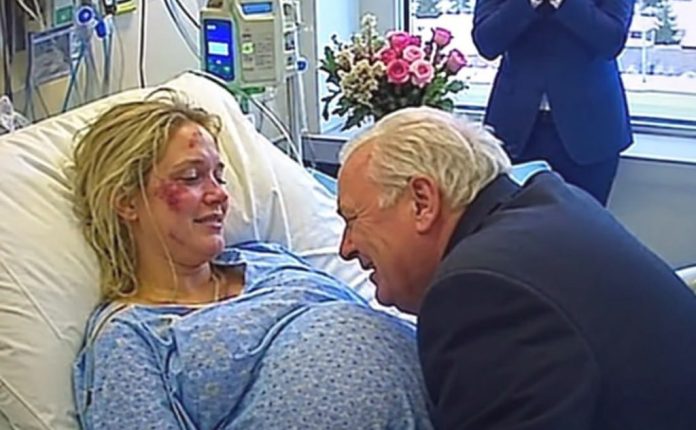
He looked alarmed. I laughed through tears and said, “Long story.” He wisely did not ask. That evening, I sat on the bedroom floor in almost the exact place where the police officer had knelt beside me five years earlier.
The mirror was gone. The scar along my cheek had faded. Henry slept down the hall. Sophie was away at university. Ben was doing homework. Ava was arguing with Ethan over the phone about a school trip.
Life had continued. That still surprised me. When a family secret explodes, the first few days make you believe ordinary life will never return. Then laundry needs folding, children need rides, babies are born, people graduate, taxes become due, and somebody forgets milk.
Normal life returns without asking whether you are ready. That is how healing often sneaks in—not as some dramatic final scene, but as Tuesday.
Mom’s health began failing seven years after the truth came out. Pancreatic cancer. Advanced. She was seventy-four. The diagnosis was brutal. Caleb called me first.
For all our conflict, he had gradually become the brother I needed again. “She has maybe six months.” I sat in my car outside work and said, “I’ll come.”
We did not discuss old money. There are moments when history becomes background. Mom chose hospice at her condominium. Caleb and I alternated nights. Vanessa came too. She and Caleb had reconciled after two years apart, though she now controlled her own finances and teased him that their second marriage required spreadsheets.
Ethan visited once. Mom apologized to him, which surprised me. “You don’t owe me an apology,” he said. She shook her head. “Yes, I do. I used your fear to buy your silence.”
Ethan looked toward me. I remained quiet. Mom told him he had been wrong to accept the money, but she knew exactly why he would. He started crying. “So did I.”
They held hands. That was enough.
A week before Mom died, she asked Caleb and me to sit beside her together. Her voice was weak. “I spent my whole life afraid there wouldn’t be enough.” I looked around the small bedroom and asked, “Enough what?”
“Money. Security. Love.” Caleb frowned at the final word. Mom explained that her own mother had favored her sister, something neither of us had known.
“She was beautiful. Easy. Everybody loved her.” Mom closed her eyes. “I was the responsible one.” Something shifted inside me. Patterns often begin long before the people repeating them understand they exist.
Mom said she had promised herself her own children would never feel insecure. I almost laughed at the tragedy. She asked what was funny. “You made us compete.”
Tears appeared in her eyes. “I know.” Caleb took her hand and asked, “Why me?” Mom looked at him. “You needed me more.”
Caleb began crying. That answer hurt him differently. He had spent decades assuming favoritism meant superiority. Mom’s explanation revealed something else: she favored the child whose dependence made her feel most necessary.
Then she looked toward me. “You didn’t need me.” I swallowed. “I did.” Mom nodded weakly. “I know now.”
Dad’s words returned immediately: Claire will rarely ask. That does not mean she needs less. Mom started crying. “I should have listened to your father.” I said yes.
“I loved you,” she whispered. I told her I knew. “Both of you.” Again, I said I knew. Caleb squeezed her hand. Mom whispered, “I just loved badly sometimes.”
No one spoke for a long time. Then I said something I had resisted for years. “I forgive you.” Mom looked at me, not relieved or triumphant, simply exhausted.
“Thank you.” Caleb said it too. Mom closed her eyes. She died five days later.
The funeral was held at the same church where she married Dad. Afterward, Caleb and I stood beside their graves—two stones, two names, one marriage containing love, favoritism, warnings, secrets, and consequences none of us fully understood while they were alive.
Caleb asked whether I thought Dad knew exactly what would happen. I smiled. “He hid a will behind a baseboard.” Caleb laughed softly. “Fair.” I said Dad knew enough.
Then Caleb looked down and apologized. I asked for what. “Being okay with being the favorite.” I thought carefully before answering. “You were a kid at first.”
“Not for twenty years.” I told him that was true. He admitted he knew Mom gave him more and simply did not want to ask why. “That was convenient,” I said. Caleb nodded. “I know.”
I looked at my brother and realized that for years I thought healing required him to suffer enough that we became equal. It did not. Nothing could equalize the past. “I forgive you too.”
He began crying. I told him to stop. “What?” he asked. “We’re at a funeral.” Caleb laughed through tears. “That seems like an appropriate place.”
We stood beside our parents’ graves until almost everyone else left. Later, Mom’s final estate proved painfully simple. Her condominium was sold, personal accounts divided equally between Caleb and me, and sentimental items distributed according to a written list.
Dad’s desk went to Caleb. His handwritten letters came to me. Mom’s jewelry was divided among the granddaughters. There were no surprise trusts, secret amendments, or unequal gifts. The attorney almost sounded disappointed.
“Everything is straightforward.” I smiled. “You have no idea how beautiful that sentence is.” Among Mom’s papers was one envelope addressed to me. For three days, I could not open it.
Finally, Sophie sat beside me and asked whether I wanted her to do it. I said no. Then I opened it myself. Mom’s handwriting had become shaky.
Claire, there is one thing I need you to know without asking you to forgive it again.
I continued reading.
When Ethan found your father’s papers, I was terrified. Not because the will existed. I had known that for years. I was terrified because the person I had most underestimated was finally close to learning exactly how much I had underestimated her.
My throat tightened. Mom wrote that she had built a story in which Caleb needed property, money, guidance, and responsibility while I needed affection and occasional help.
That story allowed me to believe I was fair. I stopped reading. Sophie held my hand. Then I continued.
Your father saw what I was doing before I did. He was right. You rarely asked. I mistook that for needing less.
Tears blurred the page.
Then I became too ashamed to correct what I had done. Shame became secrecy. Secrecy became control. Control became betrayal.
Then came the sentence I read twice.
Do not inherit that from me.
The rest was shorter.
Tell your children the truth sooner than feels comfortable. Write things down. Do not make them compete for proof of love. And if one of them needs you loudly while another needs you quietly, remember that quiet need is still need.
I love you.
Mom.
I folded the letter. Sophie rested her head against my shoulder and asked whether I was okay. “No.” She smiled faintly. “Good no or bad no?”
“Complicated no.” Sophie laughed. “Our family specialty.” That became one of our jokes: complicated truth, complicated love, complicated forgiveness.
Years passed. The educational trust eventually paid part of Sophie’s university costs, then Ben’s. Ava used her share for nursing school. Henry, the unborn baby at the center of the bedroom emergency, grew into a boy obsessed with airplanes and eventually announced he wanted to study aerospace engineering.
The trust would help him too. Every time a statement arrived, I thought of Dad—not the litigation, not Mom, not Ethan. Dad. A man writing instructions for grandchildren who did not exist yet, trying to create choices exactly as he always believed money should.
Caldwell Properties remained with Caleb. He gradually grew into the role Dad might actually have wanted for him, not because he inherited authority unquestioned but because once the assumption of automatic ownership disappeared, he finally treated the company like something he needed to earn.
Caleb paid my buyout three years ahead of schedule. I called him and reminded him the agreement gave him more time. “I know.” I asked why he paid early.
“I’m tired of owing women money.” I laughed so hard I nearly dropped the phone. Vanessa was apparently beside him because I heard her shout, “Excellent answer!”
Their marriage survived, but differently. More transparently. Vanessa became co-owner of several investments, and Caleb stopped calling financial secrecy “protecting her from stress.”
Ethan remarried eight years after our divorce. Her name was Julia. I liked her, which felt strange at first. She knew our history before marrying him. All of it.
When Ethan proposed, he showed her his business accounts, every loan, every debt, and several years of tax returns. Julia later told me, “He said secrets already cost him one marriage.” I replied, “Good.”
She laughed and called me terrifying. Ethan and I became good co-parents—not best friends and not people secretly waiting to reconcile. Something healthier.
He understood why boundaries existed. I understood regret had changed him. We stopped using the past as a weapon. Eventually, Ethan and Caleb could attend the same family events without tension.
At first they barely spoke. Later, they rebuilt a cautious friendship—two men who had both benefited from my mother’s secrecy and eventually had to learn how to function without it.
At Sophie’s university graduation, all of us stood together for a photograph: me, Ethan, Julia, Caleb, Vanessa, Ben, Ava, Henry, and Sophie wearing her gown.
For one moment, the arrangement felt absurd. Then the photographer called, “Closer.” Everyone moved inward. Families change shape. That does not always mean they break. Sometimes breaking is the shape change.
After the ceremony, Sophie handed me a small box. Inside was a framed copy of Dad’s handwritten sentence: Claire will rarely ask. That does not mean she needs less.
I covered my mouth. “Sophie.” She told me she found the scan in old case records and thought I should remember it.
Then she whispered, “And maybe stop pretending you don’t need help carrying chairs.” I laughed. She was right again.
That sentence from Dad began as evidence in a legal dispute and eventually became something closer to a family rule. When Ben became unusually quiet, I asked questions. When Ava said “nothing” too quickly, I stayed nearby.
When Henry tried solving everything alone, I reminded him people were allowed to help. When Sophie insisted she was fine during a brutal first semester, I sent groceries anyway.
Not because quiet people are secretly helpless, but because self-sufficiency should never become an excuse for neglect. I learned that lesson from both the person who hurt me most and the person who tried to protect me before he died.
Ten years after the bedroom incident, I sold the house where the will had been found. I stayed there after the divorce, raised the children there, repainted the bedroom, and replaced the broken mirror.
Eventually the house became too large. The realtor asked whether selling felt emotional. I said yes. She asked what I would miss most. I thought about it and answered, “The kitchen.”
“Anything else?” she asked. “The stairs when the kids come running down them.” She smiled. “And the bedroom?” I laughed. “Absolutely not.”
The buyers were a young couple expecting their first baby. During their final walk-through, the woman rested one hand on her stomach. I recognized the protective, automatic gesture.
She loved the main bedroom. “The light is beautiful.” I agreed. She touched the wall near the old baseboard and said they might install built-ins there. I almost warned her to check for wills first.
I stopped myself. Some stories do not need to follow the house. At closing, I signed the final documents. No family member objected. No hidden deed appeared. Nobody claimed Dad would have wanted something different.
The proceeds entered accounts in my name—clear, documented, mine. That felt ordinary and revolutionary at the same time.
I moved into a smaller home with tall windows and a backyard just large enough for family dinners. At the first Thanksgiving there, Sophie arrived early, Ben brought dessert, Ava came exhausted from nursing school, and Henry spent almost an hour explaining airplane engines to Caleb.
Ethan stopped by to return something Henry had forgotten. Julia came inside. Vanessa brought wine. Eventually everyone stayed. No seating arrangement made sense, so we pulled chairs from every room.
At one point, I stood in the kitchen looking around. My mother was gone. Dad had been gone for decades. The original family structure no longer existed, yet more people filled the table than ever before.
Nobody controlled the room. Nobody controlled the money. Nobody needed to. Sophie noticed me staring. “What?” I said nothing. She accused me of doing the emotional mom thing.
“I have no idea what you mean.” Sophie rolled her eyes and told me to sit down. I said I was getting plates. “Ben can get plates.” From the dining room, Ben shouted, “Apparently I can get plates!”
Everyone laughed. I sat. That was harder than it sounds.
For most of my life, I believed love meant being useful. Mom taught Caleb that love meant being rescued. Dad had tried to teach us something else: money creates choices, and love should too.
Real love gives people room to choose, question, leave, return, disagree, and still remain human to one another. Secrets remove choices. That was the deepest harm my family caused me.
My mother did not only hide money. She hid information that belonged to me. Ethan did the same. Caleb participated too. At different points, each claimed they were protecting the family.
What they were protecting was a version of reality that benefited them. Once I understood that, my definition of betrayal changed.
Betrayal is not only taking something. Sometimes betrayal is deciding another person does not deserve the truth because the truth might give them the power to choose differently.
That was what happened to me for twenty years. Then one unfinished baseboard, one dizzy pregnancy moment, and one falling mirror gave the truth back.
People sometimes ask whether I believe Dad somehow arranged it. I do not. I am not mystical. Dad hid papers. Ethan failed to mount a mirror. I became dizzy. Life did the rest.
But I understand why people want to believe Dad somehow reached across time, because the timing feels impossible. The will sat inside that wall before Ethan and I married, before Sophie was born, before Mom paid him, and before I ever imagined living there.
Dad placed truth inside a future he could not see, then died. He did not wait consciously, but his words did.
That is what written truth can do. It survives memory, manipulation, fear, and even the person who wrote it.
That became the final lesson our family inherited: write things down. Say what you mean. Do not make children guess whether they matter. Do not use money to measure love.
Do not call silence loyalty. Do not call control protection. Do not allow shame to convince you another year of lying is easier than one day of truth.
And when someone you love betrays you, remember that forgiveness and access are not the same thing. I forgave my mother before she died. I forgave Caleb. I forgave Ethan.
None of those decisions returned us to who we were before. That was never the purpose. The purpose was becoming people who no longer needed the old lies.
The scar on my cheek is barely visible now. Makeup can cover it completely. Sometimes sunlight catches the thin line near my jaw, and when that happens, I remember the broken mirror.
I remember Sophie holding the phone, the police officer kneeling beside me, Ethan in the doorway, Mom clutching her phone, and Dad’s papers scattered across the bedroom floor.
For years, I hated that memory. Now I see something else inside it. That was the moment the secret stopped belonging to the people who created it.
The truth became mine.
My mother hid my father’s will for twenty years because she believed she knew what our family needed better than he did. My husband hid it for five more because he feared losing what he built.
My brother accepted silence because favoritism benefited him. Every one of them eventually faced consequences. So did I.
Truth is not painless simply because it is right. It cost me a marriage. It changed my relationship with my mother. It nearly destroyed my bond with my brother.
It forced my children to learn adult truths earlier than I wanted. But secrecy had costs too. We simply had not been allowed to see the bill.
In the end, Dad’s inheritance was not Caldwell Properties, the rental houses, the family home, or even the educational trust. Those things mattered because they created choices.
But the inheritance that changed me most was a sentence written in my father’s hand long before I understood why I needed it.
Claire will rarely ask.
That does not mean she needs less.
I spent half my life believing quiet strength meant surviving without asking. Now I know better. Strength can be speaking, questioning, leaving, returning, accepting help, demanding records, and forgiving without forgetting.
Strength can mean loving someone while refusing to participate in their lie. And sometimes strength is simply sitting at a crowded Thanksgiving table while somebody else gets the plates.
Dad would have liked that.
At least, I think he would.
THE END!
Disclaimer: This is a fictionalized family-drama story created for entertainment. Characters, dialogue, inheritance details, legal events, and family relationships are dramatized, and any resemblance to actual people or situations is purely coincidental.