The first time I confronted my mother after reading Ethan’s email, attorneys were present because Marissa insisted. I was grateful. We met inside a private conference room six weeks after the bedroom incident, after investigators and forensic accountants had begun reconstructing Dad’s estate and twenty years of financial activity.
Mom entered carrying a leather handbag and wearing the navy suit she usually reserved for funerals. Caleb came with her. His attorney sat beside him. Vanessa did not attend because by then she had discovered enough about Caleb’s finances to begin asking questions of her own.
I had never seen my brother afraid of me before. It was unsettling. Mom sat directly across from me and immediately looked toward the fading scar on my cheek. “You look better,” she said. I remained silent.
“How’s the baby?” she asked. “Healthy.” She said she was glad, then folded her hands. “Claire, I never wanted you hurt.” I looked at her and asked, “Which time?” Her face tightened.
“What?” I clarified. “The night Ethan grabbed me or the twenty years before that?” Caleb shifted in his chair. Mom’s attorney tried to redirect the meeting toward estate accounting. Marissa immediately agreed. “Then let’s discuss the accounting.”
By then, investigators had reconstructed enough to make denial difficult. Dad’s second will appeared valid. The attorney who prepared it had drafted a letter to Mom shortly after Dad died informing her that a newer instrument existed. The archived copy of that letter had survived.
Mom received it. She never presented the newer will for probate. Instead, she submitted Dad’s earlier will—the one leaving nearly everything to her. That decision alone became the center of a major legal investigation, but the records revealed far more.
The company safe had been opened three days after Dad’s funeral. Patricia’s old log showed Mom and Caleb entered the office together. The signed will stored there disappeared. Caleb had been twenty-one and claimed he did not know what Mom removed.
Then the financial records told another story. Within eighteen months after Dad died, Mom began transferring company profits to herself. Some transfers covered legitimate expenses. Some paid taxes or maintained properties. More than $300,000, however, went directly or indirectly to Caleb over the following six years.
There was tuition, a car, credit-card debt, the down payment on his home, and capital for a failed restaurant partnership. Later, Caldwell Properties purchased a duplex from one of Caleb’s failing ventures at an above-market price, quietly rescuing him again.
I had received university tuition totaling approximately $38,000. For twenty years, Mom had pointed toward that contribution whenever she wanted proof that she treated us fairly. The numbers told a very different story.
Marissa placed a summary on the conference table. Mom refused to look at it. Caleb did. His face went pale. “I didn’t know it was that much.” Vanessa’s absence suddenly made even more sense.
I stared at my brother and asked whether he had never wondered how much Mom was giving him. He admitted he knew she helped. I reminded him it was money Dad intended to divide. Caleb claimed he did not know about the newer will.
Marissa quietly pushed another document across the table. An email dated twelve years earlier from Caleb to Mom. The subject line read: Claire Cannot Find Out About Dad’s Revision.
Caleb stared at it. For several seconds, nobody spoke. I almost admired how completely one piece of paper could destroy a lie. He leaned backward and said, “That was taken out of context.”
I laughed. “Please give me the context.” Mom tried to interrupt. I refused. I wanted my brother to explain. Caleb rubbed his forehead and said he knew Dad had discussed changing his will but supposedly did not know the revision had been formally signed.
I pointed toward the email. “You wrote that I couldn’t find out.” Caleb said Mom told him disclosure would create unnecessary family conflict. She claimed Dad had changed things because he was frightened about dying and therefore might not have been thinking clearly.
I reminded Caleb that Dad continued running Caldwell Properties until three weeks before he died. He signed leases, met his accountant, approved repairs, and negotiated contracts. Apparently, every decision remained valid except the one that gave me equal inheritance rights.
Caleb looked down. The truth was becoming less about money and more about who our mother believed deserved power. Mom finally spoke. “You were seventeen.” I asked what my age had to do with anything.
She reminded me I was still in high school, emotional, planning to leave town for university, and uninterested in running the company. Caleb, she said, understood the business and cared about preserving it.
I told her Dad’s will did not require me to manage daily operations. “He wanted you to own half,” she said. I answered yes. Mom insisted I probably would have sold my interest. I reminded her she had no right to make that decision for me.
“I knew you,” she said. I leaned forward. “No. You decided who I was and stole my choice.” Mom flinched. Her attorney whispered something, but she ignored him.
“I kept the company together,” she said. “For Caleb,” I replied. She insisted it was for the family. I stopped her. “There it is again. Family. You keep saying family when you mean Caleb.”
My voice began shaking. I reminded her she gave Caleb money because he was family, hid my inheritance to protect the family, and paid my husband because she did not want the family disrupted. Mom immediately denied paying Ethan for silence.
“You gave him almost three hundred thousand dollars after he showed you Dad’s will.” She said Ethan needed help. I looked directly at her. “So did your grandchildren.”
That landed differently. For the first time, Mom looked genuinely uncertain. I placed the educational trust calculations on the table. Dad’s trust should have held somewhere between $640,000 and $910,000 depending on how assets had been invested.
Instead, there was no separate trust account at all. The required contributions were never made. Sophie was already approaching high school. Ben would follow, then Ava and the baby. Their grandfather had planned for them before they existed.
Their grandmother had erased that plan. Mom whispered that she had paid for things over the years. I asked what things. Birthdays. Camps. Christmas presents. Caleb closed his eyes because even he understood how weak that sounded.
“You bought Sophie a laptop and called it generosity while withholding a trust her grandfather created for her.” Mom began crying. “I thought there would always be enough.” I asked the only question that mattered. “Enough for whom?”
She had no answer. Marissa ended the meeting soon afterward. Before I left, Mom called my name. I stopped but did not turn immediately. She said, “Your father loved you.”
I faced her. “I know.” The answer surprised her because for twenty years she had controlled access to Dad’s intentions. Now she could not. “I know because he wrote it down.”
Mom looked away. That was the first power I truly took back. Not money. Certainty.
The investigation continued for months. I gave birth in December to a healthy boy. We named him Henry. Not because I wanted to make some dramatic statement, but because after reading Dad’s letters, I finally understood how much of my father I had spent twenty years believing was gone.
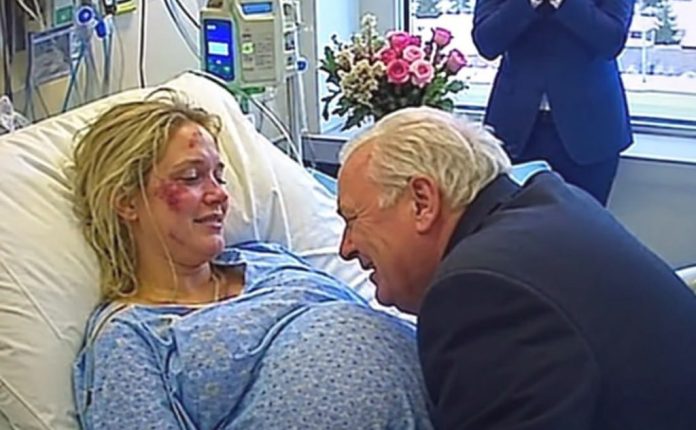
Ethan was at the hospital, though I did not allow him inside the delivery room. He met his son afterward. We were already separated by then, and I had filed for divorce three weeks before Henry’s birth.
Ethan cried while holding the baby. “I’m sorry.” I believed he was. That did not repair anything. He asked whether there was still a chance for us. I looked at the man I had loved for seventeen years.
He was the father who built Sophie a playhouse, taught Ben to ride a bicycle, held Ava all night when she had pneumonia, and slept beside me through miscarriages. He was also the husband who found my father’s will and converted my ignorance into financial rescue for himself.
Both versions were real. That was why betrayal hurt so deeply. If Ethan had never loved me, leaving would have been easier. He loved me and still betrayed me. “I don’t know how to trust you again,” I told him.
“I’ll earn it,” he promised. I answered, “You should become trustworthy whether I return or not.” His face crumpled. That was the end of the conversation.
Our divorce became complicated because some of Mom’s payments had flowed into marital assets. Ethan’s lawyers initially argued that several transfers were legitimate business loans. Then Mom’s own records showed she had privately forgiven most of them.
One handwritten note beside a $60,000 transfer read: For keeping peace with Claire. After that, Ethan stopped pretending. He accepted responsibility—not immediately gracefully, but eventually.
He pleaded to a reduced charge arising from the bedroom incident after completing counseling and agreeing to conditions recommended by the prosecutor. I did not ask for harsher punishment, but I did not ask for leniency either.
For years, I had helped people avoid consequences because their discomfort made me feel cruel. I stopped doing that. Ethan remained an involved father. Our children loved him. I never asked them not to.
Sophie struggled most because she had witnessed everything—the grabbing, blood, police, her father being taken downstairs, and Grandma trying to recover the hidden documents. She also knew Ethan had concealed Grandpa’s will for five years.
For months, she refused to answer his calls unless they involved her siblings. Ethan never blamed her. That mattered. Eventually, he wrote her a letter explaining exactly what he had done without asking for immediate forgiveness.
I was afraid of losing my company. I accepted help I should not have accepted. Then every year I stayed silent made telling the truth harder. None of that was your mother’s fault.
Sophie showed me the letter and asked what she should do. I told her, “Whatever feels honest.” She said she still loved him. I told her that was allowed. She said she was still furious. That was allowed too.
“Everything can be true at the same time?” she asked. I said yes. That became one of the central lessons our family learned: love and anger, forgiveness and boundaries, regret and consequences, compassion and truth can occupy the same room.
Caleb’s marriage also began unraveling. Vanessa discovered he had hidden other financial decisions from her. Nothing exactly like Ethan’s agreement with Mom, but enough to damage trust. He had borrowed against their investment account twice without telling her.
He had also accepted more than $90,000 from Mom during the previous decade while allowing Vanessa to believe his business earnings funded their lifestyle. For years, Vanessa thought her husband was more successful than he actually was.
The pattern repeated itself. Mom funded men she wanted to protect, then expected the women around them not to question where the money came from. Vanessa filed for legal separation. At first, Caleb blamed me.
He called one evening and said, “This didn’t have to happen.” I asked what exactly he meant. He said everything could have been handled privately. I reminded him I had spent twenty years asking the wrong questions because nobody allowed me access to the real information.
“You blew up the family,” he said. I was tired of that accusation. “No. I found what was already burning.” Caleb went quiet, then told me Mom’s health was deteriorating because of anxiety and high blood pressure.
I felt sad despite everything. Betrayal does not immediately erase the instinct to care about someone. I told him she should see her doctor. Caleb said she needed her children. I replied that she still had us, simply not in the same way as before.
“Can’t you forgive?” he asked. The question angered me. “Forgiveness is not pretending nothing happened.” Caleb reminded me she was our mother. I reminded him Sophie was my daughter, Ben my son, Ava my daughter, and Henry my son.
Dad created something for all of them, and Mom decided her judgment mattered more. Caleb said she made mistakes. I answered, “For twenty years.” He insisted she thought she was protecting us.
“From what?” I asked. He had no answer. “From me?” Still nothing. That ended the call.
The forensic accounting eventually produced a number: $1.74 million. That represented estate assets, company distributions, trust contributions, investment growth, and property interests that should have been divided or preserved differently under Dad’s later will.
It did not mean Mom had $1.74 million sitting in one bank account. Much had been spent, some remained tied up in real estate, some went to Caleb, some to Ethan, and some covered Mom’s own legitimate expenses.
Other assets had appreciated or been sold. Untangling everything felt less like finding stolen cash and more like reconstructing twenty years of alternate history. I began wondering what my life would have looked like if Dad’s plan had been followed.
Would I have chosen the same career? Bought the same house? Married Ethan? Would his company have survived without Mom’s money? Would Caleb have learned financial discipline if she had not rescued him repeatedly? There were no answers.
Money changes choices. So does its absence. Marissa warned me not to waste too much energy calculating the life I never got. “Recover what can be recovered,” she said. “Then build from there.”
Mom initially refused settlement. She insisted on keeping the family home until death, which was actually consistent with Dad’s will. I agreed. That shocked her. “You’re not trying to take my house?” she asked.
“It is your house while you live there.” She stared at me. I could almost see her trying to understand that I was not seeking revenge. I wanted Dad’s wishes followed, which was different from making decisions based on who I thought deserved punishment.
The larger negotiations centered on Caldwell Properties. Caleb had spent sixteen years running it and argued that giving me half would destroy the company. I did not want half the daily operation. I wanted the value Dad intended me to receive.
Eventually, attorneys proposed a buyout structure. Caleb would retain operational control while I received a combination of investment assets, cash over time, and property interests. The grandchildren’s educational trust would be restored first. That part was nonnegotiable.
Mom resisted because fully funding it required selling two rental properties she considered part of the family legacy. During mediation, Marissa asked her a simple question: “What is the purpose of a family legacy if not benefiting the family members the creator specifically named?”
Mom had no answer. The properties were sold. The educational trust was restored to approximately $725,000. When the independent trustee sent the first official statement, I sat at my kitchen table and cried.
Not because my children had suddenly become wealthy. They had not. The funds were restricted primarily for education and would be divided among several grandchildren, including Caleb’s children. Dad had treated them equally too.
That detail hurt Mom in a different way. The man she repeatedly claimed wanted Caleb favored had written documents treating his grandchildren fairly regardless of which child they belonged to. Dad’s fairness had survived her favoritism.
On Sophie’s fifteenth birthday, I showed her the trust statement. She stared at the amount and asked whether it was Grandpa’s money. “His plan,” I told her. She asked whether Uncle Caleb’s children benefited too. I said yes.
Sophie smiled slightly. “That’s actually kind of cool.” I asked why. She said, “Because Grandma couldn’t turn us against each other with it.” I looked at my fifteen-year-old daughter and realized she understood something adults in our family had failed to understand for decades.
Money can divide families. Transparency makes it harder to weaponize. By spring, Mom agreed to the broader settlement. She retained the family home for life. Caleb kept Caldwell Properties under a valuation and payout agreement.
I received two rental properties, investment assets, and scheduled payments. The grandchildren’s trust became independently administered. Mom surrendered all trustee and executor authority. That consequence devastated her more than the financial loss because control had become part of her identity.
Without it, she had to exist simply as our mother. That turned out to be harder for her than managing millions.
For months, she and I barely spoke. Then Ava asked to visit her. “Grandma didn’t hurt me,” she said. I swallowed and told her that was true. “Can I go?”
My first instinct was no, not because Mom was physically unsafe but because allowing access felt like surrender. Then I remembered what I kept teaching Sophie: love and anger can coexist.
I called Mom and said Ava wanted to visit on Saturday. Mom started crying and immediately offered to make lunch. I established clear boundaries. No money talk, no complaints about lawyers, no telling Ava that Mommy was angry with Grandma, and no involving her in adult problems.
Mom agreed. Ava visited and returned carrying cookies and a stuffed rabbit. I examined the rabbit jokingly as though it might contain legal papers. Ava laughed and told me I was weird. She was right.
Betrayal changes your nervous system. For a while, even kindness feels suspicious. Mom rebuilt relationships with the children slowly. Ben remained distant. Sophie more so. She refused to be pressured, and eventually Mom complained that Sophie barely spoke to her.
I reminded her that Sophie had watched police take her father away while her grandmother tried to recover hidden documents. Mom looked down and admitted, “I didn’t think about what that looked like to her.”
“That has been part of the problem,” I said. Mom asked what I meant. “You keep thinking about what things mean to you after everyone else has already experienced them.”
She flinched. I almost apologized for being harsh, then stopped. Truth did not always need softening merely because it caused discomfort. Mom began therapy. Caleb told me before she did, and I was skeptical until she continued attending regularly.
Months later, she asked me to join one session. I agreed to go once. Her therapist asked why she had concealed Dad’s later will. Mom gave the same explanations I had heard for months.
I was seventeen. Caleb understood the business. She feared instability. Dad had been ill. She wanted to preserve the company. The therapist listened quietly, then asked, “Why didn’t you tell Claire when she became an adult?”
Mom stopped talking. The question stripped away every excuse connected to my age. I watched her search for another explanation. Finally, she said, “Because by then I had already done too much.”
The therapist asked what that meant. Mom looked at me. “If I told her at twenty-five, I had to admit what I did when she was seventeen.” Suddenly, I understood.
The same mechanism had trapped Ethan. The first lie creates the second. The second protects the first. Eventually, confession becomes more expensive than continued deception, so people keep lying while insisting they are delaying the truth for everyone else’s benefit.
Mom wiped her eyes. “Every year I waited made it worse.” I said yes. She told me she kept thinking she could balance things later by giving me gifts—help with our wedding, tuition, the discounted house.
I reminded her those were gifts she chose. Dad had given me ownership rights she removed. Her face crumpled. “I know.” That was the first session where she said those words without immediately explaining herself.
No but. No you have to understand. Just acknowledgment. Something softened inside me—not enough for trust, but enough for grief.
I realized I had spent months seeing Mom only as the woman who betrayed me. She was also the woman who braided my hair badly when I was six, slept in a hospital chair beside me when I had pneumonia, and screamed louder than anyone at my university graduation.
She held Sophie before I did because I hemorrhaged after delivery. Those memories did not absolve her. They complicated her. Real people are inconvenient that way. Legal cases prefer neat categories—wrongdoer, trustee, beneficiary, victim. Family life refuses to stay inside them.
The next Christmas was our first large gathering after the settlement. I almost skipped it, but Sophie wanted to attend. So did Ben. Ethan had the younger children that morning and planned to bring them later.
Then I learned Mom had invited him too. I called her furious. “You paid him to keep secrets from me, and now you’re serving him turkey?” Mom sighed before answering, “He is the children’s father.”
I was still angry until she added something unexpected. “I am trying to stop deciding who is allowed to belong.” That sentence silenced me. It was perhaps the most self-aware thing she had ever said.
“Fine,” I replied. Mom seemed surprised. “Fine?” I repeated it. Christmas was uncomfortable at first, then ordinary, then strangely healing. Ethan helped Caleb carve the turkey. Vanessa arrived separately from Caleb because they were still separated but trying counseling.
Sophie sat beside me. Mom deliberately chose a chair halfway down the table instead of sitting at the head. Nobody mentioned the symbolism. Everyone noticed. Before dinner, Mom stood.
My entire body tensed. She noticed immediately and said, “No announcements about money.” Several people laughed nervously. Then she held a folded piece of paper and said she wanted to say one thing.
“For twenty years, I told myself keeping secrets protected this family.” The room became silent. Mom looked down. “It protected me.”
Caleb lowered his eyes. Ethan stopped moving. Mom’s voice shook as she admitted she did not want to follow Henry’s instructions because she believed she knew better. Later, she did not want to face me because she knew what admitting the truth would cost.
“I chose control over honesty,” she said. Then she looked at me. “I hurt my daughter.” She looked toward Caleb. “My son.” Finally she looked around at the grandchildren.
“And every child who learned that love in this family came with hidden accounting.” Nobody moved. Mom folded the paper and said, “I cannot undo twenty years. I can stop lying about them.”
She sat down. There was no applause, no dramatic reconciliation, and no instant forgiveness. Just silence. Then Ava asked, “Can we eat now?” Everyone laughed, including Mom.
It was the first family laughter after the truth that did not feel guilty.