Daniel drove to Margaret’s condominium that night. I asked him not to go while he was angry. He replied, “I’m past angry,” which worried me even more. Owen wanted to come, but Daniel refused. “This is between me and my mother.” For once, Owen looked relieved to be excluded.
Daniel returned three hours later looking exhausted. I was waiting at the kitchen table. He sat down and said Margaret admitted she knew about Robert’s letter. Something inside me sank, even though I had already suspected the truth.
I asked why she had ignored it. Daniel stared at the table. “She thinks Dad was naive.” I repeated the word. “Naive?” He nodded. “She said he trusted people too much.” I almost laughed. “People meaning me?” Daniel looked miserable. “Yes.”
Margaret believed Laura’s painful divorce proved that any marriage could collapse and threaten family property. Laura’s first husband had fought over almost every asset when they divorced twelve years earlier, and Margaret apparently decided that experience meant daughters-in-law were permanent financial risks.
“So she ignored Robert?” I asked. Daniel nodded. “And gave the house to Owen?” Another yes. Then I asked the obvious question. “Why not create a trust for all six children?” Daniel’s face hardened. “Because she doesn’t trust girls to keep family property.”
For a moment, I thought I had misheard him. “What?” Daniel explained that Margaret believed Grace, Emma, Sophie, and Lily would eventually marry and that the property could somehow leave the Hayes name. I asked about Lucas. Daniel said she considered him too young to take responsibility.
“So Owen gets everything because he was born first and male?” Daniel nodded miserably. For years, Margaret’s favoritism had looked emotional. Now we understood it was ideological. She believed family legacy traveled through men. Not daughters. Not daughters-in-law. Sons.
And when her own son failed to fit her preferred structure because his wife had legal marital rights, she skipped him and chose the oldest grandson instead. Daniel said Margaret genuinely believed she was protecting Robert’s legacy. I replied, “She’s rewriting it.” Daniel told me he had said exactly that.
I asked whether Margaret apologized. Daniel looked at me and said no. Of course she had not. Instead, she proposed a solution that somehow made everything more insulting. She wanted Owen to retain ownership but sign an agreement allowing Daniel and me to live in the house for life.
I stared at him. “She wants our son to grant us permission to live in the house we paid for?” Daniel nodded. I called the idea insane. He agreed. When he rejected it, Margaret accused him of allowing pride to destroy the family.
I laughed again, not because anything was funny, but because sometimes absurdity becomes too large for ordinary anger. The following day, Stephanie reviewed Robert’s letter. It did not automatically invalidate Margaret’s deed because the estate structure had left her as legal owner after Robert died.
However, the letter mattered emotionally and potentially as evidence of the representations made to Daniel over the years. We also found years of emails in which Margaret wrote things like, “This will be yours someday,” approved improvements, called the home “your inheritance,” and congratulated us after we paid off the mortgage.
Stephanie became very careful with her language. “You may have legal claims.” Daniel immediately shook his head. “I don’t want to sue my mother.” Stephanie said she understood. He told her, “I just want the house put where it was supposed to be.”
Owen spoke next. “Then I’ll transfer it.” This time, Stephanie did not stop him. Instead, she suggested creating a family trust. The property would not belong solely to Daniel, me, or Owen. Daniel and I would control it during our lifetimes, and all six children would be protected fairly later.
The plan was almost embarrassingly sensible. It was exactly the structure Margaret could have chosen if fairness and protection had actually been her goal. Owen loved the idea immediately. “So everyone gets something?” Stephanie said yes. Owen asked, “The girls too?” Stephanie looked surprised.
“Of course,” she said. Owen nodded firmly. “Good.” Daniel looked away, and I knew why. His eighteen-year-old son understood fairness more naturally than Margaret did at seventy-four. We prepared the documents, thinking perhaps the crisis was finally moving toward resolution.
Then Margaret discovered what we were doing. I never learned who told her. Maybe Harold, maybe Laura, maybe somebody else. She called Daniel screaming, “You are stealing Owen’s property!” Daniel held the phone away from his ear and calmly replied that Owen had requested the trust.
Margaret insisted Owen did not understand what he was doing and accused Daniel of pressuring him. Owen was sitting across from us and held out his hand for the phone. Daniel gave it to him. “Grandma.” Her tone changed immediately. “Owen, sweetheart.”
Owen told her his father was not pressuring him. Margaret insisted the house could someday be worth millions. Owen replied, “Then all six of us can benefit.” Margaret said the property could not practically be divided among six people. Owen explained that a trust could handle it.
“Who filled your head with that?” Margaret demanded. Owen said, “Our attorney.” Margaret repeated the word our as though it offended her personally. Owen continued, “I don’t want to own everybody’s home.” Margaret said she had given him security.
“You gave me guilt,” he replied. That silenced her. Owen admitted he had barely slept since his birthday. Margaret’s voice cracked as she said, “I did this because I love you.” Owen told her he knew. Then she asked, “So why are you punishing me?”
Owen began crying. “I’m not.” Margaret insisted that he was. Owen said, “No. I’m trying to make it fair.” Margaret answered with the belief beneath everything she had done: “Fairness destroys family property.”
Owen stared at the phone, then toward Grace, who had entered the kitchen without any of us noticing. She looked frightened. Owen said, “No, Grandma. Favoritism destroys families.” Then he ended the call.
Grace walked over and hugged him. Owen cried into his sister’s shoulder. That image replaced Margaret’s birthday photograph in my mind: an eighteen-year-old boy holding his fourteen-year-old sister because their grandmother had transformed inheritance into competition.
We signed the trust documents two weeks later. Owen transferred the property. For the first time since we moved into the house thirteen years earlier, Daniel and I had legal rights matching what we had been told all along. Not complete individual ownership, but something better.
Something clear. Something written. Something that did not depend on family promises, private assumptions, symbolic traditions, or one person’s interpretation of another person’s wishes. I thought the worst part was finally over. I was wrong.
Margaret retaliated emotionally. She stopped speaking to us, stopped attending the children’s activities, and mailed birthday cards without money. That part would have been completely acceptable. What was not acceptable were the messages she began writing inside them.
To Owen, she wrote, I hope someday you understand what you gave away. To Grace: Be grateful your brother sacrificed his inheritance for everyone. To Emma: Family property disappears when people stop respecting tradition. I intercepted Sophie’s card before she read it.
That was enough. Daniel called Margaret. “Stop involving the kids.” She said she was allowed to communicate with her grandchildren. Daniel replied, “Not like this.” Margaret told him he could not control her. He answered, “No. But we control access to our minor children.”
Margaret became furious and accused him of keeping the grandchildren away from her. Daniel explained that he was protecting them from adult guilt. Margaret snapped, “You sound like Rebecca.” Daniel paused before answering, “Good.” I cried when he told me.
I did not need Daniel to choose me over his mother. I needed him to stop treating loyalty as silence. For nineteen years, he had avoided confronting Margaret because peace seemed easier. Now he understood that peace built on one person absorbing harm is not peace. It is cooperation with the harm.
Laura openly supported us, and that damaged her relationship with Margaret too. Margaret accused her own daughter of betraying the family. Laura replied, “Dad wrote the letter. I’m not betraying him by reading it.” Margaret stopped speaking to Laura for nearly three months.
Extended relatives began choosing sides. Some believed we had publicly humiliated Margaret. Others believed she had created the entire crisis herself. One cousin told Daniel, “She gave Owen a seven-hundred-thousand-dollar house. Most kids would be grateful.” Daniel answered, “It wasn’t available to give without consequences.”
The cousin shrugged and said, “It was legally hers.” I began hating that phrase. Legally hers. Legal ownership answered one question. It did not answer whether her decision had been honest, fair, responsible, or humane.
Another relative privately told me I should have been grateful because we had lived in a beautiful home. I asked, “Would you pay off someone else’s mortgage for thirteen years because they promised you the property, then happily watch them give it to your child?” She had no answer.
Some people understand betrayal only after you remove sentimental family language and replace it with numbers. Six months passed. Margaret missed Thanksgiving, something that had never happened before. We set an extra place anyway, but she did not come.
Daniel said nothing during dinner. Later, I found him sitting alone on the patio. I asked whether he was okay. “No.” I sat beside him and said, “She’s your mother.” Daniel nodded. I reminded him he was allowed to miss her even while remaining angry.
He stared into the yard and said, “I keep thinking about Dad.” I asked what specifically. Daniel explained that Robert had spent his entire life making sure Margaret felt secure, and now she was using his memory to justify decisions he had explicitly opposed.
“She turned his memory into a weapon,” Daniel whispered. That was exactly what she had done. She repeatedly claimed Robert would support choices his own letter contradicted. Daniel admitted, “I don’t know how to forgive that.” I held his hand and said he did not have to decide that night.
Christmas arrived. Margaret mailed gifts for the children. Daniel made the decision to return them unopened because some contained notes about inheritance and loyalty. He included a letter explaining our boundary clearly.
Mom, we love you. We want you in our lives. But you cannot send gifts carrying guilt, favoritism, or messages about inheritance. If you want a relationship, it has to be with all six children equally and without punishing them for adult decisions.
Margaret did not respond. January passed, then most of February. Then unexpectedly, she fell in her condominium. Laura found her on the kitchen floor after Margaret failed to answer several calls. She had fractured her hip and needed surgery.
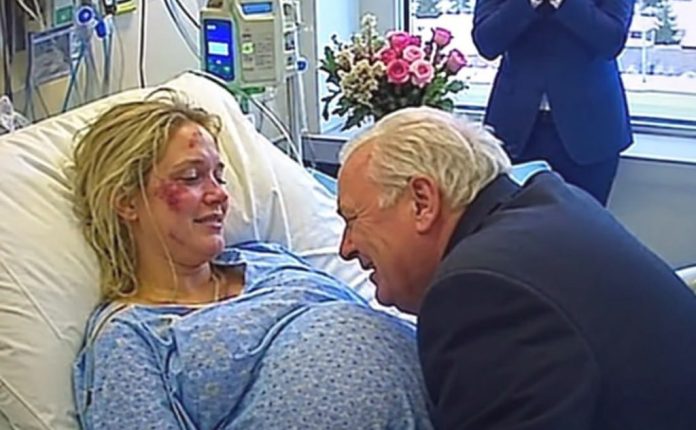
Daniel drove to the hospital immediately. I went too. Whatever anger existed, she was still family. When we entered the room, Margaret looked frightened and suddenly much smaller—not the woman holding legal documents at Owen’s birthday, but a seventy-five-year-old woman lying helplessly in a hospital bed.
Daniel approached first. “Hi, Mom.” Margaret started crying. He leaned down and hugged her. I remained near the doorway until she looked toward me. For several seconds, neither of us spoke. Then she whispered, “Rebecca.” I answered quietly, “Hi.”
Her eyes filled with tears. “I’m sorry.” I nearly accepted automatically, then stopped myself. “What are you sorry for?” The question surprised Margaret and Daniel, but I had learned something during those months.
“I’m sorry” can mean please stop being angry. It can mean I dislike the consequences. It can mean I want normal back. I needed to know which apology she was offering. Margaret swallowed and said, “I’m sorry this happened.”
I nodded slowly. “That’s not the same as being sorry for what you did.” She looked away. Daniel said gently, “Mom.” Margaret began crying harder and said, “I thought I was doing the right thing.” I moved closer and answered, “I believe you.”
She looked at me. I continued, “But you still hurt us.” Margaret whispered, “I know.” I asked, “Do you?” Silence followed before she finally said, “Yes.” For the first time, I believed she might actually be beginning to understand.
Recovery forced Margaret to depend on other people, and that changed something in her. Daniel and Laura alternated hospital visits. I brought meals. Owen visited once, and Grace came with him. Margaret looked genuinely surprised when Grace entered the room.
Grace remained near the doorway at first. Margaret held out one hand. Grace hesitated, then took it. Margaret said, “I’m sorry.” Grace asked, “For what?” Apparently, that question had become hereditary.
Margaret smiled sadly and said, “For making you feel less important.” Grace’s chin trembled. “You did.” Margaret nodded. Grace continued, “You always liked Owen best.” Owen looked uncomfortable, but Margaret did not deny it. “Yes,” she said.
Grace seemed almost stunned by the honesty. “Why?” Margaret looked toward Owen. “Because he reminded me of your grandfather.” Grace reminded her that she remembered Robert too, even though she had been young. Margaret nodded. Then Grace asked the harder question.
“And because he was the oldest boy?” There was a long silence. Margaret finally said, “Yes.” Grace started crying and said, “That’s stupid.” Owen almost laughed. To our surprise, Margaret laughed weakly too. “Yes,” she answered. “It was.”
That conversation did more healing than months of arguments because Margaret finally stopped defending every choice. There is a particular relief in hearing someone say, I was wrong, without attaching an entire paragraph that begins with but.
After hip surgery, Margaret spent seven weeks in rehabilitation. During that time, Daniel and I visited regularly. We did not discuss the house every day. Mostly we talked about physical therapy, medication, television programs, grandchildren, and whether hospital coffee actually qualified as coffee.
Normal conversation returned gradually. Trust returned much more slowly. One afternoon, Margaret asked to speak with me alone. Daniel left the room, and she looked toward the window for several seconds before saying, “I never liked that you asked about paperwork.”
“At the beginning?” I asked. She nodded. “When we moved in?” Yes. I asked why the question had bothered her. Margaret said it made her feel as though I did not trust her. “I didn’t know you well enough yet,” I replied.
She nodded. “I took it personally.” I told her that still did not explain thirteen years. “No,” she said. Then she admitted that over time she knew Daniel and I believed the house would eventually become ours.
“I could have corrected that,” Margaret said. “Yes,” I answered. “I didn’t.” I asked why. Her response surprised me. “Because I liked what you were doing to it.” I stared at her while she continued.
She mentioned the roof, foundation, windows, kitchen, deck, and mortgage. “You fixed everything Robert and I had delayed.” Margaret admitted she kept telling herself we were benefiting because we lived there, but she also knew we were investing because we believed the property represented our future.
“I used your belief,” she said. There it was, more honest than anything she had offered before. Not a misunderstanding. Not tradition. Not legality. She had allowed us to invest under an assumption because that assumption benefited her plans.
“I’m sorry,” Margaret whispered. This time, I believed the apology. I did not hug her. Not yet. Forgiveness does not need theatrical proof. Sometimes it begins with believing that someone has finally named the harm correctly.
I said, “Thank you for saying that.” Margaret nodded, then asked whether I hated her. I said no, and her shoulders relaxed. Then I added, “But I don’t trust you like I used to.” The relief left her face.
“I understand,” she said. That mattered too because she did not argue. Trust cannot be demanded as payment for an apology. It must be rebuilt through behavior. Margaret began rebuilding it slowly.
She attended Sophie’s school concert and brought flowers only for Sophie, without comparing her to Owen or discussing family legacy. At Lucas’s birthday, she gave him roughly what she had given Grace the year before. She began tracking gifts so the children were treated approximately equally.
When Owen graduated high school, Margaret gave him Robert’s old fountain pen. Not money. Not property. A memory. Owen hugged her, and it was the first time I had seen them embrace since his birthday.
A year after the deed transfer, we held another backyard gathering. It was smaller, family only. I almost canceled because the yard carried too many memories, but Daniel said, “Maybe we need a new one.” So we tried.
Margaret arrived carrying potato salad. Nothing dramatic. No envelopes. No legal documents. No symbolic keys. Grace joked, “Did you check her purse?” Margaret heard her, and everyone froze.
Then Margaret opened the purse and dumped its contents onto the patio table. Lipstick. Wallet. Tissues. Glasses. Peppermints. A church bulletin. Nothing else. “There,” she said. Grace started laughing, then Owen, then all of us.
Even Margaret laughed. Humor does strange things to old pain. It does not erase what happened. It creates space around it. That afternoon, we took another family photograph.
Margaret stood slightly apart at first until Lily pulled her closer. “Grandma, here.” She came. Daniel placed one arm around me. All six children crowded around us. Lucas blinked, Sophie leaned sideways, Owen forgot his cap, and Margaret’s hair blew into her face.
It was technically a worse photograph than the first. I liked it much more because nobody was hiding an envelope.