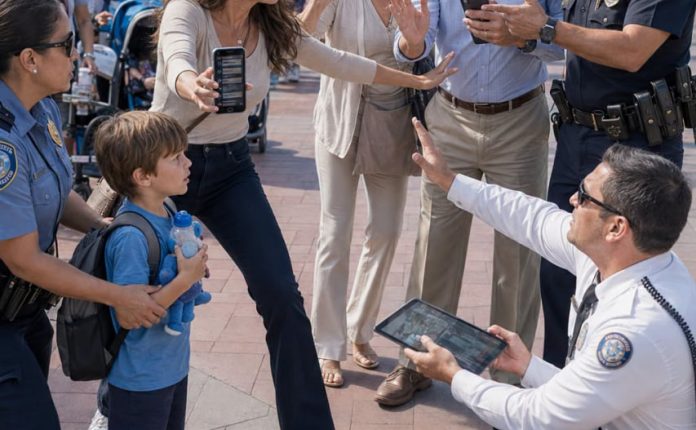
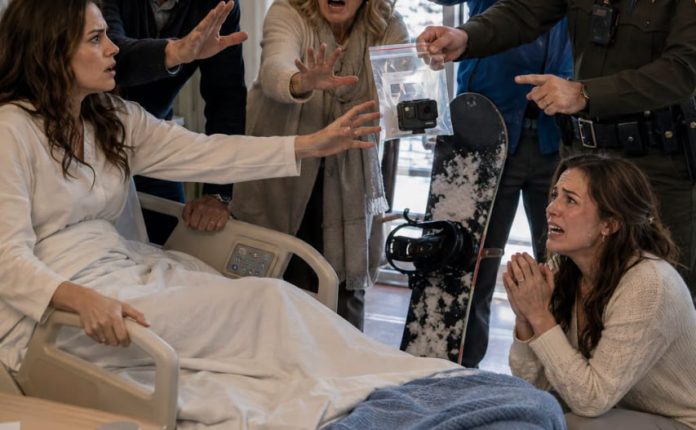
Nobody moved for several seconds after Grandma spoke those three words. Give it back. Richard’s face looked unfamiliar to me. The confidence had vanished. The banker who always had explanations, numbers, technical language, and arguments had disappeared. He looked like a frightened little boy being confronted by his mother.
“Mom,” he whispered, “you don’t understand.” Grandma’s eyes flashed with the strongest expression I had seen from her since before the stroke. With my mother’s help, she lowered herself back into the wheelchair. Then she forced out one final word. “Enough.” Almost immediately, her strength seemed to disappear.
My mother wheeled Grandma away from the table. The room stayed silent until they reached the hallway, then everyone began talking at once. Richard raised his voice above the others. “This is exactly what Laura wanted!” I stared at him. “What?” He said bitterly, “A spectacle.”
My cousin Sarah stood. “No.” Richard pointed toward me. “She planned this.” Sarah shook her head. “She brought records. You brought excuses.” Jonathan picked up Joseph’s summary and asked, “This says the trust paid your property taxes.” Richard stayed silent. Another cousin asked if the mortgage payment listed there was real.
“Richard?” someone pressed. “Yes,” he snapped. The admission silenced the room again. My brother Peter pushed back his chair and said, “You stole from us.” Richard answered, “I invested in a family asset.” Peter fired back, “It isn’t a family asset.” Richard insisted, “It functioned as one!”
Peter laughed bitterly. “So if you sell it tomorrow, do we split the money?” Richard stared at him without answering. Nobody needed a response. Then Diane suddenly stood and said, “Stop.” Everyone looked toward her. Her face was streaked with tears as she turned slowly toward her husband.
“You told me the trust had invested in the property,” Diane said. Richard’s expression changed. My heart sank. Diane continued, “You said your father wanted the house maintained for family use.” Richard glanced around and said, “Diane—” She cut him off. “No. You told me there was paperwork.”
The room became completely still. Diane asked, “Was there?” Richard said nothing. Her face collapsed as the truth reached her. “Oh my God.” She walked out of the dining room, and Richard followed. At the front door, he turned back toward me with anger and humiliation written across his face.
“I hope you’re happy,” he said. I almost answered, but Ethan touched my wrist. When I looked at my son, his expression stopped me. There was nothing useful left to say. Richard walked out. Christmas dinner ended without anyone formally ending it, leaving thirty-five people surrounded by untouched dessert and scattered financial records.
Some relatives left immediately. Others stayed to help my mother clean. A few remained around the table reading Joseph’s summary line by line, occasionally asking questions I answered only when I knew the documented truth. Nobody celebrated, but for the first time since this began, nobody pretended anymore either.
That evening, I visited Grandma in the guest room. She was exhausted and her speech had disappeared again. I sat beside her and held her hand. “You didn’t have to do that,” I whispered. She looked at me. I added, “Grandpa would be proud of you.” Her eyes filled with tears.
Three days later, Richard’s attorney contacted Maya and requested settlement discussions. I expected excuses, but their first proposal offered repayment of less than half the documented withdrawals. Maya rejected it immediately. A second proposal suggested transferring partial ownership of Coral House into the trust. We rejected that too because nobody wanted the house anymore.
The family had loved Coral House because of the memories attached to it. Once we knew what financed those memories, owning part of it felt less like compensation and more like inheriting evidence. Then Joseph uncovered another problem: Richard had refinanced Coral House three separate times over the years.
Each refinancing extracted equity. Some of that money went into personal investment accounts, other portions funded renovations, and one portion helped purchase a boat. The total benefit Richard had received from trust-supported transactions was larger than we originally believed. During mediation, Maya carefully walked through Joseph’s findings.
Richard became furious. “You’re counting the same money twice,” he insisted. Joseph calmly explained the tracing. Richard argued again. Joseph corrected him. Richard challenged another number, and Joseph opened another spreadsheet. Eventually, Richard stopped talking because the records kept answering questions his explanations could not.
Mediation lasted eleven hours. My mother attended the first hour, then left because she could not bear sitting across from her brother. Diane remained for the entire day but barely looked at Richard. Near the end, she asked to speak privately with her attorney. When everyone returned, the tone had changed.
Coral House would be sold. The boat would be sold. Richard would liquidate specific investment accounts and make additional payments over time. He would resign permanently as trustee, an independent corporate trustee would take control, and Richard would waive any claim to unpaid trustee compensation connected with the trust.
The settlement could not restore every dollar that might have existed if Grandpa’s investments had remained untouched. Twenty-two years of potential growth had been lost. Nothing could completely reverse that. But the settlement restored enough money to fund remaining eligible beneficiaries and rebuild a substantial portion of what Grandpa intended to preserve.
I thought reaching a settlement would feel victorious. It did not. It felt like cleaning up after a fire: necessary, exhausting, and sad. When Coral House was listed for sale, the real estate photographs circulated through our family group chat. Nobody commented at first because every room now carried two versions of history.
There was the kitchen where we prepared Thanksgiving dinner, the pool where our children learned to swim, the dock where descendants took annual photographs, the guest suite where relatives slept, the screened patio, and the long dining table. Every beautiful space carried the memory we had lived and the truth underneath it.
My cousin Sarah eventually wrote, I hate that I still love that place. I replied, The memories were ours. What Richard did doesn’t get to own those too. That became something I repeated to myself. Our laughter had been honest. Our love had been honest. The children’s happiness had been real.
Richard’s deception did not make every Thanksgiving fake. It simply meant the generosity we attributed to him had actually belonged to someone else. Coral House sold five months later to a retired surgeon from Ohio who knew nothing about our family. A substantial payment from the sale went directly into the restored trust.
Ethan received his ten thousand dollars shortly before beginning college. The new trustee mailed the check, and he opened it at our kitchen table. For a moment, neither of us spoke. Then he asked, “Should I feel bad taking this?” I answered immediately. “No.” He looked uncertain.
“It caused all this,” he said. “No,” I replied. “The money didn’t cause anything.” Ethan looked at me and asked, “Then what did?” I thought for a moment before answering, “Someone believing family loyalty meant nobody would ask questions.” He folded the check carefully and said he would use it for tuition.
“Your great-grandfather would approve,” I told him. Then I remembered Grandpa’s note from my eighteenth birthday: Build something with this. I found it inside an old keepsake box and showed Ethan. He read it twice, then took a photograph so he would always have a copy.
Grandma Margaret lived another fourteen months. Her speech never fully returned. Some days she could say a few words, while other days she could say none. Richard visited several times after Christmas. I never asked what they discussed, but Mom told me Grandma eventually allowed him to sit beside her and once held his hand.
That mattered deeply to Richard, though it confused some relatives. Peter asked me, “How can she forgive him?” I told him forgiveness and consequences were different things. Grandma could love her son, forgive him, hold his hand, and still believe he owed the family repayment for what he had done.
Richard remained responsible for the settlement. He remained removed as trustee. Coral House remained sold. Love did not erase accountability, and Grandma seemed to understand that better than any of us. When she died the following spring, all four of her children attended the funeral, including Richard.
He sat in the front row beside my mother and looked twenty years older than he had at the Christmas confrontation. After the service, he approached me near the cemetery gate. I almost walked away, but stopped when he said my name. “Laura.” I turned. “Richard.”
He looked toward the graves where Grandpa and Grandma now rested beside each other. “I blamed you for a long time,” he said. I waited. He gave a small, humorless laugh. “I suppose that was easier.” I answered, “Yes.” Then he looked down and said something I never expected to hear.
“I kept telling myself I’d put it back,” he said. I had wondered for years whether he would ever admit that. “When?” I asked. He hesitated. “That was the problem. At first, I borrowed forty-eight thousand for the down payment.” I repeated the word. “Borrowed?”
“That’s what I called it,” Richard admitted. I reminded him there was never a written loan, never any interest payment, and never any repayment of principal. Each time, he answered quietly, “No.” I said nothing more, allowing the truth to sit between us without making it easier for him.
Richard continued. “Then there was the mortgage. I thought I’d repay it after a bonus. Then the market dropped. Then repairs came. Then your grandmother loved having everyone there.” He looked at me. “Every year, it became easier to tell myself the house was serving the family.”
“And every year you took more,” I said. Richard nodded. “Yes.” I asked him why he never stopped. He looked toward the graves and said, “Because stopping would have forced me to admit what I’d already done.” It was perhaps the most truthful sentence he had ever spoken to me.
I asked, “Why didn’t you sell the house and repay everything when you realized how bad it had become?” His answer took a long time. Finally, he said, “Pride.” I nodded. He swallowed. “Everyone thought I was successful.” I told him, “You were successful.”
“Not as successful as everyone thought,” he replied. I asked, “So Coral House became proof?” He nodded. “Yes.” I said, “And Grandpa’s money paid for the proof.” Richard closed his eyes briefly before saying, “Yes.” For a moment, I almost felt sorry for him.
Then I remembered Luke’s laptop, the empty trust, my mother’s trembling hands, and Grandma forcing words from a body that could barely produce them. Sympathy did not require forgetting. Richard said, “I am sorry.” I answered, “I believe you.” He looked genuinely surprised by that response.
“That doesn’t mean things go back,” I continued. “I know,” he said. I told him some relatives might never trust him again and that he would have to live with that. He nodded. Then he asked, “Do you hate me?” I considered the question carefully before answering.
“No,” I said. Relief crossed his face too quickly, so I added, “But I don’t trust you.” His relief disappeared. “That’s fair,” he said. “Yes,” I replied. We stood quietly for another moment, then Richard turned and walked toward his car while I remained beside the cemetery gate.
That conversation marked the beginning of a different kind of family, not the family we had before, but something more complicated. Some relatives stopped speaking to Richard entirely. Others maintained limited contact. My mother still called him on his birthday, while Sarah invited him to her daughter’s graduation but not into her home.
Peter refused every invitation involving Richard for nearly two years. Nobody forced reconciliation, and that mattered. For too long, our family had treated peace as the absence of confrontation. I eventually realized Grandpa had never believed that. He was generous, but he was never passive when something truly mattered.
Grandpa argued when necessary, apologized when he was wrong, and expected adults to accept consequences. The trust itself proved that. He had not simply handed Richard a pile of money. He created rules, purposes, beneficiaries, responsibilities, and clear expectations. He trusted his son, but trust was never permission.
After the settlement, the corporate trustee began sending annual statements to every adult beneficiary. Nothing was hidden anymore. Everyone could see balances, fees, investments, and distributions. Some relatives initially considered the transparency excessive, but I never did because I had learned an important difference between healthy trust and blind trust.
Healthy trust survives questions. Blind trust depends on nobody asking them. Three years after that Christmas, Ethan came home from college carrying a small framed photograph of Grandpa Samuel standing beside an old tractor at his equipment business sometime in the late 1980s. Ethan placed it carefully on our bookshelf.
“Where did you get that?” I asked. Ethan said, “Grandma Elaine.” He pointed at Grandpa and asked, “You know what I think is weird?” I shook my head. “What?” Ethan said, “I barely remember him.” I reminded him that he had been very young when Grandpa died.
“But he changed my life,” Ethan said. “Yes,” I answered. Then he surprised me. “Not because of the ten thousand.” I asked what he meant. Ethan sat down and said, “Because of everything that happened around it. I learned something.” I waited. “What?” I asked.
“That people can steal more than money,” Ethan said. He looked toward Grandpa’s photograph. “They can steal the story about where things came from.” A chill moved through me because Richard had done exactly that. He stole Grandpa’s money, but he also stole credit for Grandpa’s generosity.
For twenty-two years, Richard stood inside a house financed by his father’s trust and accepted praise for bringing everyone together. The theft was financial, but the deception was emotional. That was why it cut so deeply. Ethan added, “But you fixed the story.” I shook my head.
“No,” I told him. “Grandma Margaret did.” We both laughed softly because he had heard the Christmas story dozens of times by then. Everyone had. The moment became almost legendary in our family: ninety-two years old, months without speaking, standing from her wheelchair, and confronting the son who betrayed her husband’s trust.
People remembered the sentence, Your father built that trust so the children could begin their lives. Not so you could pretend you built yours. But the words I remembered most were simpler. Give it back. Grandma did not demand revenge, disown Richard, or ask the family to hate him.
She asked him to restore what was not his. That distinction changed how I understood justice. Justice did not require cruelty. Accountability did not require hatred. Forgiveness did not require pretending harm never happened. A few years later, my mother hosted Thanksgiving again, the first large one since Coral House was sold.
We rented folding tables. People brought mismatched chairs. Children sat on the floor. The kitchen was too small, the turkey finished forty minutes late, someone burned the rolls, and the plumbing nearly backed up. It was nothing like Florida. There was no pool, canal, boat, palm trees, or screened patio.
Halfway through dinner, I looked around and realized thirty-two people had come anyway. Nobody needed a stolen vacation home to keep the family together. We had been giving Richard credit for something he had never purchased. Family. My mother raised her glass and said, “To Mom and Dad.”
Everyone became quiet. She continued, “To the things they gave us.” Then she looked around the crowded room. “And the things they taught us later.” Richard was there too, sitting near the far end rather than at the head. He was not hosting or performing generosity. He was simply present.
He lifted his glass. Nobody objected. That was enough. After dinner, Ethan helped clear the dishes and nudged me. “Better than Florida?” I looked around at the crowded kitchen, stained tablecloth, cousins arguing over leftovers, and my mother laughing because someone dropped a pie server into the sink.
“Much better,” I said. Ethan smiled. “Why?” I answered, “Because nobody owes anyone gratitude for being here.” Later that evening, after everyone left, my mother pulled a small envelope from her desk. “I found this in Grandma’s things,” she said. Inside was a letter Grandpa Samuel had written in 1985.
The letter was addressed to Grandma Margaret and written when he established the trust. The paper had yellowed, and his handwriting leaned sharply to the right. I read it slowly. Grandpa wrote that he had spent years thinking wealth meant never worrying about money again, but age had taught him something different.
Wealth, he wrote, meant having enough to help someone else worry less. He wrote about the grandchildren and explained that he hoped ten thousand dollars would not make them rich. He hoped it would make them brave enough to study, move, start something, try, fail, and begin again.
Near the bottom, one sentence stopped me completely: If this money ever makes them fight, remind them the money was never the point. I read it twice, then handed it to Mom. She began crying quietly. For years, I had wondered what Grandpa would think about everything that happened.
Richard had repeatedly invoked Grandpa’s wishes. Grandma had defended them. Lawyers interpreted documents, accountants traced transactions, and beneficiaries argued about consequences. Yet there, in Grandpa’s own handwriting, was the answer. The money had never been the point. The point was what people did when entrusted with something belonging to someone else.
Richard failed that test. Then, slowly and painfully, he began accepting what failure required: repayment, loss, humility, changed relationships, and consequences. Not because I exposed him, not because a judge ordered records, and not even because Coral House was sold, but because eventually he stopped claiming that good intentions could transform wrong into right.
That process took years. Some relatives never forgave him. Others did. I stopped measuring either response because families are not courts, and there is no single emotional sentence everyone must serve. People heal differently. What mattered to me was that Grandpa’s trust survived and the remaining beneficiaries received what he intended.
The records became transparent, and nobody again used Grandpa’s name as permission for something he had never authorized. When I think about the experience now, I do not remember the courtroom first. I do not remember Joseph’s spreadsheets. I do not even remember Richard’s face when I presented the evidence.
I remember Grandma: tiny, ninety-two years old, hands trembling, body weakened by age and stroke, and a voice nearly taken from her. For months she could barely speak because her body refused to cooperate. Yet when Richard used her husband’s memory to justify taking from their descendants, she found enough strength for truth.
Your father trusted you. That was the tragedy. Grandpa had trusted Richard, and Richard misunderstood what trust meant. He believed trust meant freedom from questions. Grandpa meant responsibility without supervision. Those are very different things. I still think about the Florida house sometimes and wonder who lives there now.
Maybe another family gathers there. Maybe children jump into the same pool. Maybe someone grills fish on the patio or watches sunsets from the dock where our children once stood. I hope they love it. The house itself was never guilty. It was simply a beautiful object wrapped inside an ugly lie.
Our family eventually learned to separate those two things. We kept the photographs, the stories, the memories of Grandma laughing beside the pool before her stroke, the Thanksgiving recipes, Grandpa’s letters, and one another, imperfectly. What we stopped keeping was the secret, and something unexpected happened once the secret disappeared.
The family did not collapse. That had been Richard’s greatest fear. He believed exposure would destroy us, but it did not. The deception had been destroying us quietly. The truth merely forced us to choose what remained. Some relationships survived, some changed, and some ended. What remained was real.
On Ethan’s college graduation day, he wore Grandpa Samuel’s old watch beneath his gown. My mother had given it to him. After the ceremony, Ethan hugged me and whispered, “I built something.” I laughed and said, “Yes, you did.” He smiled. “I think he’d understand this one.”
I looked toward the sky. “I think so too.” Then my phone buzzed. A message from Richard appeared: Tell Ethan congratulations. Samuel would be proud. Years earlier, seeing Richard invoke Grandpa’s name would have made me furious. This time, it did not. I replied, Thank you. I think he would be too.
That was enough. Richard never regained the role he once held in our family, and maybe he never should have. But he eventually learned how to be present without controlling the story. I learned something too. When I first called him about Ethan’s ten thousand dollars, I thought I was asking about money.
I was really asking whether a promise still mattered after the person who made it was gone. The answer came through bank records, court orders, a sold vacation home, thirty-five shocked relatives, and a ninety-two-year-old woman forcing herself out of a wheelchair. Yes, promises still matter.
They matter especially when nobody is watching, when keeping them becomes inconvenient, and when the person who trusted you can no longer correct you. Grandpa Samuel left twelve grandchildren a financial gift, but the larger inheritance came later when we learned that loyalty without accountability can become permission for betrayal.
We learned that silence can protect the wrong person, that generosity funded by someone else is not generosity, and that telling the truth about family is not the same as betraying family. Sometimes telling the truth is the only way to save whatever remains worth saving after the deception is exposed.
Richard spent twenty-two years draining a trust while telling himself he was preserving something: a house, a tradition, a family gathering place. But Grandpa had already given us something far more valuable than Coral House. He gave us a reason to help the next person begin. That was what the trust was for.
In the end, that was what survived. Not the pool, not the dock, not the Florida sunsets, not Richard’s reputation, and not the illusion that money had created our closeness. The promise survived. Every time another young person in our family receives a distribution, the trustee includes a copy of Grandpa’s old sentence.
Build something with this.
Underneath it, at my mother’s suggestion, we eventually added one more line. It comes from Grandma Margaret, from Christmas, from the moment twenty-two years of excuses finally ended. It contains only three words, but those three words restored Grandpa’s promise and changed our family forever.
Give it back.
THE END!
Disclaimer: This is a fictionalized family-drama story created for entertainment. Characters, dialogue, financial details, and events are dramatized, and any resemblance to actual people or situations is purely coincidental.