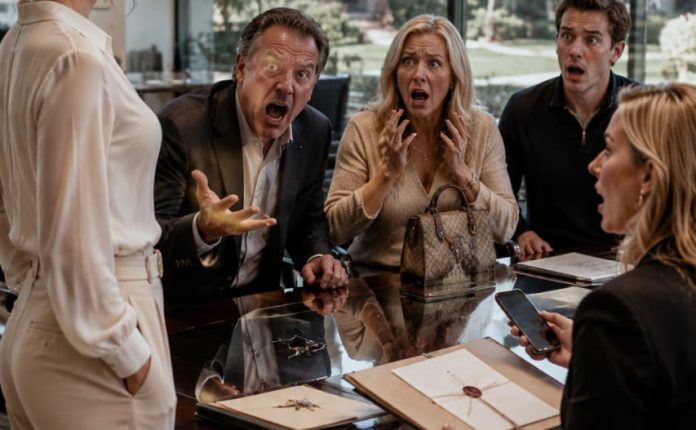
The confrontation happened the following Sunday, and this time I chose it. I called Mom and told her I was coming to the house. When I arrived, Dad was sitting in the living room with his arms crossed while Mom had prepared coffee. That almost made me laugh. Every major family argument in our house had somehow involved coffee, as though ceramic mugs could transform emotional warfare into a civilized discussion.
Chloe was there too. The moment Dad saw her beside me, he accused her of having no right to give me their private bank statements. Chloe replied that they had no right to lie about where my money was going. Dad insisted they had never lied. I pulled out the March 2024 statement and reminded him of the call where he said they couldn’t cover the mortgage because a client had delayed paying him.
I sent $4,000 after that call. Three days later, they transferred $2,600 to Chloe for her move to Austin. Dad said that money came from their account. “An account that had four thousand extra dollars because of me,” I answered. He told me I didn’t get to trace individual dollars after giving them away. I almost admired the audacity of the argument.
I reminded him that the money wasn’t a birthday present. I gave it because he told me they were struggling to cover necessities. Dad insisted they had been struggling. I told him they were struggling to maintain their lifestyle, which wasn’t the same thing. He became angry when I suggested they could sell the house. “I spent thirty years building this life,” he said.
“And I spent seven years financing part of it,” I replied. His hand slammed against the table hard enough to make the coffee cups jump. Normally Dad raising his voice ended family arguments instantly. That day, it didn’t. I stood as well and told him I had spent my entire life accepting less because my parents taught me that asking for equal treatment made me selfish.
Mom began crying. I told them they had forgotten my birthday five years in a row. Mom said they had apologized. I told her apologies meant little when nothing changed. They didn’t come to my house because they were devastated by hurting me. Mom came because the payments stopped. Dad came because the household budget stopped working. That distinction mattered.
Dad accused me again of making everything about money. “No,” I said. “Money revealed everything.” The room went silent. I pointed toward Chloe and reminded them they bought her a Mercedes while claiming they couldn’t afford their mortgage. Then I asked about Mexico, the Austin deposit, the furniture, and finally the emergency roof repair that apparently never happened.
Mom suddenly insisted the roof had needed work. I asked exactly how much the repairs cost. She looked toward Dad. That was answer enough. Dad finally admitted the problem hadn’t been as urgent as they first believed. I felt almost dizzy. He had called sounding terrified that water would destroy the upstairs ceilings, and I had transferred $4,000 immediately.
“What did the money actually pay for?” I asked. Nobody answered. Chloe finally asked whether that was when they had paid for her Mexico trip. Mom began crying harder and said Chloe had been devastated after ending her engagement. “We were helping our daughter,” Mom said. Chloe stood so quickly her chair scraped across the floor.
“She is your daughter!” Chloe shouted, pointing toward me.
The room went completely silent. I had spent decades wanting my parents to say that sentence with the urgency they always used when defending Chloe. In the end, it came from Chloe herself. Mom covered her face. Dad stared toward the floor. And for the first time, I saw the entire family system clearly—not as villains and victims, but as people trapped inside roles we had repeated for decades.
Dad decided I was capable. Mom decided Chloe was fragile. Every year reinforced those ideas. I succeeded, therefore I needed less. Chloe struggled, therefore she received more. I became even more capable partly because nobody rescued me. Chloe became more dependent partly because everybody did. Eventually, my success became proof that the unequal treatment had supposedly been correct all along.
“I don’t want your money,” I told my parents. Dad looked up. I explained I didn’t want repayment, the Mercedes, expensive birthday gifts, or apologies made only because they feared losing financial support. Mom asked what I did want. “For you to live with the consequences of your own decisions,” I replied. They had retirement savings. They could use them.
I told them they could sell the house, cancel memberships, change cars, work more, spend less, or do whatever adults do when their expenses exceed their income. Those choices were no longer mine to manage. Dad quietly asked whether I was cutting them completely out of my life. The question hurt because, despite everything, some part of me still wanted my parents.
“I don’t know,” I admitted. “But I know I can’t keep having the relationship we had.” Mom asked what that meant. I told her I was no longer their emergency fund. They could not use guilt to make me responsible for their choices, and I needed time to decide what kind of relationship was possible after everything I had learned.
Dad stared at me for several seconds before asking, “Did we really forget five birthdays?” Mom whispered his name, but he ignored her. “Five?” he repeated. I said yes. His face changed slightly, as though something had finally cracked through his certainty. “I thought it was two,” he admitted. I asked whether that somehow made the situation better.
“No,” he said.
It was the first time since the conflict began that my father answered without immediately defending himself. “No,” he repeated. “It doesn’t.” It wasn’t enough to repair thirty years of imbalance, but it was the first moment I believed he had actually heard something I said rather than merely waiting for his turn to explain why I was wrong.
Six months later, my parents sold the house. That shocked everyone, including me. Dad called once before listing it. He didn’t ask for money. He simply said, “You were right. We can’t afford the place without help.” I thought hearing those words would feel like victory. Instead, I felt sad. The house held painful memories, but it also contained much of my childhood.
There were Christmas mornings in that house. School projects spread across the dining table. Chloe and I built blanket forts in the living room. Mom taught us to bake in the kitchen. Dad pushed me on a tire swing in the backyard. Families are complicated because pain rarely erases love. Both can exist in the same memory, sometimes so tightly intertwined that separating them feels impossible.
If my parents had been cruel every day, leaving would have been simple. They weren’t. They were funny sometimes, generous sometimes, tender sometimes. I believe they loved me. They simply loved me carelessly. And love without care can injure a person almost as deeply as hatred because it teaches you to question whether your pain is legitimate whenever affection occasionally appears.
Mom and Dad bought a two-bedroom townhouse twenty minutes from the neighborhood where we grew up. Dad sold his truck and replaced it with a used SUV. They canceled the country-club membership. Mom learned to manage her own phone account. Most importantly, the world did not end. That was something I wished I had understood years earlier.
My help had never been the difference between survival and disaster. It had been the difference between change and avoiding change. I kept paying so my parents would never have to adjust their lifestyle. Once I stopped, they adjusted, because adults usually do when no one else is volunteering to absorb the consequences of their choices.
Chloe changed too, though not overnight. When her rent increased, she almost called Dad automatically before stopping herself. She took on freelance work, created a budget, and drove an ordinary Toyota for almost a year before buying a four-year-old Mazda she could actually afford. She sent me a photograph with the message: No bow. Paid the down payment myself.
I answered, I’m proud of you, and realized I meant it. Our relationship wasn’t magically healed. We talked about childhood, argued, apologized, and occasionally became defensive. Chloe admitted she had sometimes taken advantage of our parents’ favoritism because it benefited her. I admitted I had often treated her with contempt instead of recognizing that the same family system had damaged both of us differently.
One evening over wine, Chloe asked whether I thought we would have been friends if we hadn’t been sisters. I considered the question seriously. “Now?” I asked. She nodded. “Yes,” I said. She smiled and asked about ten years earlier. “Absolutely not.” She threw a napkin at me, and for once, the laughter between us didn’t carry resentment underneath it.
My parents and I spent nearly a year in limited contact. There were no weekly calls, financial emergencies, or obligatory Sunday dinners. At first, Mom constantly tested the boundaries. She would mention that the townhouse association had increased its fees, then pause as though waiting for the old Emma to offer help. Instead, I simply said, “That’s frustrating.” Eventually, she stopped hinting.
Dad took longer. One afternoon, he called because he didn’t understand a medical-bill charge. My old instinct was to ask him to send me the statement so I could fix everything. Instead, I told him to call the customer-service number printed on the bill. There was a long silence before he said, “Okay.” It sounds like nothing, but for us, it was enormous.
They were slowly learning that having a relationship with me required relating to me rather than using my competence as an unpaid service. I was also learning that saying no did not make me cruel. It made my yes meaningful. Help could be something I chose freely rather than something extracted through fear, guilt, family obligation, and the belief that good daughters never inconvenience their parents.
My thirty-fifth birthday arrived quietly. For the first time in years, I made plans without leaving emotional space for disappointment. Maya had organized brunch, Chloe was driving up, and several coworkers were joining us later. At 7:03 that morning, my phone rang. Mom’s name appeared on the screen. My heart still did the same ridiculous little jump it had always done.
Hope is stubborn. I answered. Mom’s voice trembled as she said, “Happy birthday, Emma.” I closed my eyes and thanked her. She said she wanted to be the first person to call. I joked that she was competing with automated birthday emails. She laughed nervously. Then she told me she had found something while packing up the old house.
That afternoon, Mom and Dad came to my condo. There were no balloons, giant boxes, or expensive gift bags. Mom handed me a thin envelope containing an old birthday card. The paper had yellowed with age. On the front was a cartoon cake with twelve candles, and across the envelope was handwriting I recognized instantly. It belonged to my grandmother Evelyn.
Grandma had died when I was twenty-one. I opened the card carefully. Inside she had written: To my Emma, never let people love you only for how useful you are. You deserve to be cared for on the days when you have nothing to give. I stopped breathing for several seconds. The sentence seemed almost impossible, written twenty-three years before I needed it most.
I read it again and again. Mom was crying. She said she had found the card among Grandma’s belongings and had no idea why it never reached me when I was twelve. Maybe Grandma gave it to her to mail. Maybe it was accidentally packed away. I ran my finger over the handwriting while Dad stood silently beside us.
Then my father cleared his throat and said the words I had waited most of my life to hear. “We failed you.” I looked at him, waiting for the usual explanation. Nothing came. No “but.” No reference to Chloe’s problems. No reminder that I had always been strong. Just those three words. “We failed you.” Mom reached toward my hand, then stopped before touching me.
I noticed that tiny change. For once, she waited for permission. I turned my palm upward, and she took it. Mom said they had loved me, but they kept rewarding me for not needing them until eventually they began believing I actually didn’t need them. Tears filled my eyes. “I needed you,” I said. Mom nodded. “I know.”
“I needed you a lot,” I told her. Dad looked toward the floor and admitted they had assumed being proud of me was enough. “It wasn’t,” I answered. He nodded. “No. It wasn’t.” There was no dramatic reconciliation. I didn’t throw myself into their arms or declare everything forgiven. Some wounds cannot be repaired in a single conversation simply because the right words finally arrive.
I had learned forgiveness wasn’t a door you walked through once. Sometimes it was a hallway. Sometimes you moved forward, sometimes you stopped, and sometimes you discovered another locked room you weren’t ready to enter. But for the first time, all of us were moving in a healthier direction. That mattered more to me than pretending everything had suddenly become perfect.
Before leaving, Mom gave me one small gift bag. I raised an eyebrow because we had already discussed expensive gifts. She immediately promised it wasn’t money. Inside was a single birthday candle shaped like the number thirty-five. She smiled through her tears and suggested we put it on the cake later. I laughed, and that laugh felt easier than any conversation we had shared in years.
That evening, we ate cake at my condo. Maya came. Chloe came. My parents stayed for about an hour. I deliberately bought the cake from the same grocery store where I had purchased the lonely birthday cake the year before. I wanted to reclaim the memory rather than spend the rest of my life hating everything associated with that night.
Everyone sang. When they finished, Dad told me to make a wish. I looked at the candle and thought about the woman who had sat alone on the floor exactly one year earlier, waiting for parents who had forgotten her while watching her sister receive a Mercedes. At the time, I thought cutting them off was an ending. It wasn’t.
It was the moment I stopped confusing endurance with loyalty. I had thought canceling the money would be punishment. Instead, it became the boundary that gave our family the first real chance to change. Mom had to learn tears couldn’t erase consequences. Dad had to learn authority didn’t guarantee obedience forever. Chloe had to learn constant rescue could become its own kind of trap.
And I had to learn the hardest lesson of all: being needed is not the same as being loved. Being useful is not the same as being valued. Being strong does not mean you deserve less tenderness. I looked around the room. Mom’s eyes were wet. Dad stood quietly beside her. Chloe grinned. Maya had her phone raised, recording everything.
“Come on,” Chloe said. “Before the wax melts.” I closed my eyes. This time I made a wish, but it wasn’t for my parents to become entirely different people. I didn’t wish for the past to disappear or for every broken thing to be repaired. I wished that I would never again abandon myself merely to keep someone else comfortable.
Then I blew out the candle.
Later, after everyone had gone and my apartment was quiet, I saw a photograph Chloe had posted online. It showed me laughing in front of the cake. Mom stood beside me. Dad was partly out of frame. Maya’s hand was visible holding a plate. There were no luxury cars, giant bows, champagne bottles, or expensive presents.
Chloe’s caption contained only six words: Happy birthday to my big sister. I stared at it for a long time and smiled. At thirty-five, I finally understood that the Mercedes had never really been what broke my heart. The forgotten birthdays hadn’t truly been about cards or gifts either. The pain came from constantly wondering whether I mattered when I wasn’t performing.
I had spent years trying to earn a place in a family I had been born into. I paid bills, solved emergencies, stayed quiet, remained reasonable, and made myself endlessly available. Whenever they overlooked me, I tried harder. I believed perhaps one more sacrifice would make them see me clearly. But love earned through exhaustion is not love you can safely live inside.
Sometimes the only way to discover who values you is to stop being useful for a while. Stop paying. Stop fixing. Stop chasing. Stop reminding everyone that you exist. Then watch carefully who comes searching for you rather than searching for what you provide. My mother first came to my porch because the money stopped. That truth would probably always hurt.
But months later, she started showing up when she needed absolutely nothing. Dad began calling merely to tell me ridiculous stories about neighbors or things he had seen at the grocery store. Mom sent pictures of tomatoes growing on her townhouse balcony. Neither of them asked me to pay for anything. Slowly, cautiously, we began building a relationship with no invoices attached.
When my thirty-sixth birthday came the following year, my parents called at 6:58 in the morning. It was much too early, but I answered anyway. Dad sang terribly. Mom laughed. Chloe interrupted halfway through because she had apparently called them first to make sure they were awake. I sat in bed listening to all three argue about who remembered first.
I laughed so hard that I cried. Not because everything had been repaired. Some things never return to what they were. They become something different—sometimes smaller, sometimes more cautious, sometimes healthier because everyone finally understands it can be lost. After the call, I opened the drawer beside my bed where Grandma Evelyn’s birthday card remained.
I read the sentence I had memorized: You deserve to be cared for on the days when you have nothing to give. For most of my life, I had believed love was measured by how much you were willing to endure for someone. Now I knew better. Real love does not require you to disappear so another person can remain comfortable.
It doesn’t demand that one child become permanently strong so another can remain permanently fragile. It doesn’t keep score according to who complains the loudest. And it certainly doesn’t require a luxury vehicle wrapped in a red bow to prove that someone matters. Sometimes love is much quieter. Sometimes love simply means remembering.
Sometimes it looks like apologizing without defending yourself. Sometimes it looks like returning a car. Sometimes it looks like selling a house you can no longer afford. Sometimes it looks like an adult daughter closing her front door while her mother cries on the porch because opening it would mean abandoning herself all over again.
And sometimes, much later, love looks like willingly opening that same door because the person standing outside has finally learned not to arrive carrying an invoice. That was the true gift I received from the birthday everyone forgot—not the apology, the old card, or even the repaired pieces of my family.
The gift was discovering that my value had never depended on whether my parents recognized it. I had spent years waiting for them to choose me, believing that one day they would finally see how much I had given and decide I deserved the same love they handed so easily to someone else.
But everything changed only when I stopped waiting.
For the first time in my life, I chose myself.