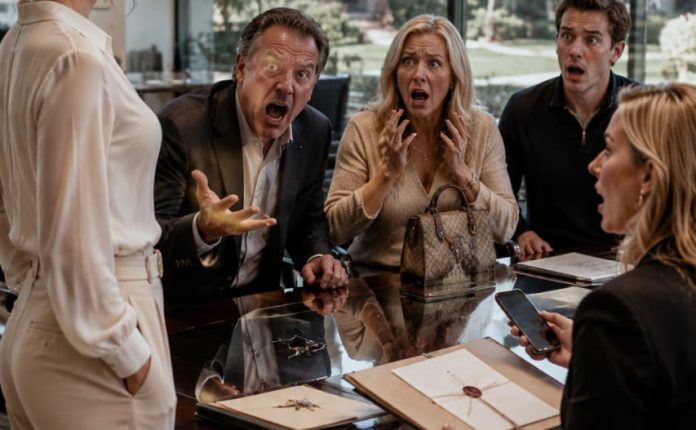
At 7:12 the morning after my birthday, Mom called. I watched the screen ring and didn’t answer. She tried again two minutes later. Then Dad called. Then Chloe texted, You’re seriously doing this over a car? I deleted the notification without opening the conversation. At 8:05, Mom left a voicemail, and I waited until lunchtime before forcing myself to listen.
“Emma, call me. Your father is extremely upset. I don’t understand why you’re turning this into some financial punishment. Chloe’s car was a special situation. There’s an explanation. We love you very much, and I think if you calm down, you’ll realize you’re being unfair.” I replayed one sentence several times: Your father is extremely upset. Not “I’m sorry we forgot.” Not even “Happy birthday.”
Dad being upset was the emergency. At noon, I met Maya at a sandwich shop near my office. She knew something was wrong before I sat down. I slid my phone across the table with Chloe’s video paused on the Mercedes. Maya watched it, then looked at me with an expression so gentle that I immediately hated it. “Don’t look at me like I’m pathetic,” I said.
“I don’t,” she replied. I told her I knew what my parents were like and should have stopped expecting anything years ago. Maya reached across the table. “Knowing something intellectually and finally accepting it emotionally aren’t the same thing.” That sentence cracked through me. I looked down at my hands and admitted the thing that hurt most: my mother had called repeatedly and still hadn’t actually wished me a happy birthday.
Maya told me not to answer. I admitted that I had canceled everything. “Good,” she said without hesitation. I told her they would call me cruel. She reminded me that they had been taking more than a thousand dollars a month from a daughter whose birthday they couldn’t remember while apparently finding enough money to buy the other daughter a Mercedes. I automatically began defending them.
“We don’t know they used my money for the car,” I said. Maya gave me a long look. “Emma, you always build their defense before they’ve even been accused.” I leaned back in my chair because she was right. I asked what would happen if they truly needed me. Maya’s expression softened. “Then they should have treated the person they needed like a person.”
That evening, Dad emailed me with the subject line Enough. He said Mom had been crying all day and that canceling my financial “obligations” without warning was irresponsible and vindictive. He said Chloe’s vehicle had nothing to do with our arrangement and reminded me that I was more financially secure than my sister, so I should know better than to compare myself with her.
I printed the email. I don’t know why. Maybe seeing the words on paper stripped them of their usual emotional power. At the bottom, I wrote one sentence in pen: I am not responsible for financing people who do not treat me like family. Then I folded the page and placed it in a drawer. The following day, my phone collected fourteen missed calls while I worked.
At 5:38 that evening, my doorbell rang. I expected groceries. Instead, my mother stood on my porch after driving nearly two hours. Her hair was messy, and her eyes were swollen from crying. For one dangerous second, I became eight years old again. My mother was upset, therefore I was supposed to fix it. Then I saw the stack of papers she was holding against her chest.
“Your father doesn’t know I’m here,” she said. She asked to come inside. I almost stepped aside automatically, then remembered the birthday, the Mercedes, and Dad’s email. “You can talk here,” I said. Her eyes widened. “You’re going to make your mother stand on the porch?” Normally, that tiny hook of guilt would have pulled me backward. This time, I answered, “You’re the one who showed up uninvited.”
Mom asked why I was being so cold. I asked why she was there. She finally held up the papers and admitted they couldn’t afford everything I had canceled. There it was. Not an apology. Not a forgotten birthday. Money. “Then sell the Mercedes,” I said. Her mouth dropped open. She told me it wasn’t that simple because the vehicle was already in Chloe’s name.
I asked why Chloe couldn’t make the payments. Mom admitted she couldn’t. Then I asked why they had bought her a car she couldn’t afford. Mom said Dad had made a significant down payment and they intended to cover the monthly payments for the first year. I asked how significant. She looked away before finally whispering, “Eight thousand dollars.”
Eight thousand dollars was almost exactly what I had transferred to them during the previous six months. I stepped onto the porch and closed my apartment door behind me. “Where did the money come from?” I asked. She said Dad’s account. I asked which account. She finally admitted it was the same household checking account where my monthly transfers were deposited.
“It wasn’t your money,” she insisted. I asked whose money it was. “Ours,” she said. “Where did yours come from?” I asked. She told me not to do this. “Do what? Math?” Her expression hardened, and she said I had given them money without conditions. I reminded her that I gave them money because they repeatedly told me they were struggling to meet necessary expenses.
“We were struggling,” she said. I asked how people struggling to afford their mortgage could put eight thousand dollars down on a Mercedes. Mom said the vehicle was important for Chloe because she needed reliable transportation. “A Mercedes?” I asked. Mom said Chloe occasionally drove clients. I reminded her Chloe worked primarily from home. Mom immediately began searching for another justification.
Then something inside me finally broke open. “My car is nine years old,” I said. Mom replied, “There is nothing wrong with your car.” I laughed. “That’s always the answer, isn’t it? There’s nothing wrong with mine. I don’t need anything. I’m fine. I’m strong. I’m responsible.” Mom tried to tell me those were compliments. “No,” I said. “Not anymore.”
I told her being the strong child in our family meant I got less because everyone assumed I would survive it. Chloe received more because she complained, struggled, cried, and demanded. I was forgotten because they believed I would forgive them. “Five birthdays,” I said. Mom became quiet. She admitted she knew, but I told her she still didn’t understand.
“You called me eleven times since yesterday. You drove two hours to my house. And you still haven’t said it.” Mom’s forehead creased. “Said what?” The fact that she had to ask hurt more than I expected. I looked at her for several seconds before whispering, “Happy birthday.” Her entire body went still. She put a hand over her mouth and finally seemed to understand.
“Oh, Emma.” She wished me a happy birthday, but I reminded her it wasn’t my birthday anymore. She apologized. I told her she was apologizing only because I had reminded her. Then she said, “I don’t know what’s wrong with me.” For one second, I wanted that sentence to be the beginning of everything I had waited years to hear. Then she looked down at the papers.
“But you can’t just stop the house payment this month,” she said. Whatever had opened inside me closed immediately. I nodded slowly. “Now I understand why you’re here.” She insisted that wasn’t what she meant and explained Dad had several bills coming due. I told her Dad should pay them. She said he couldn’t because he had moved money around for Chloe’s car.
There was the truth. Small, ugly, and complete. They had taken money I sent because they supposedly couldn’t afford basic household costs and used the freedom created by that money to help buy Chloe a luxury vehicle. Mom tried to argue that once the money entered their account, they didn’t think of it as mine anymore. I told her I finally understood exactly how they saw me.
She whispered, “We’re family.” I looked at the woman who had taught me that sentence. For years, “family takes care of family” had sounded like love. Now I understood that in our household, it mostly meant one person doing the taking care. “Then start acting like it,” I told her. I stepped back inside, closed the door, and left my mother crying on the porch.
I stood behind that door listening for nearly five minutes before her footsteps finally crossed the walkway and her car started. I cried only after she drove away, not because I regretted sending her home, but because I didn’t. That was the frightening part. For the first time in my life, disappointing my mother hurt less than disappointing myself.
Dad arrived Saturday morning. He didn’t cry. He knocked hard enough to shake the doorframe. I opened the door but left the security chain attached. His face turned red when he saw it. “Take that thing off,” he ordered. “No.” He reminded me he was my father. “And?” I asked. The word seemed to shock him more than any screaming match could have.
He said Mom had returned home devastated and accused me of tearing the family apart. I reminded him I had only canceled payments. He said we both knew it wasn’t about money. “Correct,” I answered. “It’s about five birthdays. The payments just happen to be the only part of our relationship you noticed disappearing.” Dad immediately accused me of always being dramatic where Chloe was concerned.
I told him that was the story he used whenever I noticed the favoritism. Dad claimed I had resented Chloe since childhood. I told him I hadn’t wanted Chloe’s life; I had wanted parents. He insisted I had parents. “No,” I said. “I had coaches. You taught me to perform for love. Good grades, no trouble, scholarships, a career, bills paid on time. Be useful, Emma. Be easy.”
Dad called that ridiculous. I asked what they bought Chloe for her twenty-fifth birthday. He claimed he didn’t keep a ledger. “You paid for Mexico,” I reminded him. Then I asked what he had given me for my thirtieth. He went silent. They had forgotten. Dad said they had already apologized. I reminded him Mom apologized only after I specifically told her she hadn’t wished me happy birthday.
He said he hadn’t driven two hours to discuss birthday cards. “Of course you didn’t,” I replied. He admitted they were short nearly three thousand dollars because of the payments I had canceled. I told him to sell something. When he called me childish, I pointed out that he owned two vehicles and barely worked anymore. His eyes flashed, and I knew the sentence was harsh.
Dad had spent years describing himself as semi-retired while continuing to use his struggling business to justify accepting my money. I asked why, if the business was recovering as he claimed, he still needed almost fifteen thousand dollars a year from me. He said because I had offered. I corrected him. He had asked, and I had agreed because he said they needed help.
Then he said something I will probably remember forever. “Your sister needed something good.” My chest tightened. Chloe needed something good, while I apparently needed nothing. I told Dad I didn’t need a Mercedes. I didn’t need expensive presents. I had bought myself a grocery-store cake for my birthday and sat alone waiting for them until midnight. My voice broke as I said it.
“I never needed you to buy me a car. I needed you to remember I existed without needing something from me.” For one moment, Dad looked uncomfortable rather than angry. Then pride returned. He told me I had made my decision and warned me not to expect the family to forget what I had done. I laughed through my tears. “You forgot me five birthdays in a row. I think you’ll manage.”
I closed the door.
Chloe waited until Sunday. She sent a four-minute voice message saying she didn’t understand why everyone was blaming her for the crisis. She insisted she hadn’t asked my parents to forget my birthday and hadn’t known where the car money came from. According to her, Dad said business had been good and he wanted to surprise her. She asked what she was supposed to do, interrogate them before accepting a gift?
Then she said I always acted as though she had stolen something from me whenever our parents helped her. She reminded me I had a good job, owned my condo, traveled, and had always had everything together while she struggled. Finally she said, “I’m sorry they forgot your birthday, okay? But ruining their finances isn’t going to make you feel better.”
I replied with one sentence: I’m not ruining their finances. I’m no longer subsidizing them. There is a difference. Chloe answered immediately: They depend on you. I stared at those words before replying: Exactly. She asked whether I wanted them to take the car back. After thinking about it, I answered honestly: I want nothing from them. That’s the point.
She called three times before I answered. She accused me of acting as if I were the only family member who had ever been hurt. I explained that I resented the way our parents treated us differently, not Chloe herself. She asked whether this was all her fault. I told her no. Then I revealed something she apparently had never known: over seven years, I had given our parents more than one hundred thousand dollars.
“What?” she whispered. The night before, unable to sleep, I had gone through old statements and created a spreadsheet. Transfers, insurance, repairs, property taxes, phone bills, flights, medical costs, dental work, appliances—the total came to $108,430. Even I had been shocked by the number. Chloe told me our parents had always described it as occasional help with the mortgage.
I asked whether she knew I had paid her moving expenses three years earlier. She insisted Mom and Dad had paid them. I told her the $2,600 they gave her when she moved to Austin came from money I sent the same month Dad called crying about being behind on household expenses. Chloe went silent. I asked about her trip to Mexico after her engagement ended.
She said Dad had paid for it. I explained I sent Dad $4,000 that same month because he said the roof needed emergency repairs. Then I asked whether she remembered the roof ever being repaired. Chloe admitted she didn’t. For the first time, the defensiveness disappeared from her voice. “Emma, I really didn’t know,” she whispered. To my surprise, I believed her.
I told her she had still known they treated us differently. She admitted she had. When I asked why she always pretended otherwise, her answer surprised me. “Because I was scared that if I admitted it, you’d hate me.” Then she told me our parents had used me against her too. Whenever she failed or struggled, Mom asked why she couldn’t be more like Emma.
To Chloe, I had been the perfect child, the smart one, the successful daughter Dad bragged about. She had been the screwup everyone expected to rescue. It didn’t match the story I had experienced, but I suddenly understood that our parents had hurt us from opposite directions. They neglected me because I was competent and suffocated Chloe because they believed she wasn’t.
Chloe admitted something else. Sometimes she had enjoyed getting things from Mom and Dad because it gave her something I didn’t have. The confession was ugly, honest, and strangely comforting. I admitted I had hated her for it sometimes. I told her I hated her graduation party and the blue Volkswagen. She laughed and said the Volkswagen had actually been terrible. I reminded her my Honda was worse.
We both laughed, and then somehow we were both crying. It was the first honest conversation between us in years. Before hanging up, Chloe told me she intended to return the Mercedes. I told her she didn’t have to do that for me. “I’m not doing it for you,” she replied. “I’m doing it because every time I look at it now, I’m going to see your hundred thousand dollars.”
The next week was quiet, but not peaceful. Dad stopped calling. Mom sent one message every morning telling me to call, reminding me that families make mistakes, or explaining that my father wasn’t sleeping. Finally she wrote that they might have to take money from retirement if I didn’t help them that month. I stared at the message before replying, Then take money from retirement. That is what retirement savings are for.
I started seeing a therapist. During our second session, Dr. Patel asked what would happen if I needed something from my parents. I immediately answered that I didn’t need anything. She waited. After a few seconds, I laughed because I understood what I had just done. She had asked what would happen if I needed something, and I had avoided the question by insisting I never needed anything at all.
We talked about how children praised for being useful often grow into adults who confuse having needs with being a burden. I hated therapy in the way people sometimes hate looking into mirrors that show them exactly what they have spent years avoiding. But I kept going. Slowly, I began understanding that saying no did not make me selfish. It simply stopped making my generosity compulsory.
Three weeks after my birthday, Chloe asked to meet for lunch. She arrived in a rented Toyota. I asked whether she had returned the Mercedes, and she nodded. Dad was furious, she said, because he believed she had humiliated him at the dealership. Mom had cried. Then Chloe pushed an envelope across the table and told me she had found something while helping them reorganize their bills.
Inside were copies of my parents’ bank statements. My monthly deposits were highlighted alongside restaurant bills, department stores, country-club dues, payments toward Dad’s truck, weekend trips, and transfers to Chloe. I stared at the pages until my stomach tightened. My parents had not been financially desperate in the way they had repeatedly led me to believe.
They weren’t wealthy, but my money had allowed them to preserve a lifestyle they didn’t want to reduce. Dad didn’t want to touch retirement. Mom didn’t want to sell the large house. They didn’t want to give up the country club. They wanted to continue helping Chloe without personally sacrificing anything. So they found another source of money: me.
I found the statement from the month I had sent $4,000 for the supposed roof emergency. Three days afterward, $2,600 went to Chloe. Two days later, there was a restaurant charge for more than $700. I stared at the numbers. Chloe apologized again, but I told her the money wasn’t her fault. “They lied to both of us,” she said. I shook my head slowly.
“They told themselves a story,” I answered. The story was that because I could afford to help, taking from me didn’t count as taking. Because I was successful, my sacrifices somehow cost me less. Because Chloe struggled, anything given to her was necessary. And because I had always survived disappointment, disappointing me had gradually stopped feeling like a serious consequence.