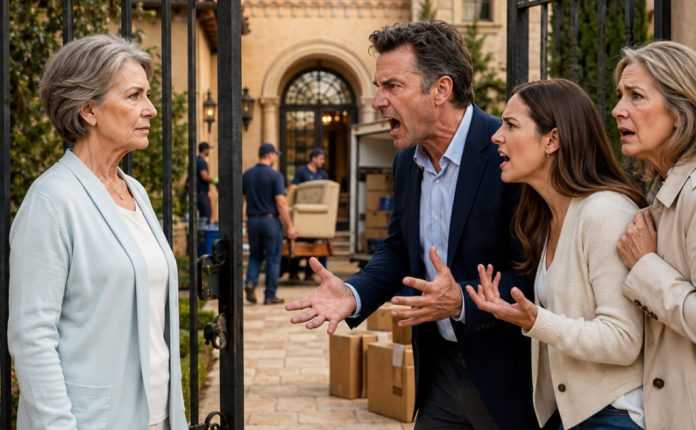
Our children learned the truth one week after I filed. Grace was twenty-four and Daniel was twenty-one. I refused to let them hear it through gossip or court documents, so I met them at Grace’s apartment. I told them their father and I were divorcing, that there had been a long-term relationship with another woman, and that serious financial problems were being investigated.
I also told them I would never ask them to choose between us. Grace stared at me for several seconds before asking, “How long?” I answered honestly. “At least three years.” Her eyes immediately filled. Daniel stood and walked to the window. Then Grace asked whether Richard had been with Vanessa when he missed her graduation dinner.
I did not know.
That was the terrible answer.
“I don’t know.”
Grace nodded slowly and began to cry. I moved toward her, but she pulled away—not because she was angry with me, but because she suddenly realized that parts of her own history might have to be reconsidered. Daniel turned from the window and asked, “Did Dad use our money?” I told him there were financial matters being investigated.
“So yes,” he said.
Later, Richard accused me through his attorney of turning the children against him. It was one of the few times I nearly responded emotionally, but Elena stopped me. “The evidence will speak,” she said. Eventually, it did. Yet the worst discovery of all came approximately six weeks after I filed, when Elena called me at 8:15 one Thursday morning.
“Margaret, come to the office.”
I asked what had happened.
“I would rather explain in person.”
By then, my body had learned to recognize danger before my mind could process it. Cynthia was already sitting beside Elena when I arrived. Another folder rested on the conference table. I almost laughed when I saw it and asked, “Another one?” Neither woman smiled.
Elena explained that additional records from Richard and Vanessa’s company had uncovered a pending real-estate deal. They had been negotiating the purchase of a larger apartment building. The transaction had not closed, but their financing proposal included collateral. I scanned the documents until my eyes stopped on an address I recognized instantly.
My home.
The house where we had raised our children. The house my father had helped us make the first down payment on. The house where my mother had spent her final Christmas. Richard had already borrowed against it once, but these documents indicated that the proposed financing could have exposed substantially more of our equity—potentially hundreds of thousands of dollars.
My hands began shaking.
“He planned to do this without telling me?”
“That appears to have been the intention,” Elena said.
Then Cynthia quietly added, “That isn’t the final discovery.”
She pushed another document across the table.
It was a life-insurance beneficiary designation. Richard had maintained a significant policy through his employer for years. We had discussed it many times, and I believed I remained the primary beneficiary because the policy existed to protect whichever spouse survived. But eighteen months earlier, Richard had changed it.
Primary beneficiary:
Vanessa Cole.
Contingent beneficiaries:
Grace Hale.
Daniel Hale.
I stared at the page until the letters blurred.
“He removed me?”
Elena nodded.
“How much is the policy?”
“Two million dollars.”
The room seemed to disappear around me. I had not merely been replaced romantically. I had been removed financially from the future Richard was planning. If he died, the woman who had secretly occupied several years of his life would receive two million dollars, while the wife who had spent almost three decades building that life with him would receive nothing from the policy.
“When did he change it?” I asked.
“February 2022.”
I remembered that month immediately. In February 2022, I underwent surgery and experienced complications afterward. Richard helped me into the shower, changed my dressings, brought medication every six hours, made soup, slept lightly in case I needed him, and told relatives how terrified he had been that something might happen to me.
During that same month, he removed me from his two-million-dollar life-insurance policy and replaced me with Vanessa.
That was the moment I stopped loving him.
People often imagine love ending through screaming, dramatic confrontations, shattered glasses, or slammed doors. Mine ended quietly in a conference room beneath fluorescent lights. I looked at a beneficiary form and felt a door close somewhere inside me.
Twenty-seven years.
Closed.
That evening Richard called from a number I did not recognize. I nearly ignored it, but eventually answered. His voice sounded exhausted. He asked me not to hang up and said he had heard we found the insurance policy. When I told him there was nothing left to explain, he insisted that he had never wanted to hurt me.
I laughed once. “You removed your wife of twenty-five years from a two-million-dollar life-insurance policy and named your mistress.”
“It wasn’t—”
“Don’t say complicated.”
He stopped.
“Finding Vanessa hurt,” I told him. “Finding the apartment humiliated me. Finding the hidden accounts frightened me. But the insurance policy told me something none of the others did.”
“What?”
“That somewhere in your mind, you had already planned for a world where I didn’t exist.”
Richard began crying. I had heard him cry only a handful of times during our marriage—when his father died, when Murphy died, when Grace was hospitalized as a child, and when Daniel was born prematurely. Once, the sound would have pulled me toward him immediately. Now I felt only distance.
“I was selfish,” he said.
“You were strategic.”
“I never meant to leave you.”
That sentence stunned me because he genuinely seemed to believe it was a defense.
“You never meant to leave me?”
“No.”
“Then what exactly was I supposed to be? The wife at home? The respectable family? And Vanessa was what—your Tuesday wife?”
He cried harder.
Finally, he said the first completely honest thing I had heard from him in years.
“I loved different things about both of you.”
I closed my eyes.
“Thank you.”
“For what?”
“For finally telling me the truth.”
The divorce lasted nearly eleven months. During that time, I learned more about money than I had learned during the previous twenty-seven years. I also discovered the difference between revenge and accountability. At first, I wanted Richard to lose everything. Eventually, I realized I did not want my future connected to his destruction. I wanted fairness, disclosure, and independence.
I wanted every hidden asset identified, every questionable debt examined, every investment valued, and every dollar accounted for. Most importantly, I wanted to leave the marriage without becoming someone I no longer recognized. Vanessa disappeared from Richard’s personal life surprisingly quickly. The Bellhaven apartment lease ended, their larger property deal collapsed, and their shared company became another financial dispute.
I never learned exactly why their relationship ended, and eventually I stopped caring. There was something almost ironic about watching a relationship that had survived for years in secrecy begin collapsing once exposed to ordinary daylight. Secrets can feel romantic while someone else is paying the price for them. Reality is much less forgiving.
Richard moved into a furnished condominium near his office. Grace remained distant from him, while Daniel stayed openly angry for months. I encouraged them to make their own decisions. “He was a terrible husband to me,” I told them, “but that does not automatically erase every good thing he ever did as your father.”
It was difficult to say because part of me wanted them completely on my side. But children—even adult children—should not become prizes in their parents’ war. Eventually, Richard started therapy. I learned only because Grace mentioned it. He sent me several letters. I returned the first unopened, but eventually I read the second.
He apologized for Vanessa, the hidden money, the house, the insurance policy, the trips, and the years of lying. He wrote that he had compartmentalized his life until he convinced himself he could preserve our marriage while maintaining another relationship separately, as though the two realities would somehow never collide.
I did not answer.
The third letter arrived about two months before our final hearing. It contained only one page. Near the bottom, Richard had written: I used to think losing you would be the punishment. I understand now that becoming the man who deserved to lose you was the punishment.
I kept that letter.
Not because I wanted him back.
Because it was the first time I believed he finally understood.
Our divorce became final in July 2024. I kept the house, not as a trophy but because I wanted one place in my life that did not have to disappear simply because my marriage ended. Richard retained certain retirement and investment assets after the full accounting. His Bellhaven business interests, hidden accounts, and questionable debts were addressed through the settlement.
The $247,000 I had transferred remained documented throughout the process and was treated as marital property rather than concealed money. Slowly, painfully, our finances separated. Then our legal lives separated. The emotional separation took longer. On the first evening after the divorce became final, I expected to feel victorious.
Instead, I made pasta for one, poured a glass of wine, and sat alone on the patio. The house was silent. No Richard complaining about mosquitoes. No television upstairs. No keys dropping into the ceramic bowl beside the entrance. For twenty-seven years, marriage had created background noise. When it disappeared, the silence felt enormous.
I cried that night, but not because I wanted Richard back. I cried because an ending can be necessary and still hurt. You can know that leaving saved you while grieving the life you believed you had. You can hate what someone did and still remember the hand that held yours while your mother was dying. Those memories do not disappear simply because the marriage ends.
Healing did not require me to declare every good memory false. It required me to accept that beautiful memories and terrible truths could exist together without controlling my future. Slowly, I began rebuilding my life. At first, rebuilding looked incredibly boring: changing passwords, reviewing bank accounts, studying insurance policies, creating a budget, and meeting with my own financial adviser.
For the first time in decades, I knew exactly where everything was and what every number meant. Then rebuilding became enjoyable. I repainted the bedroom deep green because Richard had always preferred beige. I replaced his enormous recliner with smaller chairs, transformed part of the garage into a pottery workspace, and finally adopted another dog.
His name was Archie, a ridiculous golden retriever mix who shed everywhere and slept diagonally across my bed. The first time Grace met him, she laughed. “Dad always said no more dogs.”
“I know,” I replied.
We both laughed harder.
Later, I traveled alone for the first time in my life—not for work or family obligations but simply because I wanted to. I went to Maine in October, ate lobster beside the harbor, walked through cold rain, and bought a red scarf from a tiny shop without needing to explain the purchase to anyone. At first, freedom felt strange.
Then it felt wonderful.
About eighteen months after the divorce, I unexpectedly saw Richard outside a bookstore. Archie immediately tried to sniff his shoes. Richard had aged. There was more gray in his hair and his face seemed thinner. He looked down at Archie and gave a sad smile.
“You got a dog.”
“I did.”
“Of course you did.”
We stood awkwardly on the sidewalk. Once, this man had known every inch of my body. Now neither of us seemed sure whether shaking hands would be too formal. Finally, he told me I looked good. I said the same, although he did not. Cruelty no longer interested me.
He asked about the children.
“You should ask them,” I said.
He nodded. “Fair.”
Then he apologized again.
“I know,” I told him.
“No, I mean—”
“I know.”
He stopped because, finally, I no longer needed anything else from him.
Then Richard said something unexpected. “I think about that receipt sometimes.” I asked how he knew the receipt had started everything. Grace had eventually told him. He gave a faint, humorless smile and said, “Forty-seven dollars and eighty-six cents. Twenty-seven years undone by dry cleaning.”
“No,” I replied.
He looked at me.
“The receipt didn’t undo our marriage.”
His expression changed.
“You did.”
He lowered his eyes.
“I know.”
I expected the moment to feel satisfying, but instead I felt peaceful. Richard finally understood what I had taken so long to understand myself: the receipt had not destroyed my life. It had exposed the truth about the life I was already living. People who hear the story sometimes ask me how I could have gone so long without knowing.
I used to hate that question because it sounded like an accusation, as though deception succeeds only when the betrayed person is foolish. Now my answer is simple. I did not know because I trusted my husband. Trust is not stupidity. The shame belongs to the person who exploits it. But I learned something else as well.
Love should never require financial blindness. Partnership should survive questions. Transparency should not fear verification. I had allowed Richard to become the expert in areas of our life I found tedious—taxes, investments, insurance, retirement planning. That did not cause his betrayal, but it made me more vulnerable to its consequences.
I will never make that mistake again.
The original $47.86 dry-cleaning receipt remains inside a small envelope in my desk. I almost threw it away after the divorce, but instead I wrote one sentence across the front: This did not end my life. It returned it to me. Sometimes I open the drawer and see it. I no longer feel the anger I once did.
Mostly, I feel gratitude toward the woman I was that August morning—the woman who noticed an amount that made no sense, trusted the discomfort in her chest, drove seventy-six miles seeking the truth, and quietly told a stranger, “I am his wife.” I think about the woman who hired Cynthia, sat across from Elena, gathered facts, protected herself legally, and waited until she was prepared before confronting Richard.
Courage does not always look like screaming. Sometimes courage is remaining silent while you collect information. Sometimes it is signing legal papers with a steady hand. Sometimes it is protecting yourself before confronting the person who betrayed you. Sometimes it is opening the door to an empty house months later and realizing the silence no longer frightens you.
I was forty-nine when I found that receipt. I believed my best years were already behind me. I thought losing a marriage that had lasted twenty-seven years meant losing the largest part of myself. But the marriage was something I had built. It was never all that I was.
I am older now, and I know exactly how much money is in every account carrying my name. I know where every insurance policy is stored. I know my credit score and what my house is worth. I know how to travel alone, sleep peacefully in a deep-green bedroom, and share my bed with a dog who takes up more space than Richard ever did.
Most importantly, I understand that history does not guarantee a future. Twenty-seven years can matter deeply and still end. Love can be real and still become unsafe. Someone can break your heart without breaking your ability to build another life. Richard’s final secret was meant to prove how completely he had removed me from the future he was constructing.
Instead, it gave me the clarity to remove myself from that future entirely. He had changed the insurance beneficiary, risked our house, created hidden accounts, bought property, and built another life seventy-six miles away. He believed the greatest danger was that I might discover Vanessa.
He was wrong.
Discovering Vanessa was only the beginning.
The real discovery was me—the woman underneath twenty-seven years of routines, compromise, caregiving, remembered birthdays, conference schedules, preferred cereal, medical appointments, dry cleaning, steak temperatures, and everyone else’s needs. I had spent so many years standing beside my husband that I had forgotten what it felt like to stand completely on my own side.
A $47.86 receipt reminded me.
And once I finally stood there, I never moved again.