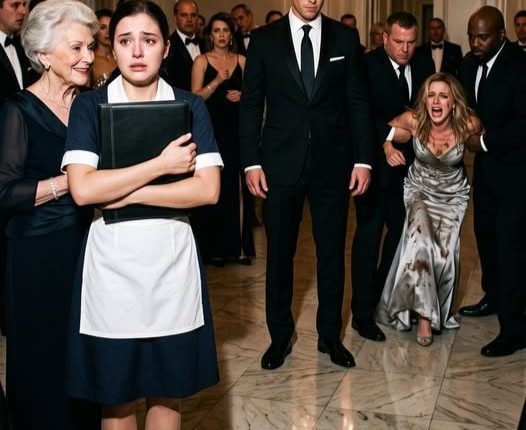
“Mom and Dad,” Audrey read, “if Audrey is reading this to you, then something went wrong exactly the way I feared it might. I loved you both. But too often you confused success with worth. Claire taught me the difference. If she is cleaning floors, then respect the floors she cleans. If she is struggling, help without controlling her. If you cannot do that, stay away from my wife and daughter until you can.”
Evelyn started crying. Real crying this time. Not offended tears. Not angry tears. Broken ones. Daniel’s final sentence was short. “Do not dishonor me by humiliating the two people I loved most.” Audrey lowered the letter. Nobody spoke. Then she looked at her grandparents and said, “Dad knew you would do this.” That sentence ended the dinner. Not loudly. Not dramatically. It simply removed every excuse they had.
I stood, but my legs felt weak. “Audrey, get your coat.” Evelyn rose quickly. “Claire, please.” I looked at her. For once, she had nothing sharp to say. “We didn’t know about the trust,” she whispered. “That isn’t the problem,” I said. “I know,” she replied. “No. You don’t.” Charles tried to recover some authority by saying the family needed to discuss the shares. I turned toward him and said, “No, we don’t.”
“They affect the company,” he insisted. “Then you can speak with the trustee through our attorney,” I said. His jaw tightened. “You’re going to use Daniel’s death against us?” I stared at him. “You just told a room full of people it was painful to see what your son left behind.” Charles looked down. I pointed toward Audrey. “That is what your son left behind.” Nobody stopped us as we walked out.
In the car, Audrey began crying. Not polite tears. Huge sobs. I pulled her against me. “You should have told me about the letter.” “I know.” “You shouldn’t have had to do that.” “I know.” “You were very brave.” She buried her face against my blouse. “I was scared.” I held her tighter. “I know.” Then she whispered, “I hate when they talk about you like that.”
I closed my eyes. “Sweetheart, their opinion does not decide who I am.” She nodded against my shoulder. “I know.” I added, “Your opinion doesn’t either.” Audrey pulled back, confused. “What?” I smiled through tears. “I have to know who I am without needing anyone else to approve.” She thought about that for a moment, then nodded slowly. “Dad knew,” she whispered. “Yes,” I said. “Dad always knew.”
That night, after Audrey fell asleep, I called Samuel Greene. He had known Daniel for years. The moment he heard my voice, he sighed. “I wondered when you would call.” I asked why Daniel had never told me. Samuel explained that Daniel wanted me to make decisions without feeling trapped by Whitmore money. He also worried his parents might challenge the trust if they knew about it too early.
“Can they?” I asked. Samuel chuckled softly. “They can try. Daniel planned well.” Over the next several weeks, I learned the full story. Daniel had inherited shares from his grandfather independently of his parents. They were legally his. While he was sick, he placed them into an irrevocable trust for Audrey. The trust generated annual income, but the principal was mostly protected until she was older.
I had broad authority to use the income for Audrey’s health, education, housing, and welfare. The shares also carried voting rights exercised by the trustee. That part mattered to Charles more than the money. Three days after Easter, he called me. I did not answer. Then Evelyn called. Then Rebecca. Samuel advised me to communicate only through him, so I did. For the first time, Charles could not summon me into a room and dominate the conversation.
A month later, Evelyn came to our house alone. No Charles. No attorney. She stood on the porch holding a cake. “I should have called first,” she said. “Yes,” I replied. “I can leave.” I nearly told her to. Then Audrey appeared behind me and said, “Grandma?” Evelyn’s face collapsed. Audrey did not run to her, and that mattered. Evelyn looked at me. “May I come in?” I stepped aside.
We sat in the kitchen, the same kitchen where I had paid bills late at night after janitorial shifts and where Daniel used to make pancakes on Sundays. Evelyn stared at her hands. “I was cruel,” she said. I remained silent. She continued. “I told myself I was embarrassed for Daniel.” I answered, “You were embarrassed by me.” She looked up. “Yes.” It was the first honest thing she had ever said about it.
“I thought he could have had a different life,” she continued. “He chose this one,” I said. “I know.” “You never respected that.” “No.” Audrey sat quietly across from her. Evelyn looked at her granddaughter and said, “I’m sorry I disappeared.” Audrey’s eyes filled with tears. “Why did you?” Evelyn answered slowly. “Because seeing you hurt.” Audrey frowned. “That’s not fair. You were the adult.”
Evelyn began crying. “Yes.” Audrey continued, “You should have come anyway.” “Yes,” Evelyn whispered. I watched my eleven-year-old daughter say things clearly that I had been afraid to say for years. Not cruelly. Simply clearly. That was Daniel’s real gift. Not the trust. Not the shares. He had left Audrey permission to speak the truth, even when adults wanted silence.
Evelyn began visiting occasionally after that. Not often, and always after asking. Charles took much longer. For nearly a year, he communicated only through attorneys regarding company matters. Then one afternoon, he appeared at the office building where I worked. I was pushing a cleaning cart when I saw him standing near the elevators in a dark wool coat. For one awful moment, I thought he had come to humiliate me again.
Then he looked at the cart, my gloves, and the trash bag in my hand. His expression changed. “I owe you an apology,” he said. I continued tying the bag. “Yes.” He told me he had rehearsed it several times. “That sounds difficult,” I replied. He almost smiled. Then he said, “I was ashamed of your work.” “I know.” “I should have been ashamed of my behavior.” I finally looked at him.
Charles told me Daniel had worked for him one summer when he was seventeen. “I know,” I said. “He hated it.” “He told me.” Charles nodded. “He said I treated people differently depending on what they did.” That sounded exactly like Daniel. Charles said his son once told him the janitor knew more about the building than he did. Despite myself, I smiled. “That sounds like him too.”
Charles looked around the lobby. “I thought success meant making sure my children never had to do work like this.” I asked what he thought now. “Daniel apparently thought success meant respecting whoever did.” I said nothing. Charles exhaled and added, “I misunderstood my son.” There was real grief in that sentence—not grief over losing the future he imagined, but grief over realizing he had not fully understood the son he actually had.
“I also misunderstood you,” he said. “Yes.” “I don’t expect forgiveness.” “That’s good.” He laughed once. Then he asked if I was going to keep working there. “For now,” I said. “You don’t have to.” I met his eyes. “I know.” That was the difference. Before the trust, I worked because I was afraid not to. Afterward, I stayed because I wanted stability while deciding what came next.
Eventually, I returned to school part-time and completed a degree in facilities management. The office complex hired me as an assistant operations manager. Three years later, I became facilities director. I still walked through bathrooms, checked trash rooms, inspected service corridors, and spoke to janitors every morning—especially the janitors—because Charles had been right about one thing Daniel had said. They usually knew the building better than anyone.
Audrey grew. At fourteen, she joined the debate team. At sixteen, she opened Daniel’s birthday letter and cried for an hour. At eighteen, she was accepted into three universities and chose the least expensive one because, in her words, “Dad would haunt me if I wasted money just because we have it.” Evelyn laughed when she heard that. Charles did too. Our relationship with them never became perfect. Perfect would have required forgetting.
We did not forget Easter dinner. We simply stopped allowing it to define every future dinner. Evelyn eventually apologized publicly to the relatives who had been there. That mattered to me because the humiliation had been public. Accountability should not always happen behind closed doors. Charles changed more slowly but more deeply. At Whitmore Industrial Components, he created a scholarship fund for hourly workers’ children.
When someone congratulated him for the idea, he reportedly said, “My son should get the credit.” Rebecca told me that later. I believed her. Years after that Easter, Audrey and I were sorting through old boxes when we found the yellow dress she had worn that night. She held it against herself. It barely reached her waist anymore. “I looked ridiculous,” she said. “You looked eleven,” I replied.
She laughed, then found the original letter. The folds had softened from being opened so many times. Audrey read one line aloud: “My future was you.” Her voice cracked. I sat beside her. For a moment, we were both back at that table—the laughter, the humiliation, the chair scraping backward, her trembling hands, and the stunned silence that followed.
Audrey looked at me. “Did Dad really know they would do that?” I thought carefully. “I don’t think he knew exactly what they would say.” “But he knew enough.” “Yes.” She smiled sadly. “He knew them.” I nodded. “He knew us too.” That was the part I eventually understood best. Daniel had not left instructions because he expected Audrey to rescue me.
He left them because he wanted both of us to remember something when grief, money, and family pressure tried to make us forget. Worth is not inherited. It is not purchased. It is not measured by job titles, expensive schools, houses, or family names. A person cleaning floors to feed her child is not smaller than the person sitting at an expensive dining table laughing at her.
And an eleven-year-old girl with shaking hands can sometimes carry more dignity than every wealthy adult in the room. I never forgot Easter dinner, but not because of what Evelyn said or because Charles mocked my work. I remember it because of the sound Audrey’s chair made when she pushed it backward. That sharp scrape across polished wood changed everything.
Everyone turned. Nobody expected anything from the quiet child at the end of the table. Then she stood there wearing the yellow dress her father had bought her and held up a letter from a man who had been gone for eighteen months. Her hands shook. Her voice did not. In less than five minutes, my daughter accomplished something I had failed to do for years.
She made the Whitmore family understand that Daniel had never been ashamed of the life he left behind. He had been proud of it. Proud of me. Proud of Audrey. Proud enough to protect us even after death. The money helped, of course. Anyone who claims money does not matter has probably never been afraid of a mortgage payment. The trust gave Audrey security and gave me choices.
But the money was never what silenced the room. The letter did. Daniel’s words did. My in-laws could dismiss my job, mock my clothes, judge my education, and pretend their son deserved a better wife. What they could not do was argue with Daniel himself. He had already answered them years in advance. And the person he chose to deliver that answer was the smallest person sitting at the table.
His daughter. My daughter. Audrey. The girl whose chair scraped backward when everyone else was laughing. The girl who stood up trembling. The girl who looked at her grandparents and said, “Listen carefully.” And for once, they did.