Three weeks after surgery, I was strong enough to walk around the block.
June came with me, carrying a folded umbrella even though the sky was clear.
“You never know,” she said.
My abdomen still felt tender, and I moved slowly. Yet every step felt like proof that my body was healing.
The emotional recovery was less straightforward.
Some mornings I woke angry.
Other mornings I felt guilty.
I imagined Margaret alone in her house, looking at old family photographs and wondering how she had lost both children in a single day.
Then I remembered her hand moving toward my surgical site.
I remembered her saying I had created the emergency.
I remembered that she had heard a doctor explain the diagnosis and still chose to delete my message.
Guilt faded when I held the full truth.
The family meeting happened five weeks after the wedding.
I did not request it.
Margaret did.
She told Adam she wanted one opportunity to explain herself in person. Adam said the decision belonged to me.
My first instinct was to refuse.
Then I realized there were things I wanted to say while looking directly at her.
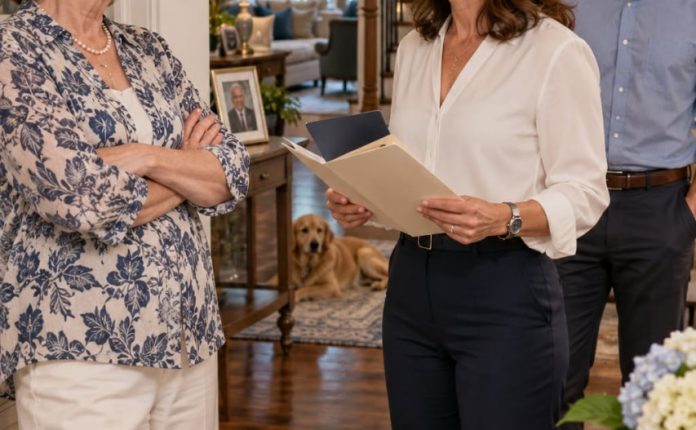
We met at Emily and Noah’s house on a Sunday afternoon. I chose their home because it was neutral and because I trusted Noah to end the meeting if necessary.
Before Margaret arrived, we agreed on three rules.
No shouting.
No interrupting.
If I asked her to leave, she would leave.
Margaret arrived exactly at two.
She looked smaller than I remembered.
Her silver hair was loose around her shoulders instead of arranged in its usual perfect style. She carried a leather handbag and a covered casserole dish.
“I brought Clara’s favorite,” she said.
It was chicken with mushrooms.
I had never liked mushrooms.
Adam took the dish and placed it in the kitchen without comment.
We sat in the living room.
Margaret chose an armchair across from me. Adam sat beside me, while Emily and Noah shared the sofa.
For several seconds, no one spoke.
Finally, Margaret folded her hands.
“I understand that everyone is upset.”
Adam inhaled, but I touched his sleeve.
Let her speak, I thought.
Let us hear the entire version before we answer.
Margaret continued.
“The wedding was an extremely emotional day for me. It was the first major family occasion without your father.”
She looked at Adam and Emily.
“I had spent more than a year making sure everything was perfect. When June called and said Clara was ill, I believed it was stress.”
“The doctor told you otherwise,” Emily said.
Margaret’s lips tightened.
“We agreed not to interrupt.”
Emily looked at me.
I nodded for Margaret to continue.
“The doctor said Clara needed surgery, but I did not understand the seriousness. No one explained it clearly.”
“Dr. Shah explained it clearly,” I said.
Margaret looked at me.
“I was in a noisy bridal suite.”
“You asked whether it could be anxiety. She said no.”
“I was confused.”
“You also told me not to contact anyone until after the ceremony.”
“I was protecting Emily.”
Emily shook her head but remained silent.
Margaret took a breath.
“When Adam’s phone kept ringing, I became concerned that he would leave before walking his sister down the aisle.”
“So you deleted my voicemail,” I said.
“I listened to it first.”
“I know.”
Margaret’s face changed slightly.
Until then, I think she had hoped Adam discovered the message only through the hospital’s later call.
“You sounded conscious,” she said.
The words were so astonishing that Noah leaned forward.
“What does that mean?”
“It means she was able to speak. I believed she was stable.”
“She said she was being taken into emergency surgery,” Adam replied.
“I thought the hospital would call if something truly serious happened.”
“They did call,” he said. “You deleted those messages too.”
“I was trying to get us through the ceremony.”
Adam stared at her.
“You weren’t confused.”
Margaret’s eyes filled with tears.
“I was overwhelmed.”
“You made a decision,” he said. “You decided Clara’s emergency was less important than the wedding photographs.”
“That is not fair.”
“It is exactly what happened.”
“I did not know her appendix was leaking.”
“The doctor told you.”
“I did not believe it was that serious.”
“Why?”
Margaret looked toward me.
No one moved to rescue her from the question.
At last, she said, “Because the timing seemed impossible.”
I felt something cold settle in my chest.
“Impossible?”
“Of all the mornings for this to happen, it happened on Emily’s wedding day.”
“Medical emergencies do not check family calendars.”
“I know that now.”
“You knew it then.”
“I knew what the doctor said.”
“But you believed I had somehow arranged it?”
“I believed you might be frightened and making it sound worse.”
“You heard the doctor.”
“Yes.”
“You listened to my voicemail.”
“Yes.”
“You knew an ambulance had taken me from my house.”
“Yes.”
“And you still decided I was exaggerating.”
Margaret looked down.
“Yes.”
The room became silent.
Her admission should have made me angrier.
Instead, I felt tired.
For weeks, part of me had searched for a version of events in which Margaret had truly misunderstood.
There was none.
She had received the facts.
She rejected them because they interfered with what she wanted.
“What happened when you came to the hospital?” I asked.
“I was upset.”
“What did you plan to do when you reached toward me?”
Margaret pressed her palms together.
“I wanted to see the bandage.”
“Why?”
“I wanted proof.”
“Proof that the doctor, the hospital, June and I were all telling the truth?”
She did not answer.
“Were you going to touch me?”
“No.”
“You pulled at the blanket.”
“I barely touched it.”
“My incision had just been closed.”
“I did not understand how fragile you were.”
“You entered a surgical patient’s room and shouted at her.”
“I lost control.”
“And afterward, you sent flowers saying the family should move forward.”
“I did not know what else to say.”
“You could have said you were sorry.”
“I am sorry.”
The words came quickly.
Too quickly.
I waited.
Margaret looked around the room as though expecting someone to acknowledge that she had completed the required task.
“For what?” I asked.
She blinked.
“For upsetting you.”
“That is not enough.”
“What would be enough, Clara?”
There was irritation beneath her question.
Not curiosity.
“Tell the truth.”
“I have told the truth.”
“No. You have described your feelings. Tell the truth about your choices.”
Margaret looked toward Adam.
He remained silent.
She turned to Emily.
Emily’s eyes were wet, but she did not intervene.
Margaret was alone with her own behavior.
At last, she faced me again.
“I knew you were having surgery,” she said. “I did not tell Adam because I was afraid he would leave the wedding.”
Her voice trembled.
“I deleted your voicemail because I wanted him to walk Emily down the aisle. I told Emily you had an upset stomach because I did not want her to panic. After the ceremony, I became angry because everyone kept asking about you.”
She wiped beneath one eye.
“I thought the wedding was being taken away from us.”
“It wasn’t.”
“I understand that now.”
“No, Margaret. It was never being taken away. Emily got married. The guests celebrated. The flowers were beautiful. The only thing threatening the day was your belief that one person’s pain had to be denied for another person’s joy to exist.”
Her mouth opened, but no words came.
I continued.
“You did not protect the wedding. You protected your image of the wedding.”
Margaret looked at Emily.
“I wanted your day to be perfect.”
Emily spoke quietly.
“My day stopped feeling perfect when I discovered my mother had lied to me while my sister was in surgery.”
“I did it for you.”
“No,” Emily said. “You did it because you were afraid of losing control.”
Margaret flinched.
Emily moved closer to Noah.
“All my life, you have told me your choices were for me. You criticized my clothes so other people would respect me. You chose my college because you wanted me to have opportunities. You called my friends unreliable because you were protecting me from disappointment.”
“I was your mother.”
“You made me afraid to make decisions without you.”
“I helped you plan this wedding.”
“Clara helped me plan it. You managed it.”
The distinction hung heavily in the room.
Margaret turned to Adam.
“Do you agree with this?”
He looked at her for a long time.
“Yes.”
Her face crumpled.
“After everything I did for you?”
Adam’s eyes filled with tears.
“This is why we never tell you the truth. The moment we do, you turn it into a list of everything we owe you.”
“I raised you.”
“And I love you.”
“Then how can you sit beside her while she attacks me?”
I felt Adam tense.
He did not raise his voice.
“Clara is my wife. She nearly became seriously ill because you told her to delay treatment. You kept me from her during emergency surgery. Then you frightened her in the hospital. Sitting beside her is not an attack on you.”
“She has wanted this for years.”
“Wanted what?”
“To separate us.”
I waited for the familiar response.
In the past, Adam would have said, “Mom, no one is separating us.”
He would have reassured her first and addressed the accusation later.
This time, he said, “You are responsible for the distance between us.”
Margaret stood.
“I cannot listen to this.”
Noah rose too.
“You agreed to stay until Clara finished.”
Margaret looked at me.
“Are you finished?”
“No.”
She remained standing, but she did not leave.
“I will not have contact with you for the foreseeable future,” I said. “You may not come to our house. You may not call me. You may not send messages through Adam or Emily.”
Her face hardened.
“You cannot forbid my son from speaking to me.”
“I am not forbidding him.”
Adam spoke.
“I am taking a break from contact too.”
Margaret turned toward him.
“For how long?”
“I don’t know.”
“A week?”
“No.”
“A month?”
“I don’t know.”
“I am your mother.”
“Yes.”
The gentleness in his voice made the boundary more powerful.
“And Clara is my wife. I need to repair the damage I allowed in my marriage.”
“I did not damage your marriage.”
“You taught me to manage your feelings before protecting hers. I chose to keep doing it. That part is my responsibility.”
Margaret picked up her handbag.
“I suppose you have all decided I am a monster.”
“No,” I said.
She looked at me.
“A monster could be dismissed easily. You are a person we love who made dangerous choices and still struggles to accept responsibility. That is harder.”
She stared at me.
“What do you expect me to do?”
“Get help.”
“I do not need therapy.”
“Then nothing will change.”
“I apologized.”
“You admitted what you did. An apology also requires change.”
Margaret looked at her children again.
Neither of them moved.
At last, she walked toward the door.
Before leaving, she turned back.
“I hope one day you understand what it feels like to believe you are losing your family.”
I held her gaze.
“I almost lost my life while you worried about losing control of a wedding.”
She left without another word.
After the door closed, Emily began sobbing.
Noah held her.
Adam sat beside me with his face in his hands.
I did not feel victorious.
There was no satisfaction in watching a family finally speak truths it had avoided for decades.
Truth did not arrive like sunlight.
Sometimes it arrived like a storm, shaking windows and breaking branches that had already been weak for years.
But after the storm, there was air.
For the first time since entering the Bennett family, I could breathe without preparing for Margaret’s reaction.
The months that followed were quiet.
Adam began meeting with a therapist who specialized in family boundaries and grief. At first, he worried that therapy would become a weekly discussion about blaming his mother.
Instead, he learned to examine his own choices.
He learned that avoiding conflict was not the same as creating peace.
He learned that rescuing someone from the consequences of their behavior prevented them from changing.
He learned that guilt could be felt without being obeyed.
I attended several sessions with him.
We spoke about the years when he had asked me to overlook Margaret’s comments. He listened without defending himself.
Once, after I described a Christmas dinner during which Margaret joked that I was “too independent to understand family loyalty,” Adam began crying.
“I laughed,” he said.
“You looked uncomfortable.”
“But I laughed.”
“Yes.”
“I made you think you were alone.”
“Yes.”
“I’m sorry.”
That apology felt different from Margaret’s.
It named the harm without asking me to make it smaller.
Emily also started therapy.
She and Noah delayed their honeymoon by two months, not because of my surgery but because Emily realized she was emotionally exhausted after the wedding.
When they finally traveled to Italy, she sent me photographs every day.
One showed her standing beside Lake Como beneath a blue umbrella.
The caption read:
It rained. The day was still beautiful.
Margaret remained out of contact for nearly four months.
She sent two letters during that time.
Adam returned the first unopened because she had addressed it only to him and written “Personal—Do Not Share with Clara” on the envelope.
The second was addressed to both of us.
We read it together.
The letter was six pages long.
The first two pages described Margaret’s childhood. Her own mother had been unpredictable and often withdrew affection when angry. Margaret learned early to manage every detail of the household so nothing would go wrong.
The next two pages described her marriage to Robert and the terror she felt after his death.
None of this was new.
We had heard pieces of it for years.
But the final two pages were different.
She wrote:
My history explains why control feels like safety to me, but it does not excuse what I did.
I knew Clara was being taken into surgery. I chose to keep that information from Adam and Emily.
I deleted messages because I wanted the wedding to continue according to my plan.
At the hospital, I was angry that the truth had become more important than my wishes. I frightened Clara when she was physically vulnerable.
I have spent years calling my behavior love when it was often fear.
I expected my children and Clara to manage that fear for me.
I am sorry.
I have begun seeing a counselor. I understand that attending counseling does not require any of you to forgive me or resume contact.
I will respect your boundaries.
I hope that, in time, my actions will show whether I am capable of changing.
I read the final paragraph three times.
Adam asked what I wanted to do.
“Nothing yet,” I said.
He nodded.
We did not call her.
We did not send reassurance.
We let the apology exist without rewarding it immediately.
That was new for all of us.
In October, Emily met Margaret for coffee in a public place.
The meeting lasted forty minutes.
Margaret did not cry, blame me or ask Emily to carry messages. She apologized again and accepted that she would not be invited to Emily and Noah’s house until they felt comfortable.
Two weeks later, Adam met her in the same café.
He returned home looking sad but peaceful.
“She listened,” he said.
“Did she apologize?”
“Yes.”
“Did she explain?”
“No.”
That mattered.
Explanations had always been Margaret’s way of reducing responsibility. This time, she had simply listened.
I was not ready to see her.
No one pressured me.
Thanksgiving approached.
For the first time in our marriage, Adam and I planned the holiday without discussing Margaret’s preferences. We invited Emily, Noah and June.
We ordered a smaller turkey.
We moved dinner to three because June disliked driving after dark.
I used the blue-and-white dishes my mother had left me instead of the formal china Margaret preferred.
The day before Thanksgiving, a small package arrived.
There was no return address, but I recognized Margaret’s handwriting.
Inside was the emergency sewing kit I had prepared for Emily’s wedding. I had assumed it was lost.
There was also a note.
Clara,
You prepared this for Emily and thought of everything she might need. I took credit for it when someone complimented the idea.
That was a small dishonesty compared with what happened later, but I now understand that my larger actions were built from many smaller ones.
I am returning it because it belongs to you.
I will not contact you again unless you invite it.
I am sorry.
Margaret
I sat at the kitchen table for a long time.
The sewing kit contained safety pins, thread, stain remover, tissues, breath mints, pain relievers and a tiny pair of scissors.
Every item had been chosen because I cared about Emily.
Margaret had looked at that care and seen competition.
I did not suddenly forgive her.
Real life rarely changes in one dramatic moment.
People do not become safe because they write one honest letter.
Trust is not rebuilt through words alone.
But I believed, for the first time, that Margaret had begun looking at herself rather than only at what others had done to her.
On Thanksgiving Day, the house filled with the smell of rosemary, butter and baked apples.
Emily brought flowers. Noah carved the turkey. June arrived wearing red lipstick and carrying two bottles of sparkling cider.
Before dinner, Adam took my hand beneath the table.
“You okay?” he asked.
I looked around the room.
There was an empty chair near the window.
Not intentionally.
We had set one extra place before realizing our mistake.
For a moment, I imagined Margaret sitting there.
Then I remembered that an empty chair did not always need to be filled immediately.
Sometimes space was part of healing.
“I’m okay,” I said.
After dinner, Emily helped me carry dishes into the kitchen.
She placed the emergency sewing kit on the counter.
“I saw Mom returned it.”
“Yes.”
“She told me she’s continuing therapy.”
“I’m glad.”
“She asked me not to tell you that.”
I looked at her.
Emily smiled slightly.
“She said she didn’t want you to think she was performing for you.”
That sounded new.
“Maybe we could invite her for coffee after Christmas,” I said.
Emily’s eyes widened.
“Are you sure?”
“No. But I’m willing to consider it.”
“That’s enough.”
The coffee meeting took place in January.
Adam came with me.
Margaret was already seated when we arrived. She stood but did not move to embrace me.
“Thank you for coming,” she said.
We sat.
She looked older than she had at the wedding, though only seven months had passed. There were deeper lines around her mouth and less certainty in her posture.
“I want you to know I do not expect anything from today,” she said.
“All right.”
“I am sorry for what I did.”
I waited.
She did not add but.
She did not mention stress, grief, the wedding or her intentions.
“I believed my fear mattered more than your safety,” she continued. “Then I became angry when you would not help me maintain that belief. There is no excuse.”
My hands trembled beneath the table.
Adam noticed but did not speak for me.
“I thought I might die before surgery,” I said.
Margaret’s eyes filled.
“I know.”
“No, you don’t. You knew there was a medical emergency, but you were at the venue. I was alone in a hallway, waiting for my husband.”
She lowered her head.
“You took away his chance to be there.”
“Yes.”
“You took away my right to decide who knew.”
“Yes.”
“And when you came to the hospital, you made me feel unsafe.”
“Yes.”
The simplicity of her answers gave my pain room to exist.
“I may never trust you the way you want me to.”
“I understand.”
“Family gatherings may be limited.”
“I understand.”
“You will never have unrestricted access to our home again.”
Margaret closed her eyes briefly.
Then she nodded.
“I understand.”
We spoke for twenty minutes more.
There was no dramatic reconciliation.
No embrace.
No promise that everything would return to normal.
Normal had been the problem.
When we left, Margaret remained at the table.
Outside, light snow had begun falling.
Adam and I walked to the car in silence.
“Do you regret going?” he asked.
“No.”
“Do you forgive her?”
“Not yet.”
He opened the passenger door for me.
“That’s okay.”
I looked back through the café window.
Margaret was sitting alone, but she was not calling anyone or wiping away dramatic tears. She appeared to be writing in a notebook.
For once, her loneliness did not become our emergency.
A year after the wedding, Emily and Noah held an anniversary picnic at Willowmere House.
The gardens looked different in sunlight. Roses climbed the stone walls, and white tables stood beneath the trees.
I had not returned to the venue since the morning I was supposed to deliver the favors.
For a few moments, I stood near the entrance remembering the ambulance, the operating-room lights and Margaret’s voice shouting, “Stop pretending.”
Then Emily came toward me carrying a tray of lemonade.
“You made it this time,” she said.
“I did.”
Margaret had been invited for two hours.
She arrived quietly, greeted us and did not attempt to control the seating, food or photographs.
When the photographer asked for a family picture, an old tension moved through me.
I expected Margaret to request one with “the original family.”
Instead, she looked at Emily.
“Who would you like in the photograph?”
Emily reached for my hand.
“Everyone.”
We stood together beneath the rose-covered arch.
Noah beside Emily.
Adam beside me.
Margaret at the end.
The photographer lifted his camera.
For years, I had believed family peace meant arranging ourselves carefully enough to hide every fracture.
Smile.
Stand closer.
Do not mention what happened.
Do not upset anyone.
But as the camera clicked, I understood that real peace was not the absence of painful truth.
Real peace was what became possible after truth was finally allowed into the room.
The photograph did not erase the hospital.
It did not restore the trust Margaret had broken or remove the boundaries we had created.
It showed something more honest.
A family that had nearly been destroyed not by one emergency, but by years of silence.
A husband learning that loyalty required courage.
A sister learning she could love her mother without surrendering her own judgment.
A woman learning that forgiveness could not be demanded.
And me, standing upright beneath the summer sun, no longer making myself smaller so someone else could feel powerful.
After the photograph, Margaret approached me.
“I will be leaving soon,” she said. “I promised Emily I would stay only two hours.”
“Thank you for respecting that.”
She nodded.
Then she looked toward the rose garden.
“I often think about what Nurse Martinez said to me.”
“What did she say?”
“That your room belonged to you.”
I remembered.
“She was right.”
“Yes.”
Margaret took a breath.
“I spent my whole life entering other people’s rooms and behaving as though they belonged to me.”
There was nothing I needed to add.
She said goodbye and left.
Emily joined me a moment later.
“Are you all right?”
“Yes.”
“Do you believe she’s changed?”
I watched Margaret walk slowly toward the parking area.
“I believe she is changing.”
“That’s different.”
“It has to be.”
Across the garden, Adam raised two glasses of lemonade and motioned for us to join him.
As I walked toward him, my hand rested briefly over the faint scars beneath my dress.
They were nearly invisible now.
But I did not hate them.
They reminded me that my body had warned me when something was wrong, even while my mind was trying to meet everyone else’s expectations.
They reminded me that being needed was not the same as being loved.
That compassion without boundaries became self-abandonment.
That a family celebration did not become more meaningful when someone’s suffering was hidden.
And that keeping the peace was sometimes only another name for protecting the person most willing to destroy it.
On the morning of Emily’s wedding, I had believed I was responsible for ribbons, favors, place cards, schedules and everyone’s happiness.
By the following morning, I understood that there was only one responsibility I had neglected.
I had not protected myself.
It took an ambulance, an operating room, a locked hospital door and a nurse brave enough to say “Step away from the patient” for me to understand what my life had been asking of me for years.
Stop explaining cruelty.
Stop apologizing for pain.
Stop calling silence peace.
Stop pretending.
Not the way Margaret had shouted it.
The words meant something different to me now.
Stop pretending that love requires you to accept harm.
Stop pretending that family titles excuse dangerous choices.
Stop pretending that your needs become selfish whenever someone else dislikes them.
And stop pretending that forgiveness is the price you must pay to prove you have a good heart.
Sometimes the kindest thing you can do for yourself—and perhaps even for the person who hurt you—is close the door, let the silence remain, and wait until truth is finally strong enough to knock.