Daniel read the DNA report twice.
Then he folded it down the middle as if damaging the paper might change what it said.
“This is fake.”
Marcus did not react.
“It was completed by an accredited laboratory under court supervision.”
“You could have paid someone.”
“The court selected the facility.”
Daniel turned toward Rachel.
“Tell him.”
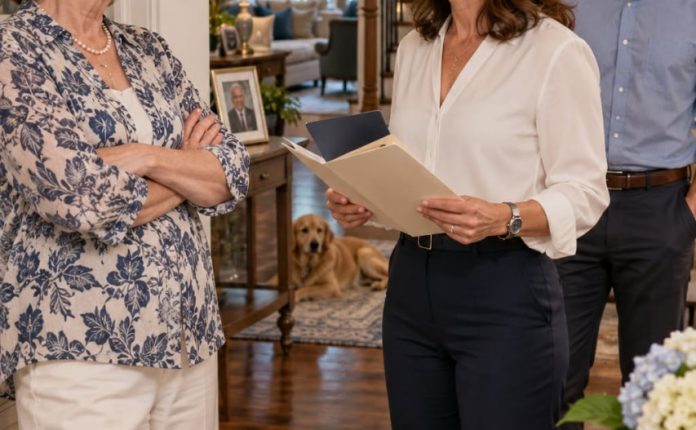
Rachel pressed both hands against the reception desk.
People had begun watching. A security officer stood near the elevator, observing without approaching.
“Tell him he’s lying,” Daniel demanded.
Rachel’s tears fell silently.
“Daniel, we should discuss this somewhere private.”
His voice rose.
“Is he lying?”
She did not answer.
Daniel stepped back as though she had struck him.
The brown folder trembled in Marcus’s hand, though his voice remained controlled.
“I’m not here to fight with you,” he said. “I’m here because my son is receiving medical treatment and his doctors need an accurate family history.”
Daniel looked at him with open hatred.
“He’s not your son.”
“The report says otherwise.”
“I raised him.”
“I know.”
“You don’t know anything.”
Marcus’s jaw tightened.
“I know that Rachel told me she was single when we met. I know she disappeared for weeks at a time. I know she contacted me the month before the baby was born and asked about medical conditions in my family. At the time, I thought she was being friendly.”
He looked toward the pediatric doors.
“And I know she denied me the first year of my child’s life.”
Rachel wiped her face.
“I was afraid.”
“Of what?” Daniel asked.
She turned toward him.
“Of losing everything.”
Daniel laughed bitterly.
“So you lied to me instead?”
Rachel looked at me.
For one second, I saw the girl who had shared lunch with me on our first day of secondary school. The girl who had once cycled five miles through rain because I had called her after my mother was hospitalized.
That girl was buried beneath years of decisions I could not understand.
“Nora,” she whispered, “please tell them we need privacy.”
I almost asked why she expected me to rescue her.
Then the pediatric doors opened.
A nurse stepped into the corridor.
“Ms. Shaw?”
Rachel immediately straightened.
“Is he all right?”
“He’s resting. The physician will speak with you shortly.”
The nurse looked at the group surrounding her.
“Only two family members can remain in the waiting area.”
Silence followed.
Family members.
One child.
Three adults standing nearby who had each believed they had some claim to his story.
I stepped away.
“This should not happen in front of him,” I said.
Daniel stared at the floor.
The compliance director had reserved a private conference room on the third floor. After a short discussion with the nurse, Rachel arranged for her mother—who had been sitting inside the pediatric wing—to remain with the baby.
None of us spoke in the elevator.
Daniel stood in one corner with his arms folded.
Rachel stared at the numbers above the door.
Marcus held the folder against his chest.
I watched our reflections in the mirrored wall.
A year earlier, I would have taken responsibility for everyone’s discomfort. I would have searched for a sentence that softened the silence.
That day, I allowed it to remain.
The compliance director, Ms. Patel, was waiting in the conference room with a hospital attorney and Dr. Samuel Hendricks, the specialist responsible for reviewing the original fertility records.
Ms. Patel had not expected Daniel or Rachel to attend. When I explained what had happened downstairs, she asked whether I wanted to continue.
“Yes,” I said.
Daniel looked at me.
“Continue with what?”
Ms. Patel gestured toward the chairs.
“I believe everyone should sit down.”
Rachel remained near the door.
“I need to go back to my son.”
Marcus spoke gently but firmly.
“We all do. That is why the truth has to be established now.”
Daniel turned on him.
“You don’t get to talk about my son.”
“No,” Marcus replied. “I get to talk about the child Rachel and I created. What happens after that will be decided responsibly, not in a hallway.”
For the first time, Daniel had no immediate response.
We sat around the rectangular table.
Ms. Patel placed several folders before her.
“The hospital recently concluded an investigation into unauthorized access and alteration of patient records at the former New Hope Reproductive Clinic,” she said. “Because the investigation concerns private medical information, I need consent before discussing individual findings.”
She looked at me.
I gave my consent.
Daniel hesitated, then gave his.
Rachel shook her head.
“I don’t consent.”
The hospital attorney leaned forward.
“You are not being asked to disclose your medical information. The records being discussed belong to Mr. Hayes and Ms. Bennett. The access audit relates to your actions as an employee.”
Rachel gripped the edge of her chair.
“I want an attorney.”
“You have the right to contact one,” he said. “However, everyone in this room has already received notice of the investigation. Today’s meeting was arranged to provide Ms. Bennett with findings concerning her records.”
Daniel looked at me.
“What records?”
Dr. Hendricks opened a folder.
“Your fertility records.”
Daniel’s face tightened.
“What about them?”
The doctor placed two reports on the table.
“These are certified copies of the original laboratory findings. These are the altered versions later added to the patient portal.”
Daniel did not reach for them.
Dr. Hendricks continued.
“Ms. Bennett’s test values were replaced with results belonging to another patient. Your results were summarized inaccurately.”
“What are you saying?”
“The original examinations showed that Ms. Bennett’s fertility markers were within expected ranges.”
Daniel turned toward me.
I met his eyes.
The doctor slid the next page forward.
“Your examinations showed a severe male-factor condition. The findings were consistent across three separate tests.”
Daniel’s mouth opened.
“That’s not what our doctor told us.”
“The physician’s initial notes reflect a plan to discuss the findings with you both. However, the files were accessed and modified before the follow-up appointment.”
Daniel looked at Rachel.
She had become completely still.
“You told me my test was normal,” he said.
Rachel shook her head weakly.
“I only explained what the clinic said.”
“No,” I said.
Every face turned toward me.
I opened my envelope and removed a printed email.
“You sent this to Daniel from your clinic account. You wrote that his test was normal and that the problem had been identified in my results.”
Daniel took the page from me.
The email had been recovered from our old joint account.
I remembered the day it arrived. Rachel had called minutes afterward, speaking in a gentle voice as she explained that I should prepare myself for difficult news.
Daniel read the message.
“Why would you do this?”
Rachel began breathing rapidly.
“I loved you.”
The answer seemed to surprise even her.
“I loved you before you ever noticed me,” she continued. “You were always talking about wanting children. Nora had everything I wanted. She had you, the house, stability…”
“I had fertility treatments because of you,” I said.
Rachel looked at me.
“I didn’t think it would go that far.”
“You changed medical records.”
“I only changed the summaries.”
“You watched me inject medication into my body.”
Her face crumpled.
“I thought the doctors would repeat the tests.”
“You worked there. You knew we trusted the reports.”
“I was angry.”
“At me?”
“At everything.”
Her voice became sharper as years of concealed resentment surfaced.
“You always got the life you wanted. At school, teachers chose you. At university, you got the scholarship. Your mother treated me like another daughter. Then Daniel met both of us and chose you.”
I stared at her.
“We were friends.”
“I know.”
“No, Rachel. Friends can feel jealous. Friends can feel disappointed. They do not falsify medical information and sleep with each other’s husbands.”
Daniel pushed away from the table.
“Did you know?”
Rachel blinked.
“Know what?”
“That I couldn’t…”
He could not finish.
She lowered her eyes.
“Yes.”
The word seemed to empty the air from the room.
Daniel stood abruptly.
The chair scraped across the floor.
“You knew the baby couldn’t be mine.”
Rachel began crying again.
“I wanted him to be yours.”
“That is not the same thing.”
“I thought if you loved him, biology wouldn’t matter.”
“Then why didn’t you tell me?”
“Because you would have left.”
Daniel turned away from her.
His hands shook.
I remembered those hands holding mine in the clinic parking lot. I remembered him promising that we were a team. I remembered them pointing toward me later as he said I had denied him a family.
Some part of me had once dreamed of seeing him learn the truth.
I thought it would feel like justice.
Instead, I felt exhausted.
Ms. Patel explained that the audit logs showed Rachel had accessed our records eleven times outside her assigned duties. She had printed documents, replaced scanned pages and deleted internal messages. The hospital had already reported the breach to the appropriate authorities and professional bodies.
Rachel listened without speaking.
Her actions had not only affected us. The investigation had identified irregular access involving other files, though no further alterations had yet been confirmed.
Daniel sat down again.
His face had lost its color.
“What were my actual chances of fathering a child?” he asked.
Dr. Hendricks answered carefully.
“The original findings suggested an extremely low probability without specialized intervention. A repeat evaluation would be necessary to assess your current condition.”
Daniel looked at the paternity report.
“So he was never mine.”
Marcus’s expression softened slightly.
“You were the person who cared for him during his first year. That matters. But we need to separate emotional bonds from biological facts and legal responsibilities.”
Daniel stared at him.
“How can you be so calm?”
“I’m not calm.”
Marcus’s voice cracked for the first time.
“I missed his birth. I missed his first smile, his first Christmas and the first time he stood up. I discovered I had a son through a photograph someone showed me on a phone.”
He pressed his palm against the folder.
“I am angry. But there is a child downstairs who is sick and confused by strangers in white coats. My anger cannot become his punishment.”
Those words changed the room.
The baby had become a symbol to Daniel—a symbol of success after our failed marriage.
To Rachel, he had become protection against abandonment.
To Marcus, he represented a stolen year.
But he was not a symbol.
He was a child.
“Marcus is right,” I said. “Whatever happens next, none of this is the baby’s fault.”
Daniel looked at me.
His eyes were red, but I could not tell whether he was grieving Rachel’s deception, his lost identity as a father, or the realization that he had destroyed our marriage for a lie.
“Nora,” he whispered.
I had not heard him say my name with that tone in years.
“I didn’t know.”
“You knew you were having an affair.”
He looked down.
“You knew you were blaming me for something we should have faced together. You knew you called me broken because it was easier than admitting you had betrayed me.”
“I thought…”
“You thought the medical report gave you permission to be cruel.”
He closed his eyes.
“I’m sorry.”
A year earlier, I would have given anything to hear those words.
Now they felt too small.
“I believe you are sorry today,” I said. “But I needed you to be decent when you believed the lie. Character is not how someone behaves after the truth corners them. It is how they behave when they think they have the power to hurt another person without consequences.”
Daniel wiped his face.
Rachel began sobbing openly.
“I never meant for this to happen.”
I looked at her.
“You made it happen one decision at a time.”
“I was afraid of being alone.”
“So you made sure I was.”
She covered her face.
“I’m sorry.”
I stood.
The meeting had given me the facts I needed. The hospital would provide formal documentation to my attorney. Further investigations would continue without me.
I gathered my papers.
Daniel reached for my wrist, then stopped before touching me.
“Nora, wait.”
I looked at his hand hovering in the air.
“What?”
“Did you know all of this when you saw us downstairs?”
“I knew my records had been altered. I knew Marcus had received the DNA result.”
“And you let me stand there and say those things.”
I almost laughed.
“You didn’t need my help to humiliate yourself.”
He lowered his hand.
“What am I supposed to do now?”
It was the same question I had asked myself after he left our kitchen.
How was I supposed to wake up in a house filled with reminders?
How was I supposed to explain the divorce?
How was I supposed to build a future after being told I was defective?
No one had answered for me.
“You begin with the truth,” I said. “Then you accept that the truth does not guarantee forgiveness.”
I walked toward the door.
Before leaving, I turned to Marcus.
“Take care of your son.”
“I will.”
Rachel looked up desperately.
“Nora, are you going to tell everyone?”
There it was.
Even then, she feared exposure more than she understood harm.
“I’m going to tell the people who need the truth,” I said. “My doctor, my attorney and anyone involved in protecting other patients.”
“What about our friends?”
“They will ask why our friendship ended. I will not lie for you.”
Her shoulders collapsed.
“But I will not turn your son into public entertainment,” I added. “He deserves privacy.”
Marcus nodded in appreciation.
Daniel said nothing.
I left the room alone.
In the elevator, my knees began trembling.
By the time the doors opened, tears were running down my face.
Not because Daniel had chosen Rachel.
Not because Rachel had lied.
Not even because years of medical treatment had been unnecessary.
I cried for the woman I had been—the woman who had stood before a mirror every morning and whispered apologies to a body that had never betrayed her.
I cried because no report could return those years.
But beneath the grief was something else.
Relief.
The shame was not mine.
It had never been mine.