The arrests began before sunrise three weeks later.
Charles Whitmore was charged with witness intimidation, obstruction of justice, and financial crimes uncovered during the investigation into the company’s settlements.
The company attorney who had threatened Rachel surrendered that afternoon.
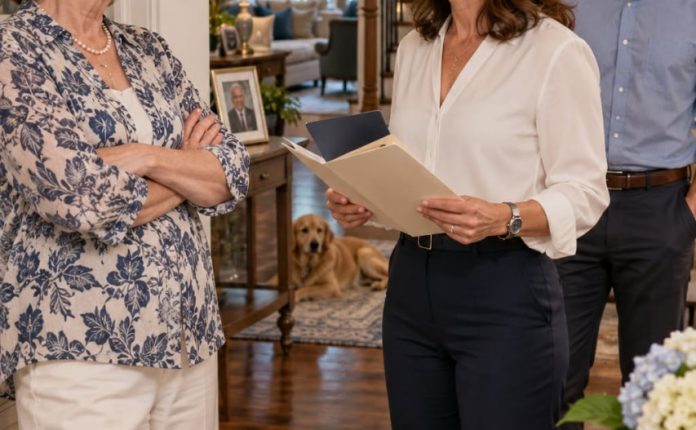
Margaret was charged with attempting to influence witnesses after investigators discovered that she had contacted Evelyn’s former roommate, offering money in exchange for a statement describing Evelyn as unstable.
Daniel faced charges for attempted assault, criminal threats, repeated violations of the protection order, and tampering with witnesses.
Television cameras gathered outside the Whitmore estate.
The same reporters who had called our marriage a “minor domestic disagreement” now spoke of a “long-standing pattern of intimidation.”
I watched none of it live.
I was at Lena’s apartment, sitting on the floor with a cup of tea cooling beside me.
My mother sat across from me.
For nearly a month, we had barely spoken. Then she appeared at the legal center carrying a cardboard box.
Inside were photographs, hospital records, and old letters documenting my father’s abuse.
“I should have left,” she said.
The first time she said it, I felt anger.
The second time, grief.
By the third, I understood that she was not asking me to comfort her. She was finally telling the truth.
She placed one photograph on the floor between us.
It showed her at thirty-eight, wearing a high-necked sweater in summer to hide bruises.
“You asked me once why I stayed,” she said.
“You said you loved him.”
“That was only part of it.”
“What was the rest?”
“I was ashamed.”
She looked down at her hands.
“Every year I stayed made leaving harder. I thought people would ask why I had tolerated it so long. I thought you would hate me for not protecting you.”
“I did hate you sometimes.”
Tears filled her eyes.
“I know.”
“But I also knew you were afraid.”
“I taught you to survive around angry men.”
“Yes.”
“I did not teach you that you could walk away.”
“No.”
She reached across the floor and took my hand.
“You taught yourself.”
I shook my head.
“Women at the center taught me. Evelyn taught me. Rachel taught me. You taught me too, even if it was by showing me the cost of staying.”
My mother began therapy.
She also filed for a permanent separation from my father, though they had lived apart for years.
When he left threatening voicemails, she saved them instead of deleting them.
Evidence, I reminded her.
For the first time, she listened.
The criminal proceedings against Daniel moved slowly.
His defense argued that his statements were exaggerated expressions of anger and that I had manipulated the situation because of my professional knowledge.
They described my laughter as proof that I had not been afraid.
That argument wounded me more than I expected.
At a preliminary hearing, Daniel’s attorney played the recording in court.
The crash of the table filled the chamber.
Daniel’s voice followed.
A woman has to be hit before she learns her place.
Then my laugh.
Cold.
Brief.
Unfamiliar even to me.
His attorney stood before the judge.
“Does that sound like a frightened woman?”
I felt every eye turn toward me.
The prosecutor rose.
“Fear does not have one sound.”
The judge allowed the recording into evidence.
Outside the courtroom, a young reporter approached me.
“Why did you laugh?” she asked.
Cynthia moved to block her, but I stopped.
I had asked myself the same question many times.
“I laughed because he thought he had discovered my weakness,” I said. “He did not know he had revealed his own.”
The quote spread online.
This time, the comments changed.
Not all of them.
Some people still accused me of destroying a wealthy family. Some insisted I should have given Daniel a second chance.
But hundreds of women began writing to the legal center.
My husband broke a door last night.
My fiancé says no one else will want me.
My father controls my mother’s money.
Is it abuse if he has never actually hit me?
Our phone lines overflowed.
Cynthia called an emergency staff meeting.
“We need volunteers,” she said. “And funding.”
The donor who had withdrawn support quietly offered to return.
Cynthia refused unless the organization issued a public apology for abandoning us during the controversy.
They did.
Six months after the wedding, Daniel accepted a plea agreement.
The evidence from Evelyn, Rachel, and the monitored courthouse meeting had made a complete acquittal unlikely.
He pleaded guilty to criminal threats, attempted assault, violating a protection order, and witness tampering. He received a custodial sentence, mandatory intervention programs, and long-term restrictions on contacting me, Evelyn, or Rachel.
Charles’s case continued separately. His company collapsed under investigations into fraudulent payments, coercive settlements, and misuse of municipal contracts.
Margaret avoided prison but received probation and community service after admitting that she had attempted to influence witnesses.
During her sentencing, she asked to address the court.
She stood with both hands gripping the podium.
“I believed protecting my son meant protecting him from consequences,” she said. “I understand now that I protected the behavior instead.”
I watched from the second row.
Part of me wanted to believe her.
Another part remembered the phone call.
Men shout. Women calm them down.
Regret did not erase the women she had silenced.
Afterward, Margaret approached me in the courthouse hallway.
A deputy remained nearby.
“Mara,” she said.
I turned.
She looked older than she had at our wedding. The perfect silver hair had grown thin at the temples. Her expensive coat hung loosely on her shoulders.
“I am sorry,” she said.
“For what?”
Her lips parted.
“For blaming you.”
“Only that?”
“For Evelyn. For Rachel. For teaching Daniel that women would always be asked to absorb his anger.”
I studied her face.
“Why did you do it?”
Her gaze moved toward the courthouse windows.
“Daniel’s father was hard on him. When Daniel became angry, I told myself he had inherited it. I thought love meant shielding him.”
“You shielded him from consequences, not pain.”
“I know.”
“Do you?”
She looked at me again.
“Yes.”
I did not forgive her.
Not then.
Perhaps not ever.
But I believed she had finally understood one piece of the truth.
“I hope you spend the rest of your life proving that,” I said.
She nodded and walked away.
The annulment was granted shortly after Daniel’s plea.
Legally, the marriage became something that should never have existed.
But no court order could return me to the woman I had been before it.
For months, I struggled with ordinary things.
The sound of a chair scraping across a floor made me tense.
A man raising his voice in a restaurant caused my hands to go cold.
I could not cook chicken stew without remembering the wall.
I dreamed about the dining table flying toward me.
In the dreams, I never moved quickly enough.
Therapy helped.
So did work.
But healing did not arrive as a grand victory. It arrived in small permissions.
Permission to sleep with the lights off.
Permission to laugh loudly.
Permission to wear the red dress Daniel once called attention-seeking.
Permission to admit that I missed him sometimes—not the real Daniel, but the man he had pretended to be.
That grief embarrassed me at first.
“How can I miss someone who threatened me?” I asked my therapist.
“You miss the relationship you believed you had,” she said. “The deception does not make your love imaginary. It makes his behavior dishonest.”
I carried those words with me.
Evelyn visited nearly a year after the case began.
She came alone.
We met at a quiet café near the legal center.
For several seconds, we simply looked at each other.
Then she hugged me.
“I thought you would be taller,” she said, wiping tears from her face.
“I thought you would be quieter.”
“I used to be.”
We laughed.
Her scar had faded, but I could still see it beneath her eyebrow.
She showed me photographs of her children.
A daughter who loved astronomy.
A son who wanted to become a chef.
“My husband knows everything now,” she said.
“How did he respond?”
“He cried because I had carried it alone.”
“You were protecting yourself.”
“I know.”
She stirred her coffee.
“After Daniel was sentenced, I stopped having the same nightmare.”
“What happened in it?”
“He would be standing outside my house. I would try to lock the door, but the lock would fall apart in my hands.”
“And now?”
“Now there is a door.”
I reached across the table.
“And it locks.”
Rachel later joined the board of the legal center.
She used part of her renewed settlement to establish an emergency housing fund for women leaving dangerous homes.
We named it the Open Door Fund.
Not after any of us.
After the moment a woman realizes the exit belongs to her.
One afternoon, nearly eighteen months after my wedding, Cynthia entered my office carrying an envelope.
“No return address,” she said.
Inside was a handwritten letter from a woman named Tessa.
She had seen the courthouse interview in which I explained why I laughed.
My boyfriend had never hit me, she wrote, but he punched walls beside my head and said I was lucky he had self-control. I kept thinking it was not serious enough to leave. After hearing your recording, I packed a bag. I am safe now.
I read the letter three times.
Then I placed it in the locked drawer of my desk beside copies of Evelyn’s first message and Rachel’s old voicemail transcript.
Not trophies.
Reminders.
Daniel’s violence had not begun with a hand against my skin.
It began with the belief that fear was his right.
The flying table was not a loss of control.
It was a demonstration of control.
He had wanted me to understand what he could do.
Instead, I understood what I had to do.
Two years after the wedding, the house was finally sold.
Because both our names had been on the deed, the court supervised the sale and divided the remaining value after legal obligations.
I had not entered the house since the day I left.
Before the closing, I requested one final visit.
Lena came with me.
The new owners had not yet moved in. The rooms were empty, and our footsteps echoed against the walls.
The dining room wallpaper had been replaced.
The broken table was long gone.
Sunlight crossed the wooden floor where the wedding photograph had shattered.
“You okay?” Lena asked.
“I think so.”
We moved upstairs.
The bedroom looked smaller without furniture.
In the closet, I found a single white ribbon trapped behind a shelf.
It had come from one of our wedding gift boxes.
I held it for a moment.
Then I placed it on the windowsill.
“I used to think leaving meant he took something from me,” I said.
Lena leaned against the doorway.
“What do you think now?”
“I think staying would have taken more.”
We returned downstairs.
Before leaving, I stood in the doorway of the dining room.
I imagined the table rising again.
The crash.
The stew on the wall.
Daniel shouting.
Then my own voice.
The gloves are off.
At the time, I had meant that I would stop being polite. Stop protecting his reputation. Stop pretending violence was a private problem.
But the phrase had come from another part of my life too.
After my mother’s second hospitalization, I began taking boxing lessons at a neighborhood gym.
I was seventeen, angry, and desperate to feel strong.
My coach, Mr. Alvarez, never taught me to hurt people. He taught me control.
“Anyone can throw a wild punch,” he used to say. “Real strength is knowing when not to.”
For years, I kept an old pair of red boxing gloves in a storage box.
After leaving the house, I brought them to Lena’s apartment and placed them beside the sofa.
They reminded me that defending myself did not make me violent.
Speaking publicly did not make me cruel.
Seeking justice did not mean I lacked compassion.
Consequences were not revenge.
Before walking out of the empty house, I touched the wall where our wedding photograph had once hung.
“I loved who I thought you were,” I whispered.
The room returned no answer.
“I will not apologize for surviving who you really are.”
Then I left.
Several months later, the legal center opened a new crisis wing funded by community donations.
At the entrance stood a simple wooden table.
Not expensive.
Not polished.
Just strong.
During the opening ceremony, Cynthia asked me to speak.
The room was filled with lawyers, social workers, volunteers, survivors, reporters, and women who had once called us from locked bathrooms.
My mother sat in the front row.
Evelyn and Rachel sat beside her.
I stepped to the microphone.
“I used to believe violence began with a bruise,” I said. “It does not. It begins when someone believes love entitles them to obedience. It grows when families protect reputation over truth. It survives when communities ask victims to be patient, private, and forgiving.”
The room was silent.
“Leaving is not simple. It can cost a home, money, friendships, safety, and the future someone believed they were building. So when a person leaves after one threat, do not ask why they did not wait for a second. Ask why we ever taught them that one was not enough.”
My mother covered her mouth.
I looked at Evelyn.
Then Rachel.
“Three days after my wedding, my husband kicked our dining table across the room because lunch was late. He believed fear would teach me my place.”
I rested my hand on the table beside the microphone.
“He was right about one thing. That moment taught me exactly where I belonged.”
I paused.
“Not beneath his anger. Not behind his reputation. Not inside the silence his family had built.”
My voice shook, but I continued.
“I belonged on the other side of the door.”
Applause rose slowly.
Then all at once.
After the ceremony, a young woman waited near the entrance.
She appeared no older than twenty.
Her sleeves covered her hands despite the warm weather.
“Are you Mara?” she asked.
“Yes.”
“My sister gave me your center’s number.”
“How can we help?”
She looked over her shoulder toward the street.
“My fiancé broke my phone last night.”
I did not ask whether he had hit her.
I did not ask what she had done before he broke it.
I opened the door wider.
“You are safe here,” I said.
She stepped inside.
As the door closed behind her, sunlight spilled across the strong wooden table in the lobby.
For a moment, I saw another table—the one flying through the air, plates breaking around it, a man shouting that pain was a woman’s proper teacher.
He had believed that violence would teach me submission.
Instead, it taught me the final lesson I needed.
Love does not demand fear.
Marriage does not erase freedom.
A threat does not have to become a bruise before it matters.
And sometimes, the bravest sound a frightened woman can make is not a scream.
Sometimes it is a laugh.
A cold, unbelieving laugh that says:
You mistook my kindness for weakness.
You mistook my history for permission.
You mistook this ring for ownership.
But now I see you.
Now the door is open.
And this time, I am walking through it.