Part 4 — The Mother Who Raised Her
There are moments a parent prepares for.
The first fever.
The first day of school.
The first heartbreak.
I had prepared speeches about alcohol, consent, college debt, reckless driving, and the difference between love and control.
I had never prepared to tell my daughter that her father had secretly arranged her adoption after conceiving her with the woman whose face he had carried on his chest throughout our marriage.
Claire stood in the kitchen, clutching Rose’s letter.
I reached for her again.
She stepped back.
“Tell me she’s confused.”
“I can’t.”
“Tell me Dad isn’t my biological father.”
I could not do that either.
Her face folded.
Rose moved forward.
“Claire—”
“Don’t say my name.”
Rose stopped.
“You don’t get to say it like you know me.”
“I know.”
“You don’t know anything.”
“You’re right.”
Claire looked at me.
“Did you know?”
“No.”
“Before today?”
“Never.”
“Are you sure?”
The question cut deeper than she intended.
“I swear to you.”
She examined my face, searching for signs that I had joined the conspiracy.
“What did Dad say?”
“That he planned the adoption.”
Claire’s mouth opened, but no sound emerged.
I guided her toward a chair.
This time she let me touch her.
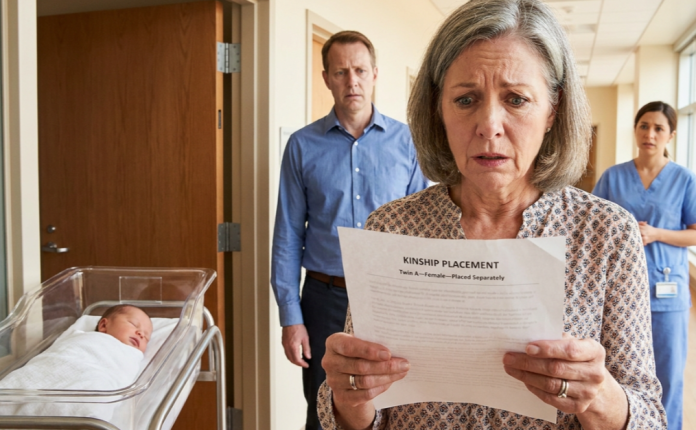
She sat at the kitchen table while I explained what I had learned. I gave her facts, not excuses. Richard and Rose had been together as teenagers. They reunited once during our fertility treatment. Rose became pregnant. Richard and Margaret arranged for us to adopt the baby.
Claire listened without moving.
When I finished, she asked, “Was I wanted?”
Rose made a strangled sound.
I crouched beside Claire’s chair.
“By me? More than anything in this world.”
“That isn’t what I asked.”
Her eyes remained on Rose.
Rose pressed both hands to her chest.
“Yes,” she said. “You were wanted.”
“Then why did you give me away?”
“I was ill.”
“So?”
“I had postpartum psychosis. I heard voices. I believed people were trying to poison you. I was hospitalized.”
“You got better.”
“Yes.”
“And you still left me.”
“I tried to get you back.”
“Did you go to court?”
Rose hesitated.
“No.”
“Why not?”
“Richard’s mother told me I would lose. She said the hospital records would prove I was dangerous. She said you had already bonded with Evelyn and that taking you away would damage you.”
Claire looked at me.
I could see the question forming.
Would taking her away have damaged her?
The answer was yes.
That did not justify how she had been taken.
Rose continued.
“I had no money. No lawyer. No stable home. Margaret showed me photographs of you with Evelyn. You looked peaceful. She told me Evelyn believed the adoption was legal and that the truth would destroy her.”
“And you accepted money.”
“Yes.”
Claire laughed once, without humor.
“How much was I worth?”
“Don’t,” I said.
“I need to know.”
Rose’s shoulders shook.
“Twenty thousand dollars over three years.”
Claire stood so quickly the chair fell backward.
“I need air.”
She ran through the back door.
I followed her into the yard.
The late-afternoon sun stretched long shadows across the grass. Claire crossed to the old swing Richard had hung from the oak tree when she was five.
She gripped one rope with both hands.
“Did he ever love you?” she asked.
“I thought he did.”
“That isn’t an answer.”
“I believe he loved me. I also believe he lied to me in ways that made his love unsafe.”
She looked toward the house.
“Do you still love him?”
“I don’t know what I feel.”
“I hate him.”
“You are allowed to.”
“I hate her too.”
“You are allowed to feel that.”
“Do you?”
I glanced through the window. Rose sat alone at the kitchen table.
“I am angry with her. But she did not steal you from me.”
“Then who did?”
“Your father made choices. Your grandmother made choices. The agency failed all of us.”
“And you got what you wanted.”
The truth of that silenced me.
I had received Claire.
Whatever had been done to Rose, whatever Richard had concealed, I had been the beneficiary.
Claire saw the realization on my face.
“I’m sorry,” she said.
“No. You are right.”
“I didn’t mean you stole me.”
“I know.”
“Are you still my mom?”
I pulled her against me.
She resisted for half a second, then clung to me with the strength of a frightened child.
“I am your mother,” I said into her hair. “Nothing anyone tells us can undo the life we have lived.”
“But she’s my mother too.”
“Yes.”
The word nearly broke me, but I said it.
Because motherhood could not be defended with another lie.
Claire cried until her breathing slowed.
Then she whispered, “I want to talk to Dad.”
I called Richard.
He arrived fifteen minutes later but remained at the end of the driveway until Claire walked toward him.
He looked older than he had that morning.
Claire stopped several feet away.
“Take off your shirt.”
Richard stared at her.
“What?”
“I want to see the tattoo.”
“Claire—”
“Take it off.”
He unbuttoned his work shirt.
The woman appeared over his heart.
Rose at nineteen.
Claire studied the face.
Then she turned toward the kitchen window, where the real Rose stood watching.
“You looked like her,” Claire said.
Richard covered the tattoo with his hand.
“I should have removed it before I married your mother.”
“You should have told her who it was.”
“Yes.”
“You should have told me who I was.”
“Yes.”
Claire’s hand trembled at her side.
“Did you adopt me because you wanted me or because you were scared she would expose you?”
“I wanted you.”
“Did you want me enough to leave Mom and raise me with Rose?”
Richard looked toward me.
“No.”
Claire flinched.
He moved closer.
“That came out wrong.”
“It came out honest.”
“I loved your mother.”
“But you loved Rose too.”
“I loved who Rose and I had been. I loved your mother in the life I chose.”
“You chose her after cheating on her.”
“Yes.”
Claire’s eyes hardened.
“Did Mom sign anything agreeing to keep Rose away?”
“No.”
“Did you sign for her?”
Richard’s expression changed.
I stepped forward.
“What does that mean?”
Rose came outside carrying one of the documents.
“I found these in the copies from Hopewell,” she said. “There were contact-preference forms.”
She handed me a page dated six months after Claire’s birth.
A box marked No future contact requested had been checked beside my name.
The signature looked like mine.
It was not.
I handed the document to Richard.
“Did you forge this?”
He stared at it.
“No.”
“Then who did?”
He looked toward the road.
A silver sedan had stopped beside our mailbox.
Margaret Mercer stepped out.
Richard’s mother was seventy-eight, elegant and upright, with white hair cut perfectly at her jaw. She carried her handbag against her body like armor.
Her gaze moved from Richard’s unbuttoned shirt to Rose, Claire, and me.
“I knew this day would come,” she said.
Claire held up the document.
“Did you sign my mother’s name?”
Margaret did not ask which mother.
She looked at me.
Then she said, “I did what was necessary to keep this family from being destroyed.”
Rose walked toward her.
“You signed before Claire was born.”
Margaret’s calm expression finally cracked.
“That document was never meant to be used.”
“Yet it was.”
“I was told the date would be corrected.”
Claire stared at her grandmother.
“You forged my adoption?”
Margaret looked at Richard.
“Tell them.”
He shook his head.
“Mother, I didn’t know.”
“That is a lie.”
Richard went still.
Margaret turned to me.
“Your husband knew Rose withdrew her consent,” she said. “He knew before the adoption was finalized.”
Claire looked at her father.
Richard said nothing.
Margaret opened her handbag and removed a sealed envelope yellowed with age.
“He asked me to destroy this,” she said.
On the front, in Rose’s handwriting, were the words:
I revoke my consent. Return my daughter.
Part 5 — What a Good Home Cannot Excuse
Richard sat at our kitchen table with his head in his hands.
Margaret remained near the doorway. Rose stood by the sink. Claire and I sat side by side.
The revocation letter lay in the center of the table like an unexploded weapon.
“You knew,” I said.
Richard did not look up.
“I knew she had changed her mind.”
“Before the adoption was final.”
“Yes.”
“And you did nothing.”
“I spoke to the agency.”
“What did they say?”
“That Rose had signed the surrender documents and that her psychiatric history made revocation unlikely to succeed.”
“That is not the same as impossible.”
“No.”
“You could have told me.”
“I was afraid you would give Claire back.”
I stared at him.
He had finally reached the center of the truth.
“You were afraid I would do the moral thing.”
“I was afraid we would lose her.”
“She was not ours yet.”
“She felt like ours.”
“To you. Because you were already her father.”
“To both of us.”
“You made me complicit without my knowledge.”
“I know.”
“No, you don’t. You let me stand in court and swear that everything in our adoption file was true.”
“I believed the agency had resolved it.”
“You knew Rose wanted Claire.”
“I also knew Rose had nowhere to take her.”
Rose gripped the edge of the sink.
“You could have helped me.”
“I offered money.”
“You offered money if I stayed away.”
“I offered stability.”
“For yourself.”
Claire looked at Richard.
“Did you think she would hurt me?”
Richard hesitated.
“At the time, yes.”
“Because she was sick for twelve days?”
“Because she had no support, no home, and no income.”
Claire’s voice sharpened.
“Then why didn’t you give her support?”
He had no answer.
Margaret spoke quietly.
“Because Rose would always have been a threat to his marriage.”
Richard turned on her.
“You arranged everything.”
“I arranged what you begged me to arrange.”
“You told me the papers were legal.”
“I told you not to ask questions you did not want answered.”
I looked at Margaret.
“You knew about the affair.”
“Yes.”
“You knew Richard was Claire’s biological father.”
“Yes.”
“You watched me celebrate.”
Margaret’s composure slipped.
“I watched you come alive again.”
“That does not excuse you.”
“You had stopped eating. You rarely left the house. After the last treatment failed, I believed Richard might lose you.”
“So you stole another woman’s child to save me?”
“I did not see it that way.”
“How did you see it?”
“As placing a baby in a stable home with her own father.”
Rose laughed bitterly.
“And erasing her mother.”
Margaret looked at her.
“You were not capable of caring for an infant.”
“Not then.”
“The first months matter.”
“So do the next seventeen years.”
Claire pushed away from the table.
“Stop talking about me like I was a piece of furniture you needed to place in the right house.”
Everyone fell silent.
She looked at Margaret.
“Did you ever love me?”
“Of course.”
“Did you ever look at me and think about what you did?”
“Every time.”
Claire’s face changed.
Margaret’s answer had been meant as proof of remorse.
Instead, it confirmed that every birthday card, Christmas gift, and bedtime story had occurred under the weight of deliberate silence.
Claire walked upstairs.
A door closed.
I turned to Richard.
“Leave.”
“Evelyn—”
“Leave this house.”
“We need to stay together for Claire.”
“She needs truth. She does not need a performance.”
“I can sleep in the guest room.”
“No.”
“This is my home too.”
“Then I will leave.”
He stood immediately. “You don’t have to.”
“You are right. I don’t.”
I went upstairs to check on Claire.
Her bedroom door was open.
The room was empty.
The window above her desk was raised.
I ran back downstairs.
“Where is she?”
Richard looked up.
“What?”
“She’s gone.”
Her car remained in the driveway. Her backpack was still beside the kitchen table, but her phone was missing.
Rose rushed to the front window.
A dark sedan was pulling away from the shoulder near the end of the road.
“Who is that?” I asked.
Margaret stepped closer to the glass.
Her face tightened.
“Martin Vale.”
Richard swore.
“Who?”
“The former director of Hopewell,” Rose said.
My stomach dropped.
“What is he doing here?”
Margaret grabbed her handbag.
“I called him.”
Richard stared at her. “Why?”
“To find out what documents still exist.”
“You brought him to our home?”
“He said he could explain.”
Rose pulled out her phone.
“I received a message from Claire.”
She showed us the screen.
I’m going to the old Hopewell office. I need to see the real records. Don’t follow me.
“She went with him,” I said.
Margaret shook her head. “Martin would not hurt her.”
“You trusted him with a forged adoption.”
“I trusted him to protect Richard.”
I seized my car keys.
Richard followed.
The old Hopewell office stood thirty miles away in a neighboring county. The agency had closed eight years earlier after losing its license over financial irregularities.
As we drove, Rose called Claire repeatedly.
No answer.
Richard contacted the sheriff’s department, but Claire was nearly eighteen and had voluntarily entered the vehicle. Unless we could prove danger, there was little they could do.
“I should have told her more carefully,” I said.
Richard gripped the steering wheel.
“This is not your fault.”
“Do not comfort me.”
“I’m not trying to—”
“You do not get to decide when you are my husband again.”
He fell silent.
We reached the Hopewell building just before sunset.
The windows were boarded. Weeds split the pavement. A faded outline remained where the agency’s sign had once hung.
Martin Vale’s sedan was parked behind the building.
The rear door stood open.
“Claire!” I shouted.
No answer.
Inside, the air smelled of mildew and paper. Filing cabinets lined the walls. Most drawers had been emptied, but boxes were stacked in the former conference room.
We heard voices downstairs.
Richard found a stairwell behind the reception desk.
At the bottom was an archive room lit by a single fluorescent tube.
Claire stood beside a desk.
Across from her sat Martin Vale, a heavy man in his sixties with rimless glasses and an oxygen tube beneath his nose.
Several files lay open between them.
Claire turned when we entered.
“I told you not to follow me.”
“You got into a car with a stranger,” I said.
“He isn’t a stranger to Dad or Grandma.”
“That does not make him safe.”
Martin lifted one hand.
“I asked Claire to come because she deserves to see what the adults refused to show her.”
Richard stepped toward him.
“You approached my daughter without permission.”
Martin laughed.
“Permission? That is a fascinating word from you.”
Claire held up a document.
“This says Rose requested contact every year.”
“I know,” I said.
“No. You don’t.”
She placed the paper in my hands.
It was a series of annual contact-review forms.
Each form offered the adoptive parents an opportunity to reconsider communication with the birth mother.
Every year, the answer was No.
Every year, my signature appeared beneath it.
Seventeen signatures.
None was mine.
I looked at Richard.
He stared at the floor.
Martin leaned back in his chair.
“Margaret forged the first documents,” he said. “But not those.”
Richard’s eyes filled.
Claire’s voice became almost inaudible.
“Dad signed Mom’s name every year.”
Martin opened another file.
“And that is not the worst thing he signed.”
He slid a document across the desk.
It was dated three days after Claire’s birth.
At the top were the words:
Petition for Emergency Termination of Maternal Rights.
The petition claimed Rose had threatened to kill her baby.
Beneath the statement was the signature of the person who swore he had heard the threat.
Richard Mercer.
Rose read the page over my shoulder.
Her face emptied.
“I never said that.”
Richard covered his mouth.
Martin looked at Claire.
“Your father did not merely hide your mother’s attempt to reclaim you,” he said. “He gave sworn testimony that she was dangerous, knowing it was false.”
Claire looked at Richard as if she had never seen him before.
Then she asked the question none of us wanted answered.
“Dad, did you lie so you could save me—or so you could keep Mom from learning what you had done?”