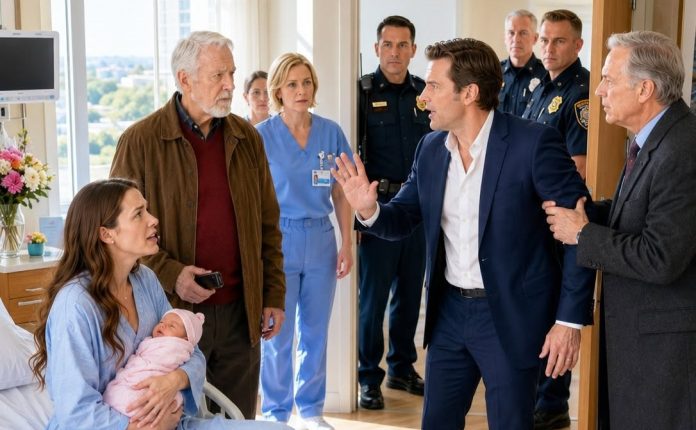
Part 6: The Hearing of Names
Seeing Grant in the photograph destroyed the last comforting lie I had preserved.
I had told myself that whatever his father planned, Grant might have fallen in love with me afterward.
The photograph showed that he had studied me before speaking to me.
Emails recovered from his second phone confirmed it.
He tracked my employment, friendships, debts, apartment leases, and relationship history. Richard’s security contractor prepared personality assessments describing me as independent but emotionally vulnerable after my mother’s death.
Grant received instructions on what restaurants I preferred, which causes I supported, and which memories made me cry.
Even his proposal included phrases taken from an email I had once written to my mother about wanting a marriage built upon safety rather than status.
He had not discovered my heart.
He had been given a map.
When Detective Vega confronted him with the evidence, Grant requested a formal interview.
His attorney attended.
Grant admitted that Richard encouraged the relationship but claimed he had eventually loved me genuinely.
Detective Vega later allowed Caroline and me to review the recording.
“I loved her,” Grant insisted.
“You created a custody file before she became pregnant,” Detective Vega said.
“My father said we needed protection.”
“You copied her electronic signature.”
“I didn’t prepare the final documents.”
“You photographed them.”
“I was scared.”
“Of whom?”
“My father.”
The answer made me laugh when I heard it.
Not because it was funny.
Because Grant had spent years teaching me that fear was weakness, yet the moment consequences arrived, fear became his excuse.
Grant offered investigators access to an encrypted Caldwell server in exchange for consideration in the criminal case.
The server contained a digital index of the blue file but not the original documents.
According to Grant, Richard stored the originals in a concealed records room at the Caldwell family estate.
“He said originals were leverage,” Grant explained. “He never destroyed anything that could control someone.”
Police obtained a warrant.
The hidden room was discovered behind a paneled wall in Richard’s private library. Its entrance was concealed by a portrait of Caldwell Continental’s first fleet.
Inside were fireproof cabinets containing original stock certificates, altered operating agreements, confidential settlements, surveillance records, and correspondence with public officials.
The blue file sat in the third cabinet.
It was not blue.
It was an ordinary gray binder marked with a blue circle so Richard could identify it quickly.
Inside was the original Monroe River Transit shareholder ledger.
Samuel Monroe: fifty-five percent.
Margaret Monroe: twenty-five percent.
Richard Caldwell: twenty percent.
No valid transfer of Samuel’s shares appeared anywhere.
Instead, Richard had inserted a photocopied page into the official ledger and removed the original.
The blue file also contained letters Richard sent to banks after the explosion, declaring Samuel dead before any government authority had issued a finding.
There were drafts of the forged transfer agreement, including one with handwritten corrections.
The handwriting matched Richard’s.
Most disturbing was a memorandum written by Richard’s former attorney:
S.M. survived initial blast and was observed entering river. Search efforts should remain limited. If recovered, local narrative must emphasize theft investigation and possible flight.
Samuel read the memorandum without speaking.
For thirty-eight years, he had wondered whether Richard knew he survived the explosion.
Now he knew Richard had received reports from the scene.
Richard had deliberately discouraged the search.
The evidence supported criminal charges connected to the sabotage, although prosecutors warned that proving every element after so many years would be difficult. Witnesses had died. Records were incomplete. Memories could be challenged.
The ownership case was stronger.
A commercial court appointed a temporary receiver over Caldwell Continental and prohibited asset transfers. The court scheduled an emergency hearing to determine whether the Monroe estate had a valid controlling interest.
Richard arrived under subpoena.
It was the first time I saw him after the hospital.
I attended remotely from a secure conference room with Lily sleeping in a bassinet beside me.
Richard looked smaller than I remembered.
Without the wool coat, driver, assistants, and private office, he resembled an aging executive struggling to understand why his authority no longer filled the room.
His attorneys argued that Caldwell Continental had operated openly for decades and that the Monroe claims were barred by delay.
Caroline’s corporate-litigation partner replied that delay caused by fraudulent concealment could not reward the person who concealed the fraud.
Miriam authenticated internal records.
A forensic document examiner testified that Samuel’s alleged transfer signature had been traced.
A banking historian confirmed that the notary died before the supposed execution date.
Federal officials unsealed portions of Samuel’s protected-witness records, confirming his identity, role in the investigation, and survival after the explosion.
Then Samuel testified.
He described Monroe River Transit, the routing system, the missing funds, and the Pier Nine meeting.
Richard watched him with open hatred.
During cross-examination, Richard’s attorney asked why Samuel had remained silent for so long.
“Because I was told speaking would endanger my family.”
“Yet your silence allowed Caldwell Continental to grow.”
“Yes.”
“Isn’t it true that you now hope to seize the achievements of another man’s lifetime?”
Samuel looked at Richard.
“The achievements began with my company, my contracts, my employees, my designs, my sister’s inheritance, and an explosion intended to erase my name.”
Richard suddenly stood.
“You would have ruined everything!”
The courtroom froze.
His attorney tried to pull him back into his seat.
Richard pointed at Samuel.
“You were going to hand the company to federal investigators. Hundreds of people would have lost their jobs.”
“You were stealing military equipment,” Samuel replied.
“I saved the business.”
“You stole it.”
“I built an empire from the wreckage you left behind.”
“You created the wreckage.”
The judge ordered Richard to sit.
He refused.
“Allison would have had nothing without us,” he shouted toward the screen. “Grant gave her a name. We gave her security.”
I leaned toward the microphone.
“You gave me bruises and called them security.”
Richard’s face twisted.
“You are destroying your daughter’s inheritance.”
“No. I am preventing you from defining it.”
The judge muted both of our microphones and called a recess.
Before the hearing resumed, a federal attorney entered with newly authorized evidence.
The old Spearpoint investigation had used a wire transmitter during Samuel’s planned meeting at Pier Nine. Investigators believed the recording was destroyed in the explosion.
A partial backup had been found in an archived evidence facility after the case number was reopened.
The audio was damaged, but two voices were identifiable.
Samuel’s voice said, “Richard, move away from the fuel truck.”
Richard answered, “You should have taken the money.”
Samuel said, “People know I’m here.”
Then Richard spoke the sentence he had spent thirty-eight years denying.
“By sunrise, Samuel Monroe will be in the river, and Caldwell will own everything.”
Part 7: Lily Grace Monroe
Richard did not return to the hearing room after the recording played.
Federal agents arrested him in the courthouse corridor on charges connected to the original fraud, evidence concealment, witness intimidation, and the Pier Nine sabotage investigation.
The oldest charges required complex litigation. Prosecutors made no promises about which counts would survive motions, damaged evidence, or the passage of time.
The ownership evidence did not depend upon memory.
It existed in original ledgers, forged certificates, bank records, internal memoranda, and Richard’s own handwriting.
The commercial court ruled that Samuel’s controlling interest had never been legally transferred. My grandmother’s shares had also been obtained through fraudulent representation and coercion.
Caldwell Continental had been built by expanding assets that never belonged exclusively to Richard.
The ruling did not instantly hand me a functioning empire.
It placed the company under extended receivership while courts reviewed creditor rights, minority shareholders, employee obligations, and decades of transactions.
Financial news programs described it as one of the most complicated corporate restitution cases in Kentucky history.
To me, it was simpler.
A man stole a company.
Then he built enough floors above the theft that everyone became afraid to examine the foundation.
Grant’s criminal case moved separately.
He initially blamed Richard for everything. He claimed he had been raised to believe family survival justified surveillance, manipulation, and financial control.
He admitted copying my signature but denied intending to have me confined permanently. He said the psychiatric documents were only “insurance” in case I became difficult after delivery.
The prosecutor played his own messages back to him.
Handle your wife.
Make sure Samuel never gets into the room.
She still refuses the name.
Grant eventually entered a guilty plea covering the assault, forgery-related conduct, violation of the protective order, and conspiracy involving the attempted transfer of my trust rights. He received a multi-year prison sentence and remained subject to a permanent no-contact order concerning me.
His legal relationship with Lily became a separate family-court matter.
He was not granted visitation.
The court emphasized that biology did not create an automatic right to enter a child’s life without regard to safety.
Grant sent one letter through his attorney before sentencing.
Caroline asked whether I wanted to read it.
I said no.
For years, Grant’s words had entered every room before mine. His explanations had followed every injury. His apologies had required me to comfort him. His promises had always contained instructions.
I did not owe him one final audience.
Richard went to trial the following year.
The jury heard the Pier Nine recording, reviewed the payments to the mechanic, and saw the memorandum advising that search efforts for Samuel remain limited.
Miriam testified for six days.
Her cooperation reduced her exposure but did not erase it. She accepted professional sanctions and later worked with investigators to recover funds hidden through Blue Heron.
Richard was convicted on several major counts, though not every allegation prosecutors brought against him. At sentencing, he continued insisting that he had saved Monroe River Transit.
Samuel attended but did not speak.
Outside the courthouse, reporters asked whether justice had been done.
Samuel answered, “Justice is not thirty-eight years arriving on time. It is simply better than another year of silence.”
He never asked to control the company after the ownership ruling.
Instead, he requested that his restored shares be placed in a restructuring trust.
After consultation with employees, creditors, regulators, and minority investors, we divided the reorganized company into three parts.
One remained a commercial transportation business under independent management.
One became an employee ownership fund, giving long-serving workers an interest in the company they had helped build.
The third funded restitution, legal claims, and a foundation supporting survivors of financial abuse and workplace retaliation.
We renamed the business Monroe River Logistics.
Samuel resisted having his name restored to the building.
“You earned it,” I told him.
“A name on a wall is not the same as repairing what happened.”
“No. But erasing it helped Richard steal everything.”
He looked up at the new sign for a long time.
“Then put Margaret’s name there too.”
The headquarters atrium now contains a plaque honoring Samuel and my grandmother:
MONROE RIVER LOGISTICS
RESTORED IN THE NAMES OF SAMUEL MONROE AND MARGARET MONROE, WHOSE OWNERSHIP WAS CONCEALED BUT NEVER LAWFULLY EXTINGUISHED.
My own recovery was less public.
I experienced nightmares in which I woke unable to breathe. I panicked when men stood too close behind me. For months, I could not tolerate high collars or scarves touching my neck.
Therapy helped me understand that leaving did not automatically end fear. Safety had to be learned after danger had trained my body to expect punishment.
Elena visited once after Lily and I returned home.
I was no longer living in the Caldwell house.
Caroline helped me obtain access to an apartment owned by neither family. I wanted walls unconnected to inheritance, marriage, or corporate history.
Elena brought yellow star balloons.
“You remembered,” I said.
“You looked like you needed different decorations.”
Samuel brought blueberry muffins every Sunday. He always knocked, even after I gave him a key.
For several months, our relationship remained careful.
I loved him, but I did not pretend his silence had caused no harm. He listened when I was angry. He answered questions even when the answers embarrassed him.
One afternoon, while Lily slept between us, I asked why he removed his hearing aids in the hospital before confronting Richard.
Samuel smiled.
“Old habit. When I was frightened, every amplified sound became distracting.”
“You were frightened?”
“Terrified.”
“You looked ready to throw Grant through the window.”
“I considered it.”
“What stopped you?”
“You were holding the baby, and I did not want the first thing Lily saw to be her great-great-uncle committing a felony.”
I laughed harder than I had laughed in months.
It hurt slightly.
Then it felt good.
When Lily’s original birth paperwork was reviewed, the clerk asked what surname I wanted recorded.
I had once fought for Monroe-Caldwell because I believed combining the names represented fairness.
By then, I understood that a hyphen could not transform possession into partnership.
I registered her as Lily Grace Monroe.
Grant’s paternity remained part of the legal record. I was not attempting to rewrite biology.
I was refusing to let the Caldwell name operate as a declaration of ownership.
On Lily’s first birthday, we held a small gathering in the garden behind the Monroe River employee center. Elena came with her wife. Detective Vega brought a wooden puzzle shaped like a riverboat. Caroline arrived late from court and gave Lily a toy judge’s gavel, which Lily immediately used to strike the cake.
Miriam attended quietly and remained near the back. Some people had forgiven parts of what she had done. Others had not.
Accountability did not require everyone to reach the same emotional conclusion.
Samuel stood beneath the restored company sign holding Lily in one arm.
Her hand rested against the faded tattoo on his forearm.
“She likes the stars,” I said.
“She has good taste.”
“What did the circle of stars mean?”
“The seven people in Spearpoint.”
“How many survived?”
“Three.”
“And how many told the truth?”
Samuel looked toward the river.
“Eventually? Two.”
I touched his shoulder.
“Eventually still matters.”
As the sun lowered, I thought about the hospital room, the silver balloon, Richard’s satisfied expression, and Grant’s belief that my exhaustion had made me powerless.
He misunderstood what power was.
Power was not controlling every account.
It was Elena locking the door.
It was Detective Vega opening a notebook.
It was Caroline placing two documents beside each other and noticing that a dead man had supposedly notarized a signature.
It was Miriam finally deciding that fear did not excuse another day of silence.
It was Samuel returning from the dead with a damaged notebook and enough truth to shake an empire.
Most of all, power was the moment someone asked whether I was safe and waited long enough for the real answer.
That evening, after the guests left, I carried Lily toward the apartment. She rested against my chest, heavier than she had been in the hospital and strong enough now to lift her head.
Samuel walked beside us.
“You all right?” he asked.
For a moment, I heard Elena’s question inside his.
I looked at my daughter.
The marks around my throat had faded. The legal cases were not all finished. Some assets remained disputed. Some memories still arrived without warning.
Everything was not perfect.
But nobody held my passwords.
Nobody answered questions for me.
Nobody had permission to turn my fear into evidence against me.
“Yes,” I said.
Then I corrected myself, because accuracy had saved us once and I no longer intended to offer comforting answers when truthful ones were available.
“I’m becoming all right.”
Lily stirred against my shoulder.
Above us, the evening sky remained bright with the last warm light, and for the first time in years, every name I carried belonged to me.