Part 4: Chosen
I read my mother’s letter three times.
Each reading changed my marriage.
The conference where Grant first introduced himself had not been accidental.
The restaurant where he claimed to recognize me from across the room had been selected because Caldwell Continental sponsored the event. The colleague who encouraged me to accept his invitation had later taken a senior position at a Caldwell subsidiary.
Even the charity board where Grant proposed marriage had received a major donation from Richard two weeks earlier.
I remembered how romantic it had seemed.
Grant said fate kept placing us in the same rooms.
It had not been fate.
It had been scheduling.
My mother’s letter described a private investigator who followed her after she began requesting historic corporate records. She wrote down license-plate numbers, dates, and descriptions. One plate belonged to a security company still employed by Caldwell Continental.
She had not accused the Caldwells of causing her fatal car accident. She had simply written:
If anything happens to me, do not let Allison believe powerful families only steal companies. They also steal explanations.
I folded the letter.
“Why didn’t you give this to me when Grant approached me?” I asked Samuel.
“I didn’t have it then.”
“You had the key.”
“The attorney who held the box died. His office merged with another firm, and the instructions were buried in archived files. I was contacted only after your wedding.”
“And then?”
“I tried to investigate Grant without frightening you.”
“You came to one dinner.”
“He had already isolated you. Every question I asked made him tighten his control.”
“So you stopped asking?”
“I made the wrong decision.”
His admission did not repair anything, but it prevented him from hiding behind excuses.
“I thought protecting you meant waiting until I had enough evidence,” he continued. “I understand now that I was protecting the case instead of protecting you.”
I looked at Lily sleeping against me.
“Everyone decided what I should know.”
“Yes.”
“My mother. You. Grant. Richard.”
“Yes.”
“I am finished being managed.”
Samuel lowered his head.
“You should be.”
I asked him to leave for several hours.
He did.
He did not argue, explain, or remind me of everything he had sacrificed.
That was the first reason I eventually allowed him to return.
Caroline helped me file for dissolution of the marriage. She also petitioned the court to preserve all marital assets, prohibit changes to insurance policies, and prevent Grant from transferring property or accessing Lily’s records.
The Caldwell attorneys responded by requesting an emergency psychological evaluation.
They submitted Grant’s private diary of my supposed instability, along with statements from household staff who claimed I had become suspicious and withdrawn during pregnancy.
Caroline read the statements carefully.
“Three employees used the exact phrase ‘fixated upon imagined financial misconduct,’” she said.
The phrase came directly from the forged incapacity form.
Grant’s evidence had been coordinated.
The court denied his immediate request but scheduled a protective-order hearing for Friday.
It was Wednesday.
By the end of the week, a judge would decide whether Grant could contact me or Lily.
Richard’s public-relations team increased its attacks. Anonymous sources described Samuel as a disgruntled former employee who had fabricated a military history. Commentators questioned why I had remained married if Grant was truly dangerous.
I stopped reading after the first day.
Elena found me staring at my phone.
“You don’t have to attend every trial strangers hold in their heads,” she said.
“They think staying means I’m lying.”
“Staying means leaving was dangerous.”
She took the phone and placed it face down.
“Rest.”
I slept for nearly four hours.
When I woke, a woman named Miriam Shaw had contacted Caroline.
Miriam was Caldwell Continental’s deputy general counsel. She had worked for Richard for seventeen years and served as the mysterious M.S. in Grant’s messages.
At first, Detective Vega suspected she had helped prepare the forged documents.
Miriam requested immunity discussions before speaking.
We met by secure video while I remained in the hospital.
She appeared to be in her fifties, with silver-streaked hair and the careful posture of someone who had spent decades revealing nothing in conference rooms.
“I participated in corporate concealment,” she said. “I did not know Grant intended physical violence.”
“That is a convenient line,” I replied.
“It is also true.”
“Did you prepare the papers declaring me incompetent?”
“No. I refused.”
“Who prepared them?”
“An outside attorney named Leonard Voss. He has handled sensitive matters for Richard since the nineties.”
“Why are you speaking now?”
Miriam looked away from the camera.
“Because Richard asked me to arrange the transfer of a family trust after your delivery. The transfer required Grant to exercise authority under the medical power of attorney.”
“What trust?”
“The Monroe Residual Claims Trust.”
I had never heard the name.
Miriam explained that after my mother’s death, an attorney had preserved any unknown legal claims connected to the Monroe estate. The trust had no identified assets, but it protected my right to pursue ownership if evidence ever emerged.
Richard could not eliminate that right directly.
However, if I assigned the trust to a Caldwell-controlled entity, the family could release the claims against itself.
Grant’s postnuptial agreement included such an assignment, hidden inside language concerning future inheritances and business disputes.
I had refused to sign it.
The forged medical authority would have allowed Grant to attempt the transfer while claiming I lacked capacity.
“And Lily?” I asked.
“Richard wanted her placed in a Caldwell family trust immediately. He believed that if your child were legally and financially controlled by the Caldwell side, you would never challenge the company.”
“The argument over her name was symbolic.”
“Yes.”
“But Grant nearly killed me over it.”
Miriam was silent.
“Did he know why his father wanted the marriage?” I asked.
“He knew enough.”
She sent Detective Vega copies of internal board minutes, payment records, and confidential memoranda. She also disclosed that Richard had ordered employees to locate the blue file.
“Where is it?” Detective Vega asked.
“I don’t know. Richard moved it personally whenever outside auditors entered the archives.”
“What is inside?”
“Original ownership records. Correspondence involving Samuel Monroe. Payments connected to the warehouse explosion.”
Samuel, who had returned at my request, leaned toward the screen.
“You saw those documents?”
“Some of them.”
“Why didn’t you report it?”
Miriam’s composure cracked.
“Because I had two children in college, a mortgage, and a career Richard could destroy with one phone call.”
I understood fear.
I did not confuse understanding with forgiveness.
“What changed?” I asked.
Miriam swallowed.
“Your husband came to my office three months ago. He wanted advice about having a spouse declared incompetent. He asked whether pregnancy-related anxiety could be used to obtain permanent control over financial decisions.”
My stomach turned.
“I told Richard I would resign if they involved me. He reminded me that my signature appeared on documents from years ago.”
“He threatened you.”
“Yes.”
“You still stayed.”
“Yes.”
Her answer carried no defense.
Then Miriam uploaded an audio file.
She had recorded a conversation in Richard’s study one week before my wedding. At the time, she intended to protect herself from liability.
Richard’s voice filled the hospital consultation room.
“Once Grant marries her, the Monroe claim becomes a domestic matter. A wife does not wage war against the company supporting her life.”
Grant sounded younger, less confident.
“What if she learns what the shares are worth?”
“She won’t.”
“And if Samuel returns?”
“He has no standing without the originals.”
There was a pause.
Grant asked, “What do you actually need from me?”
Richard replied, “Marriage. A child. Her signature. In that order.”
Grant laughed nervously.
“You make it sound like an acquisition.”
“That is because you must stop thinking like a boy in love and start thinking like a Caldwell.”
The recording continued for another minute.
Grant asked whether I was attractive.
Richard told him attraction was irrelevant.
Then came the final exchange.
“And if she refuses to sign?” Grant asked.
Richard answered without hesitation.
“Then make sure the court sees a sick woman, not an owner.”
Part 5: The Empire’s Ledger
The recording changed the investigation.
Until then, Grant’s assault and the forged hospital documents could have been presented as the actions of a controlling husband supported by an arrogant father.
The audio connected the marriage to a planned financial objective.
State investigators began examining conspiracy, fraud, witness intimidation, and attempted unlawful transfer of trust assets. Federal agents requested Samuel’s old protected-witness file, portions of which remained sealed.
The Caldwell Continental board announced that Richard would take a temporary leave of absence.
Richard refused.
He arrived at company headquarters the following morning and discovered that independent directors had deactivated his access card.
News cameras recorded him striking the glass doors with his cane while security guards watched from inside.
For thirty-eight years, employees had opened every door before Richard reached it.
One locked entrance transformed him into an old man shouting on a sidewalk.
Grant was released pending the protective-order hearing. He moved into a Caldwell-owned apartment and surrendered his passport.
Through his attorney, he offered to enter counseling if I withdrew the criminal complaint.
Caroline read the proposal aloud.
“He describes the incident as an isolated loss of temper.”
“His father planned my marriage before we met.”
“The proposal does not mention that.”
“Of course it doesn’t.”
Grant also offered to place ten million dollars into a trust for Lily.
The money came with conditions: confidentiality, no cooperation with corporate investigators, and immediate withdrawal of my ownership claims.
He had turned our daughter into a settlement document before she was one week old.
I rejected the offer.
The protective-order hearing took place through a secure video link because I had not yet been medically cleared to leave the hospital.
Grant sat beside three attorneys in a polished conference room. He wore a navy suit and the expression he used during charity photographs—solemn, attentive, wounded by circumstances beyond his control.
Richard did not appear.
The judge first heard testimony from Elena.
She described my injuries, my difficulty swallowing, Grant’s refusal to leave, and his insistence that Lily remain under his control.
Grant’s attorney asked whether postpartum patients sometimes experience emotional confusion.
“Yes,” Elena said.
“Could Mrs. Caldwell have misunderstood a physical interaction?”
Elena’s expression remained calm.
“Bruising around a patient’s throat is not a misunderstanding.”
The attorney asked whether she had personally witnessed Grant applying pressure to my neck.
“No.”
“So your knowledge depends upon Mrs. Caldwell’s account.”
“My knowledge also depends upon the injury, the patient’s symptoms, the forged incapacity papers, Mr. Caldwell’s conduct in the hallway, and the fact that he attempted to prevent a private safety assessment.”
The attorney stopped smiling.
Samuel testified next.
Grant’s lawyer tried to portray him as a revenge-seeking claimant.
“You believe the Caldwell family stole your company?”
“I know Richard forged documents after trying to kill me.”
“That allegation was never proven.”
“The ownership records were hidden for thirty-eight years. That tends to slow the process.”
“You attended Mrs. Caldwell’s wedding.”
“I did.”
“You did not object.”
“I did not yet know Grant had been assigned to marry her.”
“Assigned is an inflammatory word.”
“It is the word his father used on the recording.”
Grant looked down.
When it was my turn, Caroline asked me to describe the attack.
I explained the argument over Lily’s name. I described Grant’s forearm pressing against my throat and the darkness closing around my vision.
Then Grant’s attorney questioned me.
“Mrs. Caldwell, you were exhausted, medicated, and in active labor, correct?”
“Yes.”
“You had argued with your husband for several hours?”
“We disagreed about our daughter’s name.”
“You threatened to prevent him from seeing the child.”
“No.”
“You told him the Caldwells would never control your daughter.”
“I told him she was not corporate property.”
He lifted a printed email.
“You have expressed suspicion about Caldwell Continental for years, haven’t you?”
“I identified unexplained payments while reviewing its accounts.”
“You were not employed by Caldwell Continental.”
“Fraud does not become invisible because the person noticing it is unpaid.”
The judge concealed a brief smile.
Grant’s attorney asked why I had remained married despite earlier incidents.
The question struck the place where shame had been living.
I looked directly into the camera.
“I remained because he controlled money, communication, transportation, medical appointments, and information. I remained because every time I considered leaving, he documented my fear as proof that I was unstable. I remained because his family had more attorneys than I had friends left. And I remained because I kept believing the next apology would be real.”
I took a breath.
“The fact that I survived long enough to ask for help does not make what he did less violent.”
The judge granted the protective order.
Grant was prohibited from contacting me or Lily for six months, subject to review. Any future request for visitation would require a full safety assessment and separate family-court proceedings.
He had lost access to both of us before Lily was seven days old.
Grant’s face changed when the ruling was announced.
The wounded expression disappeared.
He leaned toward the screen.
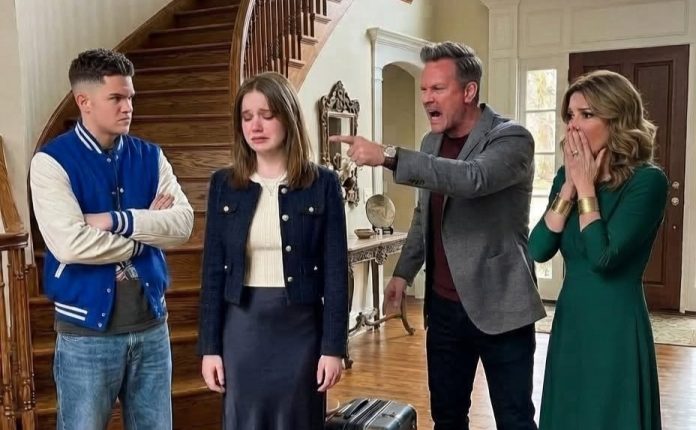
“You can’t take my daughter.”
The judge warned him not to speak directly to me.
Grant ignored her.
“Lily is a Caldwell.”
The connection was terminated.
That afternoon, a corporate forensic team began examining Miriam’s records. I assisted from the hospital because the payment structures resembled the vendor schemes I had studied before my medical leave.
Blue Heron was not a conventional company. It was a financial reservoir.
Caldwell Continental sent money to Blue Heron for maintenance, consulting, risk management, and equipment storage. Blue Heron transferred funds to law firms, private investigators, former employees, and dormant trusts.
The company had paid the notary connected to my forged medical documents.
It had paid the investigator who followed my mother.
It had paid the contractor who removed the empty document case from the archive.
In 1988, an earlier version of Blue Heron had paid the mechanic who disabled the warehouse fire-suppression system before the Pier Nine explosion.
Samuel stared at the transaction.
“That is the payment we could never find.”
The mechanic had died eleven years earlier. However, bank microfilm showed that he deposited a large check two days after the explosion.
Richard’s signature appeared on the authorization.
The federal case against the cargo-theft network had failed because investigators could not connect Richard directly to the sabotage.
Now the connection sat on a screen in my hospital room.
More files followed.
Private surveillance logs documented my grandmother, my parents, my mother after my father’s death, and finally me.
The Caldwell family had watched the Monroe descendants for decades.
One photograph showed me at twenty-two, walking toward an orientation session for my first compliance job.
A date had been printed in the lower corner.
At the edge of the photograph stood a young man in sunglasses beside a black car.
Grant.
The image had been taken almost four years before he introduced himself and claimed we had never met.