Part 6: The Night The Walls Opened
Federal agents flooded the house.
“Drop the weapon!”
Adrian pulled Lily’s body between himself and the staircase even though she was still in Daniel’s arms several steps above him. His gun swung wildly between us.
Evelyn stood behind him, frozen.
Simon Creel remained on the living-room floor.
One security man raised his hands. The other was still unconscious upstairs.
Agent Naomi Park entered with her weapon trained on Adrian’s chest.
“It’s over,” she said.
Adrian laughed.
“No, it isn’t.”
His voice had changed. The polished executive was gone. What remained was a frightened man who had spent decades confusing power with invincibility.
“You have an unlawful recording, a voluntarily missing employee, a hysterical spouse, and a family dispute,” he said. “You have nothing.”
“We have your threat against a child.”
“A misunderstanding.”
“We have Dr. Reeve’s files.”
That frightened him.
Only slightly, but enough.
Evelyn whispered, “What files?”
Adrian did not answer.
Agent Park continued, “We have the pension transfers, the shell companies, the payments to Dr. Reeve, and the fabricated psychiatric records. We also have your lawyer as a witness.”
Everyone looked at Simon Creel.
He slowly stood.
“I did not know Daniel was imprisoned here,” he said.
Adrian aimed the gun at him.
Daniel moved Lily behind the upstairs banister.
I stepped between Adrian and the staircase.
He turned the weapon toward me.
“Mara,” Daniel said.
I did not move.
Adrian’s finger tightened.
Evelyn grabbed his wrist.
The gun fired.
The bullet struck the ceiling.
Agents tackled Adrian. The weapon slid beneath the sofa. Evelyn collapsed against the wall, staring at her hands as though they belonged to someone else.
Ortiz ran upstairs and took Lily from Daniel.
I reached my husband as his knees gave way.
He was alive.
The entire world could see that now.
But public truth did not arrive cleanly.
It arrived through flashing lights, ambulance sirens, lawyers, cameras, medical examinations, court filings, and competing versions of what had happened.
Adrian’s attorneys immediately claimed Daniel had voluntarily orchestrated his disappearance after discovering his wife was unstable. They released the forged emails before federal authorities could seal them. Television commentators questioned why Daniel had remained silent for fifty-eight days if he truly feared for his family.
Evelyn’s attorney argued that she had provided food and medical care to a son who requested privacy.
A photograph of Daniel entering the linen closet voluntarily was leaked online.
So was a video of me tearing apart the bedroom.
The public divided itself within hours.
Some believed me.
Others believed Adrian.
Many believed the truth was probably “somewhere in the middle,” which was another way of saying suffering became less important when it was complicated.
Daniel spent nine days in the hospital. Doctors found dehydration, malnutrition, nerve damage in his wrist, and traces of sedatives in his blood. The drugs supported his claim, but they did not erase the fact that he had entered the passage willingly.
He asked to see me every day.
I visited twice.
Lily refused to enter his room.
“She thinks I chose the wall over her,” he told me during my second visit.
“You did, at first.”
“For three days.”
“For a child, three days and fifty-eight days are not different. You disappeared.”
“I know.”
“Stop saying that.”
He nodded.
“I will.”
He looked older. Smaller. Not because of the beard or weight loss, but because the image I had carried of him—the careful, dependable husband who would always protect us—had been dismantled.
“I loved you,” I said.
His eyes filled.
“Past tense?”
“I don’t know yet.”
He accepted that without asking me to soften it.
The criminal investigation moved quickly, but the custody case remained open. Evelyn’s emergency order had been suspended, not erased. Her attorney argued I had involved Lily in a dangerous operation, hidden evidence from police, and allowed her to return to a house I believed was under surveillance.
The judge ordered a full hearing.
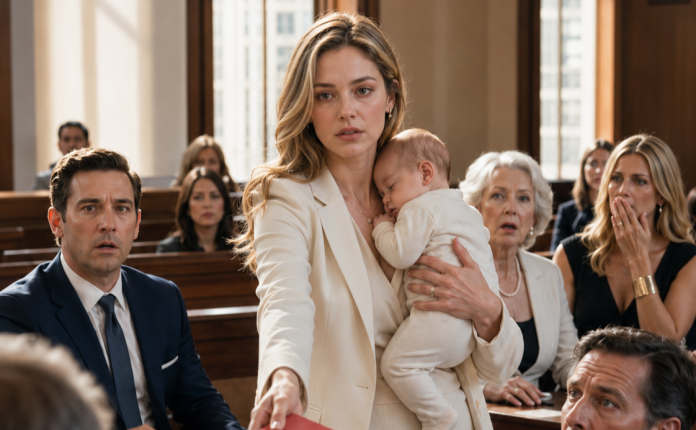
Adrian remained in federal custody, but Evelyn appeared in court wearing navy blue and pearls. She looked composed enough to attend a board meeting.
Dr. Reeve testified remotely from a protected location.
He admitted he had accepted consulting payments from Vale Meridian. He admitted Adrian’s team had provided edited medical records and demanded language that would make me appear paranoid. He admitted Evelyn described me as “an obstacle to proper control of the child’s assets.”
Then Evelyn’s attorney attacked him.
“You were paid by the same company you now accuse?”
“Yes.”
“You falsified a diagnosis?”
“I was pressured, but yes.”
“You lied to the court?”
“Yes.”
“And now you expect this court to trust you?”
“No,” Reeve said. “I expect the court to verify the records I preserved.”
Agent Park presented bank transfers linking Adrian to shell companies and payments to Reeve. Detective Ortiz described the staged evidence surrounding Daniel’s disappearance. Simon Creel testified that Adrian instructed him to prepare trust documents based on false information.
Then Daniel took the stand.
The courtroom became completely silent.
He told the truth without protecting himself.
He admitted he had doubted me.
He admitted he agreed to vanish.
He admitted he placed secrecy above Lily’s emotional safety.
He described the threats, the locked door, the drugs, and his mother’s role.
Evelyn watched him without expression until his attorney asked the final question.
“Mr. Ellison, did your wife know about or participate in your disappearance?”
“No.”
“Did she threaten you?”
“No.”
“Did she misuse your accounts?”
“No.”
“Did she ever prevent you from seeing your daughter?”
“No.”
“Then why did you write messages saying she had?”
“I didn’t.”
Evelyn’s attorney stood.
“We have authentication records showing the emails originated from your personal account.”
Daniel looked toward Agent Park.
She nodded once.
“My mother had my passwords,” he said.
Evelyn finally reacted.
Her chin lifted.
“You gave them to me,” she called from the counsel table.
The judge struck the bench with her gavel.
Daniel looked at her.
“I gave you the passwords because you said you were protecting my family.”
“I was.”
“You poisoned me.”
“I calmed you.”
“You locked me in a room.”
“You would have ruined everything your father built.”
“My father tried to expose Adrian too, didn’t he?”
Evelyn’s face emptied.
Daniel continued, “That’s why he died believing I was ashamed of him. You told me he lost the company because he was reckless. But he discovered the theft first.”
Her attorney whispered urgently.
She ignored him.
“Your father was weak,” she said.
The courtroom murmured.
“He wanted to destroy the only institution that gave our name meaning,” Evelyn continued. “Adrian’s father offered him a settlement, but Richard would not stop. He cared more about being righteous than keeping us secure.”
Daniel stared at her.
“What did you do?”
She realized too late that she had said too much.
The judge ordered a recess.
Before the court could adjourn, Agent Park approached the bench.
“We have one additional exhibit,” she said.
Evelyn’s attorney objected.
Agent Park held up a memory card.
“The hidden camera recorded more than the hallway. Its microphone captured a conversation inside the open passage after Mrs. Ellison believed the device had stopped.”
I had never heard that recording.
The camera’s visible file had ended when the memory card appeared full, but a temporary audio cache had continued saving to internal storage.
A technician recovered nineteen additional minutes.
The courtroom speakers crackled.
Evelyn’s voice filled the room.
Richard should have taken Adrian’s offer. I warned him what would happen if he went to the authorities.
Then Adrian’s voice answered.
You did more than warn him.
The recording continued.
Evelyn said, I changed the medication because your father promised it would only make his heart condition look natural. I have protected this company longer than you have.
Daniel turned toward his mother.
She closed her eyes.
The courtroom seemed to tilt around us.
Richard Ellison’s death six years earlier had not been natural.
My mother-in-law had just confessed to helping kill her husband.
But the recording was not finished.
Adrian’s voice said, And now you will do the same thing to Daniel if he refuses to sign.
Evelyn answered after a long silence.
Only if there is no other way.
Daniel stopped breathing.
Then the final sound played.
The scratch of a pen.
A door opening.
And Evelyn saying, Once Lily is mine, Mara will have an accident before she reaches the hospital.
The judge ordered deputies to detain her.
Evelyn did not resist.
As they placed her in handcuffs, she looked directly at Lily.
“You would have understood when you were older,” she said.
Lily stood beside me, shaking.
“No,” she answered. “I understand now.”
Evelyn was led away.
I thought that was the end.
Then Agent Park approached me with a sealed evidence envelope.
“We found this in Adrian Vale’s private safe,” she said.
Inside was a letter written by Richard Ellison the week before his death.
It was addressed to Daniel.
At the bottom, beneath his signature, Richard had added one final line:
If anything happens to me, do not trust your mother.
Part 7: What We Built After The Truth
The truth destroyed Vale Meridian in stages.
First came the arrests.
Adrian Vale was charged with conspiracy, fraud, pension theft, obstruction of justice, kidnapping, witness intimidation, falsification of medical records, and multiple financial crimes. Additional charges followed after federal investigators uncovered bribery involving public contracts.
Evelyn was charged in connection with Daniel’s confinement, the plot against me, and Richard’s death. Prosecutors alleged she had replaced one of Richard’s heart medications with a drug supplied through an executive connected to Adrian’s father.
Simon Creel accepted a cooperation agreement. His testimony helped identify altered trust documents and illegal board transactions. Dr. Reeve surrendered his medical license and later pleaded guilty to falsifying clinical records, although prosecutors credited him for preserving evidence that prevented further harm.
The two security men testified against Adrian.
Vale Meridian’s board removed him within forty-eight hours. The merger collapsed. Government agencies froze company accounts and appointed an independent monitor. Millions of dollars were eventually recovered for employees whose pension funds had been raided.
Lily’s shares remained in trust.
I petitioned the court to replace every trustee connected to the Ellison family or Vale Meridian. The judge appointed an independent fiduciary and added protections requiring court approval for major voting decisions until Lily became an adult.
None of that repaired my family.
Legal victories are clean on paper.
Healing is not.
For weeks, Lily refused to sleep upstairs. We moved into a small rental house across town because she could not look at a wall without asking whether someone was inside it. She checked closets before bed, covered every heating vent, and panicked whenever I left the room without explaining where I was going.
Daniel entered residential trauma treatment after leaving the hospital.
He did not come home.
That was my decision.
He had been imprisoned, drugged, threatened, and abused. He was also the person who began the chain by choosing secrecy over partnership. Both truths deserved space.
Our marriage counselor called it “holding complexity.”
I called it learning to breathe while angry.
Daniel wrote Lily letters.
At first she would not open them.
Then she asked me to read them aloud without telling him.
He never begged her to forgive him. He never claimed he had disappeared only because he loved her. He wrote about fear, cowardice, and consequences in language an eight-year-old could understand.
In one letter, he wrote:
I thought being a good father meant stopping bad things before you ever knew they existed. I was wrong. Being a good father also means trusting your family with the truth and not deciding alone what they can survive. I made you carry a secret that no child should carry. You did not betray me when you told Mom. You saved me.
Lily cried after that letter.
Two days later, she drew him a picture.
It showed three people standing outside a house with no walls.
Six months after the arrests, Daniel and I met at a park.
He looked healthier. His beard was gone. The scar on his wrist remained.
We sat on opposite ends of a bench while Lily played near the swings with Detective Ortiz, who had somehow become part of our lives beyond the investigation.
“I signed the separation agreement,” Daniel said.
I nodded.
He looked toward Lily. “I will accept whatever visitation arrangement makes her feel safe.”
“She wants to see you next week.”
His face changed.
“She does?”
“For one hour. In the therapist’s office.”
“I’ll be there.”
“She may change her mind.”
“I’ll still be there.”
That answer mattered.
I asked whether he had read Richard’s letter.
“Yes.”
The letter contained more than a warning. Richard had described his suspicions about Evelyn, Adrian’s father, and the company’s financial crimes. He had apologized for failing to protect Daniel from the family’s obsession with power.
“He knew he might die,” Daniel said.
“He tried to warn you.”
“My mother intercepted it.”
“Agent Park thinks Adrian kept it as insurance against her.”
Daniel stared at his hands.
“For most of my life, I thought my father failed because he was weak. Now I know he lost everything because he refused to become them.”
“You can honor him without turning him into another perfect man.”
Daniel looked at me.
“You don’t believe he was?”
“I don’t believe anyone is.”
A sad smile crossed his face. “Not even you?”
“Especially not me.”
I had made mistakes too. I had ignored warning signs in Daniel’s relationship with Evelyn because confronting them felt exhausting. I had allowed her criticism to become ordinary. I had mistaken Daniel’s calmness for honesty and his professional success for strength. After his disappearance, I had sometimes frightened Lily with my desperation, even though the danger was real.
But my mistakes did not make their lies acceptable.
That distinction took me months to understand.
Evelyn’s trial began the following year.
She pleaded not guilty.
Her attorneys claimed the hidden-camera audio had been misunderstood and that her comments about Richard referred only to changing his appointment schedule, not his medication. Experts disagreed. Pharmacy records, financial transfers, and testimony from a former nurse connected her to the drug that caused Richard’s fatal cardiac event.
During cross-examination, the prosecutor asked why Evelyn had helped Adrian target me.
She looked toward the gallery, where I sat beside Daniel.
“Because she made my son content with an ordinary life,” Evelyn said. “He stopped wanting what was his.”
The prosecutor paused.
“And what was his?”
“The company. The name. The future.”
“No,” Daniel whispered beside me.
Evelyn heard him.
For the first time, her certainty cracked.
Daniel stood when the judge permitted him to deliver a victim-impact statement.
“My mother taught me that love was proven through obedience,” he said. “She called control protection, fear loyalty, and silence strength. For years, I believed her. Even when I knew she was wrong, part of me still wanted her approval.”
Evelyn stared at him.
He continued, “What happened behind that wall began long before I entered it. The room was only the final version of the life she built for me—small, hidden, and locked from the outside.”
I felt Lily take my hand.
Daniel looked at us.
“But I entered that room by choice. I will spend the rest of my life taking responsibility for that choice. Not because I caused the crimes committed against me, but because fear does not excuse what I did to my wife and daughter.”
Evelyn was convicted on every major count.
Adrian was convicted separately several months later.
Neither of them apologized.
Two years after the night the wall opened, the original house was sold.
I never returned after collecting our belongings, but Daniel went once with a construction crew and Agent Park. They removed the hidden panel, the steel door, and part of the reinforced wall for evidence.
The new owners planned to renovate the entire upper floor.
Lily asked whether the passage would still exist.
“No,” I told her. “They opened it completely.”
“Good.”
By then, she was ten.
She still disliked closed closets, but she slept in her own room. She attended therapy less frequently. She saw Daniel every week and sometimes spent Saturdays with him. Their relationship rebuilt itself through small promises kept consistently.
He arrived when he said he would.
He answered questions honestly.
He never asked her to keep secrets from me.
Our marriage did not return to what it had been.
It became something different.
For almost a year, Daniel and I remained legally separated. We learned to speak without pretending pain had vanished. We attended counseling alone and together. He accepted that forgiveness was not a doorway he could knock on until I opened it.
It was a landscape we crossed unevenly.
Some days I loved him.
Some days I hated the memory of his voice behind the wall.
Some days both were true.
On the third anniversary of his disappearance, he made pancakes for Lily and me in the kitchen of my new house.
They were shaped like crooked stars.
Lily examined hers.
“It still looks like a dead spider,” she said.
Daniel laughed.
Then his eyes met mine across the island.
There was no secret hidden behind them.
No silent decision he had made on my behalf.
Only a question.
I walked over and sat beside him.
That did not erase the fifty-eight days.
It did not erase the forged evidence, the custody hearing, the drugs, the fear, or the sound of his mother striking his hand as he tried to escape.
It did not restore the people we had been.
But healing was never restoration.
It was construction.
Slow, visible, imperfect construction—with every wall inspected, every door unlocked, and every truth spoken aloud.
Later that evening, Lily placed the old hidden camera on my desk. Federal investigators had returned it after the trials.
“Do we still need this?” she asked.
I turned the small cube in my hand.
That camera had captured the truth when no person in power was willing to believe me. It had saved Daniel, protected Lily, exposed Evelyn, and helped dismantle Adrian’s empire.
But it had also been born from fear.
I opened the drawer, considered placing it inside, then stopped.
Together, Lily and I carried it outside.
Daniel followed.
We set it on the driveway, and Lily brought down a hammer.
“Can I?” she asked.
I nodded.
She struck it once.
The plastic cracked.
Again.
The lens shattered.
Daniel placed his hand over mine, but he did not guide it. He waited until I chose to lift the hammer.
I struck the camera one final time.
The casing split open, exposing wires, circuits, and the tiny memory slot that had held fifty-eight days of terror and one night of truth.
Lily looked at the pieces.
“Now nobody is watching us,” she said.
Daniel glanced at me.
I looked toward the house behind us.
Its windows glowed warmly in the evening light. The doors were open. Music drifted from the kitchen. There were no concealed rooms, no inherited secrets, and no voices trapped behind the walls.
“No,” I said. “Nobody is watching.”
Then I took my daughter’s hand, and the three of us went inside.