They could not sell the house because it belonged to me. They could not touch the trust without records. So Dad forged a correction deed, claiming Grandma meant to leave everything to him. Mom notarized one signature through a friend from her old real estate office. Brandon, who was supposedly too innocent to understand paperwork, opened student loans in my name using my social security card and an old school ID. The money went into an account Dad controlled, then disappeared in pieces to cover Brandon’s disasters.
My education had not been threatened at dinner.
It had already been stolen years earlier, then dangled in front of me like a leash.
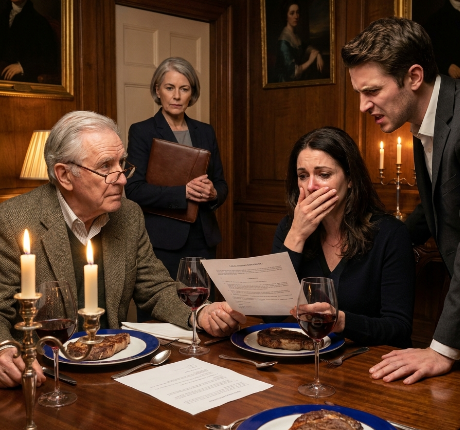
The twist that silenced everyone came from Aunt Renee. She pulled a thumb drive from her purse and handed it to Marla.
“What is that?” Dad asked.
“Mom’s kitchen camera,” Aunt Renee said. “You remember the little camera we put up after she started falling? It recorded audio too. You went to her house three days before she died and screamed at her about the trust for forty minutes.”
Dad went white.
Aunt Renee’s voice shook, but she held his stare. “You told her Ava would never survive without you. She told you Ava would survive the minute she got away from you.”
Brandon dropped his head. For one second, I wondered whether he had ever believed his own golden-boy act. Then he looked up with pure hatred, and my sympathy left.
“You ruined my life,” he said.
“No, Brandon,” I said. “I just stopped letting you use mine.”
The officer led him into the hallway after Marla found three loan approval notices in his backpack. He had been trying to take the originals, not to protect Dad, but because his name appeared on one transfer request. Even his panic was selfish.
Dad was not handcuffed that morning. Not yet. Investigations move more slowly than rage. But he was told not to remove documents, not to contact certain offices, and not to threaten me. Watching a stranger explain consequences to the man who had ruled our dinner table felt unreal.
Mom followed me onto the porch when I carried my suitcase outside.
“Ava,” she said. “I was afraid. Your father said we would lose everything.”
I looked back at the brick house glowing in the early sunlight. From the outside, it looked like every safe, ordinary family home on the block.
“You did lose everything,” I said. “You just lost it by protecting the wrong person.”
Aunt Renee took me to her apartment. She made terrible coffee and let me sleep on her couch under a quilt that smelled like lavender detergent. When I woke, my phone had eighty-seven messages. Some relatives called me cruel. Some said they had always known something was wrong. My university adviser wrote that my enrollment was secure while the fraud claim was reviewed. The student loan unit froze the accounts. The estate attorney said the deed would hold unless Dad could prove fraud.
At noon, my second scheduled email went out.
I did not stop it.
That email was not revenge. It was a record. Dates. Transfers. Scans. A timeline so clear even Uncle Mark, who once lost a parked car at a county fair, could understand it. I removed anything that was merely embarrassing and not evidence. I wanted truth, not a bonfire.
By evening, Brandon’s fiancee returned the ring. The diamond had been bought with trust money too. She sent me one message: I am sorry I believed them.
Over the next months, my life did not turn into a victory montage. Real justice comes with paperwork. I worked breakfast shifts at the diner. I filled out affidavits between classes. I sat through meetings where men in suits said “misappropriation” while I fought the urge to scream, “You mean theft.”
But I also moved into my dorm.
I bought a used laptop with money Aunt Renee insisted was a loan and then refused to let me repay. I froze my credit. I testified in a civil hearing wearing the only blazer I owned, and when Dad’s attorney suggested I was just an angry daughter exaggerating family conflict, I looked at the judge and said, “Being angry does not make the documents fake.”
The house was placed under court protection until the estate issues were resolved. Dad eventually accepted a settlement that restored the trust funds through the sale of assets he swore did not exist. Brandon took a plea on the loan fraud because the evidence had his fingerprints all over it, literally and digitally. Mom avoided charges by cooperating, which hurt in a different way. She called once to say she was proud of me.
I told her, “I hope one day you mean that when it costs you something.”
Then I hung up.
A year later, I stood outside Ellison’s library after my last final of sophomore year. The sun was warm. My backpack was too heavy. My coffee tasted burnt. My life was still messy, still expensive, still nothing like the glossy brochures promised.
But it was mine.
That morning, Aunt Renee texted me a photo. The old house had sold. The money went where Grandma had intended: my education, my credit repair, and a small scholarship fund in her name for students whose families treated opportunity like a bargaining chip.
I sat on the library steps and cried again, but this time I laughed too. Somewhere, I could almost hear Grandma saying, Took you long enough, kid.
People ask why I only said one word at dinner. Why not scream? Why not defend myself?
Because “alright” was not surrender.
It was the sound of a door unlocking.
So tell me honestly: when parents protect the golden child by sacrificing the quiet one, is exposing the truth betrayal, or is it justice? Comment what you would have done if your family asked you to apologize to the person who stole your future.