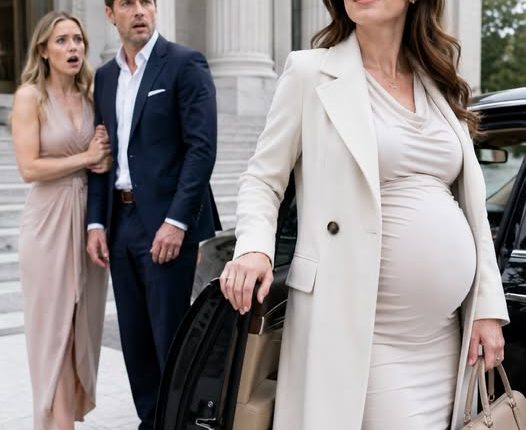
Harold Waverly stood on the porch in a charcoal suit, flanked by two attorneys and a small private security team. He looked calm, almost apologetic, the way professional men do when they are about to deliver a truth that requires no raised voice.
Parker stormed to the entrance, his face red with anger.
“Who gave you permission to come onto this property?”
One of the attorneys opened a folder.
“The current owner,” he said. “This house was legally sold yesterday. Mr. Waverly is here to begin the possession process.”
Marjorie appeared behind Parker, still holding the baby blanket over one arm.
“That is impossible,” she said. “This is my son’s house.”
The attorney looked at her with the patience of a man who had heard many confident wrong answers in his career.
“It never belonged to your son.”
The room changed.
Not loudly at first. It changed in small movements: a cousin lowering his fork, an aunt turning toward Parker, Brooke’s phone dipping halfway toward her chest, Marjorie reaching for the back of a chair as if the floor had shifted beneath her expensive shoes.
Parker snatched the papers from the attorney’s hand and began reading. His eyes moved quickly at first, then slower, then hardly at all.
He found my name.
He found the purchase date.
He found the truth he should have cared enough to know years earlier.
“No,” he whispered.
Brooke stopped recording, but she had waited too long. Her own live video had already carried the moment beyond the room. Dozens of relatives, friends, and acquaintances had watched her celebrate my removal, only to witness the house slip out from under them like a rug they had been dancing on.
Marjorie’s face lost all its authority.
“Parker,” she said, her voice thin. “Tell them.”
But Parker had nothing to tell.
Tessa stepped out from the kitchen with the baby carrier in one hand. She looked from Parker to the papers, then to the attorneys at the door. Her expression changed in a way I recognized immediately: calculation turning into disgust.
“Are you telling me,” she said slowly, “that you do not own this house?”
Parker turned toward her.
“Tessa, we can work this out.”
“Do you have money?”
He swallowed.
“It is complicated.”
“It sounds simple to me.”
Marjorie stepped forward.
“Young lady, this is still a family matter.”
Tessa gave a small, humorless laugh.
“Family?” she said. “That is interesting, because there is something I never told any of you.”
Even through the camera, I saw Parker go still.
The whole room waited.
Tessa adjusted the strap of the diaper bag on her shoulder and looked straight at him, no softness left in her face.
“You were useful when I thought you had a house, Parker. But if the house, the money, and the life all belonged to your wife, then maybe you should have been kinder to the only woman in this story who actually had something.”
No one spoke.
I closed my laptop before she said anything more.
For the first time in six years, I did not need to hear the rest.
What I Took With Me
Two days later, I met Harold Waverly at the house for the final walkthrough.
The balloons were gone. The dining room smelled faintly of lemon cleaner and panic. Most of Parker’s family had disappeared from the scene as quickly as they had arrived, leaving behind only folded chairs, half-empty soda bottles, and the uncomfortable silence people leave when celebration turns into consequence.
Parker was there, sitting on the bottom step with his elbows on his knees. He looked smaller than I remembered, not because he had changed, but because I no longer stood beneath the version of him I had built in my mind.
When he saw me, he stood.
“Evelyn,” he said. “Please. Can we talk?”
I looked at him, really looked at him, and felt something softer than anger. Not forgiveness. Not pity exactly. More like the tired tenderness you feel for a person you once loved before they taught you why distance can be holy.
“You had six years to talk to me,” I said.
His eyes filled, but I did not move toward him.
“My mother pushed too hard,” he said. “Brooke made it worse. I got trapped.”
That almost made me smile.
Not because it was funny, but because it was so familiar. Parker had always been trapped by whatever choice embarrassed him after he made it.
“No,” I said gently. “You chose. You chose when you stayed silent. You chose when you let them call me names. You chose when you brought another woman into a life I was still helping you hold together.”
He looked down.
“I did not think you would sell it.”
“That was the problem,” I said. “You never thought I would choose myself.”
I walked past him and went upstairs one last time. The bedroom was nearly empty now, stripped of warmth, stripped of the little signs of a marriage I had tried to save long after it had stopped saving me. In the closet, on the highest shelf, I found one thing I had forgotten: a framed photograph of my father standing in front of the house the day I bought it. He was smiling, one hand on the porch column, proud in the quiet way good men are proud when their daughters build something solid.
I held the frame against my chest for a moment.
Then I carried it downstairs.
Marjorie was waiting in the foyer. Her pearls were gone. Her dress was plain. She looked at me as if seeing me for the first time, not as an obstacle, not as a disappointment, but as the owner of every room she had mistaken for her son’s achievement.
“You should have told us,” she said.
I paused with my hand on the door.
“No,” I said. “You should have asked.”
Outside, the afternoon light was bright over the porch, and for a second, the house looked exactly as it had the first day I saw it: weathered, graceful, waiting for someone to love it honestly.
I left with one suitcase, a cedar box, and my father’s photograph.
That was all I needed.
By the end of the week, Parker had moved into a rented apartment. Brooke deleted her video, though not before enough people had saved it to make her careful at church for a while. Marjorie stopped calling. Tessa, from what I heard, left Savannah before the month ended.
As for me, I bought a smaller house near the coast, one with a porch facing the marsh and no room large enough for people who mistook kindness for weakness. In the mornings, I drank coffee barefoot in the kitchen, and in the evenings, I worked at the long wooden table by the window, designing homes for people who understood that a house is not truly yours because you stand inside it.
It is yours because you honor what built it.
For years, I thought losing a marriage would feel like being emptied out.
But when I finally walked away, I learned the truth.
Sometimes the life you leave behind was never holding you.
Sometimes it was only standing in the doorway, blocking the light.