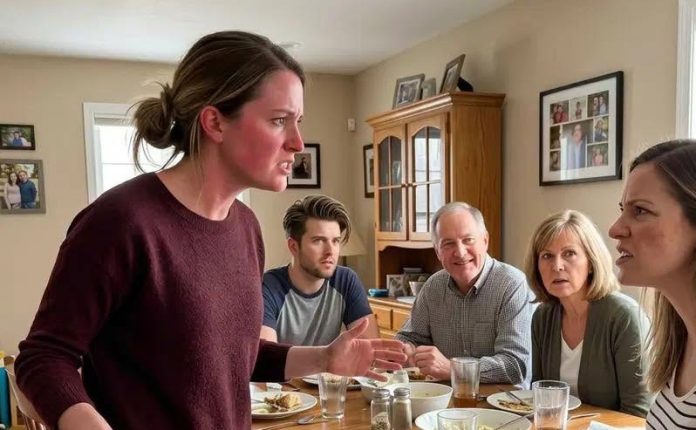
“Your father was in excellent health and the signing was witnessed by several independent parties.” Liam grabbed the documents from the table, scanning the pages as if his anger could somehow change the legal reality.
“This is a scam!” he yelled. “This cannot be happening!”
“The house belongs to your sister,” Scott said firmly. My mother had not spoken a single word, but when she finally did, her voice was a mere whisper.
“He never told me,” she said. “We were married for nearly forty years, and he never said a word about this.”
“He explicitly asked me to keep it confidential,” Scott explained. “I was legally bound to honor his request.”
My mother turned to look at me, and for the first time in my life, she did not see a burden or a guest. She saw the person who held the keys to her very survival.
“Fiona,” she said, her voice cracking with desperation. “We need the money from that sale because Liam owes some very dangerous people.”
The room erupted into shocked whispers. Aunt Harriet gasped and Uncle Thomas stared at Liam with newfound clarity.
“How much does he owe?” I asked. No one answered me at first, so I spoke the truth for them.
“Is it four hundred thousand dollars?” I asked. Liam did not even try to deny it.
My mother finally broke down, her expensive makeup running down her face. “I have been covering his losses for years,” she confessed.
“I gave him everything I had left, and the house was our only way out.” I stood up slowly, feeling the weight of the moment.
“I am not taking anything from you,” I said. “I am simply accepting what my father chose to leave me.”
I looked directly at Liam. “He saw this day coming, and he was right to protect the house from your choices.”
I turned back to my mother. “You can stay in the house,” I told her. “I am not going to throw you out on the street.”
A flicker of relief crossed her face, but I was not finished. “We will draft a lease for one dollar a month,” I said.
“But Liam is not allowed to live there, and that is final.” “You cannot do that!” she cried out.
“I can,” I replied. “The house belongs to my company, and Liam needs professional help, not more of your enabling.”
I picked up my bag and walked out of the room. In the parking lot, my grandmother caught up to me, leaning heavily on her cane.
She took my hands in hers and told me she had known about the LLC for years. My father had asked her for advice on whether he should protect me.
“Why did you not tell me?” I asked. “Because I wanted to see if your mother would do the right thing on her own,” she said sadly.
“She did not, but you did, because you stood your ground without being cruel.” Liam found me by my car a few minutes later.
His arrogance had vanished, replaced by the look of a man who had finally run out of luck. “I really thought I could win it all back,” he admitted.
“I just needed one more big win to fix everything.” “It never works that way, Liam,” I said.
He lowered his eyes in shame. “Go to a treatment program,” I told him.
“If you stay clean for ninety days, then we can talk about your future.” He nodded slowly.
Then my mother appeared, looking smaller and more fragile than I had ever seen her. “Did he leave any message for me?” she asked.
“Anything at all?” I could have lied to her to make her feel better, but I looked at the woman who had spent decades telling me I did not belong.
“No,” I said. “He did not mention you in the letter.”
She flinched as if I had slapped her. “I gave him my entire life,” she whispered.
“He did not leave me the house because he loved me more than you,” I explained. “He left it to me because he knew you would give it to Liam, and then you would both have nothing.”
Two weeks later, Liam checked himself into a facility in North Carolina. I did not visit him, but I sent him a short note telling him I was rooting for his recovery.
In the winter, I moved back into the house on Willow Creek Drive. I kept my apartment in Annapolis for work, but I spent my weekends reclaiming the space that had been taken from me.
The first thing I did was clear out my old bedroom. I moved Liam’s designer bags and electronics into the garage and painted the walls a soft sage green.
My mother stayed in the guest room under the one dollar lease. We did not talk much, and while it was not exactly peace, it was no longer a state of war.
On Sunday evenings, my grandmother would come over for dinner and tell me stories about the family. I placed fresh flowers on the mantel next to my father’s picture every week.
One evening, I sat on the porch with a cup of tea, watching the sunset over the trees. I had my father’s letter in my pocket, the paper soft from being read so many times.
I used to think my father did not love me because he was always so quiet. I was wrong about him.
He just did not know how to express his love through words. He came from a generation that viewed emotions as a liability.
He loved me through fifteen years of legal filings and corporate paperwork, protecting me in the dark until the light finally reached the truth. At last, I understood that his silence was not absence; it was a shield.