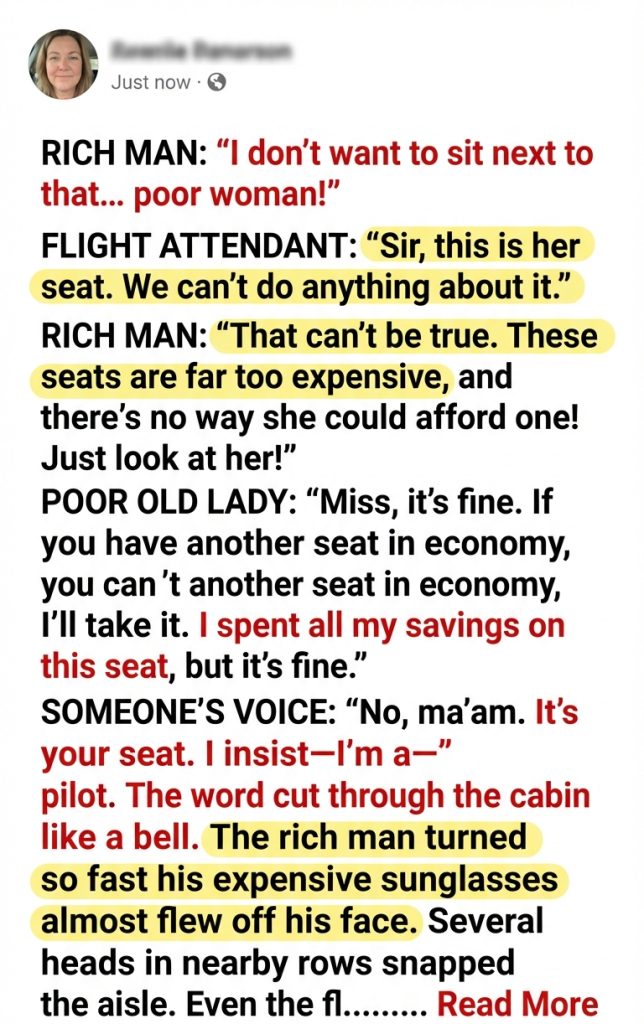
…… flight attendant paused mid-breath.
A tall man in a crisp uniform stood a few steps away, one hand resting on the overhead bin as if he’d stopped in the middle of walking and decided, right then and there, that he was done with nonsense.
He looked calm. Professional.
But there was something in his eyes that made the air feel heavier.
“No, ma’am,” he repeated gently, looking directly at the elderly woman. “It’s your seat. I insist—I’m a pilot.”
The poor old lady blinked up at him, startled. Her hands were folded in her lap like she was trying to make herself smaller. Her purse—worn leather with scuffed corners—sat on her knees like a shield.
“I… I didn’t mean to cause trouble,” she whispered.
“You didn’t,” the pilot said. “He did.”
The rich man’s face flushed red. He forced a laugh that sounded like it was scraping its way out of his throat.
“Captain,” he said, trying to recover his dignity, “I’m sure there’s been a misunderstanding. I paid for this seat, and I’m not comfortable sitting next to—”
“Sir,” the pilot interrupted, still polite, still calm, “your comfort does not override her ticket.”
The flight attendant straightened, relief flickering across her face like someone had finally brought backup.
The rich man drew himself up. “Do you know who I am?” he snapped, loud enough for people to hear.
The pilot didn’t blink. “No,” he said. “And I don’t care.”
A few people nearby murmured. Someone coughed to hide a laugh.
The rich man’s mouth opened and closed. His gaze swept the cabin—looking for support, for someone to validate his outrage. But the faces around him were blank, unimpressed, or quietly disgusted.
He turned back to the flight attendant with a sharp gesture. “Move her,” he said.
The old woman’s shoulders slumped. She started to stand, the way older people do when they’ve learned that pushing back only makes things worse.
“Miss, it’s fine,” she said again, voice small. “If you have another seat in economy, I’ll take it. I spent all my savings on this seat, but it’s fine.”
Those words did something to the cabin.
Spent all my savings.
It wasn’t just money. It was years. Time. Life. Sacrifice.
The pilot’s face softened. “Ma’am,” he said, “please sit.”
She hesitated, then lowered herself back into the seat with trembling hands.
The rich man scoffed. “All her savings?” he repeated loudly, mocking. “Please. That’s her problem.”
The pilot turned his head slightly, and his voice dropped, quiet but firm—quiet in the way that makes people lean in.
“Sir,” he said, “I’m going to ask you one last time to lower your voice and take your seat.”
“And if I don’t?” the rich man shot back.
The pilot held his gaze. “Then you won’t be flying today.”
Silence.
You could almost hear the engines outside.
The rich man stared, stunned that anyone—especially airline staff—would challenge him. People like him were used to throwing money around like a key that unlocked obedience.
He smirked. “You can’t remove me. I have meetings. I paid—”
The pilot nodded once. “So did she,” he said. “And she paid with more than money.”
The rich man scoffed again, but there was a crack in his confidence now. “This is ridiculous.”
The pilot turned slightly to the flight attendant. “Please call the chief purser,” he said calmly. “And inform ground staff we may have a passenger refusing crew instruction.”
The flight attendant’s eyes widened slightly—then she nodded briskly, grateful for the authority.
As she stepped away, the rich man’s face changed from arrogance to alarm.
“Wait,” he said quickly. “There’s no need for that. I’ll sit.”
The pilot looked at him for a long moment. “Good,” he said simply.
The rich man dropped into his seat with a stiff motion, jaw clenched, eyes forward like a child forced to behave.
But it wasn’t over.
Because the pilot hadn’t stepped in just to enforce a policy.
He stepped in because he knew the woman.
He looked down at her again, and his voice softened, not for the cabin this time—just for her.
“Ma’am,” he said gently, “did you bring it?”
Her eyes widened. “I… yes,” she whispered, fumbling in her worn purse with shaking fingers.
From inside, she pulled out a small envelope, edges creased from being held too tightly.
The rich man glanced over, irritated. “What is that?”
The pilot ignored him. He took the envelope with careful hands, as if it held something fragile.
Then he looked around the nearby rows.
“I apologize to everyone for the delay,” he said, voice carrying now. “But some moments matter more than schedules.”
People leaned in, curious. Someone in the aisle raised their phone slightly, then thought better of it and lowered it again.
The pilot swallowed once, like he was steadying himself.
“This woman,” he said, nodding toward the old lady, “is the reason I’m sitting in that cockpit today.”
The cabin went still.
The rich man let out a short laugh, disbelieving. “Oh, come on.”
The pilot’s eyes flashed. “Sir,” he said sharply, “you’ve spoken enough.”
The man shut his mouth.
The pilot continued, calmer. “When I was twelve, my father died. My mother worked two jobs and still couldn’t keep up. I was angry. I was failing school. I was… headed in the wrong direction.”
The old lady stared at her hands, but her eyes glistened.
The pilot’s voice softened. “This woman lived in the apartment below us. She was widowed. She didn’t have much. But she noticed a kid who was slipping.”
He paused, breathing carefully.
“She started leaving food by our door. She’d say it was extra. She’d pretend it was nothing. Sometimes she’d hand my mom an envelope and insist it was ‘for groceries’—even when we knew she needed groceries too.”
The rich man shifted uncomfortably, staring straight ahead.
The pilot lifted the envelope the woman had brought. “Years later,” he said, “when I was accepted into flight school, my mother cried because we couldn’t afford it. I told her it was fine. I’d find a way.”
He looked down at the old lady. “And this neighbor… she knocked on our door and handed me an envelope.”
He tapped the envelope in his hand. “Inside was a check for the exact amount of my first semester fees.”
A murmur moved through the cabin like wind.
The old lady’s voice trembled. “It was my savings,” she whispered, almost too quiet to hear. “I didn’t want you to give up.”
The pilot nodded, eyes wet. “I tried to refuse,” he said. “She wouldn’t let me.”
He looked around the cabin again. “That money didn’t just pay a bill. It changed a life.”
Then his gaze hardened as he looked back at the rich man.
“And today,” he said, voice steady, “I heard someone look at her and decide she didn’t belong. Because of how she looks. Because of what he assumed.”
He paused.
“And I couldn’t let that stand.”
The cabin was silent.
The rich man’s face had gone pale. His jaw tightened.
The pilot turned back to the old lady, softer now. “When I finally found her again,” he said, “I bought her this seat. Not because she needs charity. Because she deserves comfort. Because she earned it.”
The old lady blinked rapidly, tears slipping down her cheeks. “I told you I didn’t need it,” she whispered.
“I know,” the pilot said with a small smile. “That’s why you deserve it.”
He leaned down slightly, lowering his voice. “And because you asked me to do one thing,” he added.
The old lady nodded. “Yes.”
The rich man couldn’t help himself. “What ‘thing’?” he muttered.
The pilot looked at him, expression flat. “To bring her home,” he said.
Home.
The word landed softly, but it carried weight.
The pilot turned to the cabin one last time. “We’ll be departing shortly,” he said, voice returning to professional. “Thank you for your patience.”
Then he looked down at the old lady, and his voice softened again.
“Ma’am,” he said, “if you’d like, after takeoff I’ll have a flight attendant bring you tea. The good kind.”
She gave a shaky laugh through tears. “You always remembered my tea.”
“I remembered everything,” he said.
Then he straightened, and before walking away, he added one final thing—quiet, but loud enough for the rich man to hear:
“And sir? The most expensive thing on this plane isn’t the seat.”
He let that hang for a heartbeat.
“It’s dignity.”
He walked toward the front, leaving the cabin buzzing with a silence that felt like judgment.
The rich man stared at the tray table in front of him as if it had suddenly become fascinating. His confidence was gone. All that remained was embarrassment, and the kind of discomfort money can’t fix.
The poor old lady sat back in her seat, hands trembling, tears drying on her cheeks.
A woman across the aisle leaned over and whispered, “You’re a beautiful person.”
The old lady smiled softly. “I just… did what anyone should.”
The woman shook her head. “Not everyone does.”
And that was the truth, wasn’t it?
Some people see wealth as proof of worth.
Some people see struggle as failure.
But the world is full of quiet heroes who don’t look impressive until the moment you learn what they carried.
As the plane began to taxi, the old lady glanced at the rich man beside her.
He didn’t look at her.
He couldn’t.
Because if he did, he’d have to face the fact that the “poor woman” he dismissed had once changed a child’s entire future.
And that no amount of money could buy him the kind of respect she had earned without trying.
When the seatbelt sign dinged on, the old lady folded her hands again, calmer now.
And for the first time since she boarded, she looked like she truly belonged—because she did.
Not because someone powerful insisted.
But because kindness, once given, has a way of coming back with wings.