At exactly 2:19 a.m., the emergency dispatcher almost didn’t answer the call.
Night shifts were notorious for prank dialers, half-asleep teenagers testing boundaries, or accidental pocket calls that ended in embarrassed apologies. The phone rang once, twice, its sharp sound cutting through the quiet hum of the control room. The dispatcher sighed and reached for the headset.
The moment she heard the voice on the other end, her posture stiffened.
It wasn’t loud.
It wasn’t panicked.
It was small, shaky, and terrifyingly calm.
“Um… hello… my parents won’t wake up… and the house smells funny.”
The dispatcher’s fingers tightened around the console.
“Sweetheart,” she said gently, switching instantly into protocol mode, “what’s your name?”
“My name is Amelia,” the voice replied. “I’m seven.”
“Okay, Amelia. You’re doing the right thing. Where are your parents right now?”
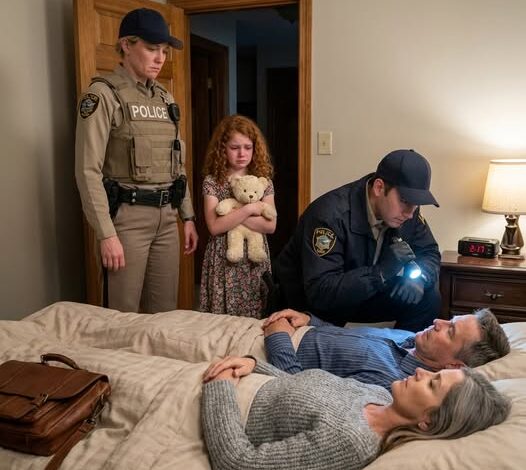
“In their bedroom. I shook them. Mom didn’t move. Dad didn’t move either.”
The dispatcher didn’t hesitate. She signaled silently to her supervisor while keeping her voice steady.
“Amelia, I want you to listen to me very carefully. Can you go outside right now? Take a jacket if you can, and wait as far from the house as possible.”
There was a pause.
“Is my house broken?” Amelia asked.
“No, sweetheart,” the dispatcher replied softly. “We just want to keep you safe.”
Within minutes, a patrol unit was dispatched to the address — a modest single-story home at the edge of a quiet residential town where nothing dramatic ever happened and everyone assumed danger lived somewhere else.
When Officers Grant and Alvarez arrived, the first thing they noticed was the smell.
Even before stepping out of the vehicle, it hit them — sharp, metallic, unmistakable.
Gas.
Amelia was sitting barefoot on the front lawn, knees pulled to her chest, clutching a threadbare stuffed rabbit with one missing eye. Her face was pale, her eyes rimmed red, but she wasn’t crying. That unnatural stillness unsettled both officers immediately.
“You did great calling us,” Officer Grant said, kneeling to her level. “Are you hurt?”
She shook her head. “I just got scared. It smelled bad.”
Alvarez didn’t waste time. He radioed for the fire department and medical units while Grant escorted Amelia farther from the house, wrapping her in his jacket.
Inside the home, the situation was worse than expected.
The air was thick. Heavy. Dangerous.
In the bedroom, Amelia’s parents lay side by side on the bed, unmoving. No signs of struggle. No visible injuries. Just stillness — the kind that made even seasoned officers feel uneasy.
A smoke detector blinked silently on the wall. Its batteries were gone.
They were evacuated immediately.
As paramedics worked frantically, Amelia watched from a distance, fingers clenched tightly around the rabbit’s ears.
“Are they going to wake up?” she asked quietly.
A nurse crouched beside her. “We’re going to do everything we can.”
But even as the ambulance doors closed, something didn’t sit right.
The main gas valve was open far wider than normal. And inside the bedroom, the ventilation duct had been deliberately blocked — a towel jammed tightly in place from the inside.
Officer Grant exchanged a look with Alvarez.
“This wasn’t an accident,” Grant said under his breath.
Amelia was placed temporarily in protective care while her parents were rushed to the hospital, both in critical condition due to prolonged carbon monoxide exposure.
As dawn crept in, forensic investigators combed through the house.
What initially looked like negligence began to unravel into something darker.
The boiler hadn’t malfunctioned on its own.
It had been tampered with.
A technician shook his head slowly. “This doesn’t just fail like this. Someone knew exactly what they were doing.”
Later that morning, Grant sat with Amelia in a quiet child services room, crayons scattered across the table between them.
“Can you tell me about last night?” he asked gently.
She nodded, eyes fixed on her drawing.
“Dad was on the phone again,” she said softly. “He was angry. He said he didn’t have the money. He said he needed more time.”
“Did he say who he was talking to?”
She shrugged. “He just said… ‘please.’ And then he said, ‘don’t come here.’”
Grant’s pen paused.
“Has anyone been coming to your house lately?”
Amelia hesitated. “Some men. They don’t smile. Mom tells me to stay in my room.”
The pattern was becoming disturbingly familiar.
At the hospital, doctors confirmed that the poisoning had been severe. If Amelia hadn’t called when she did, her parents wouldn’t have survived the night.
Security footage from nearby homes revealed a hooded figure approaching the house shortly before midnight. The individual walked with a slight limp on the left side. Five minutes later, he left.
Too fast for coincidence. Too precise for chance.
Then came the notebook.
A social worker found it tucked beneath Amelia’s bed while packing her things for temporary foster care. Inside were drawings — innocent in style, devastating in implication.
Men without faces standing near the house.
Her father shouting into a phone.
And one image that made Grant’s stomach turn.
A shadowed figure descending the basement stairs while Amelia lay awake in bed.
When asked about it, she hugged her rabbit tighter.
“I heard footsteps,” she whispered. “I thought it was Daddy… but he was already asleep.”
That changed everything.
The intruder hadn’t come after the parents fell asleep.
He’d come before.
Bank records soon confirmed the motive.
Small, regular deposits. No contracts. No official lender. A shell company linked to illegal loan operations across multiple counties.
The father had borrowed money he couldn’t repay.
And someone decided to send a message.
The man with the limp was identified within days. Arrests followed. Then more. The investigation cracked open an entire extortion network operating quietly in towns just like this one — places where people didn’t expect danger and didn’t know where to turn.
Three days later, Amelia’s parents woke up.
Her mother sobbed when she saw her daughter. Her father could barely speak through tears and oxygen tubes.
“I’m so sorry,” he whispered. “I should’ve asked for help.”
The criminals were prosecuted. Sentenced. Assets seized.
The family received support, counseling, and protection.
And Amelia?
She went home.
Months later, Officer Grant stopped by their house with a new smoke detector, batteries included. Amelia ran to the door, smiling, rabbit still in hand.
“Hi,” she said proudly. “My house doesn’t smell weird anymore.”
Grant smiled back, heart full.
Because sometimes, bravery doesn’t look like strength.
Sometimes, it sounds like a quiet voice at 2:19 a.m., refusing to stay silent.
And sometimes, that voice saves lives.