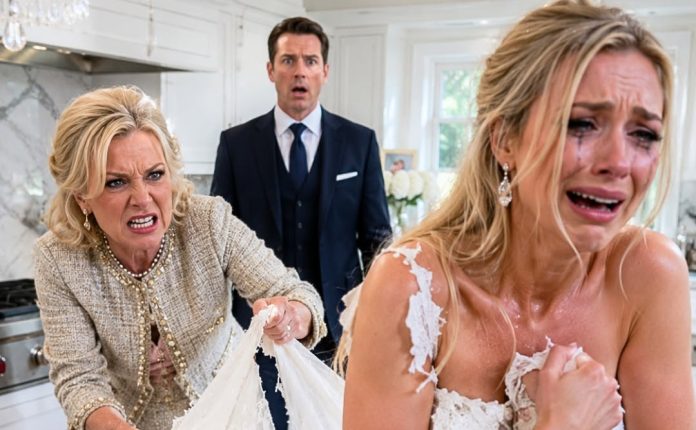
At 2:47 p.m., my Honda coughed its last breath in the driveway like it was embarrassed to be parked in front of a house it could barely afford to look at. I sat there for a second, staring at the garage—at the leased BMW X5 gleaming in the center like a trophy my husband, David, hadn’t actually earned.
My meeting with the tax auditors had been canceled. Rare gift. Empty afternoon. I wasn’t supposed to be home until six.
David was supposed to be downtown, “closing the deal of the century.” That’s what he’d been calling it for weeks, puffed-up and smug, as if confidence could pay bills.
But his car was home.
Then I noticed the front door.
Unlocked.
David never left it unlocked. He was paranoid about security—motion lights, cameras, new locks every time the neighbor’s kid so much as looked at our mailbox too long.
I stepped inside and called his name. The house answered with a silence so heavy it felt like it had hands.
And then I saw them: red stiletto heels kicked against the baseboard like someone had hurried out of them.
My stomach dropped, and my body did this weird thing where it tried to bargain before my brain could even catch up. Client meeting. Woman client. She took off her shoes. That’s normal, right?
Then the perfume hit me—sweet vanilla and burnt sugar—thick enough to choke the clean lemon smell of my own life.
Upstairs, something thudded. Feet scrambled. A door clicked.
And in the master bedroom, my husband stood there in a towel, flushed and panicked, like a kid caught stealing.
“Emily,” he squeaked. “You—you’re home early.”
Behind him, the closet door… moved.
Not much.
Just enough.
—————————————————————————
1. The Shoes
I didn’t run. I still don’t know why. Maybe because some part of me needed to prove to myself I wasn’t the kind of woman who sprinted toward disaster like a cartoon.
My hand slid along the banister as I climbed. Each step felt too loud. My heart beat like it wanted to punch its way out of my ribs.
“David,” I called again, louder.
Another thud upstairs. A frantic shuffle. That sound—quick and desperate—was what broke the last of my bargaining. No client meeting sounds like that. No “professional lunch” ends with someone scrambling like prey.
The bedroom door was cracked. I pushed it open.
David stood in the middle of the room in nothing but a towel, wet hair sticking up, face blotchy with panic. His eyes darted—past me, toward the hall, toward the closet—like he was trying to calculate the fastest route out of his own lie.
“Emily,” he said again, like repeating my name could reset the scene.
“The meeting got canceled,” I said.
My voice didn’t sound like my voice. It sounded like someone reading a report—detached, neat, bloodless.
I stepped in. The bed was unmade. Our expensive sheets—Egyptian cotton I’d saved for—were twisted into a messy knot. Pillows on the floor. The air smelled like sweat and that syrup perfume.
“Whose shoes are downstairs?” I asked.
David’s laugh was sharp and wrong. “Shoes? What shoes? Oh—those. I bought those for you. Surprise. I was just checking the size.”
I stared at him.
“You were checking the size of women’s heels,” I said slowly, “while naked in the middle of the day.”
He took a step to block my view, like his body could stand between me and truth.
“I took a shower,” he stammered. “Came home to freshen up. It’s hot out. You know how I get.”
“Who is here, David?”
“No one,” he snapped. Then softened instantly, switching tactics like flipping a coin. “You’re imagining things. You always do. It’s that little bookkeeping job—it’s stress. You’re paranoid.”
There it was—his favorite move.
Make me the problem.
My eyes went past him to the closet.
The door vibrated slightly. A tiny hinge squeak.
“Why is the closet door moving?” I asked, quieter now.
His face drained. “Draft,” he said. “AC vent. The house is settling.”
“The AC is off,” I said.
I stepped around him.
His hand clamped around my arm—hard. Desperate.
“Emily, don’t,” he hissed. “You’re going to embarrass yourself.”
I looked down at his hand. Then up at his eyes.
“Let go of me.”
Something in my voice finally landed. He released me like I’d burned him.
I walked to the closet.
My hand shook as I wrapped my fingers around the knob. Not from fear of what I’d see—at that point I already knew—but from the grief of being right.
I took a breath.
And opened the door.
2. The Shirt
A woman was crumpled inside my closet like a secret shoved into a corner.
Mid-twenties. Blonde hair messy. Mascara smudged. She clutched her clothes to her chest, breathing fast. Her eyes snapped up to mine, wide with panic.
But I didn’t buckle because she was there.
I buckled because of what she was wearing.
To cover herself, she’d grabbed the first thing hanging on a hook—red-and-black flannel.
My father’s flannel.
The shirt he wore the day he died.
The one I kept wrapped in plastic, tucked in the back where I could touch it when the world felt too sharp. The shirt that still held a ghost of pipe tobacco and sawdust. The closest thing I had to his hug.
And this stranger wore it like a towel.
The room tilted.
For a moment, the only sound was breathing—hers, mine, David’s—ragged, uneven, trapped.
I waited for David to say something human. An apology. A plea. A collapse.
Instead he sighed.
A long, exasperated sigh like I’d interrupted his lunch.
“All right, Tanya,” he said. His voice dropped into that tone he used on waiters and customer support lines. “You can come out. She sees you.”
Tanya.
The woman scrambled out of my closet, still gripping my father’s shirt around her shoulders like she owned it.
And then, unbelievably, she smirked.
Not at David.
At me.
“I told you she’d come home early,” Tanya said, ignoring me like I was a piece of furniture. “Bookkeepers are so predictable.”
She walked to the bed and started dressing right in front of me—no bathroom, no shame—like she was the wife and I was the intruder.
“David,” I said, voice thin, “that shirt—make her take it off.”
David rolled his eyes.
“Oh, stop,” he said. “It’s just an old rag. You keep it wrapped like it’s sacred.”
“It was my father’s,” I said, each word scraping my throat.
“Your father was a broke carpenter,” David sneered. “Let’s not pretend he was royalty.”
His hand settled on Tanya’s lower back as she zipped her skirt—casual intimacy, ownership, comfort.
That touch hit harder than the bed ever could. Because it meant this wasn’t a mistake. This wasn’t drunken. This was practiced.
Then David clapped his hands like he was ending a meeting.
“Okay,” he said. “We need to be adults. I didn’t want you to find out like this, but maybe it’s for the best.”
“For the best,” I repeated.
He gestured at me like I was a boring spreadsheet.
“Look at you,” he said. “Gray slacks. Sensible blouse. Hair in that tight bun. You’re a utility bill, Emily. Necessary, sure. Keeps the lights on. But boring.”
Tanya giggled. “He’s right, hun. You look like you’re dressed for a funeral.”
A funeral.
The word landed like a sick joke, because my father’s shirt was warm from her body.
David tightened the towel and nodded toward the door.
“So,” he said, cheerful now, “pack a bag. Go to your mom’s. Motel. I don’t care. I need the house tonight. Investors are coming. And I can’t have you moping around in your depression cardigan killing the vibe.”
He cheated. He violated my sanctuary. He desecrated the only thing I’d kept safe.
And now he was evicting me.
My hands clenched so hard my nails cut into my palms.
I could’ve lunged. I could’ve screamed. I could’ve made the kind of scene people talk about for years.
But in the middle of that rage, my father’s voice rose in my memory—calm, warm, sure.
The loudest person in the room is usually the weakest. True power is silent.
I took a breath.
Let my hands unclench.
Let my face go blank.
“Okay,” I said.
David blinked, confused. “Okay?”
“Yes,” I said. “You want me to leave? I’ll leave.”
I walked toward Tanya. She flinched, bracing for a slap.
“Give me the shirt,” I said, low and flat.
Tanya looked at David. He shrugged.
“Give it to her,” he said. “It reeks.”
Tanya peeled it off and tossed it at me like trash.
The flannel hit the floor between us.
I knelt—slowly, deliberately—and picked it up with care, folding it as if I were folding my father’s memory back into place. I ignored that it was warm. I ignored the perfume that clung to it like an insult.
I stood.
“You have thirty minutes,” I said to David, still calm, “to move your things into the guest room if you want Tanya to keep breathing my air.”
David scoffed. “Excuse me?”
“Thirty minutes,” I repeated. “And don’t touch my office. Don’t touch my computer. Don’t touch my files.”
David’s eyebrows rose. “I’m not moving to the guest room in my own house.”
I tilted my head slightly.
“Then I call your mother,” I said, “and tell her exactly why her golden boy is naked at 2:47 p.m. with a woman in my closet wearing my dead father’s shirt.”
That did it.
David’s face tightened. His mother was the only person alive who could turn his spine into jelly with a single phone call.
For the first time all day, he shut up.
I walked out of the bedroom, down the hall, into my tiny office, and locked the door behind me.
Then I sank onto the floor with the flannel pressed to my chest and breathed like my life depended on it.
No screaming.
No crying.
Just breathing.
And then I looked at my laptop.
The screensaver bounced a bland shape around the display like a joke.
David called me a utility bill.
A mole woman.
He had no idea what I really was.
3. Ten Years of Quiet
People love to ask why women stay.
They ask like it’s simple. Like you wake up one morning and decide, Yes, today I will donate my dignity to a man who hates me.
It doesn’t happen like that.
It happens gradually—death by a thousand paper cuts and one mortgage payment at a time.
I met David when I was twenty-eight. He was charming in a way that felt like sunlight after years of being invisible. He talked about “building something” and “living big” and “never settling.” He called me smart in public, kissed my forehead in private, and made me believe I’d finally been chosen.
He called himself an entrepreneur.
I didn’t understand yet that sometimes “entrepreneur” is code for “unemployed with expensive taste.”
I was a freelance bookkeeper. Not glamorous. Lots of receipts. Lots of clients who wanted miracles. But I was good at it. Meticulous. The kind of person who could find a missing $72.14 in a ledger like it was a bloodhound scenting guilt.
When we got married, David started a “tech consulting firm” called Nexus Dynamics. Fancy name. Leased office. Business lunches. Very little actual work.
For ten years, I funded his dream.
I took on clients I hated. Restaurant owners who paid in cash and screamed at midnight. Contractors who “forgot” invoices until tax season. Boutique owners who couldn’t tell the difference between revenue and vibes.
I drove a beat-up Honda Civic with a broken AC because David needed the BMW to “project success.”
“You have to spend money to make money,” he’d say, adjusting his tie while I calculated how long we could keep the lights on.
So I paid the BMW lease.
Paid the mortgage.
Paid his suits.
Paid the country club membership because “that’s where deals happen.”
And what did I get?
Neglect.
Midnight arrivals smelling of scotch.
Criticism—my ironing, my cooking, my “energy.”
When the IRS audited him three years ago because he tried to write off a Cabo trip as a business expense, I spent six weeks organizing his records and negotiating like my life depended on it—because it did.
David didn’t thank me.
He just said, “See? I knew you’d handle it. That’s what you’re good at. The boring stuff.”
He didn’t see me as a partner.
He saw me as infrastructure.
Useful. Invisible. Replaceable.
Then, six months ago, he started talking about a “game-changing software” he was “developing.” He drained our savings.
“Trust me,” he said, eyes bright with manic confidence. “Once this launches, you’ll never have to look at another spreadsheet again.”
I wanted to believe him.
I was so tired.
But deep down I knew the truth: David didn’t build. He consumed.
And while he was out playing CEO, I was working.
Not just on his books.
On my escape.
4. The Secret Account
Three years ago, a young developer named Alex came to me. Brilliant, messy, hopeless with money. He had an idea for cybersecurity—something real—but his finances were chaos. Nobody would take him seriously.
I cleaned up his mess. Incorporated the business properly. Set up payroll. Created structure. Not because I was a saint, but because I recognized hunger and talent and I remembered what it felt like to be underestimated.
“I can’t pay you,” Alex said once, staring at his shoes.
“I know,” I said. “Pay me in equity.”
It was a gamble. A lottery ticket.
Five percent.
I filed the paperwork away.
And I didn’t tell David.
Because even before I had proof, I had instinct.
Six months ago, the universe—cold and fair and occasionally hilarious—balanced the scales.
Rainy Tuesday. Gray sky. Overdue bill on the table.
Alex emailed me:
We did it. Guardians Tech got acquired. Deal closed this morning. Check your account. Thank you.
I logged into the account I kept under my maiden name. The one David didn’t know existed. The one I’d opened years ago as a quiet safety net.
The number on the screen made my brain stutter.
$3,842,000.
I sat there breathing like I’d just surfaced from underwater.
My first instinct—conditioning is hard to kill—was to tell David. I grabbed my phone. Dialed.
Voicemail.
“You’ve reached David Carter, CEO of Nexus Dynamics…”
Then I did something I hadn’t done in months.
I drove downtown.
Not to congratulate him.
To give him the good news.
To watch relief wash over his face.
I parked my Honda a block away from his shared workspace, walked through the rain, and saw him under an awning across the street.
With a blonde woman.
Laughing.
Hand on his chest.
Then he kissed her—hungry, familiar, marital.
I stopped.
Rain soaked my sleeves.
And then my phone buzzed.
A message synced to the family cloud—David’s setting glitching like fate wanted me to see it.
From Tanya.
Can’t wait for tonight, baby. Tell the mole woman you’re working late.
Mole woman.
That wasn’t a slip.
That was what he called me.
That’s what they called me.
I stood there shivering, staring at my husband kissing his mistress while $3.8 million sat quietly in an account he didn’t know existed.
And in that moment, my love died cleanly.
Not with a scream.
With a cold snap.
I turned around and went back to my car.
I didn’t confront him.
I didn’t give him the money.
I gave him nothing.
Instead, I called the only person in my life who loved me fiercely enough to be dangerous.
My Aunt Martha.
Retired divorce attorney. Seventy-two. Courtroom legend. Drinks gin like it’s water and judges daytime TV like it owes her money.
“Martha,” I said when she picked up.
“Emily,” she rasped. “You sound like you finally killed that husband of yours.”
“I found him in our closet with his assistant,” I said. “She was wearing Dad’s flannel.”
Silence.
Then, Martha’s voice dropped.
“The flannel,” she repeated. Not a question. A verdict.
“Yes.”
“Good,” she said. Ice clinking in a glass. “We don’t get mad, Emily.”
I swallowed.
“What do we do?” I asked.
Martha’s smile came through the phone like a blade.
“We get everything.”
5. The Trap
We met at a diner. Vinyl booths. Bad coffee. Martha in oversized sunglasses like she was hiding from the world—or daring it to look closer.
I showed her my finances, the acquisition, the money kept separate.
Martha whistled low.
“Smart,” she said. “You kept it out of his reach.”
“That’s not enough,” I said. My hands trembled—not with fear, with clarity. “I don’t just want to leave. I want him exposed.”
Martha stabbed a pickle with her fork. “Cheating gets you divorced. Fraud gets you leverage.”
Then she slid a number across the table.
“Laya,” she said.
“Who’s Laya?”
“David’s former office manager,” Martha said. “Fired her to hire Tanya. Said she didn’t fit the ‘image.’ Laya’s got a spine and a memory.”
I called.
Laya answered like she expected a scam.
“This is Emily Carter,” I said. “David’s wife.”
A harsh laugh. “Ex-wife, I hope.”
“Working on it,” I said. “I heard he fired you.”
“That snake,” Laya spat. “Five years I covered for him.”
Then, like a dam cracking, she started talking.
Fake invoices. Inflated numbers. Loan money used for personal nonsense. Emails where he bragged and slipped and admitted too much.
“I have copies,” Laya said. “I knew he’d turn on me eventually.”
That’s when my plan stopped being emotional and became architectural.
David needed money. He needed an investor. He needed someone to save him before his house of cards collapsed.
So we gave him one.
A name.
A company.
A shadow he’d be too greedy to question.
Phoenix Holdings.
The funniest part? David thought Phoenix Holdings sounded “elite.”
He didn’t realize he was walking into a cage I built.
6. The Party
David planned a “launch party” at a hotel ballroom. Press invited. His parents invited. People he wanted to impress.
He even invited me.
“Come see what success looks like,” he texted. “Bring the divorce papers. We can sign them there.”
He wanted me to stand in the crowd while he shined, one last humiliation.
So I agreed.
And I stopped being small.
I dug out a dress I’d bought years ago for an event David never took me to—midnight-blue silk, elegant, powerful. I put on red lipstick. I let my hair down.
In the mirror, I barely recognized myself.
Not because I looked like someone else.
Because I looked like me—uncaged.
At the hotel, the ballroom glittered. Champagne, string lights, a stage with a projector behind it. David in a suit acting like a king. Tanya glued to his side like a trophy. People laughing on cue.
David saw me and blinked like his brain couldn’t reconcile “mole woman” with “woman in blue silk.”
Good.
Let him be confused.
Then the lights dimmed.
David took the stage.
“Ladies and gentlemen,” he boomed, “tonight we celebrate a new era. Nexus Dynamics is evolving.”
Applause.
He clicked his remote. Charts appeared. Buzzwords. Promises.
Then he clicked again.
And the screen went black for a second.
David frowned.
And the video played.
A closet.
My closet.
The room went dead still, the kind of silence that makes your ears ring.
David’s voice filled the speakers—clear, cruel:
“You’re a utility bill, Emily. Essential, but boring.”
Tanya’s giggle echoed.
“You look like you’re dressed for a funeral.”
Gasps rippled through the room.
David froze on stage, staring behind him like he was watching his own death.
He clicked the remote frantically. Nothing changed.
I had control now.
The screen switched again.
This time: Tanya’s recorded voice, laughing, dismissive, venomous.
“He’s such a loser. His cards are maxed out. I’m waiting for the money to clear so I can take what I want and leave.”
The room erupted—whispers, shocked laughter, someone muttering “Oh my God.”
Tanya’s face turned white. She looked at David like he was suddenly radioactive.
David turned toward her, mouth opening and closing like a fish.
That’s when I stepped into the spotlight.
I walked up the stairs to the stage slowly, calmly, like this was just another meeting I was about to balance.
I took the microphone from David’s limp hand.
He whispered my name like a prayer. “Emily… please…”
I looked out at the crowd—his investors, his parents, his carefully curated audience.
Then I looked at David.
“You wanted a partner who matched your level,” I said evenly. “So I showed up.”
The screen changed again. A document. A signature. A legal agreement he hadn’t read closely enough because arrogance makes people lazy.
“Phoenix Holdings,” I said into the mic, “is mine.”
A sound went through the room—something between shock and delight. People love watching a bully get cornered.
David’s face twisted. “You—what—”
“You were so desperate for money,” I continued, “you didn’t even verify who you were taking it from. You signed what was put in front of you.”
David’s parents sat in the front row like statues. Tanya started backing toward the exit.
“And since I now have documented proof,” I said, “that you’ve been misrepresenting your finances and using business funds improperly…”
I held up a piece of paper.
“…your deal collapses.”
David made a strangled sound. “Emily, stop—”
I leaned into the mic.
“You called me boring,” I said. “But boring people keep receipts.”
Then I turned slightly, addressing the room again.
“I’m filing for divorce,” I said. “And I will be pursuing every legal option available to ensure he cannot continue to solicit money under false pretenses.”
That part was important. Not revenge—containment.
David stumbled, his knees buckling. Not a dramatic movie fall. A real one. A man realizing his image is the only thing he had, and it just shattered in public.
At the back of the ballroom, uniformed officers stepped in with a detective.
David’s head snapped toward them.
No one moved to help him.
No one.
He looked up at me like I was the last lifeline.
“Emily,” he rasped, “you—fix this. You fixed it before…”
I stared down at him.
“I’m off the clock,” I said.
And I walked away.
7. Aftermath
The news cycle ate him alive.
“Local CEO Humiliated at Gala” became “Local CEO Investigated” became “Local CEO Arrested.”
Tanya vanished the way women like her always do when the money dries up—fast, furious, and blaming everyone else.
David’s mother wrote me a letter full of venom.
I didn’t respond with explanations.
I responded with boundaries.
I changed the locks. I hired a cleaning crew. I boxed up everything that felt like him and handed it to a company that specializes in estate cleanouts, because I refused to touch his choices with my bare hands anymore.
I hung my father’s flannel back where it belonged, inside a fresh protective cover. Cleaned. Respected. Returned.
And for the first time in a decade, my house felt quiet in the good way.
Not the “holding its breath” quiet.
The “nothing is stalking me” quiet.
A few weeks later, David requested a jail visit.
Martha called me from her kitchen, gin in hand.
“Don’t go,” she said. “He’ll try to crawl into your head. Men like that never stop selling.”
“I know,” I said. “But I want to see him once. Not for him. For me.”
So I went.
David sat behind glass in an orange jumpsuit that made him look smaller than I remembered. His hair was greasy. His eyes were desperate.
“Emily,” he said, voice rough. “Thank God you came.”
He picked up the phone like it was a negotiation.
“You have to get me out,” he said. “Post bail. Call your lawyer. We can fix it. We can be a team again. Think about—”
“There’s no team,” I said calmly.
His face twisted. “I love you.”
I laughed—not mean, not hysterical. Just honest.
“No,” I said. “You loved what I did for you. You loved the utility bill.”
His mouth opened. Closed. Opened again.
“I didn’t mean—”
“You meant it,” I said. “Because you said it when you thought I couldn’t hurt you.”
I stood.
He pressed a palm against the glass. “Emily, please—”
I held the phone for a second longer, just to make sure he heard what I said next.
“I’m not leaving you,” I told him. “I left you a long time ago. You just didn’t notice because you were too busy looking in mirrors.”
Then I hung up.
I walked out.
And his voice faded behind me like a bad song finally turning off.
8. What Silent Power Looks Like
A year later, I wasn’t living in a mansion or throwing champagne parties or proving anything to anyone.
I bought a small villa in Italy the way my exhausted heart once dreamed—nothing flashy, just stone walls, lemon trees, and air that smelled like the sea.
I drank coffee slowly in the morning. I worked because I wanted to, not because I was terrified. I learned words in another language and let myself be bad at something without apologizing.
I met someone too—an architect named Marco who restored old buildings with patient hands. He didn’t care about my car or my “image.” He cared if I ate lunch. If I slept. If I laughed.
One evening, an email came in through a prison messaging system.
David wanted to add me as a contact.
The old me would’ve felt something—rage, triumph, guilt.
The new me felt nothing.
I clicked reject.
Then I closed the laptop and went outside where the sun was setting, painting the sky gold and violet.
Marco handed me a glass of wine.
“Tutto bene?” he asked.
I smiled.
“Just clearing spam,” I said.
Because that’s what David had become.
Not a wound.
Not a war.
Just spam.
And that—more than money, more than courtrooms, more than humiliation—was the real ending.
THE END