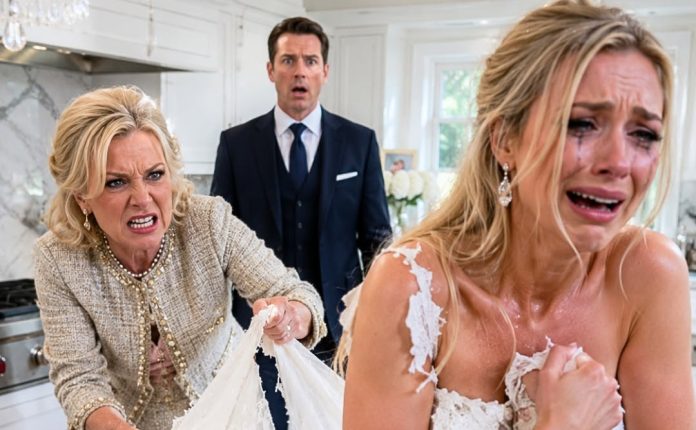
Mark’s silence was a physical weight in the room, a heavy, suffocating blanket that confirmed every dark instinct screaming in the back of my brain. He wouldn’t look at me, and he certainly wouldn’t look at his wife, who was currently trying to merge with the drywall in a desperate attempt to disappear. His hands stayed buried in his pockets, his shoulders hunched as if he could hide his cowardice behind a designer sweater. I didn’t wait for his answer, because the answer was written in the jagged, rhythmic trembling of Emily’s hands. I reached out and gently took her chin, tilting her face so the light from the overhead chandelier hit the damage. It wasn’t just a hit; it was a systematic dismantling. The bruises weren’t consistent with a “trip” over a rug and a collision with a coffee table. There were fingertip-shaped marks on her upper arms—deep, dark impressions of where someone had held her down. There was a faint, yellowish staining at the corners of her mouth that explained the sour, chemical smell in the foyer. They hadn’t just beaten her; they had been “managing” her. Linda took a step toward us, her face a mask of high-society concern that didn’t reach her cold, reptilian eyes, and told me again that I was overreacting to a simple domestic accident.
I stood up slowly, and for the first time in years, the “man of peace” I had worked so hard to become stepped aside to make room for the man I used to be—the one who had spent twenty years in the field of industrial intelligence, dismantling corrupt empires before breakfast. I looked Linda Wilson dead in the eye and saw the moment she realized I wasn’t going to be handled. I told her that if she spoke one more word, I would consider it an act of interference with a crime scene and treat her accordingly. Robert tried to intervene, his voice booming with the unearned authority of a man who had bought his way out of every consequence his entire life. He told me that this was his house and that I was trespassing, threatening to call the police if I didn’t leave immediately. I pulled my own phone out and laid it on the beige coffee table—the one they claimed had attacked my daughter—and told him to go ahead. I told him I’d love to have the forensic team examine the blood patterns on the rug and the sedative residue in the kitchen sink. The silence that followed was absolute, broken only by the sound of Emily’s shallow, ragged breathing.
I turned back to Mark, who had finally looked up, his face a pathetic mixture of guilt and terror. I asked him again, with a voice that sounded like grinding stones, if she had fallen. He opened his mouth to lie, but he saw the way I was looking at the “Private Clinic” intake forms sitting on the end table—forms that were already filled out in Linda’s perfect, loopy handwriting. They weren’t trying to help her; they were preparing to disappear her into a facility where “episodes” like this could be hushed up permanently. Mark’s lip trembled, and he finally whispered that things had just “gotten out of hand.” That was all I needed. I didn’t strike him, though every nerve in my body begged to; instead, I reached down, scooped Emily into my arms as if she were six years old again, and walked toward the door. Linda tried to block my path one last time, her hands outstretched as if she could physically stop the truth from leaving her foyer, but I didn’t stop. I walked through her, my shoulder connecting with hers just hard enough to send her stumbling back into her expensive beige furniture, and I didn’t look back.
The drive to the hospital was a blur of neon lights and Emily’s quiet whimpers in the passenger seat. I kept one hand on her shoulder, feeling the way she flinched at every shadow, while the other hand gripped the steering wheel so hard the leather groaned. When we reached the emergency room, I didn’t just ask for a doctor; I asked for a forensic nurse and a rape kit, knowing instinctively that Mark’s “accidents” went far deeper than a split lip. As they wheeled her away, I sat in the plastic chair of the waiting room and began to make the calls that would start the fire. I didn’t call the local police first—Robert had too many friends on the city council. Instead, I called a man I hadn’t spoken to in a decade, a federal prosecutor who specialized in human trafficking and domestic captivity. I told him I had a “case study” in Brighton Cove that needed immediate, high-level attention. By the time the sun began to peek over the horizon, a team of investigators who couldn’t be bought with a Wilson campaign donation was already assembling.
The medical report came back three hours later, and it was a catalog of horrors that turned my fury into a cold, calculating machine. Emily hadn’t just been assaulted; she had been systematically drugged with a cocktail of benzodiazepines and industrial-grade sedatives to keep her compliant and “hushed.” The “lemon and sweat” smell I had detected was a mixture of a cleaning agent used to scrub the living room floor of her blood and the cold sweat of a woman who had been held in a “vicious cycle” of domestic imprisonment for months. They had confiscated her phone, her car keys, and her passport, telling her that she was “unstable” and that they were the only ones who could save her from herself. It was a “calculated betrayal” of the highest order, orchestrated by Linda to protect the “perfect image” of her son and their family legacy. They thought my daughter was a trophy they could break and glue back together at their whim, but they had forgotten that she was my daughter, and I don’t believe in glue—I believe in consequences.
The “reckoning” began on Thursday morning. While the Wilsons were likely sitting down to a brunch of croissants and lies, the first of the search warrants was served. Because the drugs found in Emily’s system were controlled substances that had been illegally diverted from Robert’s pharmaceutical firm, it became a federal matter instantly. I watched from my truck across the street as the “solid oak door” was not pounded on, but breached by a tactical team. Linda was led out in her silk robe, her “perfectly coiffed” hair finally coming undone, while Robert was handcuffed in front of the neighbors he had spent forty years trying to impress. Mark was found in the basement, clutching a bottle of scotch and a stack of shredded documents—documents that my team had already recovered from their digital cloud hours before. They had tried to delete the evidence of the “clinic” they had built on the outskirts of town, a place where other “difficult” wives and daughters had been sent to “rest” over the years.
I didn’t stop at the arrests. A father’s fury isn’t satisfied by handcuffs alone; it requires the total eradication of the power that allowed the abuse to happen. I spent the next month working with a group of forensic accountants to dismantle the Wilson Charitable Foundation. We discovered that the “philanthropy” Linda was so proud of was actually a massive money-laundering operation that funneled offshore accounts into Robert’s political aspirations. Every gala, every ribbon-cutting, and every beige room had been paid for with stolen futures. By the time I was finished, the Wilson name wasn’t just tarnished; it was a synonym for “predatory fraud.” The bank foreclosed on the mansion within ninety days, and the “expensive beige furniture” was sold at a public auction to pay for Emily’s long-term recovery and the legal fees of the other women we discovered in the “clinic” records.
Emily spent those months in a quiet cottage by the lake, rediscovering the sound of her own voice and the feeling of a door that didn’t have a security chain on the outside. We sat on the porch together every evening, much like I used to with her mother, and watched the water. She didn’t speak much at first, her mind still foggy from the “unending lies” and the chemical haze they had forced upon her, but slowly, the light began to return to her eyes. She started to realize that her “broken” state wasn’t a permanent condition, but a “sacred fracture” that was being knit back together with the steel of the truth. She watched the news as the Wilsons were sentenced to terms that ensured they would never see the inside of a beige living room again, and for the first time, I saw her smile—not a pageant smile, but the real, stubborn grin of a survivor.
The “family drama” the Wilsons tried to hide became a national landmark case for domestic captive legislation. Mark, ever the coward, turned on his parents in exchange for a lighter sentence, revealing that the “episode” that led to Emily calling me was actually her discovering the truth about the foundation’s fraud. They had beaten her to keep her quiet, and they had drugged her to make the world think she was insane. They had played a game of “high-stakes manipulation” with the wrong family. I look back at that night, at the “four inches” of the door that Linda opened, and I realize that she wasn’t trying to keep me out; she was trying to keep the darkness in. But darkness can’t survive the “fury of a father” who is willing to burn the house down to find his child.
The house in Brighton Cove eventually sat empty, a hollow shell of a “perfect world” that never truly existed. The neighbors stopped talking about the Wilsons and started talking about the “man who came in the night” to settle a debt that could only be paid in justice. Emily is a different person now—stronger, quieter, and infinitely more aware of the power she carries. She moved across the country to start over, but she calls me every night at 9:00 PM, just to hear my voice and to remind herself that the sky is still there. I am an old man now, and the “stiffness in my joints” is a permanent reminder of the night I crawled across a beige rug to reach my baby, but I have never felt more at peace. I didn’t just save my daughter; I saved the memory of what it means to be a protector.
I’ve learned that the most “dangerous” thing in the world isn’t a man with a gun or a woman with a secret—it’s a person who has nothing left to lose but their child’s respect. The Wilsons thought they were the “queens and kings” of their little hill, but they didn’t realize that their throne was made of “unending lies” and their crown was a “mask of deceit.” When that mask was stripped away, there was nothing left but the small, petty people they had always been. I don’t feel “vengeance” anymore; I only feel the “clarity” of a job well done. As I sit on my own porch, watching the sunset over the hills of my own modest life, I know that the “fury” has served its purpose. The fire I started didn’t just burn their world down; it cleared the ground for something new to grow. Emily is graduating with her law degree next spring, specializing in victim advocacy, and she told me she wants to use the Wilson name in her thesis as a “case study in the failure of silence.”
The “family matter” is finally closed, and the “outsider” who barged in like a maniac is the only one left standing in the light. I think about that “solid oak door” sometimes and how it felt under my fist—the resistance of the wood, the coldness of the glass, and the heat of the rage in my veins. It was the last door that would ever stand between me and my daughter’s safety. I’ve realized that “love” isn’t just about the quiet moments or the shared meals; it’s about the “devastating reckoning” you are willing to unleash when someone tries to dim the light of the person you love most. We are the Coles, and we don’t “leave quietly.” We stay until the “truth” is the only thing left in the room. Emily’s voice on the phone isn’t crying anymore; it’s laughing, a bright, clear sound that echoes through my house and fills the empty spaces where the “silence” used to live. We are whole, we are free, and we are finally, truly home, standing together in the light of our own truth and seeing only the beauty of our future. Everything brought us exactly where we were meant to be, a place where the shadows are gone and only the light remains for our souls.