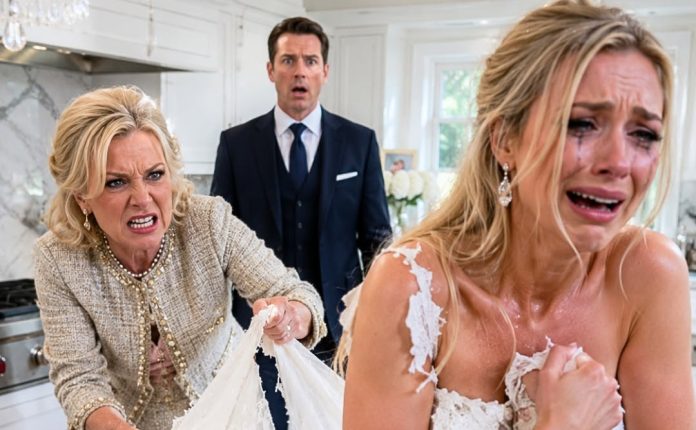
The day Sarah proposed an open relationship, the air in our living room seemed to turn into lead, thickening until every breath felt like a chore. We had been married for eight years, years I thought were built on a foundation of mutual respect and a quiet, enduring kind of love that didn’t need the fireworks of a new romance to stay lit. She sat across from me on the velvet sofa we had picked out together during our second anniversary, her eyes avoiding mine as she spoke about “personal growth,” “exploration,” and the stifling nature of “traditional boundaries.” I knew, even before she said his name, that this wasn’t about a philosophical shift in her views on monogamy; it was about Julian, the charismatic project manager she had been mentioning with increasing frequency over the past six months. The word “open” was just a polite euphemism for a permission slip to betray me with my blessing, a way to keep the security of our home while sampling the excitement of a new bed. I felt a cold, sharp clarity wash over me in that moment, a survival instinct that whispered that the woman I loved was already gone, replaced by a stranger who saw my heart as a secondary consideration. I didn’t scream, I didn’t beg, and I didn’t point out the hypocrisy of her request. Instead, I looked at her and quietly agreed, watching the flicker of relief and perhaps a hint of “triumph” cross her face. She thought she had won a concession; she didn’t realize she had just triggered the end of our world.
For the next three months, I lived in a waking nightmare that I had technically authorized. I watched her get ready for “dates,” saw her choose the earrings I had bought her for her thirtieth birthday to wear for him, and felt the house grow colder every time she walked out the door. While she was out exploring her “crush,” I was sitting in a fluorescent-lit office downtown, meeting with a divorce attorney who specialized in high-asset separations and quiet exits. I played the part of the supportive, modern husband during the day, listening to her talk about how she was “finding herself,” while at night, I was meticulously cataloging our assets, moving funds into protected accounts, and filing the paperwork that would sever our legal ties. I wanted her to have her “freedom” in its most absolute form—without me. When the day finally came to serve her the papers, the look of shock on her face was almost enough to make me feel a twinge of guilt, but then I remembered the scent of his cologne on her neck the night before, and the guilt withered into ash. We divorced quietly, efficiently, and I moved into a small apartment by the lake, determined to build a life where “loyalty” wasn’t a negotiable term.
But Sarah wasn’t finished with my life. A year after the ink had dried on our first divorce, she appeared at my door, drenched in rain and smelling of the lavender soap she used when she wanted to feel comforted. She wept, telling me that the “open” life was a hollow lie, that Julian was a shadow of the man I was, and that she had realized too late that she had thrown away the only thing that ever mattered. She spoke of “regret,” of a “momentary lapse in judgment,” and of a “soul-deep connection” that she could only find with me. I wanted to be strong, to tell her that the bridge was burned and the river had moved on, but the human heart is a treacherous organ that remembers the warmth of a touch long after the mind has recorded the sting of a slap. I let her in. We spent months “healing,” going to therapy, rediscovering the rhythms of our old life, and eventually, convinced that we were a story of “redemption” and “miraculous survival,” we remarried. I thought we were the exception to the rule. I thought our love had been through the fire and come out tempered.
The second marriage felt like a dream for the first six months. We were attentive, passionate, and seemingly transparent. I had deleted my cynicism and replaced it with a fragile, beautiful hope. Then, the envelope arrived. It was a plain, manila packet with no return address, left in my mailbox on a Tuesday afternoon when the sun was too bright and the world seemed too peaceful. When I opened it, I expected junk mail or a bill; instead, I found a stack of high-resolution printouts that felt like shards of glass in my hands. They were screenshots of text messages, hundreds of them, dated from the week after our second wedding up until the previous night. There were photos, too—grainy but unmistakable images of Sarah’s car parked outside Julian’s apartment at two in the morning, and shots of them sitting in a darkened corner of a bistro three towns over. The messages were the worst part. They didn’t just show an affair; they showed a “calculated betrayal” that made the first one look like a misunderstanding. She wasn’t just meeting him; she was mocking me. She spoke to him about how “easy” it was to pull me back in, how my “need for stability” made me the perfect safety net while she continued her “real” life with him. She told him she loved him in the same hour she texted me to ask what I wanted for dinner.
The tears that came weren’t just for the loss of a woman, but for the death of a part of myself that I will never get back. I realized that the “remarriage” wasn’t an act of love on her part; it was an act of “convenience” and “cruelty.” She hadn’t stopped seeing him; she had simply learned how to hide it better, using the trust I had painstakingly rebuilt as a cloak for her ongoing infidelity. She had been meeting him a couple of times a month, maintaining a “double life” that required a level of sociopathic precision I didn’t know she possessed. I felt a profound, bone-deep exhaustion settle over me, a realization that some people don’t seek “forgiveness” to change, but to find a better vantage point from which to strike. The second divorce was not quiet; it was a scorched-earth campaign. I didn’t care about the assets or the house anymore; I just wanted to be surgically removed from her existence.
Now, as I sit in a house that feels like a museum of mistakes, I look at the empty space on my ring finger and feel nothing but a cold, hollow vacuum where my faith used to be. I don’t believe in the “power of love” to change a person, and I don’t believe in the “sanctity of second chances.” I’ve learned that “mercy” is often just an invitation for a second betrayal, and that “honesty” is a language some people only use when they are cornered. My life is quiet now, but it is the silence of a graveyard. I fill my days with work and my nights with the kind of sleep that comes from knowing you have no more illusions left to lose. People tell me that I’ll “find someone else,” that “not everyone is like her,” and that “love will find a way back,” but they don’t understand that the fire didn’t just burn the house down this time; it sterilized the soil. I see couples holding hands in the park and I don’t feel envy; I feel a strange, detached kind of pity, wondering which one of them is holding the “envelope” in their mind.
The most terrifying part of this “unending lies” saga isn’t the infidelity itself, but the realization that I was an active participant in my own destruction. I chose to believe the “miraculous reunion” narrative because the alternative—that I was disposable—was too painful to face. I let her “manipulate” my empathy until it became a weapon used against me. Sarah tried to call me a few weeks ago, probably to offer another “apology” or to spin another “web of deception,” but I didn’t even look at the screen. I’ve realized that the only way to win a game rigged by a “narcissist” is to stop playing entirely. I am divorced for the second and final time, and while the legal papers are settled, the emotional audit continues. I am a man who has seen behind the curtain of “forever” and found only a “calculated betrayal” and “hollow vows.” I don’t believe in love anymore, not because I’m angry, but because I’m finally awake to the reality that some hearts are not “broken”—they are simply “empty.” The “second chance” I gave her was the most expensive lesson I ever bought, and the price was my ability to trust the world. I move through my days with a “hardened heart,” not out of spite, but out of a necessity for “self-preservation.” I used to look for the “light” in people, but now I only look for the “truth,” and more often than not, the truth is a “cold, dark room” where love used to live before it was starved to death by….